

Tired of the fact that most reality TV shows are populated by the same showily belligerent Los Angeles actors? So was producer Jon Kroll, so he dreamt up a twist that had lawmakers up in arms long before his show even hit the air this summer.
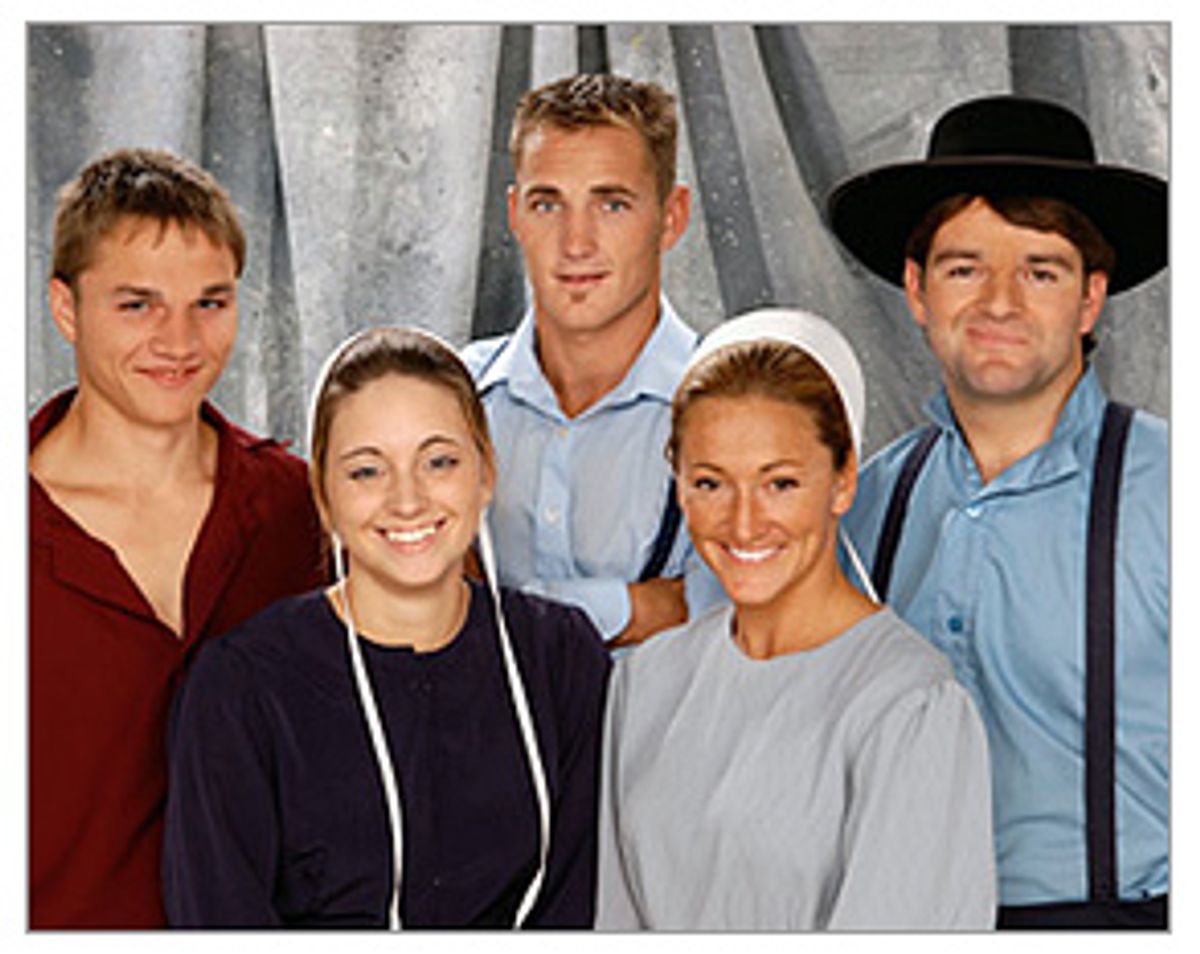
"Amish in the City" (Wednesdays at 8 p.m. on UPN) places five Amish kids who are on rumspringa, a time during which young people are free to explore the world outside their community, in the same house with six urban kids. The resulting drama is a far cry from the exploitive, inhumane circus that critics in Congress had contended it would be. Although it has familiar beats, with the typical "Real World"-style arguments over messiness and backbiting, the show presents a surprisingly poignant departure from the typical reality-TV shouting match.
Kroll, who's worked on such unscripted mainstays as "The Amazing Race" and "Big Brother," never could have predicted the controversy -- not to mention the impressive ratings and favorable reviews -- his show would attract. Having spent his own childhood on a commune without electricity or telephones, Kroll says he can relate to the Amish and felt frustrated that most kids on rumspringa don't see much of the world before deciding whether or not to return to their Amish communities. He wanted a chance to expose the Amish to new things while creating a reality TV show with a more educational, enlightening format.
Sounds like a tall order? Not for Kroll, whose earnest enthusiasm never faltered as he spoke to me from the New Line Television offices in Beverly Hills about a new generation of constructive, literate reality TV shows that are just around the corner.
What sparked your interest in doing a show like "Amish in the City"?
Well, first of all, I had seen "Devil's Playground" (a documentary about Amish rumspringa by Lucy Walker) last summer. I knew nothing about the Amish. I had seen "Witness"; that was the extent of it. I loved the idea of rumspringa, but I was frustrated with the fact that clearly, from watching that film at least, it seemed that most people did not take full advantage of the time. It was kind of frustrating that the people involved didn't have the educational or financial resources to really explore it fully. I kept thinking about it in terms of my own background, because I grew up in a Northern California commune without television or telephones or electricity.
Was there pressure to stay in your community?
Not the kind of pressure that the Amish face. It was presented to me that, "You're welcome to stay and do this sort of New Age homesteading thing that we're doing. You don't have to leave." And after living like that for 10 years, I really had itchy feet. I wanted to get out there, just like some of the Amish on the show. I mean, the Amish kids who were selected are the ones who actively wanted to pursue more experiences before making their decision.
How did you figure this would make a good reality show?
One of the mantras I like to preach, as silly as it may sound, is that reality shows at their best can be documentaries for the masses. They can be something that presents real-life situations in a way that they're entertaining enough to draw a big audience. Now, you can't do the kind of depth that you can with "Devil's Playground," but you can still explore topics that are really interesting and provocative. So I called Daniel Laikind and Steven Cantor, the producers of "Devil's Playground," and said, "Hey, I have this idea. I think we can do this right." They were a little bit hesitant because reality shows have a certain connotation, but after one long phone conversation, they saw that what I wanted to do with it was respectful and provocative but not insulting. We went about quickly developing a show that was based on that, took it out in two days of pitches, and instantly it was sold to UPN.
What were the surprises along the way in pulling the show together?
There were several different surprises. The first surprise for us was the initial strongly negative reaction that people had to the announcement of the show. Because the thought of doing a show that was disrespectful to the Amish -- I know this sounds strange, but it had not even occurred to us. We had always intended to do something that would be respectful.
The second surprise was the strong reaction the city kids had to the Amish kids and how harsh they were at the start. But if you look at how tourists treat Amish people when they're in Amish country, they don't look at them as people. They often look at them as objects. The reason we chose not to soften that and really chose to present that in all of its rawness, even though it's uncomfortable, is that it forces people to look at their behavior and the level of tolerance that they have. I think it's fascinating to see people being very critical of that aspect of the show.
People have been critical of showing how negative the city kids are to the Amish?
Yeah, I've read a lot of that. To my mind, we would've been highly irresponsible had we either coddled them and only put them in there with people who would pussyfoot around them, because that's not what the city's like, or if we'd toned down how the city kids were treating them. We felt it was important to put it all out there.
But the third surprise, and the most pleasant one of the whole experience, is, even though the Amish are people who have never seen an escalator or a parking meter or an avocado, they will break out with philosophical comments about life and priorities that are so wise and so thought-provoking. They place an importance on family, community and faith, and that's something, for those of us who are worried about when we're going to get a bigger car or a big promotion, that makes all of us look at our priorities. That's one of the messages that I really hope comes out of people watching the entire arc of the show, because that's something that's consistent throughout it.
It seems to me that it was important to have them dressed up in their Amish clothes when they first arrived at the house, but maybe people reacted badly to that. Of course, plenty of people were freaking out before they even saw the show.
And they continue to freak out, even though they still have not seen a single episode. A lot of people have speculated incorrectly about the clothes they wore at the door. All of the Amish kids who were in the house brought the clothes that they own, that they wear sometimes when they go to church but don't wear so often now because they're in rumspringa. We told them that their roommates did not know that they would have Amish roommates, and we said, "It's up to you, but if you want to make it clear that that's who you are, then obviously wearing your clothes would be a good way to do that, but you don't have to wear them." And in fact, Jonas, one of them, chose not to. But we said, "We're never going to tell you you have to or can't wear your clothes the entire time that you're in the house. That's totally up to you." So four of the five wore them. They actually thought it was really funny that the other kids didn't know that they would have Amish roommates, and they're very proud of their Amish heritage, so they wanted to do that.
I wonder what exploitation means in terms of a reality show. What would be an example of someone being exploited?
Well, there was great potential in a situation like this for these people, who were not as familiar with television or reality television, to be taken advantage of. So we were incredibly diligent about having long conversations with them about what the show was, what we intended to do, what the reaction could be from their communities and from the public after it was all over. We really tried to educate them as well as we could. Amish people who are in rumspringa have seen television, they may have seen a little bit of "The Real World." It's not a regular part of what they do, but they have seen it. It's just something they choose not to partake in. If we had pulled people right off the farm who had never been in a car, who had never seen television, and thrown them on a show without any warning, I think that would've been exploitive.
I think that if you talk to any of those five individuals, they're glad they had the opportunity to do this, because so few Amish young people on rumspringa have these kinds of chances.
Do we find out at the end of the show whether the Amish kids are going to go back to Amish life or not?
All 11 of the kids have decisions that they make. The six city people were selected because they're at a crossroads in their own lives. And there are varying levels of resolution for each of the 11 that range from incredibly satisfying to a small change that's a step in one direction.
In other words, some of them have made up their minds and others land somewhere in between.
Yes. This experience has certainly had an impact on their decision-making process, and it has pointed them in a direction, but there are issues outstanding that need to be resolved before they reach a final conclusion. Who knows? Maybe there'll be a "Where are they now?" follow-up show where we can get an update on that. But obviously we would never put them in a situation where, on their last day we say...
"All right, what's it gonna be? Modern life or Amish life? Roll camera!"
Or, "According to the contract with this show, you are required to make a decision on the rest of your life." That's not the way we looked at it. Certainly, though, they knew going in that we wanted to know what their intent was when they left the show, and they were all very good about making clear what they felt their next step was.
What qualities did you look for in casting the Los Angeles group?
Well, we really felt it was important to find people who were as far from the Amish as possible. Otherwise what would the point be? It's no accident that there's a vegan in the house and you've got people [the Amish] who were raised in the dairy industry. It's no accident that there's a gay guy and the Amish are people who have not been exposed to gay people. It's no accident that there's an African-American woman from the inner city, because that's a very different experience, and yet, she says at one point, "I'm an Amish person myself," because she's being exposed to brand-new experiences just like the Amish people are. And in last week's episode, she took the other kids in the house to visit with her family, and that's one of my absolute favorite scenes in the entire series.
We wanted to challenge the Amish kids and basically let them know that if they live in the city, they have to be able to get along and interact with all kinds of people. We didn't want to sugarcoat it; we wanted it to be part of the light side and dark side of city life. The light side is that there are all these opportunities; there are things you can do. The dark side is, there are pressures, there's crime, there are all these different things. In this case, there are people you get along with who are fascinating, who stimulate you, and there are people who make you crazy.
Having grown up in a similar way, what do you think are the advantages to being raised without modern technologies?
For me, my life growing up that way was really about reading a lot, personal interaction ... We had to entertain ourselves, so the kinds of entertainment you would have would be very human-based.
That sounds like the way I grew up! My mom didn't get us many toys, and we had a really awful black-and-white TV for 15 years. I still watched it, of course.
There's this wonderful Swedish commune movie where the hippie kid goes to see the city kid, and the city kid has LEGOs and he says, "Wow, I'd like LEGOs," and the city kid says, "You don't have LEGOs?" And the hippie kid says, "My dad was going to make me a set but he only made three." I can relate to that, because all the adults would say, "You guys can entertain yourselves. You live in the country! There's lots of things you can do." And we're going, "Yeah, like what?" So it was all personal interaction and human dynamics and literature as opposed to TV, telephone and electronic stimulation. And in fact, I still think that I have less of that kind of thing -- well, I certainly have plenty of TV -- but I still read a lot, I still need peace and quiet time, I still do yoga, I still do some things that sort of keep me grounded in that spirituality, even though I'm now feeding the television machine.
And what do you think of the disadvantages? Did you see anything about the Amish kids that you thought was really a shame?
Well, certainly one of the aspects of Amish life that's highly controversial is their view on education, which is simply that kids go up until the eighth grade, and then that's it, and they're taught by people who've only gone up to the eighth grade. I'm a big believer in education and that's something that's very difficult, to see people who were really not given that kind of encouragement. The feeling is, if you're going to stay in the Amish community you don't need more than an eighth-grade education because of the things that you're going to spend your life doing. But that's one of the things that make people go back to the church. More education leads to more information leads to more curiosity.
But how educated are the other kids, even though they may have finished high school and college? It depends largely on a kid's attention span and the culture he or she grew up in.
Well, there's an arc on the show in which education takes a front and center role, and I think it's going to be very fascinating to see how it evolves, as one of the characters starts on a journey that's one of the most memorable aspects of the series.
What other kinds of shows are you interested in creating?
I think that anything that gets people talking in an interesting and provocative way is good, provided it's not just steeped in negativity. I think that exploring issues of spirituality is really interesting -- I think that's an interesting aspect of "Amish in the City." Something I love to get into, if it could be done in the right way, is exploring issues related to race and racial relations. I think that's something we've come a long way with and we can go a lot further. I've talked to a couple of people about shows that could get into that, but it's gotta be the right show and handled in the right way.
Yeah, there's always the token black guy, but you never get a chance to see six blacks and six whites in a house.
I've certainly been to the pitch meeting where that's been suggested, and I'm not willing to do it unless it's done in the proper way. "Amish in the City" only made sense because everyone involved was committed to making the show that you see, and I'll stand by that show. I don't want to do a show that deals with something as delicate as race relations unless it's done in a similar way and I feel like I can stand behind it.
I'd also love to take unscripted shows to a different epic scale, so that they could start to attract people who might tune in to a television miniseries or a dramatic series, and not just a reality show audience. I think that "The Amazing Race" and "Survivor" certainly get close to that. But we've been working on an unscripted series that's based on "The Odyssey" and that's really exciting, because the scope and scale of it are so off the map for anything that's ever been done.
Shares