


To listen to a podcast of the interview, click here.
To subscribe: Click here to add Conversations to iTunes or cut and paste the URL into your podcasting software:

There has been one key question running through the fourth season of "Top Chef": "Can a woman finally win?" So far, only men have nabbed the title on the beloved Bravo reality show, as if the victors' circle were a reflection of the cooking profession itself, which is famously male-dominated. From episode to episode, the producers made sure to remind us just what a boys club the chef world can be. "It's not common to have one woman in the kitchen," said Zoi, a lesbian contestant whose girlfriend also competed on the show. "That is probably the biggest struggle as a female -- just break[ing] people's image of what a chef is." But as the season wore on, the dudes who had been sharpening their Wüsthofs for a dick-slinging showdown -- Dale with his "I'm not here to make friends" attitude, Spike with his smug grin and tilted porkpie hat -- were forced to pack their knives and go. And by the time it got down to the final four, a sea change had occurred: Three women and one man remained.
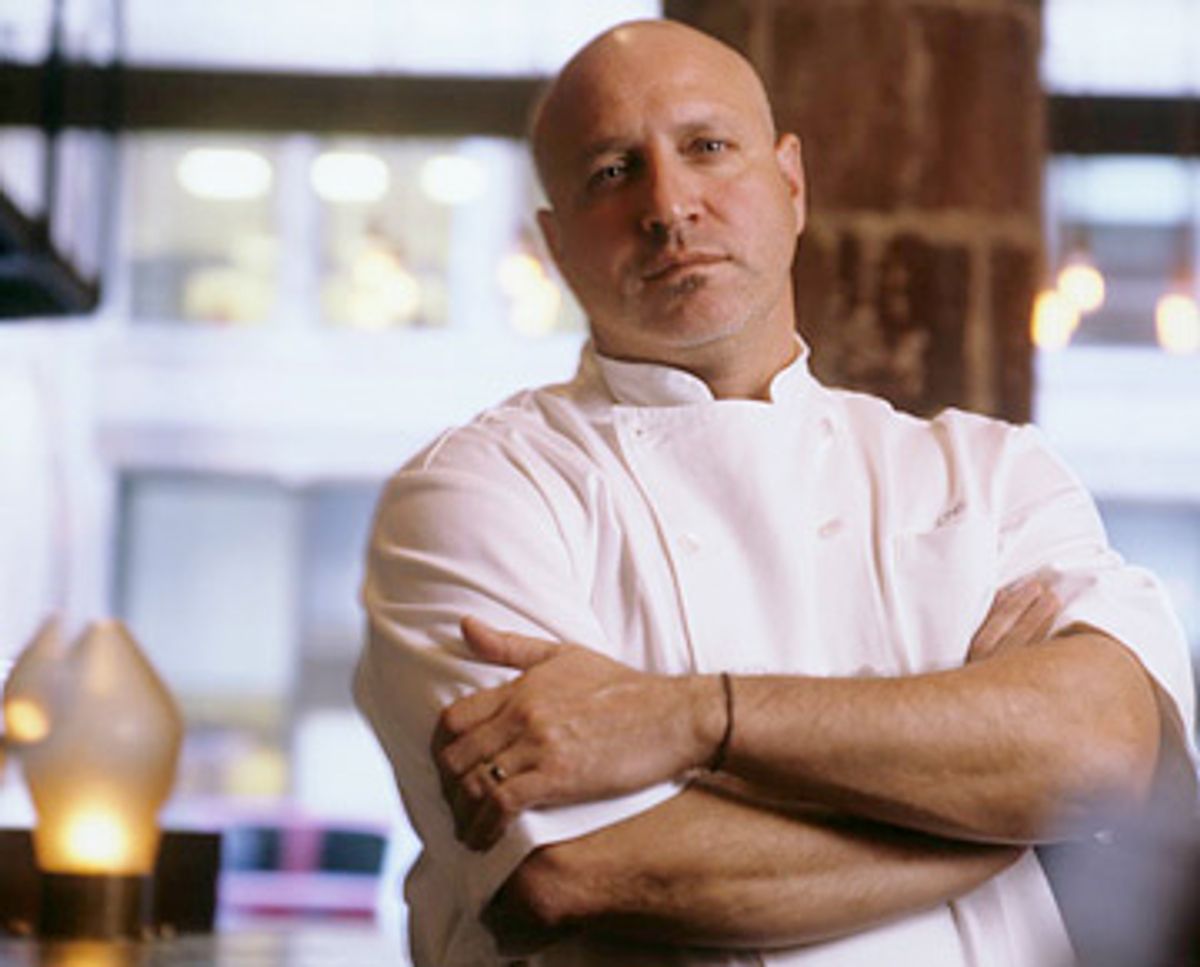
Their fate rests, at least partly, in the hands of "Top Chef" co-host Tom Colicchio. The former chef and co-owner of Gramercy Tavern and creator of Craft, the influential Manhattan restaurant that now has locations in Dallas and Los Angeles (and offshoots such as Craftsteak, Craftbar and 'Wichcraft), Colicchio has found fame as the show's measured voice of experience. TV chefs often lean on gimmicks and razzle-dazzle, but Colicchio has a subdued approach, offering critiques that are direct, honest and articulate. The same could be said for the man's approach to a meal; Colicchio has made simplicity in cooking something of a rallying cry. At his restaurants, and in books like "Craft of Cooking" and "Think Like a Chef," it is as though he is urging people to actually cook less, focusing instead on the best, freshest ingredients. (He has said the most underrated seasoning is salt and pepper; he detests microgreens.) He's a good fit for Bravo's viewing audience -- sophisticated, never ingratiating. (Oh, and in case you hadn't heard, Colicchio has a bit of a following among gay men. Interested parties can read more about this here.)
On Wednesday night's episode, which relocated the contest from Chicago to balmy Puerto Rico, the ever-driven mother figure Antonia was booted in an upset. Now three contestants remain: Richard, the wacky innovator who has dominated from Day One; Stephanie, the versatile and eminently likable fan favorite; and Lisa, the feisty underdog everyone loves to hate. Colicchio, interviewed over the phone two weeks before the finale airs on June 11, can't talk about the final contestants. But he can assure us, repeatedly, that whoever takes the title, he and the people behind "Top Chef" have no agenda aside from making sure the best man -- make that chef -- wins. (Listen to the interview with Colicchio here.)
This has been a particularly good season for women on the show. On a show like "Top Chef," where you need to differentiate one season from the next, do you feel pressure to have, say, the first female winner?
No, not at all. Pressure from who?
I don't know. From fans?
No. If we start doing what the fans want, then we might as well just open up the voting to the fans. And they're not tasting food, so that might be hard to do.
The competition has traditionally been male-dominated, as are most professional kitchens. Why is cooking such a macho profession?
Well, that's a two-part question. I'd like to go back to the first part. I don't think the show has been male-dominated. In the first season, Tiffany came so close to winning. In the second season, Elia was in the finale. In the third season, Casey was in the finale. So I don't agree with that.
OK. Would you agree that cooking is a macho profession?
It can be. A lot of professions happen to be male-dominated because women drop out at a certain point. It's unfortunate. When I was a chef at Gramercy Tavern, I think we'd been open for five years, at least half the kitchen staff, probably more, were women, and in fact they were all in the big positions -- saucier, sous-chef. Of the six or seven women in the kitchen -- well, more like 10 or 12 -- only two of them are still cooking.
And why do you think they drop out?
They have children. If you want to have a family, it's a very tough business. You're working nights. You're working weekends. It's not conducive to rearing children. I have a 15-year-old and when he was 8, 9, 10, it was hard for me.
So let's talk about this season. A lot of people were surprised that Dale was kicked off. He was one of the more seasoned chefs on the show, no?
I wasn't there that night. When I saw the episode the night it aired, I could see why people were upset. But I didn't taste the food. And this is what I keep lecturing people about when they say we make bad decisions. I think, "Great, I'm glad you were next to me eating food. I don't remember seeing you."
If you're basing your decision on a two-hour discussion and you saw five minutes of that discussion and those five minutes were clearly made to keep people in suspense, then I can understand why you're upset that Dale was gone. But what I know from behind the scenes is that they thought his dish was by far the worst dish that night, and it was such a bad dish that it got him thrown out. It's about food. We judge only on that episode. People think we sit around and watch tape of all the [behind-the-scenes footage of the contestants] before we make a decision? We don't see that stuff. We're not allowed to talk to the contestants during shooting.
Let's talk about your role on the show. You're kind of the opposite of Gordon Ramsay. You have this evenhanded way about you.
The show is not about me. The show is about the contestants, so I'm just there to judge them. I don't say anything for shock value. I don't mug for the camera. These chefs work their asses off. They're not sleeping, they're constantly being judged, they have no idea what's coming at them, and I think I owe them a certain amount of respect. And that doesn't include dressing them down and screaming at them and belittling them. That's how I run my kitchen. I know from personal experience, if a chef yelled at me in a kitchen, the first thing I'd want to do is hit them with a pot.
Have I raised my voice in the kitchen? Of course I have. When I was 26, 27 years old I was running a kitchen in New York, and I was a raving lunatic. The older you get, you figure out you don't need to do that. You realize at a certain point, there's a certain gravity to what you say and what you do. If that's not enough, all the yelling in the world is not going to matter.
So what you see on the show is how I run my kitchens. The show is not about me. And I think Gordon Ramsay's show is about Gordon.
One of the contestants said that 99.9 percent of the competition is getting your point of view across. Would you agree with that?
No, 99.9 percent of the competition is cooking good food. Really. There's nothing more to it than that. It's amazing to me when I read the blogs and the conspiracy theories that are swirling around -- the producers want a woman to win and all this. We don't care. We want to make a good TV show. And I personally want to make sure that our decisions are the best decisions.
I'm curious what stands out to you as maybe the worst dish you've tasted this season.
I don't recall spitting anything out this season. There were some things that weren't very good, but there was nothing I can think of that was just so godawful that I was, like, "This is terrible!"
Have the cooks gotten better each year?
I think this is the strongest group as a whole. They have a lot of experience; they've worked in a lot of good restaurants collectively. I remember in the first episode I stepped back and said, "Wow, this is going to be a great season." Because usually, early on, you can see five or six people that there's no way they're going to make it. This season it was one or two. Don't ask me who -- I'm not going to tell you.
Fair enough. So why would somebody with a successful restaurant business decide to go on television?
I always tell this story. My wife says, "You gotta stop telling this." I got tired of sitting next to Mario Batali or Bobby Flay at a book signing when they sign 200 books and I sign 10. And I don't think it's because they're better chefs or they have a better book.
Twenty years ago, 30 years ago when I started cooking, media wasn't even a path that we thought about. Things have changed, and I wouldn't do it unless it drove business to my restaurants.
A couple of months ago, I was down in Florida for the Food and Wine Festival. And this journalist grabbed me and said, "How does it feel to be a TV guy? You're no longer in the restaurant business." And I laughed. I asked him, "How long do you think it takes me to do a season?" He said, "Well, 200 days." And I was like, "200 days? Try 20!"
Why do you think there's so much interest in chefs at this time?
It started, I would say, in the early to mid-'80s, when people realized they couldn't just keep going to discos and snorting coke, and they had to grow up and find another form of entertainment. And it became restaurants. I'm serious about that. I'm not joking.
But then chefs started coming out from behind the stove, and you started to know who they were as people. I'm talking chefs. Julia Child was a great TV personality, but when you say the word "chef," it means "boss," and I don't know what she was boss of, but it wasn't the kitchen. Not to take anything away from Julia; she was brilliant. But she wasn't a chef. The first chef to step out from behind the stove and become a personality was Paul Bocuse. And I think in the States we just followed suit. When you have Wolfgang Puck, who's clearly a great personality, and you have Paul Prudhomme, these were great personalities that people want to know. Once you eat their food, you want to know the person behind it. It's like anything. The actors, it's great that you see them on the screen. But who are these people?
I always look at it as though people are hobbyists when it comes to chefs. First, they start collecting cookbooks and recipes, and that's going to lead to redoing their kitchen with fancy appliances, and then they go out and buy all the fancy olive oils and vinegars, and maybe they'll get to wine along the way. At a certain point, they start collecting chefs.
Obviously the Food Network's had a lot to do with it. I think also the success of things like the Food and Wine Festival in Aspen. This is, I think, the 25th anniversary this year. And so when you have 4,000 to 5,000 people at a festival in a town as small as Aspen, where the chefs and the winemakers are the reason people are there, it becomes more than just a little movement. It sort of blends right into lifestyle. There's so much affluence in America -- where people have the leisure time to do their kitchens over and collect the chefs and stuff like that. It's not inexpensive to go to Aspen for a weekend to rub shoulders, see the seminars, attend the book signings and things like that.
There was a New York magazine cover story a while back about how Bravo reality shows were churning out these eccentric personalities who were having trouble turning their wins into business success. How much do you concern yourself with the fate of these contestants after they leave your show?
Some of them. [Season 1 winner] Harold, when he was opening his restaurant, called me for advice and I spoke to him at length. I talk to Sam a lot. I'd like to see all the chefs do well. And again, for several reasons. One, it validates the show. And two, I think that if anyone in the industry does well, it's good for our industry.
Which of the winners of your show would you hire for your kitchen?
Any of them. I have purposefully stayed away from hiring anybody that's been a contestant. But I think Tiffany, a woman from Season 1, was fabulous. She wasn't a fan favorite, but I thought her cooking was brilliant. Harold I would have hired. Forget about the show for a second -- if Harold walked into my restaurant and said he wanted a job, I would have hired him. Same thing with Sam. [Season 3 winner] Hung, definitely. I think a better question would be, "If you were going to open a restaurant with one of them, who would it be?" That's a little different. Probably Harold or Hung. I think [Season 2 winner] Ilan -- he's a good cook, just a little immature, and he has a little way to go. If I were going to raise money and put someone in charge of the kitchen, I'd want someone with a little gravity or weight to them.
I have to ask you how you feel about being what's known in the gay community as a bear.
Whatever! [Laughs] It's fine. I'm very comfortable with my sexuality.
How did you find out about your status there?
You get little rainbow-colored bear things. They just show up in your mail one day, and you know you're an honorary member. No, you know, I read the blogs. It's kind of funny. I think my wife found it one day. She e-mailed me and said, "Tom, guess what? You're an honorary bear!"
Did you know what that was?
Yeah, I knew what it was. I'm in the restaurant business. I've got plenty of gay friends. I get a kick out of it. But I took it as someone saying, "You need to lose weight." I started running after that.
Shares