

"Could I resist its glow? or even that, could I withstand its pressure? ... I shrank back -- but the closing walls pressed me resistlessly onward."
-- Edgar Allan Poe, "The Pit and the Pendulum"
When Frank Rich claimed in the New York Times last year that more and more people seemed to be getting their political news from late-night TV comedy shows, the reaction in many quarters was a sort of contemptuous disbelief. "How could people be so silly?" But those of us who hung on every hour of the Fox TV drama "24" this season may feel an instinctual kinship with those people. It's not that, in the case of "24," fiction is stranger than truth but rather that this fiction feels more real than what the media has been telling us is true.
The thrill and the awfulness of this second season of "24" has been in the way that it seemed to be one of the only outposts in the media to take the full measure of the last five years of American political life and tell us, no, you weren't dreaming, things really have been as bad as you thought. The show was an extended bad dream that promised -- and provided -- no relief. Week by week, it began to seem an ever more accurate mirror of the real world.
This has little to do with the last half of the season's main plot mechanism: nefarious oil tycoons plotting to trick the U.S. into declaring World War III on the Middle East so their shares of Caspian Sea oil will skyrocket. That's a cheap pulp mechanism, born of left-wing conspiracy theories and too much time spent listening to Rage Against the Machine, swallowing Noam Chomsky's inhuman rationalist simplifications of America the Evil and knocking back double espressos.
The power of "24" has been in the way that it synthesizes every one of our most recent political nightmares, from the attempted right-wing coup against Bill Clinton to the Supreme Court's stealing the election for George W. Bush to Sept. 11 to the way the (necessary) war on terror has become the administration's excuse to trash civil rights to the rush to war in Iraq on faulty evidence and the still-unknown consequences of that war. As the bombs went off this past week in Riyadh, in Casablanca, in Israel, and as the terror alert goes to orange, the free-floating dread we've done our best to deny has become palpable. The aim of "24" this season has been to connect us with that dread, to give it shape and weight. At times, watching "24" has made you feel as if you were Johnny Rotten climbing over the Berlin Wall at the end of "Holidays in the Sun," both eager to see the worst, and knowing that the worst will be worse than you could have imagined.
It requires a bit of exegesis to explain how an action serial, even one as ingeniously and complexly written, directed, acted and edited as "24," comes to feel as if it were trumping newspaper reports and network broadcasts week after week. The best place to begin may be the media's current indignation over the falsifications of Jayson Blair. It's not that the media are wrong to be enraged about Blair (or that other odious little con man, Stephen Glass, trying to worm his way back into good graces with his manure pile of a novel "The Fabulist") or are exaggerating when they say he has damaged the trust between readers and newspapers. But in condemning Blair, the media (with the exception of Hendrik Hertzberg in this week's lead New Yorker editorial) has ignored the far worse falsifications it has presented as straight-faced fact.
Last week in Salon, Joe Conason reported that Joseph Lelyveld, executive editor of the New York Times when the paper ran its first Whitewater story in 1992, managed to get major facts about that case wrong in his New York Review of Books review of Sidney Blumenthal's "The Clinton Wars." (Lelyveld, claiming Blumenthal leaves out details and incidents that are in fact in the book, appears not even to have read the book he is reviewing.) And Blumenthal's book itself lays out a virtual horror show of mistakes and falsifications by a host of reporters and broadcasters, among them the Times' Jeff Gerth, the Washington Post's Susan Schmidt, Newsweek's Michael Isikoff and ABC's Jackie Judd. Blumenthal presents a sideshow of rumor presented as verified fact, full exonerations reported as if they proved the guilt of the accused.
Meanwhile, with all the current breast-beating about journalism's need to maintain the trust of the public by adhering to the facts, the American media have largely ignored the BBC documentary that claimed it swallowed the Pentagon's false story about the rescue of Pvt. Jessica Lynch. (The only mention I could find of the story in last Sunday's New York papers was one line in Liz Smith's gossip column.) If the media has more and more come to seem as if it were acting out an agreed-upon script rather than reporting the news, then why shouldn't fiction seem more real?
The source of inspiration in this season's "24" was its realization that the most consistent truth of American political life since 1998 has been that the unthinkable is real. In one of the show's most daring and inspired twists, President David Palmer (Dennis Haysbert, who was majestic in the role), convinced that the audiotape of three Middle Eastern governments plotting to detonate a nuclear bomb in Los Angeles is a forgery, is deposed by his vice president and Cabinet, who want the bombing of those countries to proceed. Conflating the failed coup against Clinton and Bush's ascension to the presidency without the will of the electorate, the show seemed to be savor the outrage of those two events, unwilling to let them simply recede into history.
That they should recede is the view expressed by Time this week in Lev Grossman's review of the Blumenthal book. The utter failure of American journalism to get the Clinton story is summed up by Grossman's claim that Blumenthal's case for "a right-wing political cabal that manipulated the media and the legal system to make mountains out of dunghills" is "surprisingly convincing." Is this what journalism has become? After the revelations about the Arkansas Project, about David Hale and Richard Mellon Scaife; after right-wing operative David Bossie turned up as an aide to Republican Congressman Dan Burton and was fired when it was discovered he had doctored transcripts of taped conversations between Web Hubbell and his wife to remove exculpatory evidence about Hillary Clinton's involvement in Whitewater, Grossman is still surprised.
Grossman ends the review with this: "To us" (speak for yourself, asshole), "the events he describes already feel like they happened decades ago, but he writes as if they just happened yesterday ... 'The Clinton Wars' is neither history nor journalism nor memoir. It's just more politics." Perhaps it's naive to expect the press to react positively to an 800-page book that demonstrates that it didn't do its job. To turn that demonstration into "just more politics" is evidence of a deeply rooted cynicism that, like much cynicism, is also deeply naive.
Against this, "24," with the stature and immense dignity of Haysbert's performance, has refused cynicism, giving us a vision of a president as we would like him to be, as we would expect him to be. In last night's finale, when Palmer, having barely averted the war, addressed the Cabinet that removed him from office by saying, "Leaders are required to have patience beyond human limits," and then rebuked them by adding that war can only be waged when "the strictest standards of proof have been met," could there be any doubt that he was talking about Bush's unproven claims of Iraqi collusion with al-Qaida, and his ongoing snipe hunt for stockpiles of chemical and biological weapons?
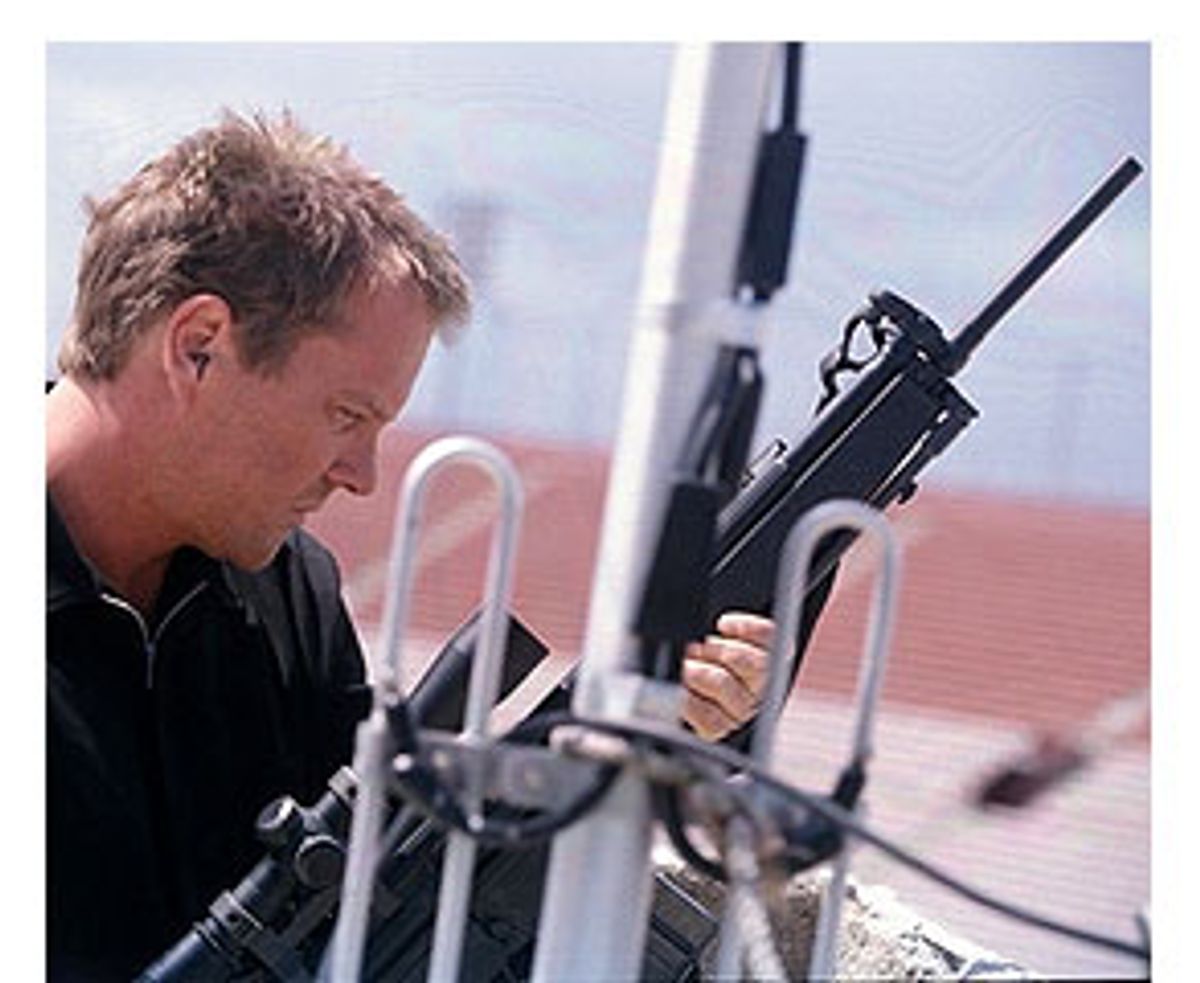
But the nightmare that has resonated most throughout this season of "24" has been of course that of Sept. 11. As befits any real thinking about that event, the show has been unpredictable and upsetting, refusing to countenance the illusions of either the right or the left. Jack Bauer (Kiefer Sutherland) is called out of retirement from the government's Counter Terrorism Unit when the agency learns that Middle Eastern terrorists are going to explode a nuclear bomb in Los Angeles. That, of course, is our most feared scenario, an event that would make planes flying into skyscrapers seem like a dress rehearsal. "24" played ruthlessly on our fear and on our thirst for revenge, the revenge we still have not gotten for 9/11, only to slake that thirst in a way that invites our disgust.
Pop culture has accustomed us to seeing überheroes -- Arnold Schwarzenegger, Bruce Willis, Harrison Ford -- take down cartoon projections of the terrorists we fear. "24" did not allow us the comfort of revenge fantasies, shattering any illusions about what it will take to fight terrorism. In the beginning of the season, that played out as a sort of extreme pulp braggadocio, with Bauer, needing to infiltrate a militia to gain information, killing a protected government witness and then presenting his head to the men he was set to testify against. You laughed and gasped at the outrageousness of that. No one was laughing by the time Jack located Said Ali (Francesco Quinn), the terrorist whose group was behind the bomb. In order to discover the location of the bomb, Jack sets Ali in front of a live TV feed from the Middle East showing masked, armed men holding guns on Ali's family. When Ali refuses to give up the location of the bomb, his youngest son is shot before his eyes.
It turns out to be staged (Jack Bauer has to be the hero, after all), but that scarcely matters. The show does the seemingly impossible in this scene, putting us inside the agony of a man we have every reason to hate, a man we should hate, and asking us to imagine the horror of being forced to watch as your family is killed. Typical of the show's complexity, though, it does not simply allow us to be appalled either. At the same time as we are repelled by Jack's torture of Ali, we can also see the necessity of his actions.
This is territory far from the comfort zone of big action movies that ask us to cheer the warriors capable of doing the dirty job no one else will. We are not allowed the cushy moral phoniness here of believing that good guys never harm innocents, nor spared from seeing the worst of men as human beings.
The tension that has played out throughout "24" has been the tension between an America that lives up to its ideals and an America that, adapting to the new threat against us, has to narrow those ideals to survive. Torture has been the recurring motif this season, and it's not just a tool used by terrorists. At times the deepest horror of the show has been that of watching good men choose to act in ways they never dreamed of acting. President Palmer detains a journalist to keep him from going public with news of the possible nuke and thus starting a panic, and he orders one of his aides tortured for information when it becomes clear that the man colluded to bring the nuclear bomb into the country. (The revelation of these scenes is that even torture won't get a performance out of Harris Yulin.) After himself being tortured with a scalpel dipped in acid, Jack injects one of his torturers with a serum that will kill him with agonizing slowness and offers the man the mercy of a bullet if he gives him the information he needs.
If this sounds like pulp overkill, it didn't play that way. These scenes were appropriate to a time when America is having a previously unimaginable conversation about the ethics of torture. The argument "24" presented was unresolvable. It's hardly cold realpolitik to believe that torturing an informant would be worth preventing a nuclear explosion. But at the same time, "24" didn't pretend that those methods would not diminish us somehow as a nation. And it didn't shy away from the thuggish brutality that our fears could unleash. After the bomb is exploded in the desert, Americans go on a rampage against their Arab-American neighbors. A Middle Eastern agent working with Jack is beaten to death by a group of thugs, and they steal the computer chip he carries proving that the pretext for America bombing the Middle East is false. By the time Jack corners those men, they threaten to destroy the chip if he doesn't back off. You couldn't ask for a more succinct or more potent image of the consequences of American ignorance -- the fate of the republic waiting to be crushed under a yahoo's boot heel.
There are no innocent parties in "24" because, in the show's vision, everyone plays a part in that fate. When Edward Rothstein claimed in the New York Times last week that "24" presented a "pop-thriller version of power-drunk war mongers [that] resembles Noam Chomsky's nightmare version of America" in which "terrorist guilt is mitigated," he couldn't have been more wrong. No one's guilt is mitigated in "24" and, unlike Chomsky's view, in which we are powerless in the face of the military-industrial-media complex, every character in "24" has a chance to affect the course of the country by their actions. That sounds like the very definition of citizenship to me -- and the very opposite of a self-hating view of America as a neofascist empire that has reduced its citizens to puppets. What may have upset Rothstein is that "24" did not simply presume that the enemies of the republic lurk exclusively without.
This season's sliest creation was undoubtedly Marie Warner (Laura Harris), when we first meet her a perky, blond bride-to-be planning her wedding to her Middle Eastern fiancé. Marie's older sister Kate (Sarah Wynter), suspicious of the man her sister is marrying, hires a detective who turns up what may be terrorist links. They're phony. It's sweet, bland Marie who turns out to be in collusion with the terrorists. She seems an all-American version of the shallow and committed young activists of Jean-Luc Godard's "La Chinoise," particularly Anne Wiazemsky as the girl who plots an assassination, kills the wrong man and then calmly returns to the scene and kills the intended target. When Kate confronts her sister about how she could be a part of killing millions of people, she gets programmed agitprop in response: "People have to die before things can change." This is exactly where "24" puts the view Rothstein claimed the show to have of America as a rotten, blood-soaked demon -- in the mouth of a young terrorist wannabe sprouting dogma.
Marie returned in the finale for a final appearance and it was stunning. Shackled to a chair in a Plexiglas-fronted cell, she looked like the unholy offspring of Hannibal Lecter and an angel. Harris was preternaturally blond in this scene, shot to make her look as if she were glowing, lit from inside by righteous fire. Separated from her father and her sister by that glass, she seemed to have retreated even further into absolute conviction. Yet not so far away that, like some hovering scourge, she couldn't bask in the chaos she had helped sow. The scene that followed between Marie, her father and Kate might have been a dramatization of the arguments of Paul Berman's current astonishing book, "Terror and Liberalism."
In the book, Berman -- who may be the most eloquent voice the left has right now -- says, "The apocalyptic and death-obsessed mass movements of the past aroused many responses among good-hearted and intelligent people around the world ... It came from people who were themselves liberals, who did not quarrel with any aspect of liberal civilization and accepted its values ... It is very odd to think that millions or tens of millions of people, relying on their own best judgments, might end up joining a pathological mass movement. Individual madmen might step forward ... [But] the very idea of a pathological mass movement seems too far-fetched to be believable." Thus, Marie's father, desperate to know how his daughter could have become this monster, pleads, "There must be a reason." His daughter Kate speaks the truth his good, rational liberalism cannot countenance, "There is no reason, Dad." And the pain of that scene is not that Marie has accepted madness, but that her sister, having been through hell herself, having escaped torture and then death at the hands of her sister, is now in a position to understand the presence of the irrational at work.
If I have not said much about "24" as a piece of craft, about the sustained subtlety and intensity of Sutherland's performance (particularly the rich uses to which he puts that almost purring voice of his), about how the show, with its split-screen images and multiple plot threads, may be the most narratively sophisticated piece of storytelling in current pop culture (it is certainly working at a level that movie audiences no longer seem able to follow), about its almost incredible ability to sustain nearly unbearable tension over a whole season, it's because I thought it urgent to give the show credit for the articulation and toughness and irreducible complexity it brings to its up-to-the-minute portrait of the state of the union.
In the week before the final episode, everyone I know who watched the show imagined that there was no way it was going to turn out well. I imagined us left like Frank Sinatra's Ben Marco at the end of "The Manchurian Candidate," reduced to a choked, despairing "Oh, hell ..." What "24" did was a fine example of how cruelty can be used for artistic purposes. Jack Bauer pulled a rabbit out of his hat, his insistence was proven that the evidence on which the U.S. was going to war was phony, war was averted, the bastards who had schemed against the country got theirs and the decent, brave president was reinstated.
And then it all went to hell.
The cruelty of the finish was only partly the incident that ended this season. The real cruelty was in what preceded it. Palmer, his leadership vindicated, addresses a crowd gathered to hear him. He reassures them of the strength of America, of their own safety, of our ability to pass through a crisis with our national soul intact. You feel the crowd responding, a burden lifted from them, the reassurance of being able to place their trust in a good, strong leader. With an almost Norman Rockwell-like corniness you felt a belief in America as something bigger than yourself, and yet something that depends on each of us for the health of the larger body politic. And then came a Judas kiss in the form of a handshake, disaster from the smallest means after a more grandiose disaster had been averted. Suddenly, what echoed through that scene wasn't Palmer's words but the last words of Marie Warner to her sister: "You think you'll be safe out there. You're wrong."
With devastating precision, the show swept away the sense of relief we had finally been allowed after the preceding 23 hours and 45 minutes. It was a setup for next season, and it could have seemed a version of the Cold War warning that ends Howard Hawks' "The Thing" -- "Keep watching the skies!" -- reconfigured for the age of terror. It was something considerably more: the show's way of saying that there is no relief from the part each of us plays in the fate of the republic. And so, with the sound of a man's heartbeat replacing the show's usual digital ticking of the clock, "24" ended its second season by telling us that the fate of the country rests on our ability to hear the heartbeat of the republic, especially at its most fragile.
Shares