

Skimming is the new reading. As newspapers scramble to hold onto their dwindling audience, magazines shrink the size of their articles down to caption size (or replace them altogether with “charticles”) and bloggers compete to capture whatever shards remain of our already fragmented attention, one thing is clear: The act of reading — of hunkering down and focusing on one piece of writing at a time, all the way through — is quickly becoming a luxury we can’t afford, at least not if we’re pretending to fight that losing — and increasingly pointless — battle known as “keeping up.”
Now more than ever, we need Masterpiece Theatre’s “Bleak House.”
In the past few weeks I’ve had numerous conversations with people, some of whom haven’t looked at Masterpiece Theatre in years, who suddenly found themselves hooked on this British-made Charles Dickens adaptation, currently airing on PBS. (The series began with a two-hour opener on Jan. 22 and will continue through the month of February, ending on the 26th.) That’s what happened to me: I turned the show on, never having read the book, and almost immediately slipped into its world.
Many of us have become used to the experience, pleasurable in its own right, of sitting down with a fat DVD box set (a season’s worth of a novelistic TV series like “Alias” or “Lost,” for instance) and watching a complete arc in a few greedy stretches. It can be fun to whiz through some six months’ worth of shows at a clip — akin to the act of reading pages as quickly as you can turn them. But the downside is that you lose any sense of anticipation between episodes. Cliffhangers become nothing more than puddles to jump. By the time you’ve even formulated the question “Who shot JR?” (and made a quick trip to the fridge), you can have the answer.
“Bleak House” will be available on DVD on Feb. 28, almost immediately after the series completes its TV run. But nearly everyone I know who has begun to watch the show prefers to see it the old-fashioned way, on successive Sunday nights, as it airs — a way of approaching Dickens’ work that’s not far off from the way his earliest reading public would await each installment of his newspaper serials. Dickens’ biographer Edgar Johnson has written about how American fans waited at the docks in New York, shouting out to the crew of an incoming ship, “Is Little Nell dead?”
Just like those faithful readers, the fans of this “Bleak House,” the ones who haven’t read it, are left to wonder: Will anyone ever unlock the secrets of the disputed will in the Jarndyce v. Jarndyce case, and if so, who will benefit? What will become of the quietly compelling Esther Summerson, a girl of sterling character who has no family of her own, and who has been brought to live at the ominously named Bleak House by the kindly John Jarndyce (whose own family traumas have caused him great suffering)? Who is Nemo, found mysteriously dead in his room, and what happened to him? And just what are we to make of the stunningly cool Lady Honoria Dedlock, an inscrutable beauty whom we might think incapable of human emotion — until she faints dead away at the sight of a particularly distinctive sample of handwriting, a style of penmanship in which a curvily graceful J, as found in the name Jarndyce, looks more like an elegant musical notation than a simple letter?
This handwriting means something to Lady Dedlock, but just two episodes into the series, we don’t yet know what. And having four more installments of “Bleak House” to go is like having a particularly plush cushion of narrative to sink into — it’s the TV-watching equivalent of a luxurious cat stretch. The series has two directors (Justin Chadwick for the first half, Susanna White for the second), and was adapted by Andrew Davies (who wrote the script for the much-loved 1995 BBC miniseries “Pride and Prejudice”). And although I was almost scared off, very early on, by a scene featuring bewigged blowhards gassing on in an English courtroom — the kind of scene that usually screams “Masterpiece Theatre,” and not in the good way — I quickly gave myself over to the seductive languor of the storytelling. “Bleak House” may not move fast, but its grace is its own kind of liveliness. And while the series pays the proper amount of attention to Victorian atmospherics (there are country houses rendered lonely and ghostlike in misty rain, and grimy city back alleys where mothers clutch their ailing babies with mournful desperation), as with all great Dickens adaptations, it’s the characters, and the actors who play them, who make everything click.
“Bleak House” is, among other things, Dickens’ excoriation of the absurd and highly inefficient English legal system of the day. And this adaptation captures his great delight in puncturing hypocrisy and pretension. Dickens had a predilection for angelic woman characters, a convention that can work well enough on the page but often turns deadly on-screen: “Goodness” and “generosity” are flat, gray qualities that are almost impossible for actors to play with any spark. And yet Anna Maxwell Martin, as the sturdy, sensible orphan Esther Summerson, clues us in to what a character who can always be relied upon, whose judgment is always sound and fair, goes through when she’s left alone with her feelings at the end of the day.
Martin’s face is undeniably youthful. It still has a touch of baby fat around it — at times she resembles a Victorian bisque baby doll with a pleasantly placid expression. But she makes you feel the weariness of always being the responsible sort, even though Esther would never admit to feeling that weariness herself. When she learns that the young surgeon to whom she finds herself attracted, Allan Woodcourt (Richard Harrington), is leaving for India, she bears the news stoically, and yet the flicker of disappointment that shadows her face has the weight of a rainstorm. Later, when she momentarily believes that, before his departure, he has left flowers at Bleak House for another woman, the lunar glow of her skin dims just a little, but visibly. And when, seconds later, she learns that she’s mistaken, that Woodcourt has left the flowers for her, her relief is so radiant it practically changes the contours of her face. Esther is the sort of woman who doesn’t ask for much in life, which is why we need to believe, for her sake, in the restoration of possibilities, if not in the absolute certainty of her future happiness.
This “Bleak House” is peopled with a vast assortment of characters, all beautifully cast — and in any Dickens adaptation, that’s only the first hurdle, but it’s a crucial one. There’s Miss Flite, played by Pauline Collins (perhaps best known to American audiences for her role as saucy housemaid Sarah on the Masterpiece Theatre chestnut “Upstairs, Downstairs”), a dithery elderly woman who spends her days at the Court of Chancery following the proceedings in the Jarndyce v. Jarndyce case, and her evenings caring tenderly for the various caged birds who share her small room; Mr. Guppy (Burn Gorman), an oily and ambitious young law clerk who bears an unnerving resemblance to the young Willem Dafoe (and who, after being rebuffed by Esther, can surely be up to no good); and Ada Clare (Carey Mulligan) and Richard Carstone (Patrick Kennedy), John Jarndyce’s two young wards, who potentially have much to gain from the Jarndyce v. Jarndyce lawsuit but who also, as their guardian keeps warning them, have much to lose. Carstone is likable but ridiculous (he can’t settle on a profession, largely because he assumes he’ll never need one), and Ada — Esther has been brought to Bleak House as her companion — is pretty, openhearted and bland. We don’t want anything truly disastrous to befall these two, yet we’re left wondering, as the case becomes more and more tangled, is there enough good to go around?
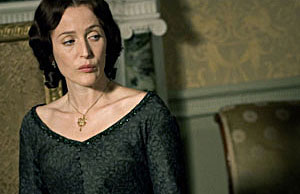
And will any good come to, or from, the story’s most mysterious and compelling character, Lady Dedlock (her name itself an obvious Dickensian metaphor), played with chilly (and yet potentially heart-rending) elegance by Gillian Anderson? Anderson, beloved by fans of “The X-Files,” has worked on the London stage but has barely made a blip in the movies, despite the astonishing performance she gave as Lily Bart in Terence Davies’ flawed but affecting “House of Mirth.” “Bleak House” restores Anderson to us TV watchers, while also giving her a role perfectly suited to her age, her abilities and her chiseled-from-marble profile.
In the first episode of “Bleak House,” Lady Dedlock stares from the window of her well-appointed Lincolnshire house; her eyes tell us little, next to nothing. But in them, we can see specters of all her dark, matte secrets — we just can’t get a good enough look at those specters to understand them, or identify them. She says, to no one in particular but possibly to her husband, the much older Sir Leicester (Timothy West), who has married her for love, that she is bored. She elongates the word bored as if she were drawing a threaded needle through a patch of drab linen, as if the mere enunciation of it were a tiresome task. Her bearing is dignified almost to the point of being stiff; she carries herself like a moving version of those spooky draped figures found on Victorian gravestones.
Which is apt, because although Lady Dedlock appears to be alive, there is something in her that is already dead, something that has been killed off or snuffed out. And yet as we look into her drably glittering eyes — or when, in Episode 2, we stare in amazement at the fiery glare set alight in them when she first catches sight, in church, of the dewily alive Esther — we realize that whatever has died in Lady Dedlock has only made whatever life remains more desperately vital. Does Lady Dedlock mean well, or does she intend evil? Anderson doesn’t signal her character’s intentions in this performance; instead, she makes us wait for more. We’re her willing lapdogs, ready for whatever morsels she cares to dish out.
In “Bleak House,” Dickens explains that Lady Dedlock had no significant family background, but did have “beauty, pride, ambition” and “insolent resolve.” After her marriage, “wealth and station soon floated her upward.” His description of her manners and appearance follows that explanation, and Anderson, with her almost excruciating stillness, is a breathing manifestation of his prose:
“How Alexander wept when he had no more worlds to conquer, everybody knows — or has some reason to know by this time, the matter having been rather frequently mentioned. My Lady Dedlock, having conquered her world, fell, not into the melting, but rather into the freezing mood. An exhausted composure, a worn-out placidity, an equanimity of fatigue not to be ruffled by interest or satisfaction, are the trophies of her victory. She is perfectly well-bred. If she could be translated to Heaven to-morrow, she might be expected to ascend without any rapture.”
Dickens is one of relatively few writers whom people around the world feel they “know” even when they haven’t read any of his work. His characters are so vivid that many of them — Ebenezer Scrooge, Madame Defarge — have become, in the popular imagination, better known as figures of speech than as people. But Dickens was also a man of surprises, as any master of the serial form would have to be. (That goes for modern TV practitioners of the form, like Joss Whedon, J.J. Abrams and Rob Thomas.) After watching Episode 2 of “Bleak House,” I now think I have some idea of where the story is going, and of at least some of the secrets that Lady Dedlock is suffering with. But I’m sure, in places at least, I’ll be proved wrong. For these next four Sundays, I’ll be turning the pages, figuratively speaking, with many other viewers, and on Feb. 26, I’ll close the cover at last.
And then, instead of feeling confident that I already know the story backward and forward, I anticipate reading the novel for real — alone, as we always are with a book, and yet not alone at all.
