

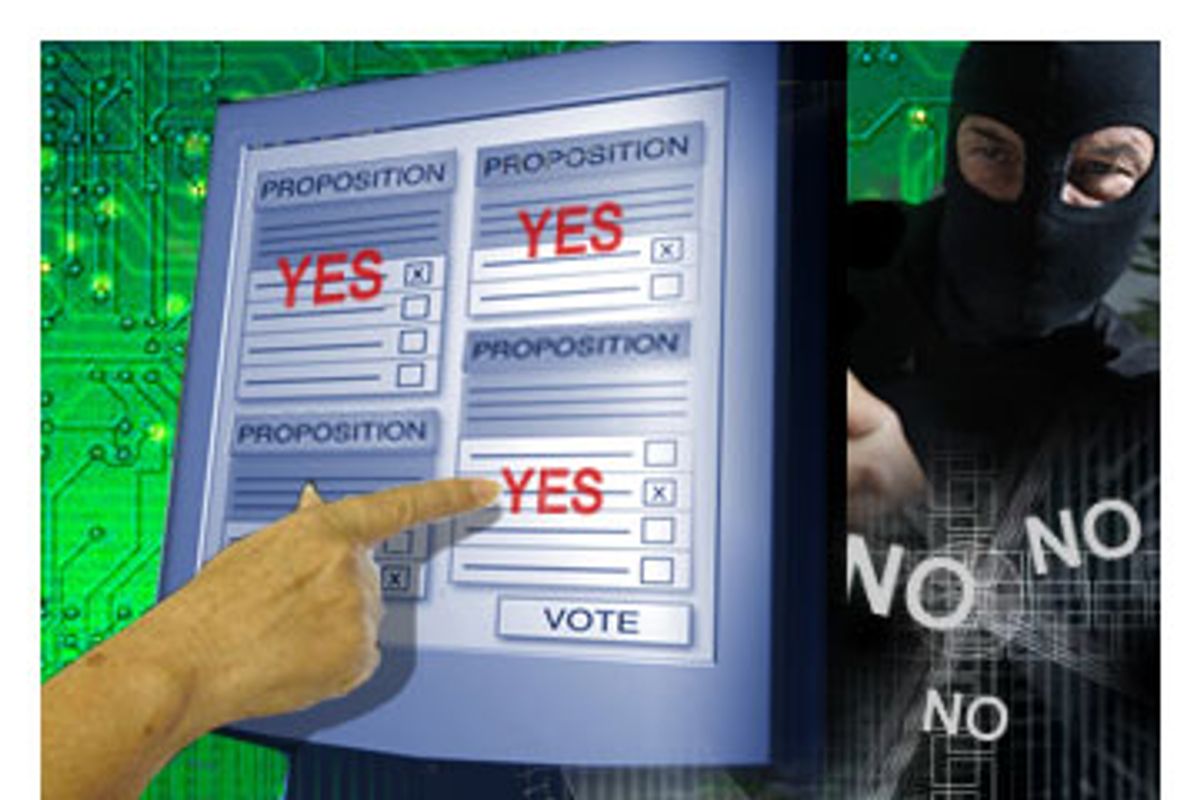
"When people see what is really going on, there is no way we will allow this to continue," the crusading election-reform activist Bev Harris declares at the beginning of "Hacking Democracy," a documentary film about the flawed American election system that premieres on HBO on Nov. 2. It's a nice thought, one you want to believe: If only Americans could be made to understand the true, gut-sinking atrociousness of just about everything involved in U.S. elections -- from the gerrymandered districts to the undemocratic distribution of electoral power to the enormous influence wielded by partisan officials to the underfunded, overwhelmed local offices to, finally, the insanely dangerous technology we use to run the whole thing -- well, then, maybe folks would actually do something about the problem.
But it's been four years since Harris launched her campaign to expose the dangers of new voting technology -- and it's been six years since we witnessed a presidential election in which the winner actually lost, and two years since we saw one in which errors were so widespread that rational people are still arguing over whether what actually happened was historic theft or historic incompetence. Reports of voting irregularities are now a mainstay of the mainstream media, and politicians and political parties regularly vow to fix the problem. Still, in all this time, little has changed. Surveys suggest that many Americans will go to the polls on Nov. 7 feeling (justifiably) uncertain about the integrity of the vote. If you're not already among that number, watch this film.
"Hacking Democracy" follows Harris -- a middle-aged writer and literary publicist from Seattle who first became interested in voting difficulties shortly before the 2002 race -- as she travels the country to sound the alarm about what has become the most talked-about problem in elections, the dangers posed by the paperless electronic voting machines. Harris makes a grand subject for a documentary: Not only is she responsible for discovering some of the greatest vulnerabilities in touch-screen systems, she's a firecracker who's got Michael Moore's flair for sarcastic confrontation. The film captures Harris and a band of fellow muckrakers engaged in a spate of guerrilla media spectacles -- they spar with voting company representatives at official hearings, they storm into elections offices and demand evidence of electoral accuracy, they dig through garbage cans for proof of official malfeasance, they stage mock elections to show how quickly you can break into the nation's voting equipment.
People who have been following the debate surrounding electronic voting -- Salon and other tech and political outlets began covering the issue in 2002 -- might find much of "Hacking Democracy" a rehash. But if you're new to the dangers of electronic voting, the film is sure to blow your mind. In a nutshell, the case against touch-screen voting systems -- on which about 40 percent of Americans will cast their ballots this year -- boils down to this: You can never really know what's going on inside. In most other voting systems -- even those that use computerized counting machines, like punch-card and optical-scan machines -- paper acts as a record of last resort. If officials ever need to recount the vote, they can always examine the ballots by hand (provided, of course, that Antonin Scalia approves). But paperless touch-screen machines store their votes on hard drives and memory cards, rendering recounts impossible. If the computer hasn't recorded people's votes correctly in the first place, or if someone has weaseled into the database and shifted around the totals, the true count will be lost to all forever.
Computer security is not an easy topic to explore on film, but "Hacking Democracy" conveys the danger in a remarkably simple manner. It does so by focusing on the slipperiness of one company, Diebold, a leading provider of touch-screen machines that has long been Harris' chief target. Diebold has all you could ask for in a corporate enemy -- ties to the Republican Party, a history of both lying to and currying favor with officials, a brusque and secretive posture in its dealings with critics and the press, and, worst of all, a pattern of technological ineptitude so startling you sometimes wonder if the people who work there are trying to sabotage the vote. The problem, Harris makes clear, isn't just that electronic voting technology is inherently untrustworthy -- the scary thing is that we're getting bad technology from people who act oblivious to the danger. Either they don't know how vulnerable their equipment is (which they should, as various studies have discovered alarming security flaws), or they know and aren't admitting it. Neither scenario inspires confidence. (Diebold alleges that "Hacking Democracy" is riddled with "inaccurate reporting," and it has called on HBO to cancel the broadcast.)
The film's other virtue is its commitment to the facts. Regular readers know that I've frequently criticized people in the election-reform movement for making claims that they don't have evidence to back up -- especially that George W. Bush stole the 2004 presidential election, an allegation that, as I've argued before, casts any effort to repair our elections as little more than a hobbyhorse of the far left. "Hacking Democracy" criticizes the 2004 race (as I have as well), but the film doesn't argue that Kerry won, and, in the main, it avoids conjuring the vote-stealing conspiracies that Robert F. Kennedy Jr., Mark Crispin Miller and others saw in 2004. "It's not quite as simple a picture," Harris says of theories that the GOP has the voting companies in its back pocket. "The state of Maryland and the state of Georgia have Democrats very tightly wed to using the Diebold system, and it's the Republicans who are fighting against it there. And in my own home county, King County, Washington, it's the Democrats who are pushing these systems and the Republicans who are a little bit skeptical."
Indeed, more than partisan mischief, "Hacking Democracy" really documents a parade of electoral ineptitude stretching from sea to shining sea. Here and there you find well-meaning officials and outside groups trying to make sure the vote goes well -- but to watch this film is to see that too many county-level functionaries who run elections believe that covering their asses, rather than assuring an accurate vote, is the real point of the game. In one scene, Harris and her friends show up at the elections office in Volusia County, Fla., a couple of weeks after the 2004 vote. They find a garbage bag sitting outside the county's warehouse, and when Harris tears it open she sees "poll tapes" -- each voting machine's printed tally of how many votes it recorded on Election Day -- floating about in the muck. "I would think ... you would be very concerned about this," Harris says to Deanie Lowe, Volusia's elections supervisor. "I mean, you can't throw away polling place tapes ... that are signed by six poll workers and put them in the shredder. I think we all understand that." But Lowe offers no explanation. One county employee dismisses the problem, sputtering to Harris, "Basically you're making a molehill out of a mountain."
The film also includes startling footage from the recount of punch-card ballots that Cuyahoga County, Ohio, held after the 2004 election. In Ohio, a manual recount is supposed to occur in two steps. First, a county must manually count a random sample of 3 percent of the votes -- if that sample doesn't match the original computer count, then the county must count every ballot by hand. But in Cuyahoga (the county that includes Cleveland), observers present during the first hand count noticed that the 3 percent sample of votes didn't appear to have been randomly selected -- the Bush ballots and the Kerry ballots were coming in patterns, suggesting that they'd been pre-sorted. In the film, when election workers are confronted about how they selected the "random" sample, they all but admit to picking and choosing. "Our random is our random," Kathleen Dreamer, the county's manager of ballots, says. Jacqui Maiden, Cuyahoga's Elections Division director, adds, "We have that option to select." In April, a special prosecutor indicted Dreamer, Maiden and another co-worker, alleging that they'd sorted the ballots in order to make sure that they wouldn't have to go through the hassle of a full manual recount.
"Hacking Democracy" ends on a sour note, which serves as an apt metaphor for the entire election-reform movement. We see Harris and her hacker friends set out to prove that they can program a Diebold memory card -- the card that stores votes in touch-screen and optical-scan counting machines -- so that it easily steals an election. Their demonstration is so unmistakably successful you can't help feeling sick. Susan Pynchon, a member of the Florida Fair Elections Coalition who's present at the hack, breaks down into sobs as she sees the voting machine deliver manipulated results. "How can this be happening to our elections?" she asks.
But actually, the problem is even worse than the film suggests. "Hacking Democracy" does not mention the work of Ed Felten, the respected Princeton computer security researcher who proved, in a September report, that it's possible to install a kind of voting machine "virus" on Diebold's memory cards. Felten's study is a blockbuster: Conducted on the very same machines that will be used throughout Georgia and Maryland this year, Felten showed how attackers can secretly attach a vote-stealing program that spreads from voting machine to voting machine in a completely undetectable fashion. Robert Ehrlich Jr., Maryland's Republican governor, has since called for the state to scrap the $106 million Diebold system (purchased by Democratic elections director Linda Lamone), and he urged residents there to cast their votes this year on paper-based absentee ballots. But this idea has created another problem -- so many voters in Maryland have requested absentee ballots that the state now looks certain to face a shortage.
Also missing from the film is much mention of the voter-verified paper audit trail, which many in the election-reform movement have held up as the solution to problems posed by touch-screen voting. A VVPAT, as it's known among reformers, is simply a slip of paper that an electronic machine prints out when a voter casts his ballot -- this ballot proves to the voter that his selections were recorded accurately, and it can be counted by officials in the event of a manual recount. Twenty-two states now require electronic machines to produce a paper trail, and many voting firms, including Diebold, produce paper-trail machines -- which sounds like good news, until you learn how badly these machines have fared.
In April, the Election Science Institute, a nonpartisan election-reform group that studied the results of the primary election held in Cuyahoga County, Ohio, reported that at least 10 percent of the paper-trail ballots produced by the Cuyahoga's Diebold machines couldn't be manually recounted. Some paper trails were crumpled, some were torn, some were taped together, some showed long blank spaces of missing text. Diebold blamed poorly trained poll workers for the trouble, but other observers see the bad results as a sign that Diebold is deliberately trying to kill off support for paper trails.
Which brings us to Nov. 7, 2006. Unlike everyone else in the Republican Party, Karl Rove has lately been expressing bizarre optimism about the GOP's prospects in November. Of course, it's certainly possible that Rove knows something we don't -- that, as he says, he's looking at polls that none of the rest of us have access to. It's possible, too, that he's just aping optimism for cameras, and is dying on the inside. And you also have to guess that if Rove were planning on rigging the election, he would probably not be advertising his certainty now.
But the problem with how we run elections these days is that you just can't get the darker story out of your mind. Already, doubts are creeping in: In Jefferson County, Texas, early voters trying to select a straight-party Democratic ticket have reported their machines surreptitiously choosing Republicans instead. Voters have experienced similar trouble in Dallas; in Hempwallace, Ark.; and in Maplewood, Mo. Touch-screens everywhere, and not even a paper trail to save us. Whoever wins on Election Day, will it be possible for any rational person to look at the results and not at least ... wonder?
Shares