

March 22
To the Editor:
Michael Massing's latest missive, "The Elephant in the Room," discusses at great length his perception of U.S. counter-drug policies. However, what Mr. Massing describes bears little resemblance to our efforts. Massing has built this fiction because the facts don't support his arguments.
Massing complains that the administration's proposed counter-drug aid package for Colombia and the Andean region has been received with "little fuss or fanfare." It seems that Massing has not been reading newspapers, watching TV, listening to the radio or viewing C-Span lately. The administration's proposal has been the subject of coverage and editorial comment by literally every major news outlet in the nation across every form of media -- ranging from CBS to the New York Times to NPR. Congress has already held three hearings on the proposal over just the last month, and full floor debates are scheduled in both houses.
Massing's approach to Colombian aid typifies his modus operandi: Where the facts don't support his premise, he simply ignores them. Why be constrained by reality when you can create your own world?
Massing states that "If drugs were legalized, the whole noxious network of drug traffickers, smugglers and money launderers stretching from the jungles of South America to the streets of our inner cities would suddenly disappear." This conclusion is not only incorrect but ludicrous.
There is a vast array of otherwise legal products that are also commodities on the black market. For example, the fact that guns are legal in the United States has not eliminated crime and violence on our streets. Nor has it halted the black market in weapons that puts guns in the hands of criminals.
Contrary to Massing's argument, legalization of marijuana use in the Netherlands did not cause traffickers to vanish in thin air. Organized crime runs the Dutch "pot" industry, according to a March 13 Salon article (David Downie, "Going Dutch," Downie notes one Dutch official's report that "90 percent of smoking coffee shops in the city are controlled by organized crime." The illegal Dutch marijuana industry today brings in more money than the other traditional, legal Dutch crop: tulips. One of Salon's sources, Kurt van Es, a noted reporter with the Amsterdam daily Het Parool and a self-declared proponent of drug legalization, goes so far as to say: "The Dutch have become the Colombians of marijuana and hash trafficking in Europe." If decriminalizing or legalizing drugs was supposed to reduce crime, no one told that fact to the crime kingpins who are using their pot riches as venture capital for other criminal enterprises -- such as running guns and pushing drugs like heroin and ecstasy.
Massing claims that the main strategy for dealing with hardcore drug addicts in the U.S. is "arrest, prosecution and incarceration." This assertion is incorrect. Over the last two years, the administration has focused on changing how the criminal justice system deals with the link between drugs and crime. Our aim is not to lock up countless low-level, nonviolent, addicted drug criminals but to use the leverage of the criminal justice system to help these individuals obtain supervised treatment, learn to live drug-free, and remain in society as productive members.
For example, there has been a dramatic increase in the number of drug courts -- which offer low-level, nonviolent drug offenders supervised treatment in lieu of prison. There were only 12 such courts in 1994; today, there are over 457 with another 250 planned. The president's current budget request calls for an additional $112 million to increase the number of treatment programs within the criminal justice system.
We are focusing on treatment in the criminal justice system because, as Massing concedes, hardcore addicts are responsible for the bulk of drug-related crime. The vast majority end up in jail. In addition, breaking free of addiction to heroin or methamphetamine is not easy, and most addicts will relapse. Studies show that the average cocaine addict has been in treatment three times, and heroin addicts attempt treatment five or more times. However, when the options are between staying in treatment or facing graduated sanctions resulting in imprisonment, the incentive to tough it out and get clean is far greater. Not only have these programs been proven to reduce drug use, but they have also cut recidivism by 40 percent. The criminal justice system is, perhaps, the most effective vehicle for treating hardcore addicts because the majority of these people can be found behind bars at one time or another.
Massing is wrong when he suggests we are expending tremendous resources arresting "teenagers ... for smoking pot." During fiscal year 1998, only 33 federal defendants were sentenced to jail for base offenses involving less than 5,000 grams of marijuana. During this same period, 196 criminals were sentenced for crimes involving between 1 million and 2.99 million grams of marijuana -- more drugs than can fit in a van, much less a pocket.
At the state level, recent studies show that the average sentence for individuals convicted of felony drug possession charges -- the crime many drug traffickers end up pleading to -- received either five months in jail (41 percent) or 36 months of probation (30 percent). Even in New York state, home to the Draconian Rockefeller drug laws, in 1996 fewer than 10 percent of felony drug arrestees (with no prior felony arrests or convictions) were sentenced to state prison.
These crime statistics call into question what Massing means by a "public health" approach. The overwhelming number of drug criminals have committed serious crimes involving weapons, selling drugs to children, running drug syndicates or committing drug-related crimes like murder. Surely, even Massing wants criminals like these behind bars.
For practical purposes, what difference would Massing's approach really make? Unless he wants hardened criminals to go free and unpunished, we would still be arresting serious drug offenders and seeking to get them into supervised treatment.
Massing wants us to direct our attention at so-called "hard drugs" rather than marijuana. Here again, his analysis is flawed. Marijuana, the first illegal drug most young people try, is a gateway substance. An article in the March edition of the American Journal of Public Health Studies notes that marijuana use is an important precursor to the use of other drugs. By preventing or delaying youngsters from trying marijuana, we dramatically decrease the likelihood that a child will have a substance-abuse problem later. Preventing marijuana is thus smart public-health policy.
Moreover, Massing's view that marijuana is somehow "soft" or benign and that "a convincing case can be made for legalizing, or at least decriminalizing, marijuana ..." is out of touch with reality.
- An article in this month's American Journal of Public Health notes that marijuana (and alcohol) "use increases risks for a range of serious adolescent health and behavior problems."
- According to the Substance Abuse and Mental Health Services Administration, children who begin smoking "pot" at an early age are less likely to finish school and more apt to engage in acts of theft, violence, vandalism and other high-risk behavior than children who do not smoke marijuana.
- The ONDCP-sponsored report "Marijuana and Medicine," prepared by the Institute of Medicine, indicates that 9 percent of marijuana users became dependent on the drug.
- Legalizing marijuana would give young people greater access to this psychoactive drug. Arguing for a policy that would result in more young people using marijuana is irresponsible since this drug adversely affects children's health.
Massing's pro-marijuana bias colors his views of the administration's drug-prevention efforts. He argues that "at the moment, drug prevention consists mainly of 'This is your brain on drugs'-type messages aired on television or taught in classrooms." America's National Youth Anti-Drug Media Campaign -- a five-year, $2 billion public-private partnership -- uses the full power of the modern media (television, comic books, curriculum, the Internet, sports marketing, newspaper ads, billboards and grass-roots efforts) to help young people reject drugs. The campaign goes far beyond "just say no." In fact, it gives young people things to which they can say "yes." For example, we are sponsoring youth anti-drug soccer tournaments across the country, an anti-drug bike clinic at the Summer X-Games, online rock concerts with anti-drug themes, and a pilot program funding a New York Rangers anti-drug hockey clinic in the New York metropolitan area. This campaign is unlike anything the federal government ever did previously.
The campaign works precisely because of these cutting-edge efforts. Studies show that not only are our messages getting noticed, but they are already having an impact on behavior. A 1999 study by the Partnership for a Drug-Free America found that:
- In just one year, the number of youth (ages 13-18) who strongly felt that "really cool" teens don't use drugs went up 5 percent (40 percent in 1999 compared to only 35 percent in 1998). Only 8 percent of youth believe marijuana users are popular, down from 13 percent in 1998.
- In one year (1998 to 1999) the number of teens who tried to talk a friend out of drug use increased to 41 percent, up from 38 percent.
With the campaign now reaching 95 percent of its target audience (youth and adults who care about children) roughly seven times per week, it is hard to see how Massing missed the blitz of media messages encouraging healthy lifestyles.
In his zeal to criticize, Massing paints the Nixon era as a drug-policy Utopia, which he holds up as a model. In fact, this analysis is about as useful as comparing the world of communications in the 1970s with the year 2000 without considering the impact of the Internet or cell phones. America during the Nixon administration had yet to experience crack cocaine and the drive-by violence this drug brought to our neighborhoods. Methamphetamine production, perhaps the greatest drug threat to America today, was still small and discrete -- largely confined to biker gangs. The cold-cooking method of meth production, which over the last few years has helped spread this drug across the nation, did not exist until the 1990s.
Massing's analysis of drug budgets under Nixon and Reagan is disingenuous. In 1972, the year he suggests overnight success was achieved due to "hundreds of millions of dollars" for treatment facilities, total spending on demand reduction was $239 million (which includes both prevention and treatment). That figure equals less than $1 billion in 1999 dollars, or less than 20 percent of current spending in this area. Massing's assertion that these programs were "gutted" by the Reagan administration is curious, given the fact that federal spending on demand reduction increased every year during the 1980s (as it did in the 1990s for that matter).
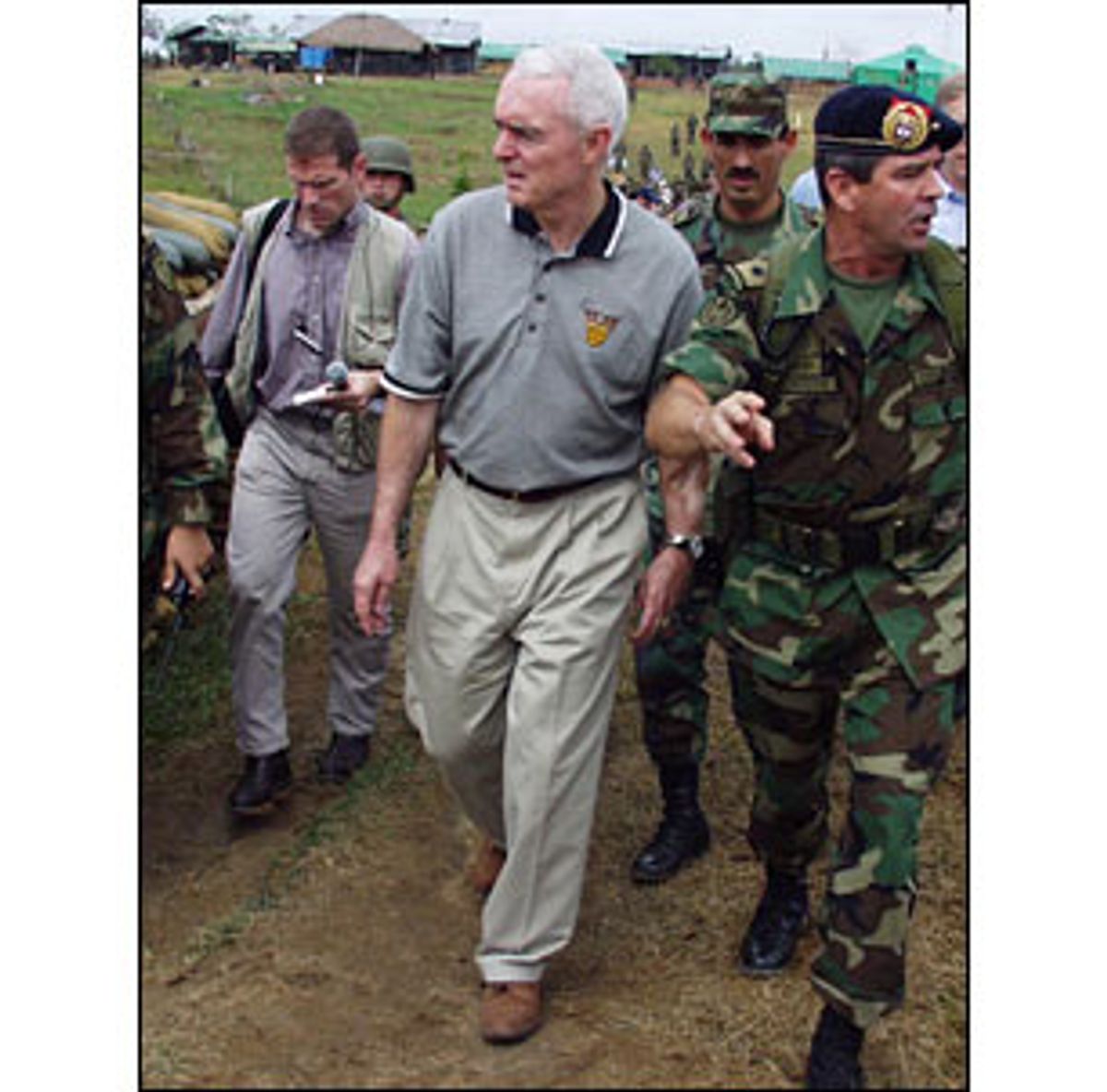
Massing reveals his prejudice when criticizing White House Drug Policy Director Barry McCaffrey simply because of his military service. (Most Americans see honor in McCaffrey's long career of public service, including his heroism in defense of this nation.) Massing ignores McCaffrey's success in fighting drugs during his tenure as "drug czar."
Under director McCaffrey, the nation's counter-drug budget grew from $13.5 billion in 1996 to a projected $19.2 billion in 2001, an increase of 42 percent. During this same time frame, the amount of money dedicated to drug prevention increased by roughly $850 million, or 53 percent. Similarly, funding for drug treatment rose $985 million, or 35 percent.
At the same time, director McCaffrey has spearheaded efforts to increase drug treatment within the criminal justice system, provide insurance parity so addiction would be covered like any other disease and increase access to quality methadone treatment programs for heroin addicts. He also fought to end the disparity between crack and powder cocaine sentencing guidelines.
With respect to drug prevention, McCaffrey launched the Youth Media Campaign, created the Drug-Free Communities Program (which funds prevention efforts for local community coalitions), developed the National Middle School Drug and Violence Coordinators Program and protected the Safe and Drug-Free Schools Program (America's largest drug-prevention program). Massing ignores this record in favor of building a strawman to tear down.
Rather than creating a fictitious drug-control policy to attack, confining oneself to reality would be far more useful. Our National Drug Control Strategy is a balanced approach to combating the scourge of drugs. It is working. Consider the following facts:
- The National Household Survey released in 1999 found that overall youth drug use is down 13 percent, youth cocaine use dropped 20 percent and youth inhalant use plummeted 45 percent in just one year.
- Drug-related murders have hit the lowest point in over a decade.
- In the last four years, the amount of money Americans waste buying drugs decreased from $66.8 billion to $63.2 billion.
- In Latin America, Bolivia reduced coca cultivation by 55 percent since 1995 while in Peru cultivation declined 66 percent.
These achievements have brightened the future for our children, made our streets safer, and left our hemisphere more stable. On an issue as important as drug policy, we cannot afford to distort reality.
-- Robert Housman
Assistant director, strategic planning
The White House
Michael Massing's response to Robert Housman's letter:
On March 14, Robert Housman telephoned me and began berating me for my article in Salon. His manner was so abusive and unprofessional that, after a few minutes, I refused to continue the conversation. Here, he continues his harangue by other means. His letter helps explain why so many people have become disillusioned with Clinton administration drug policy.
My article offered a critique of that policy. It argued that the administration was waging a futile war on drugs, concentrating too much on military adventures in Latin America and drug arrests at home rather than on treating the hardcore addicts who are at the heart of our drug problem.
I began by questioning the wisdom of the administration's proposed $1.3 billion aid package for Colombia. With a bitter civil war raging in that country, I wrote, "American lives will clearly be at stake." Housman concentrates his fury on my comment that the aid proposal was greeted with "little fuss or fanfare." My article appeared Feb. 22. Housman's letter is dated March 22 -- a month later. Most of the debate over the Colombia package -- and all three of the congressional hearings he mentions -- occurred after my article appeared. Given that the aid package forms the centerpiece of the White House's 2000 drug strategy, I would have expected Housman to offer some defense of it. Instead, he latches on to a trivial clause. It's like reprimanding a burglar for not wiping his feet before breaking into your house.
From reading Housman's letter, you'd think my article was a brief for legalizing drugs. It wasn't. On the contrary, it strongly rejected the idea of legalizing hard drugs. "As long as legalization is seen as the main alternative to the drug war," I wrote, "the movement toward reform will stall."
In explaining my opposition to legalization, I attempted, as any serious student must, to weigh the costs and benefits of such a policy. On the plus side, I maintained that legalizing drugs would put drug traffickers and smugglers out of business. This seems to me a given. If cocaine and heroin were legal, companies like Merck and Pfizer could produce them for a tiny fraction of their current cost. What incentive, then, would traffickers in Colombia or Asia have to produce them? None.
The proper comparison is not to guns (where the problem is that the market is too open) but to alcohol and tobacco. Both of these substances are legally available, and the black market in them is negligible. The repeal of Prohibition put an end to the crime associated with the distribution of alcohol, and the same would no doubt happen with cocaine and heroin. But, as I noted in my article, the end of Prohibition also resulted in a sharp rise in alcohol consumption, and legalizing drugs, I argued, would risk a similar increase. So, I wrote, it seemed on balance a bad idea.
Housman sneers at me for distinguishing between marijuana and other drugs like heroin, cocaine, crack and methamphetamine. Well, let me enumerate the differences. No one has ever died from a marijuana overdose. All those other drugs can be lethal. Injectors of heroin and cocaine can contract HIV and other deadly infections; marijuana poses no such danger. Cocaine and crack can cause heart failure; marijuana can't. Crack and methamphetamine produce psychotic reactions in many regular users; marijuana rarely does. Heroin, cocaine and methamphetamine are all highly addictive, and suddenly desisting from their use usually produces severe withdrawal symptoms and uncontrollable cravings. Marijuana usually produces neither. The notion that marijuana is a "gateway" drug, meanwhile, has been repeatedly rebutted, most recently in the Institute of Medicine's 1999 report, "Marijuana and Medicine."
"Because underage smoking and alcohol use typically precede marijuana use," it stated, "marijuana is not the most common, and is rarely the first, 'gateway' to illicit drug use. There is no conclusive evidence that the drug effects of marijuana are causally linked to the subsequent abuse of other illicit drugs."
This is not to say that marijuana is harmless. It can sap people's motivation and induce paranoia. Smoking marijuana, like smoking tobacco, is not good for the lungs. And driving while stoned can be very dangerous. For young people in particular, marijuana use should be discouraged.
The key question is, should young people, or anyone else, be arrested for using it? Housman is simply wrong when he asserts that we are not spending large sums on arresting people on pot charges. In a typical feint, he limits his discussion of marijuana arrests to the federal prison system when he surely knows that most such arrests occur at the local level. According to the White House's 2000 drug strategy, of the 1,559,100 arrests for drug offenses in 1998, 38.4 percent were for marijuana possession. That works out to 600,000 arrests for using pot. An additional 84,000 arrests were made for selling it.
Now, marijuana may be harmful, but even Housman must admit this is wildly excessive. A comparison with alcohol is revealing. An estimated 14 million Americans suffer from alcoholism and alcohol abuse, and collectively they cause far more damage to society, in terms of car wrecks, physical assaults, medical emergencies and domestic abuse, than do marijuana users, yet nobody talks about arresting them.
So, if one disapproves of arresting people for marijuana use, what's the alternative? The case of the Netherlands is instructive. Housman is again wrong when he claims that Holland has legalized drugs. What it has done is decriminalized marijuana use (allowing it to be smoked in coffee shops) while keeping the production and distribution of the drug illegal. That's why marijuana distribution in Holland remains in the hands of organized crime. If the sale of marijuana were made legal, it would no doubt put those criminals out of business. Doing this, however, would almost surely lead to increased consumption. In Holland, the spread of pot-selling coffee shops has in fact resulted in increased use. That's why, in the end, decriminalizing marijuana is probably the best (or least bad) of all approaches, representing a middle ground between total intolerance and unrestricted access. What's more, if we stopped arresting people for pot possession, we could spend the money saved to establish more prevention programs for young people.
Housman takes issue with my assertion that the government's main strategy for dealing with hardcore drug users is arrest, prosecution and incarceration. Again, a look at the numbers backs up my point. Of those 1,559,100 drug arrests made in 1998, 25.6 percent -- 400,000 -- were for cocaine or heroin possession. An additional 11 percent -- 172,000 -- were for selling these drugs. As any student of the streets knows, many of those arrested for selling drugs are actually addicts seeking to support their habit. And, because of the mandatory-minimum laws on the books in most states, many of these people end up doing time. Of the 1,179,000 people in state prison in 1998, 20.6 percent -- 243,000 -- were drug offenders. This is 41 percent more than in 1992, the year before Clinton took office. (Of the 123,000 people in federal prisons, a remarkable 62.6 percent are there for drug offenses.)
No doubt some of these offenders are hardened criminals who deserve to be behind bars, but many are not. And it is not only woolly-headed liberals like me who believe this. Last year, John DiIulio, the Princeton criminologist who did so much to promote the idea of long mandatory sentences, described his change of heart in a Wall Street Journal article headlined "Two Million Prisoners Are Enough." "Current laws," he wrote, "put too many nonviolent drug offenders in prison." As a remedy, he called for the repeal of mandatory-minimum drug laws and the release of drug-only offenders. In New York, Gov. George Pataki -- frustrated at the continued need to devote valuable prison space to low-level offenders -- has repeatedly sought to reform the Rockefeller drug laws, only to be stymied by demagogic state legislators.
It is precisely because so many nonviolent drug offenders are crowding the criminal justice system that the drug court movement has flourished. And I applaud this development. Diverting nonviolent offenders from prison to treatment makes a lot of sense, and Barry McCaffrey deserves credit for helping promote this.
What I object to is the notion -- embraced so enthusiastically by Housman -- that we should concentrate our treatment resources in the criminal justice system. With so much money being spent there, it's becoming increasingly necessary for addicts to get arrested in order to get treatment. Doesn't it make sense to make help available outside the criminal justice system, too, so that addicts who want to enter treatment can? According to the White House's own figures, 5 million Americans stand in need of drug treatment, yet only 2.2 million are getting it, leaving a treatment gap of 2.8 million. As a result, there are long waiting lists for treatment around the country. According to the Department of Health and Human Services, closing that gap would require spending an additional $8 billion.
Under McCaffrey, there has been some growth in the federal treatment budget, but nowhere near what is needed. The White House's proposed drug budget for 2001 contains not quite $100 million more in new treatment money outside the criminal justice system. This is dwarfed by the $1.3 billion requested for Colombia, the $420 million requested for new federal prison space to house drug offenders and the $112 million requested for new customs interdiction programs. Overall, two-thirds of the federal drug budget goes for law enforcement and criminal justice, and just one-third for treatment and prevention. This is a balanced strategy?
At one time, federal policy looked very different. As I noted in my article, and as I discuss at length in my book "The Fix," the Nixon administration made treating addicts the core of its strategy. Housman's "facts" on the history of this period are flatly wrong. Nixon's 1973 drug strategy ("Federal Strategy for Drug Abuse and Drug Traffic Prevention, 1973") shows that spending on treatment and rehabilitation (excluding prevention) came to $143 million in fiscal year 1972, $266 million in FY 1973 and $274 million in FY 1974, for a total of $683 million. It's true that the Nixon administration predated crack and methamphetamine, but Housman is wrong to pooh-pooh the severity of the crime problem in that period. When Nixon took office, the nation was in the throes of a fierce heroin epidemic, and those caught up in it were feeding a sharp surge in crime.
During the eight years prior to Nixon's taking office, crime had doubled in the United States. In January 1969, the month Nixon became president, 19 bank robberies took place in Washington alone. In 1971, the year the Nixon treatment offensive began, 17,780 people were murdered in the United States, a rate of 8.6 per 100,000. From 1986 to 1992 -- the peak years of the crack epidemic -- the murder rate ranged from 8.6 to 9.3 -- virtually the same. As I attempt to show in my book, Nixon's treatment offensive succeeded in bringing down the rate of drug-related crime, as well as that of new hepatitis cases and hospital emergency room visits.
Housman is no more accurate on the Reagan years. In fiscal year 1982, the first full one under Reagan, the federal treatment budget was cut by 25 percent, and it remained at that low level for the next several years. (See Page 217 of "Treating Drug Problems" by Dean Gerstein et al., a study of federal treatment policy published by the Institute of Medicine in 1990.) The devastating effect those cuts had on the ability of rehab centers to treat addicts was the subject of several congressional hearings (e.g., "Drug Abuse Treatment and Prevention 1984," House Select Committee on Narcotics and Substance Abuse, June 26, 1984, and "Alcohol, Drug Abuse, and Mental Health Administration," House Appropriations Committee, May 10, 1984).
Housman makes much of the fact that, under McCaffrey, the nation's drug budget has grown 42 percent, from $13.5 billion in 1996 to $19.2 billion in 2001. What return have we gotten on this investment? The amount of money Americans spend on drugs, Housman writes, has dipped from $66.8 billion to $63.2 billion. This drop is so insignificant that it's silly to believe that it can even be measured. Drug use among young people declined from 11.4 percent in 1997 to 9.9 percent in 1998, a 13 percent drop; in 1996, however, the rate was 9 percent, so basically the level of use has returned to where it was when McCaffrey took office. And, yes, coca cultivation has dropped in Bolivia and Peru, but, in another display of selective data use, Housman does not mention that coca cultivation has soared in Colombia, from 50,900 hectares in 1995 to 122,500 hectares today -- more or less making up for the decreases in those two other countries.
According to the White House's own drug strategy, both cocaine and heroin are today available in the United States at record-low prices -- a sign that these drugs remain easily obtainable.
Housman omits some other important numbers. In 1997 (the latest year for which data are available), 15,079 people died from drug-induced causes. This is the highest level ever recorded, and 36 percent above the 1992 level. Similarly, in 1998, the number of drug-related emergency-room visits reached 542,544 -- another all-time high. Drug users visit hospital emergency rooms not only because they're suffering adverse reactions to drugs but also because they can't find help elsewhere. That these numbers are rising so sharply stands as a sharp indictment of the Clinton administration's policy.
As Housman points out, McCaffrey has done some good things as drug czar. He has promoted drug courts, pushed insurance parity for drug abusers, sought to widen access to methadone and worked to provide young people alternatives to drug use. He has also talked repeatedly, and eloquently, about the need to help hardcore addicts break their habits, and about the role treatment can play in accomplishing that. Unfortunately, on this last point, his budget has not matched his rhetoric. Rather than confront the problem of addiction at home, the Clinton
administration prefers to fight phantom enemies in distant jungles. Last week, the House of Representatives approved the White House's proposed
aid package for Colombia, bringing us a step closer to involvement in that country's endless violence. Clearly, the war on drugs lives on.
Shares