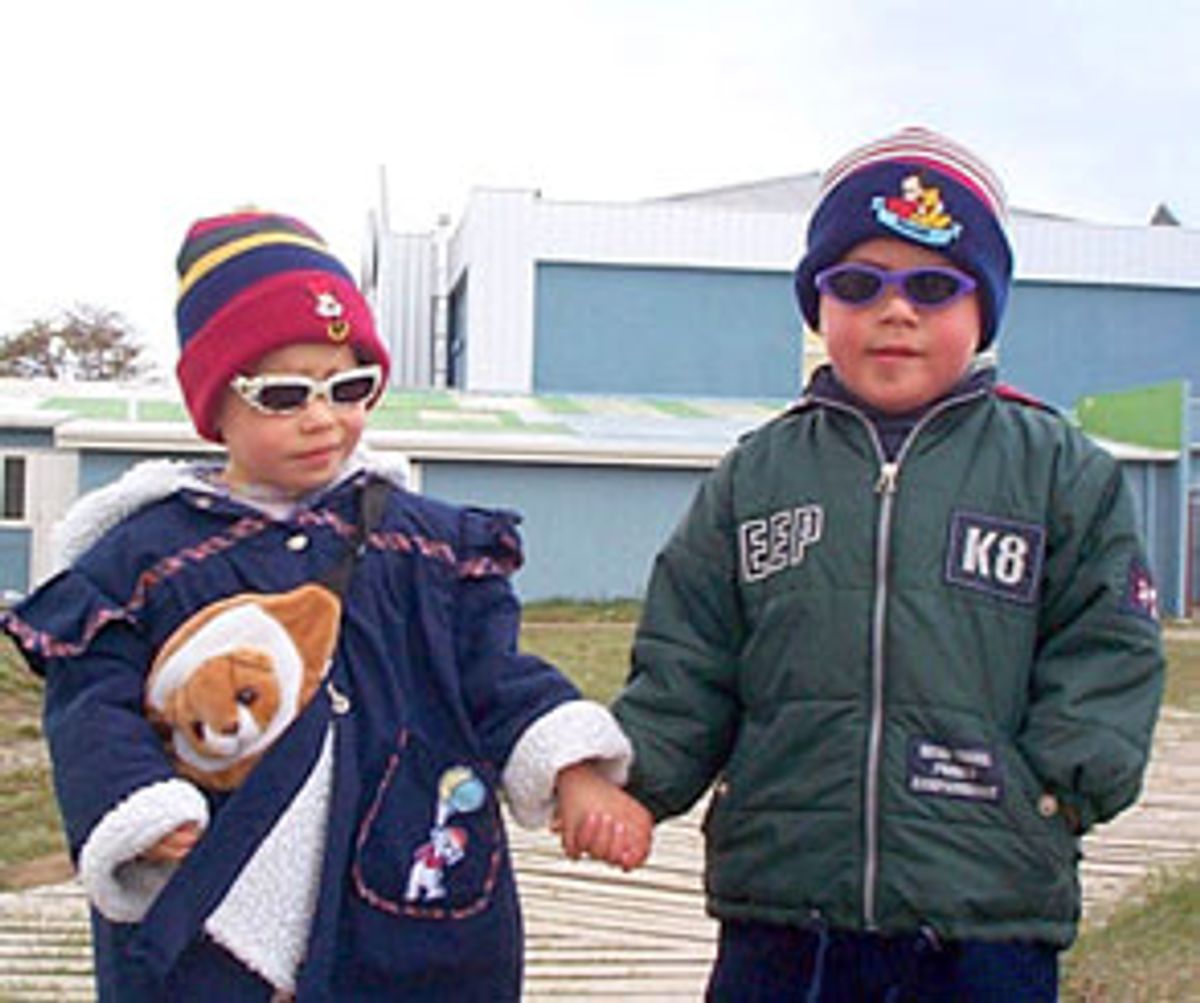
Below an expansive sky that stretches on forever, hundreds of 4-year-olds tucked into puffy winter coats hold hands and file eagerly into an elementary school auditorium. Though it is barely 45 degrees outside, the preschoolers are here to learn about the dangers of the sun.
Paul the Penguin, a 7-foot-tall mascot, appears onstage accompanied by two friends in beach clothes. They warn him that the sun will turn his skin red but that if he douses himself in Eucerin sunblock, he can play outdoors as long as he likes. After the show, the preschoolers line up once again, giggling and squealing, to receive free trial-sized bottles of Eucerin, courtesy of the cosmetic company that makes it. As they grab their gifts and file out, they look like giggling children anywhere -- even though they're not.
The festive setting, complete with beach balls sporting Eucerin's name in big black letters, belies the grim reason they have all gathered. Like the "duck-and-cover" classroom exercises during the Cuban missile crisis, and Los Angeles' smog alerts in the 1980s, which cautioned students not to go outside when pollution levels were high, today's presentation is teaching a generation of kids in the southern tip of Chile how to accept the unacceptable -- how to survive under the expanding ozone hole the rest of the world has created.
"It's very sad," says Eduardo Mortiric, a 15-year-old with pale skin and cheeks so sun-kissed it looks like he has rouge on. "I can't go outside and ride my bike, play soccer anymore or go walking. I burn easily."
Welcome to life in Punta Arenas in the ozone depletion age.
This port city of 120,000 people, at 53 degrees south latitude, has always been known more for its proximity to other places -- five hours from Patagonia's Torres del Paine, an hour from a penguin colony, a boat ride to Antarctica -- than as a destination in its own right. But as ground zero of a global ecological catastrophe, Punta Arenas is becoming famous, or infamous, as the city that has squatted directly under the gaping hole in the earth's ozone layer. What's happening down here on the edge of nowhere is an uncontrolled science experiment: exposing human beings in their natural habitat to long-term doses of potentially deadly ultraviolet radiation.
It may take years before the results are in, before we know the full toll in vision problems and skin cancers, illness and death. Until now the rest of the world has watched from afar, complacent in the conviction that it has largely addressed the problem. But it might be a good idea to pay closer attention to what happens down here, because scientists fear that -- in the future -- regions farther from the poles could be hit by a thinning of the ozone layer.
Contradictions abound in this small city. On many days in September and October -- the spring months when the ozone layer is at its thinnest -- Punta Arenas officials warn residents to stay inside between 11 a.m. and 3 p.m. or risk a severe sunburn. Yet most don't listen. The regional health minister in charge of disseminating this advice to the public appears at official events with a deep tan from a recent skiing trip. People here complain about the ecological disaster the rest of the world has inflicted on them -- then they complain that foreign visitors draw too much attention to the problem. Doctors warn patients of the need to wear protective hats sturdy enough to withstand the powerful wind down here -- but know that the gear must be attractive enough so fashion-minded Chileans will actually wear them. Officials acknowledge the critical need to address the problem -- but claim they won't be able to afford $180,000 for an ozone- and radiation-measuring instrument after Punta Arenas scientists return the only one they have later this month to the institute in Brazil from which they borrowed it.
And Punta Arenas is where Beiersdorf, a German cosmetics company, markets itself by sponsoring a play for preschoolers featuring an adorable penguin who slathers the firm's sunblock over himself from head to web.
Though scientists once thought they had a handle on the problem, the ozone hole reached its largest dimensions yet in September, stretching across an area of 11 million square miles -- a distance three times the size of the United States. And it has subsequently wandered all the way from its icy seasonal home of Antarctica to this port city. In Punta Arenas, according to local measurements, the residents are exposed to levels of UVB radiation 40 percent greater than normal when the ozone hole is above.
The worsening situation has so alarmed Chilean officials that, for the first time ever, they are demanding help from the international community to help finance research on the effects of ozone depletion on ecosystems and human health. Chile's ambassador to the United Nations, Juan Gabriel Valdes, is addressing the U.N. General Assembly on the issue this month.
But Chilean officials are concerned because asking for assistance affronts their pride and sense of self-sufficiency. "I am not like the guy in 'Jerry Maguire,' saying, 'Show me the money! Show me the money!'" says Rodrigo Alvarez, a congressman for the Magallanes region, where Punta Arenas is located. "This is a problem that we didn't create. There is an international responsibility to this southern region -- Australia, Argentina, Chile. The [ozone hole] was created by the whole world."
The ozone layer lies in the stratosphere more than 10 miles above the Earth's surface. Because it absorbs most of the sun's sometimes deadly, DNA-destroying ultraviolet B radiation, or UVB, it enabled life as we know it to thrive on earth. "It's like a bulletproof vest -- if you start thinning out the lead, you let more bullets through," says Ed DeFabo, research professor of dermatology at George Washington University Medical Center and chairman of the International Arctic Science Committee's panel that examines the impacts of increased UVB radiation.
Scientists discovered the hole in the ozone layer -- more accurately, a thinning of the layer -- in 1982. They linked it to the widespread use of manmade chemicals like chlorofluorocarbons (CFCs) and hydrochlorofluorocarbons (HCFCs) in such products as aerosol sprays, refrigerants and solvents. Once released, these substances rise to the stratosphere, where the sunlight causes them to break apart into chlorine and other elements. In the Southern Hemisphere, the depletion occurs largely in the spring because rising temperatures and the presence of ice crystals atop the polar stratospheric clouds facilitate complex chemical reactions between ozone molecules and the CFC and HCFC components.
In 1997, more than 140 countries signed the Montreal Protocol, in which they agreed to phase out the use of these chemicals. However, because the CFCs and HCFCs can take years to rise high enough to start causing the damage, scientists believe that it will be decades before the ozone layer can replenish itself and return to normal.
More recently, however, evidence has mounted that global warming, not just the CFCs and HCFCs, can also cause ozone depletion. Virtually all members of the reputable scientific community believe that much of the current trend of global warming can be attributed to human use of non-renewable sources of energy. And they believe that many of the bizarre ecological and climatic phenomena of the past few years -- the record high temperatures and the shrinking of the polar ice caps, for example -- can be attributed to global warming.
The situation is not likely to improve any time soon. According to a report released recently by the United Nations Intergovernmental Panel on Climate Change, average global temperatures could rise as much as 11 degrees Fahrenheit over the next century. That also means that ozone depletion could get worse -- much worse -- before it gets better.
"This could mean a truly torrid world in many areas and frightful extremes of weather," says Arjun Makhijani, president of the Maryland-based Institute for Energy and Environmental Research.
So far the problem has mostly affected large swaths of the Southern Hemisphere. In some ways the situation might ultimately be worse in places like Australia and New Zealand, where higher temperatures prompt people to spend more time outdoors wearing far fewer clothes. But some researchers ominously predict "ozone hole creep" as the century progresses. Jonathan Shanklin, one of the scientists who discovered the Antarctic hole, announced just last week that a second hole above the Arctic, which has generally been smaller than the one over the southern pole, could grow to the same size by 2020 because of global warming.
Some scientists also fear that there could be increased ozone thinning across the globe, not just at the poles. This could be particularly dangerous for places like Miami and San Diego, since regions closer to the equator already experience relatively high natural levels of UVB radiation even without ozone depletion. But double doses from a thinning ozone layer could push these sun-belt cities well into the danger zone.
Given the stark differences in environmental policy between the two presidential candidates, next week's election could have a significant impact on the situation. Though President George Bush memorably mocked Al Gore as "Ozone Man" during the 1992 campaign because of Gore's long-standing interest in the environment, the fate of the ozone layer itself has not been an issue in the current presidential race. But global warming has entered the debate.
Gore has pledged to sign the 1997 Kyoto Treaty, which calls for countries to reduce their use of fossil fuel to stem global warming and is the subject of a gathering of world leaders in The Hague later this month. Texas Gov. George W. Bush opposes the treaty and maintains -- against virtually all the available evidence -- that the jury is still out on the causes and impact of global warming.
Far from the rhetoric of Washington and the presidential campaign, Nelson Paredes sits behind the registration desk at Punta Arenas' public hospital on this frigid Sunday afternoon. Paredes, the hospital supplies manager, needs no words to describe how harsh the sun's springtime dose has become. His face reads like a textbook on the current state of the environment in Punta Arenas.
Paredes looks older than his 48 years. His face is blotchy, like a ragged quilt with interlocking patches of natural coffee-colored skin and big, white scars. He explains that one sunny day last October, he attended a sports event and stood outside for four hours. That night he could feel "despidir" -- fire -- on his face. "I was surprised because that night I couldn't open my eyes, they were so inflamed," he says. "Nothing like this ever happened before."
Though the pain lasted for three months and the effects of the burn remain highly visible today, Paredes, like many residents here, does not always remember to put on his protective lotion. Nor does he keep up with the official day-to-day media alerts about levels of radiation. On this particular afternoon, he explained as music blared in the background, he had forgotten to look at the newspaper that morning and, once at work, was caught up listening to the radio.
When he got sunburned last year, Paredes sought out Dr. Jaime Abarca, a dermatologist at the public hospital in Punta Arenas. Paredes was one of 31 patients who came to him with sunburns last year. In the previous 13 years, says Dr. Abarca, only one person would generally arrive each season with a sunburn. "It's a fact that not only here in Punta Arenas but in the rest of the world, we are going to have more skin cancer due to the ozone depletion," Dr. Abarca says. "That's what happens after about 50 years of intermittent severe exposures to the sun."
The sun's touch in Punta Arenas feels gracious, not harsh, but its aftereffects are punishing. Though I have slathered myself with SPF 45 constantly since I arrived here, after two days my cheeks are slightly sunburned. I don't need to worry about the rest of my body, since I am covered from head to toe in winter wear. The cold was once considered a curse down here, but now people are grateful for it, since it forces them to cover up just to survive the temperatures. Now their clothes also help to protect them against the harmful effects of ozone depletion.
UVB is known to affect the skin, eyes and immune system, but there is no immunologist in town. And the local health minister, Lidia Amarales, has been granted scarce resources -- just $30,000 a year from the regional government -- to educate people about the problem. "It is impossible to give the sun cream to everyone in Punta Arenas because it's expensive," says Amarales. "We have other priorities, like cancer, diabetes, hypertension, adolescent and mental health, and respiratory diseases."
Amarales has focused her efforts on what she calls "education and prevention," but her policy boils down to little more than warning the residents to protect themselves by wearing sunblock that many can't afford, wide-brimmed hats, long-sleeved shirts and sunglasses offering protection from UVB rays. She has also proposed a plan to require all students to take a class on the ozone layer, and has pushed for the local newspaper, La Prensa Austral, to receive daily radiation projections.
Since earlier this year, the projections have become, like the horoscope, a daily feature of the newspaper. On the last page, a picture of a traffic signal, with colors corresponding to the level of radiation for that day, from red (the worst) down to orange, then yellow, then green. There have been 13 red alerts so far this year. The radiation levels are collected by Claudio Casiccia, the harried geophysicist who single-handedly monitors the depletion levels from the rooftop of Punta Arenas' University of Magallanes. A red alert means that the radiation level is so high that it can cause some people's skin to burn within five minutes.
And yet when you ask many people on the street about that day's color alert -- including the hotel receptionist, as I did morning after morning -- they simply don't know. Sometimes they guess, raising their inflection on the last syllable to transform their statement into a question -- "na-ran-JA?" (orange), for example, or "roJO?" (red). Or else they may confide knowingly, like an impoverished woman who works in a fish cannery and lives near the town port, that a red alert indicates that a big storm is about to blow in.
"I think a lot of people are going to die in the future," says Alvarez, the congressman from the region. "People at the refinery, the fisherman, I think a lot of people are not going to change their way of life and many will suffer and risk dying." Alvarez is backing a bill that proposes to use public funds to subsidize the cost of protective gear for those who can't afford it. The cheapest glasses with UV-B protection at the local optometrist shop cost around $33; sunscreen with SPF 15 is about $12.
While the much-applauded Montreal Protocol addressed the problem of the ozone-destroying chemicals, it did not establish any type of fund for researching the long-term biological effects or for helping those countries on the front lines. There has also been no other international initiative to deal with the problem; as a result, the people in the world's southern regions -- like Chile, Argentina and Australia, where ozone depletion is the most severe -- have little information as to what will really happen to them after many years. "The industrialized countries have been mainly responsible for emitting ozone-depleting compounds, but they haven't taken responsibility for the health and ecological damage that their emissions may cause to third parties, like Chile," says environmental researcher Arjun Makhijani. "As we see health effects emerge, there's no way to hold people accountable for the damages and no one has stepped up to the plate and said, 'We will help you if there are damages.'"
The effects of the UV radiation on the ecosystems and animals in the area are also not known. Sheep, which dot the pastures like cotton candy, are so prevalent that Magallanes is called the "region granadera," or cattle region. "We don't know how the animals feel -- maybe they feel something," says Carlos Rowland, a veterinarian and director of the regional branch of the national Agricultural and Cattle Services. "But the sheep live for four to five years and then the farmers send them to be killed. The sheep don't live long enough to see if they are developing problems with their eyes and skin."
Every morning at 7, Maria Teresa Argüelles, an unassuming kindergarten teacher, arises and applies sunburn cream and then reminds her 11-year-old son Daniel to put on his hat and lotion. She has bought Daniel sunglasses but is afraid to let him take them to school because they are expensive and she fears he will break them. And like many kids, he often just shoves his hat in his bookbag. "I think the problem is that people in general aren't conscious of the sun's effects," she says.
Argüelles points upward with her index finger and explains that the sky looks no different than when she was a child. But it certainly feels different. "It now stings my skin," she says as she touches her cheeks with both hands and scrunches up her face.
She worries, too, about her students. They come in with rosy cheeks after outdoor playtime -- one child recently burned himself severely and had to stay out of school for several days. And her husband Jorge Asencio, a security guard for a 7-Up factory who works outside for much of the day, comes home complaining of headaches when the sun's been particularly bright.
Two weeks ago, he came home complaining about vision problems. "I think it's because of the sun," she says about his right eye, which is completely bloodshot. Asencio says he has problems seeing up close, but he can't afford to go to the doctor until the end of the month, when he gets paid.
"These people are not accustomed to much radiation and suddenly, they are getting more," says Dr. Juan Honeyman, head of the department of dermatology at Santiago's University of Chile Medical School. "The problem is, with the switch, people can get burned -- the acute effect of UVB radiation."
While there have been noticeable health changes in the people of Punta Arenas, as Honeyman has documented in new research, the effects haven't been as severe as might have been expected. He compared two studies, one from 1992 and one last year, that examined the health of similar groups of people -- middle-aged hospital employees and outdoor workers like farmers and fishermen. Honeyman found a 28 percent increase in cheilitis (fissures and cracks around the mouth); a 16.4 increase in conditions like solar spots (small patches of sunburn); and a 3.6 percent increase in benign skin conditions like facial hyperpigmentation (a darkening of the skin), herpes simplex type 1 and photoaging (a premature aging and wrinkling of the skin).
Only a few days after I left Punta Arenas, I felt the first tingle of a cold sore forming in the right-hand corner on my upper lip. Was this because I forgot to put on my SPF lip balm after the first day? Despite my hyperawareness of the issue -- the whole reason I came was to learn about the ozone hole's effects -- I behaved no differently than most of the people who live here.
On the first day, I bundled up completely and looked as if I'd been dressed by an overprotective mom, with a baseball cap pulled down to shade my face, sunglasses, lip balm and sun cream. But gradually I shed my concern and went about my business as if nothing was amiss -- even though I knew everything was. I stopped using my hat because the face-slapping wind kept blowing it off, and I tired of constantly transferring my sunglasses between my eyes and my purse.
While I saw some people completely bedecked in protective clothing, Honeyman confirms the sense I got walking around the streets that few bother. According to his most recent study, 64 percent of people have never used sunburn lotion to protect themselves despite official warnings, and 41 percent have never worn sunglasses in their entire lives. But he stresses that he found no significant change in rates of skin cancer or pre-malignant cancer. According to the local health minister Amarales, the incidence rate of skin cancer is 6.3 per 100,000 people, although she has no figures for the rate 10 years ago. Only recently were doctors required to start reporting cases of skin cancer the way they report cases of infectious disease.
Many of the officials here make it sound like it will be a simple task to convince people to suddenly change their daily habits. Amarales seems naive, and a little flippant, as he talks about how easy it is to remain in the shadows of trees or tall buildings on high radiation days, even though it's freezing here and even colder in the shade. After a few days in Punta Arenas, I found myself crossing the street to walk in the sun's path and bask a little in the warmth -- and I was highly motivated not to, and knew I was leaving soon.
The fact is that not everyone has the luxury of choosing whether or not to be in the sun. How can farmers stay out of the sun, when their animals are scattered across thousands of acres and their days start at 7 a.m. and continue until dusk? And how about the construction workers I passed on a Saturday morning, burly men shoveling gravel in the middle of the street in direct sunlight? Their foreman, Juan Aguilante, directed them from the shade while wearing his protective clothes. "No, none of them are wearing sunblock," he says. "They can't afford it."
But Amarales remains confident she can get her message across. "Changing people's habits is the most difficult thing in the world, but I think I am optimistic because the people in our region are easy to educate," she says.
Of course, there are a few signs that the message is reaching the populace. Some people on the street stroll past wearing sunglasses and baseball caps; locals say no one did in the past. A taxi driver who is standing outside his cab waiting for customers says he became concerned just this year. Every day now, he says, he listens to the reports on the radio and scans the alerts in the newspaper so he can dress appropriately.
Yet people here can be prickly and defensive when the subject arises. Even Dr. Honeyman, whom everyone appears to regard as an expert on the subject, says that more UVB radiation falls on sunny Santiago, the country's capital and most populated city. And on many days this is true. The ozone layer is naturally thinner closer to the equator; over the poles it is usually thick until the seasonal depletion occurs. (The problem, of course, is that people living closer to the equator are more used to dealing with the effects of the sun -- and as the ozone layer thins, the problems in those hotter cities will worsen.)
They also express irritation at the foreign reporters who are so interested in their fate. More than once, people told me to consider the situation in my own country, in places like Florida and Southern California, where people strut around in bikinis and trunks for months at a time with the sun glaring down on them.
And many people still don't believe there's a problem. Long before Dolly, the infamous Scottish lamb that claimed her 15 minutes of fame by being the first animal to be cloned, there was another picture of what happens when you mess with Mother Nature -- the Sheep of Punta Arenas. Apocalyptic reports from local farmers of sheep that had gone blind from the sun with cataracts circulated across the globe. But the reports were found to be untrue.
That was several years ago, but the false report has long lingered in some residents' minds, bolstering their sense that all this talk of ozone doomsday is just an exaggeration, as overhyped a threat as the Y2K bug. Jurgen Schulmeister, a 45-year-old German expat, is one of the skeptics. Atop a hill just outside town, he lives with his Chilean wife and two children in a house with its own indoor swimming pool. "Ten years ago, some tourists gave me an article from German scientists saying that yes, there is a big problem and that plants and animals will die. And now I live here, and there's no problem with plants, animals, cancer. Ten years later people work normally, they live, with no problem."
Of course, scientists like Honeyman say that it's the cumulative effects of the sun that will cause the real damage, and that it may take years before the consequences become apparent. Until then, the people here continue with their lives, taking each day as it comes, adapting their behavior accordingly -- or not -- and wondering what the bright yellow disc in the sky will do to them and their children.
Maria Arguelles is one of those who worries. As she sits by her living room window and watches the fierce wind rip clothes off the laundry line, she says sadly that she feels helpless against the elements. If the situation does get worse in the next few years, she says, she and her family will probably leave town.
"But at that point, wherever you go, you take your health problems with you," she says. "Now all I can do is wait."
Shares