Editor: Sarah Hepola
Updated: Today
Topic:

Scientology

Scientology's no good, very bad week

Oscar-winner Paul Haggis breaks with the church. Leader Tommy Davis storms off "Nightline." Whither Tom Cruise? Video
AP Photos
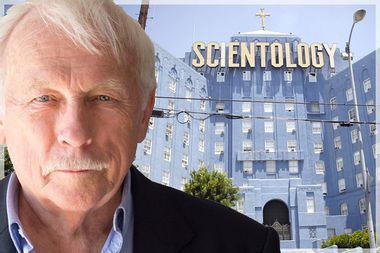
Left: Actor Paul Haggis. Right: The Church of Scientology Celebrity Centre is seen Tuesday, April 18, 2006, in the Hollywood section of Los Angeles.

When Paul Haggis, the writer of "Million Dollar Baby" and "Crash," kicked his faith to the curb after 35 years, he did so as only an Oscar-winning scribe could: with a badass screed. His resignation letter, dated Aug. 19, emerged on ex-Scientologist Mark Rathburn's blog yesterday and promptly went viral.

In his letter, Haggis explains, "for ten months now I have been writing to ask you to make a public statement denouncing the actions of the Church of Scientology of San Diego. Their public sponsorship of Proposition 8, a hate-filled legislation that succeeded in taking away the civil rights of gay and lesbian citizens of California -- rights that were granted them by the Supreme Court of our state -- shames us." Though the Church claims not to dictate personal sexual practices and has several openly gay members, it's perhaps no coincidence that Scientology also has a reputation as Hollywood's biggest closet, with gay rumors persistently dogging famous members like Tom Cruise and John Travolta.

Even before Haggis' resignation came to light, it had not been a good week for the Church's public relations. On Friday, ABC's "Nightline" aired a scathing investigation of celebrity Scientology by gotcha journalist nonpareil Martin Bashir (of the infamous Michael Jackson interview). The Church's high-profile membership, its secrecy and unusual practices -- which Salon explored extensively back in 2005 -- have long made it a subject of fascination and disdain.

But the real corker of the recent "Nightline" story came when Bashir brought up founder L. Ron Hubbard's most confidential -- and controversial -- doctrines.  Many organized religions sound like so much sci-fi gobbledygook to outside ears, but Scientologists aren't known for their generous senses of humor on the subject. And so, when Bashir asked Church spokesman Tommy Davis the age-old question, "Do you believe that the galactic emperor called Xenu brought his people to earth 75 million years ago and buried them in volcanoes?" Davis immediately became defensive. "I am not going to discuss the disgusting perversions of Scientology's beliefs … things that are so fundamentally offensive for Scientologists to discuss." When Bashir gently tried another tactic, asking about L. Ron Hubbard's personal beliefs in Xenu, Davis unclipped his microphone and stalked off.

Davis, the son of actress Anne Archer (perhaps best known for her role in "Fatal Attraction"), has a history of getting huffy about the whole Xenu thing. Two years ago he stormed off an interview with Britain's Panorama, saying, "I'm angry. Real angry." And last year, he responded to a question about "alien parasites" on CNN by chortling, "Does that sound silly to you? It's unrecognizable to me." But in an interview for KESQ last March, Davis did cop to being "familiar with" "the confidential scriptures of the Church."

Davis is also well known to the Church's newest ex-member, Paul Haggis: It was to him that Haggis addressed his resignation letter. In it, Haggis cited not just the Church's support for Proposition 8 but the church's policy of disconnection -- the practice of forcing members to cut off ties to anyone it views as enemy of the Church -- which Davis recently denied to CNN.

"You said straight-out there was no such policy, that it did not exist," Haggis wrote. "I was shocked. We all know this policy exists. I didn't have to search for verification -- I didn't have to look any further than my own home. You might recall that my wife was ordered to disconnect from her parents because of something absolutely trivial they supposedly did twenty-five years ago when they resigned from the church ... To see you lie so easily, I am afraid I had to ask myself: what else are you lying about?"

The Church of Scientology has been accused of taking a harsh and punitive stance toward those who speak against it. Haggis himself acknowledged it in his letter, noting, "I was truly disturbed to see you provide private details from confessionals to the press in an attempt to embarrass and discredit the executives who spoke out ... You took Amy Scobee's most intimate admissions about her sexual life and passed them onto the press and then smeared them all over the pages your newsletter! ... So, I am now painfully aware that you might see this an attack and just as easily use things I have confessed over the years to smear my name. Well, luckily I have never held myself up to be anyone's role model."

Though the Church of Scientology has not yet spoken about Haggis' departure, the man who wrote a movie about a prizefighter seems comfortable with the possibility of battle.  As for Tommy Davis, it may be a bad time to be an ex-Scientologist, but it's an even worse one to be their spokesman.

UPDATE: And it just keeps getting bleaker. On Tuesday a French court convicted the Church of organized fraud and fined it 600,000 euros (roughly $900,000), ruling that it had "harassed" its members into parting with large sums of money. On the bright side for Scientology, the court rejected the prosecution's request the Church be banned entirely.

Before you leave in a huff, here are a few of Tommy Davis' greatest hits.

Church of Scientology convicted of fraud in France

A Paris court convicted the Church of Scientology of fraud and fined it more than euro600,000 ($900,000) on Tuesday but stopped short of banning the group as prosecutors had demanded.

The group's French branch immediately announced it would appeal the verdict.

The court convicted the Church of Scientology's French office, its library and six of its leaders of organized fraud. Investigators said the group pressured members into paying large sums of money for questionable financial gain and used "commercial harassment" against recruits.

The group was fined euro400,000 ($600,000) and the library euro200,000. Four of the leaders were given suspended sentences of between 10 months and two years. The other two were given fines of euro1,000 and euro2,000.

However, the court did not order the Church of Scientology to shut down, ruling that it would be likely to continue its activities anyway "outside any legal framework."

Prosecutors had urged that the group be dissolved in France and fined euro2 million ($3 million).

The verdict is "an Inquisition of modern times," said Scientology spokeswoman Agnes Bron, referring to efforts to rout out heretics of the Roman Catholic Church in centuries past.

The head of an association that helps victims of sects, Catherine Picard, called the verdict "intelligent."

"Scientology can no longer hide behind freedom of conscience," she said.

The Los Angeles-based Church of Scientology, founded in 1954 by the late science fiction writer L. Ron Hubbard, has been active for decades in Europe, but has struggled to gain status as a religion. It is considered a sect in France and has faced prosecution and difficulties in registering its activities in many countries.

Defense lawyer Patrick Maisonneuve said during the trial that neither the Church of Scientology nor the six leaders on trial had gained financially from the group's practices.

The original complaint in the case dates back more than a decade, when a young woman said she took out loans and spent the equivalent of euro21,000 on books, courses and "purification packages" after being recruited in 1998. When she sought reimbursement and to leave the group, its leadership refused. She was among three eventual plaintiffs.

Olivier Morice, lawyer for civil parties in the case, said the verdict was "historic" because it was the first time in France that the Church of Scientology has been convicted of organized fraud.

Investigating judge Jean-Christophe Hullin spent years examining the group's activities, and in his indictment criticized what he called the Scientologists' "obsession" with financial gain and practices he said were aimed at plunging members into a "state of subjection."

The Church of Scientology teaches that technology can expand the mind and help solve problems. It claims 10 million members around the world, including celebrity devotees Tom Cruise and John Travolta.

Belgium, Germany and other European countries have been criticized by the U.S. State Department for labeling Scientology as a cult or sect and enacting laws to restrict its operations.

The big secret about secret societies

Step right up, folks, and read the one true guide to Western and Eastern esoteric societies from the Freemasons to the Rosicrucians. Relics, totems and secret handshakes revealed!

Why are secret societies so secretive? The automatic assumption is that they're up to no good. At the Bohemian Grove, rich and powerful men convene to hatch plots and direct world events -- or so we're told, by people infuriated at having been excluded from the California campground. But, hey, wouldn't a corporate boardroom or a private dining suite at a pricey restaurant do just as well for that sort of high-level skulduggery -- and attract much less press? On the other hand, it's probably a lot easier to sneak a van full of hookers into a campground than into 30 Rockefeller Center or the Four Seasons.

In either case, their discretion has backfired. It may well be that the activities of the world's most notorious secret societies consist of little more than grown men cavorting in drag and performing dopey ceremonies under the influence of strong drink. Whatever -- the public will never believe it's all innocuous. Secrecy turns out to be the most effective attention-getting, fantasy-inciting trick in the book. Remember how the neighbor kid's previously unimpressive playhouse became instantly and irresistibly fascinating the moment he taped a "Keep Out" sign to the door? If a cabal of evil masterminds really wanted to keep their fiendish plans quiet, they'd cook them up in a Christian Science Reading Room and hand out fliers on street corners.

Of course, Christian Science has its own set of secret doctrines, and once protected them as fiercely as the Church of Scientology now shields its own wacky space-opera theology. Religions were the first institutions to really milk the secrecy gambit for all it was worth. Swear your acolytes to silence and make any violation of the sanctum punishable by death, as the orchestrators of the Eleusinian Mysteries and other ancient cults did, and you cloak your relics, totems and chants in an extra-thick layer of otherworldly glamour. The current presidential administration isn't the first cabal to obsess over controlling "the message," or to realize that sometimes control is the message.

Nowadays, however, it's hard to keep even the most awesome secrets under wraps. Sooner or later, no matter how tight your security or how fearsome your lawyers, a disgruntled apostate will leak your closely guarded scripture to the Web, where, stripped of mystery, it often looks as absurd as middle-aged white guys wearing purple robes and trading funny handshakes. Somehow, the precious sacred writings always turn out to be endless, badly written tracts stuffed with woolly, incomprehensible abstractions. Christian Science and Scientology are among the very few "secret" societies whose beliefs Mark Booth doesn't promise to unveil in his new book, "The Secret History of the World: As Laid Down by the Secret Societies," but in this respect, at least, they fit right in. Booth, an editor at a British publishing house, presents his book as an alternate history of the cosmos and humankind, with the early chapters relating the creation of the world and later chapters devoted to all of crankdom's usual suspects: "Egyptian" hermeticism, Neo-Platonism, the Knights Templar, the pineal gland, alchemy, Rosicrucianism, Freemasonry -- you name it. He maintains that his version of the creation narrative, distilled from all these sources, is "a teaching common to Mystery schools and secret societies from all over the world." To have written such a comprehensive synthesis of Western and Eastern esoteric mysticism would be a formidable accomplishment indeed -- if there were any reason to think that Booth's claim were true. For what it's worth, the metaphysics can be summarized thus:

The material universe is an emanation of the cosmic mind, which began to "precipitate" (the central metaphor is of crystals forming in a solution) when the mind (i.e., God) first reflected on itself. The thought of God became more and more "dense," turning to "gas, then liquid and finally solids." Matter continued to pass through a series of stages of increasing density until it formed the Earth, living creatures and finally human beings. Humanity, in turn, continues to evolve toward the ultimate end of the entire process: the universe becoming fully aware of itself. Memorable early milestones in this saga include the stage at which the universe consisted of a "vast vegetable being" and the part where the "fish gods" came along to teach us all how to talk to plants.

From this you might conclude that "The Secret History of the World" is a truckload of drivel, and you would be right. It is a mess of a book, disjointed and rambling, rife with puzzling non sequiturs that are obviously meant to be suggestive or evocative but that more often read like the symptoms of an advanced case of Attention Deficit Disorder. The many illustrations culled from Western art ("Egyptian snake goddess with knives," "Zarathustra with rolled scroll") are largely undated and unsourced, as are most of the colorful but unenlightening anecdotes. We are informed that the 16th-century Swiss alchemist Paracelsus was "a strange, aggressive character" who "seems never to have grown a beard" -- but Booth leaves out his contributions to the world's store of knowledge. (He was the father of toxicology.)

Booth is forever intimating that he's about to explain something important to the reader and then abruptly dropping the subject. He has all the smoke and cymbals of the Great and Terrible Oz, but can rarely muster even the fake disembodied head as a crescendo. He makes a promise, for example, in the caption to a reproduction of Leonardo da Vinci's "The Last Supper" -- "It has been suggested that this painting alludes to suppressed secret doctrines regarding the feminine role in Christianity. We shall see shortly that this is true, but not in the way proposed by 'The Da Vinci Code'" -- that is never fulfilled; he never mentions the painting again.

Furthermore, much of the "information" Booth chooses to supply is either incorrect or, frankly, untrue. Some of these errors seem to be the result of simple ignorance. He has, for example, the idea that the "laws of probability" dictate that "a coin flipped in strict laboratory conditions will ... land heads up in 50 percent of cases and tails up in 50 percent of cases." (Probability only indicates that a coin is equally likely to land on either side on any single toss.) He entirely misconstrues the thought experiment known as Schrödinger's Cat -- not an uncommon confusion, it's true, but since Booth chooses to make "modern science" the villain of his secret history, complaining incessantly that it fails to understand the "deeper" philosophical issues of existence, he should at least make some effort to grasp what it does understand.

Like most writers working this particular vein of mumbo jumbo, Booth traffics in a lot of unsubstantiated stories that have been discredited by historians he dismisses as slaves to "convention." This, of course, doesn't prevent him from flaunting the credentials of academics whose ideas he likes. (Either a professorship lends credibility to a scholar's claim or it doesn't -- make up your mind.) A fringe theory about the chronology of Egyptian dynasties that seems to support the historical basis of the Bible is, Booth approvingly notes, "gaining ground even among the older generation of Egyptologists." But the fact that no Egyptologist would endorse Booth's bizarre assertion that the Great Sphinx at Giza was built around 10,000 B.C. (7,000 years earlier than it was actually built, and long before Egyptian civilization was even founded) doesn't trouble him a whit.

Some of Booth's untrue assertions (such as the claim that the writings of C.S. Lewis are rife with coded "Rosicrucian" symbolism) are clearly examples of wishful thinking. Others are rank misrepresentations: Charles Darwin did attend a couple of séances at the request of his older brother (an enthusiast), but he pronounced spiritualism to be "rubbish" and the medium in question was later proven to be a fraud. Still other errors in "The Secret History of the World" are simply baffling. Why does Booth write that Pythagoras perished in an arson attack in the city of Croton, when the Greek philosopher was instead banished and died in Metapontum?

And these are only the errors and misrepresentations I happened to spot because I have a little knowledge of the subjects in question. No doubt there are many more that will be leap out at readers with more expertise, especially in the sections on the Cabala, Hinduism and the French Revolution. Nevertheless, there is something to be learned from "The Secret History of the World" -- not about the world, certainly, or about its history, but about the things people want to believe and the rationales they invent for doing so.

Unlike the authors of most other books purporting to introduce esotericism to a lay audience, Booth hardly bothers to fabricate a facade of coherent argument in order to make "The Secret History of the World" more plausible. By contrast, that masterwork of pseudohistory, "Holy Blood, Holy Grail," by Michael Baigent, Richard Leigh and Henry Lincoln (source for the Mary Magdalene theory in "The Da Vinci Code"), is more typical of the genre and of historical conspiracy theory in general. Baigent, et al., inundate their readers with a tidal wave of obscure footnotes, uncheckable sources, faux scholarship, cherry-picked facts and ingenious sophistry. To the unsuspecting, "Holy Blood, Holy Grail" can easily pass as well-researched and even reasonable. To refute it, you have to spend all your time tracking down and disproving a bunch of trivial details without ever getting around to asking why anyone would embrace such a preposterous theory to begin with.

Booth, on the other hand, can't concentrate on anything long enough to fashion a convincing lie about it, and as a result, the desperate longing lurking behind the ideas he trumpets -- and, by extension, behind much of esoteric lore -- is stripped bare. After surveying other popular writings on his theme, Booth complains that "you have only to dip into these books and web sites to see there is no guiding intelligence at work, no very great philosophical training and very little hard information" -- a pretty accurate characterization of "The Secret History of the World." Without any sort of intellectual apparatus to hamper the view, you can very clearly see the desire that drives this author.

What does Booth want to believe in, and by extension, what is the underlying emotional appeal of the "secret doctrines" he touts? He's far from unusual in his attraction to this kind of thing, as demonstrated by the success of not only "Holy Blood, Holy Grail" and "The Da Vinci Code," but also the booming interest in apocryphal gospels, religious conspiracy thrillers and such pop-Gnostic phenomena as the "Matrix" movies. The bad guy in his story isn't the orthodox churches that have long and violently suppressed heretical beliefs, but science and "militant materialists" like the author Richard Dawkins. It turns out that not everyone who objects to today's anti-theists is conventionally churched. Against the "intellectual dishonesty" of "the people who guard the consensus" Booth offers an alternative that rejects both old-fashioned faith and new-fashioned skepticism. It's not a religion, exactly, or quite a philosophy, but if offers the following comforting features:

1. You are the center of the universe. Even in the traditional Christian worldview, in which God's eye rests upon the lowly sparrow, a single soul can feel insignificant. In Booth's universe, "Nothing happens in the cosmos except to affect humanity in some way." The universe cannot attain its destiny until each human mind is reunited with the cosmic mind, and by extension, the littlest event in your own psyche has repercussions that extend throughout creation.

2. Everything has meaning. Instead of inhabiting a world of sometimes frightening randomness, every event and every molecule of matter is suffused with purpose, the purpose of elevating human consciousness to the level of the divine. Far from being alone in the universe, humanity is surrounded by intelligent spirits keenly interested in its affairs. Every work of art and architecture is packed with coded clues alluding to the secret practices that have enabled special individuals to communicate with and even master those spirits.

3. Human beings control everything. Even in cases when bad luck, laziness, disorganization and simple ineptitude might seem to explain why certain events occur (or fail to occur), the truth is that somebody, somewhere is covertly pulling the strings. The string-puller's intentions may be (in fact, quite possibly are) malevolent, but nothing happens by accident or because everybody is running around like a chicken with its head cut off. Just as everything has meaning, everything is intended, even if we don't know by whom.

4. The answers to all life's questions are known within a special club. If you're in it, you get to participate in exciting initiation ceremonies and exchange secret passwords and signs, as well as partake of the mysteries of the universe. If you're not in it, you get to participate in exciting investigations into the club's hidden influence on world affairs and exchange the results of your detective work with other fearless seekers after truth. Either way, you have the inside scoop.

5. Superpowers are attainable. According to Booth, some "adepts" in the esoteric disciplines have acquired the ability to perform such diverse feats as levitation, reading minds, visiting other people in their dreams, rearranging the molecular structure of metals, and killing a goat by staring at it for 15 minutes.

6. History never has to be boring. All major turning points in the past are orchestrated by divinely inspired geniuses who have been initiated into secret societies, communicate with spirits and are invested with superpowers. Artists and scientists achieve wonders not by virtue of unstinting hard work and devotion combined with genetic gifts, but are blessed with supernatural abilities that destine them for success. Wars and revolutions happen not as a result of tedious economic factors like excessive taxation and trade imbalances, but as part of titanic struggles between good and evil. For example, Julius Caesar invaded Britain not in search of tribute and tin in order to fund the Roman empire, but because he planned to pass himself off as the Sun god and needed to wipe out the Druids before their teachings exposed him as a sham.

7. You don't have to die. This is, of course, the killer app of religions everywhere. In Booth's vision of the esoteric philosophies, the main purpose of secret rituals and doctrine was to instruct initiates on what to expect beyond the grave in order to lessen the terror of the "after-death experience" and prepare them for reincarnation.

[Did you notice that I listed seven features? That's the sacred number of the planetary spirit beings! This can only signify that I, too, must be a secret initiate, trying to put the scientists off the scent!]

Obviously, this makes for a thrilling and entertaining cosmos. Although Booth generally misrepresents science and scientists in "The Secret History of the World," accusing them of believing that they are on the brink of figuring out "everything there is to be understood about the structure, origin and future of the cosmos" (something I've never seen any scientist claim), he does make one -- perhaps only one -- valid point. Science is inadequate to answer the "big WHY questions" that have perplexed humanity since our days as a giant vegetable.

Of course, the vast majority of scientists do not purport to answer such questions, at least not in their capacity as scientists. These are metaphysical mysteries about our own existence that scientific materialism doesn't address. Booth complains that while someone like Dawkins says he finds sufficient cause for awe in the contemplation of a purely material universe, the rest of us can't subsist on such thin philosophical gruel.

"However they deck it out with the rhetoric of mystery and wonder, theirs is a universe of blind force," Booth writes, and you don't have to believe in Isis and the philosopher's stone to see his point. Most people will still choose to believe in something "more," whether it's the ninefold path of the Buddha or the pillars of Islam or pyramid power. Chances are that whatever they choose will sound ridiculous to anyone who doesn't also believe. That's something religion has always had in common with sex: If you're not into it, it looks silly. Which explains why all the really clever people do it behind closed doors.

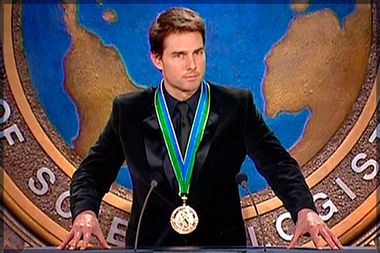
Scott Bateman: Tom Cruise explains Scientology or something

An excerpt from the actor's freedom medal of valor or whatever speech thing. Video

The latest from Scott Bateman.

A friend is involved in Scientology. Should I interfere?

I've studied fringe religious movements and I know the dangers they pose. What is my role here?

Dear Cary,

As an undergraduate, I picked up a hobby of reading about fringe religious movements. As a result, I became pretty familiar with the Church of Scientology, to the extent that a layman hobbyist can be. I also casually knew a couple of folks involved, though I wouldn't call them close friends.

Anyway, I recently developed a friendship with someone, and as it was going along, I picked up fairly quickly from the things that she was discussing that she was a Scientologist. If I wasn't as familiar with the church as I am, I probably wouldn't have figured it out, so it wasn't as if she was trying to tell me.

I chose to ask her about it, and my worry about her involvement showed. I didn't bring up any of the really horrible facts about the actions of the church, but I did honestly express my concern about the organization. She told in general terms how she had been recruited, and that she had been involved for over a year, but not many other details. However, she gives the impression to all but her closest friends and family that she is not a Scientologist. She also believed I was invading her privacy and was pretty angry.

Fast forward a couple of weeks. I had dropped the subject at her request, but I am still greatly concerned. She did say she would talk to me about it sometime, but it has been over a month and she hasn't brought it up.

I don't believe her non-Scientologist friends have expressed much concern because they aren't aware of how dangerous involvement can be. But I don't know for certain. Her family has been shut out of the discussion because of their opposition. Our friendship has become more distant, but we are talking.

My question is, Should I start asking her about Scientology again? I know I can't change her mind or convince her to leave. The church is much better at that than I am. But I'd like to keep the avenues of communication open, just so there may be some way to reach her in the future. Complicating that is the fact that we were not so close to begin with. Should I be pressing this issue? Am I overstepping some bounds? I am genuinely concerned about her emotional and financial well-being, and I worry quite a bit about her.

I guess I'm just kind of at a loss about how to proceed.

A concerned acquaintance

Dear Concerned Acquaintance,

I had a bout with Scientology when I was about 20.

Let me tell you a little bit about what I was feeling at that time. I felt a fear that something was terribly wrong. I was filled with unexpressed rage. I felt powerless. I felt hopeless and without direction. I felt fearful that I would never make anything of myself. My parents had recently divorced, and my friends were all off at college making successes of themselves, while I had failed to do the necessary paperwork to get into a good college. I had done some work at a community college in north Florida but had come back to south Florida. I had no home to retire to, since my parents had split up and sold the house. They were both going from apartment to apartment. I was living with one and then living with the other. I had no job.

I believed, simplistically, that there was some one tragic wound, some one traumatic event in my past, that if I could just get at and remember it or perhaps relive it, I would be freed from this messy human frailty. I thought that if there were just some method ...

You know that abstracted, glazed look that Scientologists get, that steely, cold, rationalistic, power-hungry force field around them?

Scientology looked pretty good to me at the time. It looked like power. It looked like a solution: Not to feel, not to be confused, to have a rational framework, to be able to change the weather. Especially the part about being able to change the weather looked good to me. Who says you can't change the weather using your mind? Who says? Just some asshole scientists?

I liked the nautical aspect of it, as if we were all on a big ship. Captain L. Ron Hubbard was out there on the big white ship sailing the seas, and we ensigns were carrying out his noble work in the big, orderly house full of bustle and optimism and auditing with tin cans. It was a little like "Star Trek" -- or like Steve Zissou!

I liked the auditing: Well, somebody's attention was on me! I liked that. I could express a little of my pain. It's the same kind of attention you get in actual therapy, although you can keep the wall up much easier in Scientology. You can simply report these events from your past and do not have to bring your whole self to bear on them. You just report them and magically you're supposed to be rid of them, these troubling, irrational events, these injuries, these engrams. The distanced, hyperrational style of it appealed to me, as though the mind were just a machine.

I think now that at the bottom of that dream of power and perfection is fear and pain, and spiritual loneliness and isolation. There is some emotional wound, a fear of being vulnerable, a fear of letting anyone know how scared we are and at the same time a grandiose belief that if we can just find a system that can fix us, we will never have to join society and be simply a citizen among citizens. If we can find the system that trumps everything, we can always remain special and different and unique and better than the rest. And it exempts us from recognized and accepted tests of merit -- scholastic achievement, work success, marriage and family, gaining a solid reputation, finishing projects, making art, that kind of thing.

My advice to you, in dealing with your friend, would be to try to reach her emotionally. Try to form a bond with her and be there for her as somebody she can talk to honestly. Who knows what hell she is going through. If you try to take on the Scientology thing head-on, and argue with her about it, all you are doing is reinforcing in her mind the fact that you don't get it. You don't get the enormous appeal of this. And why not? Because you do not feel what she feels. And what does she feel? She might not talk about it explicitly. She may display a placid exterior. Nonetheless, my guess is that she is having the same kind of problems that I was having, the same unvoiced fears, the same desperate need to appear in control, to not let anyone know that she's desperate. So if she can be comfortable in your presence while feeling the way she feels, she may find herself coming to trust you, and she may be able to use you as a sounding board to air her doubts and fears. Just accept her. Talk of your own feelings at this time in your life. Talk of your own difficulties and how you are facing them.

If she hears you talk of your own challenges, she may tell you that you need Scientology auditing. You don't have to disagree or change her mind. Establish a bond of reality between you so that she can talk about what is really going on. Help her to remember who she is. Stick with her through this. Perhaps if she can keep one foot in the world of our reality, she will not become enmeshed in Scientology as a cult. And if she does become enmeshed in it to the point that she tries to cut off all contact with the rest of us, well, you will have the best chance of anyone of remaining in contact with her.

From my perspective, it is an unfortunate choice to join a cult, one that takes us farther from self-discovery rather than nearer. But for people in unacknowledged desperation, it can be a safe haven for a while, as it was for me.

As it turned out, while I had great emotional vulnerabilities, I did have an independence of mind such that, even though I was not able to express emotion, I was able to make choices. And I chose to ditch the Scientology thing and do lots of drugs instead. Who knows what was the smart thing. It's just what happened.

There is no telling what she will do.

My hope is that you stick with her through whatever she is going through.


Buy Cary's book

SYA cover
"Since You Asked," a collection of your favorite columns by Cary Tennis: On sale now at Cary Tennis Books. Buy now to receive an autographed first edition!


What? You want more?

  • Read more Cary Tennis in the Since You Asked directory.
  • See what others are saying and/or join the conversation in the Table Talk forum.
  • Ask for advice or make a comment to Cary Tennis.
  • Send a letter to Salon's editors not for publication.
  • Girls just want to have frills (and cats)

    The Cruise-Holmes wedding may feature some quirky vows.

    Here at Broadsheet we've been planning to turn a blind eye to the upcoming nuptials between Katie Holmes and Tom Cruise. Sure, we've written about TomKat now and again, but those were darker times, back before the midterm elections. Today, however, our best-laid plans were scuttled by Reuters reporting that "when Tom Cruise marries Katie Holmes this weekend, like many a devout Scientologist, he may promise to provide her with 'a pan, a comb, perhaps a cat.'" How can we overlook the fact that Operating Thetans pledge their love using language straight out of "Goodnight Moon"?

    But, of course, it gets better. The "perhaps a cat" line comes at the end of a short primer on women in the traditional Scientology wedding ceremony, which notes that "girls" require "clothes and food and tender happiness and frills, a pan, a comb, perhaps a cat" -- amenities husbands are expected to provide. Still, a bride shouldn't get bent out of shape if her groom doesn't follow his vows to the letter; the ceremony also notes that "young men are free and may forget" their promises, Reuters reports.

    Scientology certainly isn't the only, um, faith with sexist marriage vows; traditionally, Protestant Christian brides vow to obey their husbands, and Mexico recently amended its official vows to remove a dictum that wives "avoid awakening the most brusque, irritable and hard part of (their husbands') character." But Scientology isn't grounded in ancient, or even particularly old, tradition. L. Ron Hubbard's seminal tome "Dianetics" was first published in 1950. In this context, Seuss-esque turns of phrase like "a pan, a comb, perhaps a cat" wear less well.

    Still, we have to thank Tom and Katie (who, of course, may not actually use the traditional Scientology ceremony when they wed -- who's to say Tom won't go wild and promise Katie a hamster?) for keeping us on our toes. As the tipster who sent us the Reuters link observed, "Golly, celebrities are so entertaining in their weirdness!"

    It's a Suri world, after all

    With all that pressure, could it be that Hollywood's No. 1 baby is already dieting? Can baby say "Photoshop"?

    My first thought when Katie Couric revealed Suri Cruise's photo last night on "CBS Evening News" was, I wonder if that baby has been Photoshopped to look like she has lost 20 pounds. After all, news reports last week were actually blaming babies for being born too fat. Since Suri is the arguably the biggest baby in Hollywood -- and the pressures of beauty standards being so heavy -- it can't be too early for her to start a low-fat, high-protein diet along with a healthful regimen of lifting weighted baby books and toys before she's even ambulatory.

    Yep, Katie came through with the world's biggest get. Bigger than George Bush, who got bumped to night No. 2 to make way for Suri. The only bigger guest Katie could have booked was Osama bin Laden. He hasn't been seen, well, longer than... Dick Cheney. Where has Cheney been? I like to the think that Osama and Dick are hanging out in plain sight at a Rally's in Van Nuys.

    What, you think that's so crazy? Then again, if anyone had told you the world's biggest, sexiest, most macho movie star would be labeled a possibly gay, certainly crazy, brainwashed dyslexic religious freak with a fake baby, a fake marriage and no movie studio to call home -- all in the space of one year -- you would probably have said that was crazy too.

    From the very start of the whole Suri saga, when Tom Cruise appeared on "Oprah" to wax rhapsodic about the brand-new love in his life, something smelled fishy. He'd fallen madly in love with a mildly famous, mildly talented TV actress named Katie Holmes, who coincidentally had a major summer blockbuster movie to promote -- "Batman" -- just as Tom was talking about "The War of the Worlds."

    Never one for understatement, Tom came leaping into love. He'd just dumped statuesque statue winner Nicole Kidman on the eve of their 10th wedding anniversary, adding fuel to the fire that their marriage had been a sham. That he was gay. That Nicole was gay. Plus, no one likes to see someone else happy. Especially a rich, handsome movie star. Suffer a little. So the schadenfreude kicks in, and the rumors start.

    It was all orchestrated P.R., we said. Katie signed a contract with Tom. She's been brainwashed. She's following a script. What do you mean, she's pregnant? Well, if she is, it's not really her baby. Or she really is pregnant, but it's not Tom's baby. It's L. Ron Hubbard's baby, made with his frozen sperm. Look, she's shoe shopping on Rodeo Drive the day before she's due, that's not a real bump! The alien baby was born last month! There never really was a baby! Some other Scientology actress saw the nonexistent baby. Oh, please, for god's sake, someone somewhere find these people a baby!

    Beyond our basic human lust for gossip, there's a reason the saga of Suri has compelled us all so intensely. It really is a perfect storm of all the issues that collide and affect our lives at this bizarre moment in history. The speed at which we now receive information -- and our ability to send it without any control -- is a society-altering tool that we haven't learned how to wield yet. It's on a par with the wheel. On a par with electricity. With fire. You can bet that there was a lot of singed arm hair back in Neanderthal days.

    We'd like to believe that when see a news photo of Beirut buildings on fire, those buildings really are on fire, especially if the photo has been published by a respected news bureau like Reuters. But then we find out it's been enhanced -- and it's not the only one. "Wag the Dog," kids. For whatever reason, we are still shocked to discover that photos we see online, in magazines and in newspapers have been manipulated, even when we can get the red eye out on our very own home computers when we take family photos. We long to believe in what we see.

    Back in the day it was so simple -- when we lived in the real world, not the "Real World." We trusted the images we saw, whether from wars or from film premieres. We had faith that celebrities were the men they said they were. Remember "Top Gun" Tommy, so freakin' hot in his military whites, striding around in that jumpsuit, wrapped up that towel, always pumped and sweaty, feeling that need for speed. I still get turned on picturing him riding that big bike and wearing his leather jacket as the sun sets on the California coast, waiting to give Kelly McGillis the thrill of her ever-loving life, taking away her breath and mine. Forget those John Hughes-y girly men like Andrew McCarthy and Rob Lowe who made the transition out of the funky, punky, Euro-trashed early '80s. Tom Cruise was a hot, full-bloodied passionate American man.

    And now he's not. Bye-bye Mr. American Pie and the whole era he represented. Bruce and Madonna and Tina Turner. Reagonomics and American might and the end of the Cold War. MTV played videos, we played video games, and all was right with the world.

    Twenty years later, everything has gone haywire. The government keeps telling us about the triumphs in a war we can't win. The biggest stars of the time -- Tom, Mel Gibson, even Harrison Ford, with an earring in his ear and Ally McBeal on his arm, seem like ciphers. Their babies, their bodies, their marriages -- all seem fake. We're betting on divorce dates before they even get married. No trust. The truth isn't out there. Maybe it never was.

    I keep asking myself, what are they putting in the water in Malibu? Why have the "good" celebrities gone bad while the "bad" ones got so good? Angelina Jolie should be pulling a Courtney Love, but she's too busy saving refugee children one at a time. Brad should be shtupping a starlet a month, but he's too busy rebuilding New Orleans post-Katrina. What happened to the celebrity rule book?

    I was so impressed to hear that last Thursday, Tom had gone over to Brooke Shields' house to apologize to her for the very public way he had raked her over the coals for using antidepressants to fight postpartum depression. Wow, I thought. That takes balls. "Top Gun"-size balls. Sure, it happened within a week of his major boot out of Paramount Studios, and the guy had to realize that karmically he was way out of control.

    And then Brooke mentions it on Leno. Where, coincidentally, she had dropped by to promote her appearance on the season premiere of "Nip/Tuck," on which she plays a psychologist: in other words, a person who doles out antidepressants for a living.

    Remember, that premiere was Monday night, the night before Tuesday night, when Katie Couric made international headlines by showing the images of the world's most shrouded celebrity on Katie's own national TV debut: Little Miss Suri Cruise. We can't see coincidence anymore -- only manipulation. Not just in the pages of Vanity Fair, we wonder, but even, maybe, on the evening news.

    Page 1 of 5 in Scientology Earliest ⇒

    Scientology in the news

    Loading...

    Currently in Salon

    Other News