They're a critically acclaimed trio of teenaged Brooklyn girls who sing punk rock anthems to baby animals. And in their new video, Care Bears on Fire have a few choice words for America's favorite fashion icon, Barbie.
As the girls chase her down through the pages of a fashion magazine, they hector the ubersvelte doll queen who's "got no brains, but she's got style" to "eat a sandwich, give it a try!" It's a carbs and cheese-friendly message to women -- and women to be -- everywhere that's strong, funny, and most of all, it rocks.
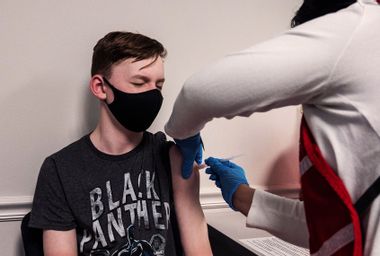
Remember all the conservatives who swore the HPV vaccine would give girls free license to go buck wild? How they argued that inoculating girls against a sexually transmitted disease that causes cervical cancer -- a disease that kills more than 4,000 women each year -- would be harmful because it would rid youngsters of their deathly fear of premarital sex? Well, I wonder how they'll respond to a new study that arrives at the opposite conclusion -- that getting vaccinated actually reinforces the risks of having sex.
Researchers from the University of Manchester surveyed more than 500 local girls age 12 and 13 who were offered the vaccine. A whopping 79 percent said that getting the shot reminded them about the risks of having sex, while 14 percent reported that they might take more sexual risks as a result. Unsurprisingly, 93 percent said that getting vaccinated showed that they took their own health seriously.
The results in no way provide a definitive answer to how the vaccine will affect girls' and women's sex lives, and it's worth viewing the study with a skeptical eye for a couple of reasons. First off, it was funded by GlaxoSmithKline, the maker of the HPV vaccine Cervarix. The company has an invested interest in convincing parents that the vaccine won't turn their daughters into man-eating sex zombies, which seems to be the assumed result of making sex less deadly. Second, this isn't a long-term comprehensive study of how the shot actually affects girls' sex lives. Instead, the findings are based on pubescent girls' response to whether getting vaccinated made them think about the risks of sex (you'd sure think it would, seeing as that's why they're getting the damn shot) and their predictions of their future sexual behavior (let's just say the study participants do not belong to an age group known for mature foresight).
But even if you give the study more credence than it deserves, it's rather stunning that some members of the British media have managed to pervert the findings to mean that the vaccine will make girls have riskier sex, as a Daily Mail headline puts it. Even the Telegraph manages to hold its own against the queen of trash, boldly declaring: "Cervical cancer jab would 'make girls more promiscuous.'" Isn't it great how they absolve themselves of any responsibility for misrepresenting the study's findings by using quote marks in their headline? Better still, the quoted text isn't found anywhere in the piece.
There aren't many reliable conclusions to come to from all this, but at least one thing is clear: Some people find girls' sexuality more viscerally threatening than even cancer.
Kids these days! If they're not shoplifting or sexting, they're insisting on solo circumnavigating the globe. On Sunday, Australian 16-year-old Jessica Watson departed Sydney Harbor on a pink yacht, aiming to become the youngest person to sail around the world nonstop and unassisted. Last summer, American Zac Sunderland completed a similar trip at age 17, holding a world record for all of six weeks before the U.K.'s Mike Perham unseated him. In August, a Dutch court forbade 13-year-old Laura Dekker from setting out on her own round-the-world journey. (Previously, she'd been taken from her parents temporarily after they let her cross the North Sea alone.) It's madness! Next thing you know, parents are going to actually let their 6-year-olds take solo balloon flights, instead of just pretending it happened accidentally.
Or not. I can certainly understand the concern about letting a 13-year-old spend a year alone on a boat, and I think it's probably a good thing that Dekker's been forced to cool her young heels. And just in general, the idea of a world record for "youngest person ever to pull off a life-threatening stunt" is a bit unsavory, given where it must inevitably lead. But still, it's hard to say what the minimum age for such a trip should be, since A) so much depends on the individual, and B) attempting to sail around the world alone is extremely dangerous and slightly bonkers at any age. My grad school classmate Tania Aebi did it at 18, pre-GPS, with very little sailing experience and a boat plagued with problems. That she lived to tell the tale in two books and make a career out of sailing doesn't make her original decision to go one iota less batshit, in my opinion, but I am neither a sailor nor a particularly adventurous soul. What I've learned from Tania, and from reading about all these teenage voyagers, is that those of us whose personalities are fundamentally incompatible with the thought "Solo circumnavigating the globe sounds like a hoot!" really just don't understand enough to offer a useful opinion.
Meanwhile, I can't help noticing that there's been a lot more hand-wringing about Watson doing it than there was about Sunderland and Perham -- both of whom I only heard of after their trips were complete. "I do not want to shatter your dreams but to undertake such a voyage requires more experience than you currently have," wrote sailor Andrew Cape in a painfully condescending letter to Watson. Recently, the L.A. Times asked "Is the girl strong enough, mentally and physically, to deal with considerable hazards at sea, or the long, lonely calm stretches she's sure to face?" and fretted that the color of Watson's boat, "Ella's Pink Lady," would "announce to other mariners the presence of the fairer sex." Hmm, I wonder why folks are so much more worried about Watson than they were about those other two teenagers. There must be some difference there, but I can't quite put my finger on it.
Watson's been sailing for half her life, has logged over 5,000 nautical offshore miles, and knows damned well what she's up against, as do her parents. Her father, Roger, has explained the calculation they've all made quite bluntly: "It would be devastating if we lost her ... but I still think it would be worse to say 'no you can't go' because of that risk, because of what she's put into it." Again, I have trouble imagining myself coming to a similar conclusion, but setting world records for perilous tests of human endurance is really not my thing. So I will defer to the opinion of someone whose thing it was, and who paid the ultimate price for her adventurous spirit: Amelia Earhart, whose new biopic comes out this Friday, 72 years after her disappearance. In a letter she left for her husband before her final flight, Earhart wrote, "Please know I am quite aware of the hazards. I want to do it because I want to do it. Women must try to do things as men have tried. When they fail, their failure must be but a challenge to others."
As far as I can tell, that's what it comes down to for Jessica Watson: She is quite aware of the hazards, but she wants to do it because she wants to do it. And in light of that, I'm with Australian Deputy Prime Minister Julia Gillard: "I'm nervous for her. But my words at this stage, given that she's determined to go, would be to wish her the best of luck and to urge her to keep safe."
When I went to college in the early ‘90s, freshman and sophomore year was a coming-out fest. I had a few gay friends in high school, but almost none of them dared to come out in our conservative school. So I was pretty shocked – and very proud – when my younger brother’s best friend, a punk rock Czech girl made up like Siouxsie Sioux came out at 14 while attending the same middle school I had five years before. Fifteen years later, this generation of gay and bisexual kids are becoming more comfortable with coming out earlier and earlier, according to a cover story by Benoit Denizet-Lewis in this weekend’s New York Times magazine (the story is available online and has already become the most e-mailed story of the day).
How early? Most of the kids interviewed by Denizet-Lewis are still in middle-school. According to recent studies, most kids don’t self-identify as gay or bisexual until 14, 15, or 16, but the mean age at which they become aware of their orientation is 10 (boys tend, on average, to know a year earlier than girls). And some of these kids are coming out to their families and friends and living lives that “would have been nearly incomprehensible to earlier generations of gay youth,” according to Ritch Savin-Williams, the author of “The New Gay Teenager.”
Many of the scenes in the article are frankly astonishing in their sunny depiction of gay youth: Denizet-Lewis attends a gay dance for middle-schoolers located next to a Baptist church in a small town in Oklahoma, where the place is “practically over run by supportive moms”; he interviews a pair of eighth and ninth grade girls who are dating each other and tell him they met “in church”; and attends a meeting of the Gay Straight Alliance at Daniel Webster Middle School in Los Angeles, where dozens of students and teachers in the mostly Hispanic and African-American school mill around in what seems to be gay-straight heaven. “I feel like I’m in a parallel gay universe,” says Denizet-Lewis.
This certainly disrupts the “long-time narrative of gay youth in crisis,” and suggests that the higher rates of depression, suicide and substance abuse recorded among gay teens of earlier generations have – no duh – more to do with the difficulties of dealing with homophobia than anything else. And it suggests that gay and straight adults of the previous generation – by pushing for civil rights, gay marriage and the right to parent children – have succeeded in convincing teens and their parents that gay and bisexual teens have just as much a shot at living happy adult lives as their straight peers.
Parents who feared for their children’s safety were a staple of earlier coming out narratives. “The biggest difference I’ve seen in the last 10 years isn’t with gay kids – it’s with their families,” says Dan Woog, an openly gay varsity soccer coach in Connecticut. “Many parents just don’t assume anymore that their kids will have a sad, difficult life just because they are gay.”
But we could still do much better: Only 12 states have laws that explicitly protect students from bullying on the basis of sexual orientation and gender identity or expression, and teens are still being bullied and harassed for their orientation. Denizet-Lewis writes:
In a 2007 survey of 626 gay, bisexual and transgender middle-schoolers from across the country by the Gay, Lesbian, and Straight Education Network (Glsen), 81 percent reported being regularly harassed on campus because of their sexual orientation. Another 39 percent reported physical assaults. Of the students who told teachers or administrators about the bullying, only 29 percent said it resulted in effective intervention.
More visibly gay teens can, unfortunately, translate into more visible homophobia. One parent describes her child’s school as a “war zone”; Austin, a 15-year-old living in Michigan was taunted with epithets like “gay freak” and forced off the bleachers by students who told him it wasn’t “the queer section.” When his mother, Nadia, complained to the principal, she was asked what her son had done to “provoke” the attacks. “So I took a job as the lunch lady at school,” she says, “because I felt I had needed to be his bodyguard.”
While I want to hug this mother, the solution is obviously not to have every parent of a gay teen physically present to protect their kid. Some administrators worry that just talking about gay and bisexual teens means they have to talk about, well, sex. But knowing one’s orientation isn’t the same as being sexually active, any more than it is for any other teen: Most of the teens interviewed in this piece had little sexual experience; some hadn’t even kissed yet. So how do they know their orientation? Didn’t most of us know by middle school who we had crushes on, and with whom we wanted to go steady and slow dance? “My parents said, ‘How do you know what your sexuality is if you haven’t had any sexual experiences?’”, says one 15-year-old boy. “I was like, ‘Should I go and have one and then report back?’”
Even some staff members at Daniel Wallace, the school with the thriving Gay Straight Alliance that looks like utopia for a gay middle schooler, were “livid” when the principal, Kendra Wallace, first suggested forming the alliance. “They thought it would be about sex, or us endorsing a lifestyle,” she says. “And the most amazing thing has happened since the GSA started. Bullying of all kinds is way down. The GSA created this pervasive anti-bullying culture on campus that affects everyone.”
In other words, protecting GLBT students from harassment helped to make middle-school safer, kinder and more pleasant for all students. Isn’t that the kind of change we can all get behind?
Parents, brace yourselves. No more feeling superior to your less enlightened counterparts, except maybe the ones on "Toddlers and Tiaras." When it comes to all those things you're "supposed" to be doing for your kids -- showering them with positive reinforcement, bulking up their self-esteem, exposing them to diverse environments, limiting TV to PBS -- well, you may in fact be doing them all wrong.
Never mind what I'm "supposed" to be doing, you might be thinking. I don't read "parenting books." I don't even use "parenting" as a verb. I go by instinct. Ah, yes. But even "instinct" can lead us astray, say Po Bronson and Ashley Merryman in "NurtureShock: New Thinking About Children," whose revelations about what the latest child-rearing research actually says may make you wonder, honestly, how any of us turned out OK.
"Really, the actual instinct -- the biological drive that kicks in -- is the fierce impulse to nurture and protect one's child ... But as far as how best to nurture, [parents] have to figure it out," write Bronson and Merryman, who have covered the science of parenting in New York and Time magazines. "In other words, our instincts can be so off-base because they are not actually instincts. Today, with three years of investigation behind us, [we] now see that what we imagined were our 'instincts' were instead just intelligent, informed reactions. Things we had figured out. Along the way, we also discovered that those reactions were polluted by a hodgepodge of wishful thinking, moralistic biases, contagious fads, personal history, and old (disproven) psychology -- all at the expense of common sense."
The result of the authors' dogged parsing of reams of research: The book reads, in a way, like some sort of Freaky Friday Opposite World parenting manual written by our kids, just to mess with us. For example: PBS can make kids more aggressive than Power Rangers. Diverse schools may be more segregated. Educational baby DVDs may actually retard language acquisition. (Way to go, Einstein.) Arguing can be a sign of respect; lying, of autonomy and smarts. And, in the authors' perhaps most-discussed -- and most rankling -- observation: Rote or broad "you're-so-smart" praise can backfire, undermining rather than boosting self-confidence.
So, yes, in less gracious, more incurious hands, "NurtureShock" could have been subtitled: You People Have No Clue. But it's not a manual, nor is it an attack on anything but the slapdash, headline-happy way in which scientific research is often uncritically blurred into existing conventional wisdom or spun from rough, complex wool into overly simple, flimsy "tips." Nor, pleasantly enough, is it necessarily a critique of parenting "culture," helicopter or otherwise. We're fumbling along with good intentions but rusty tools, the authors seem to say. Because much of the research they've found offers this reassurance: that kids -- despite our best efforts -- are doing better than we think.
Salon talked to Bronson about the complexities of modern child rearing and why parents, too, should be praised for their effort. (Also: For more on the book's discussion of children and race, click here.)
I'd like to compliment the book, but I want to make sure I do so without undermining your self-confidence. What is the basic problem with the way parents tend to deliver praise?
Only kids about 7 and under are still taking praise at face value. But otherwise, the basic problem is that telling kids they're "so smart" conveys the idea that intelligence is something you're born with. Parents think saying that is going to give their kids confidence, like this little angel on their shoulder saying, "Don't back down." But instead what it teaches them is this idea that you've either got it or you don't. When we're telling kids they're smart all the time, effort gets stigmatized. They come to think that effort is proof to the other kids in class that you can't cut it on your natural gifts. And they also become averse to academic challenges that put them at risk of not looking so smart.
Don't they also start to associate a teacher's praise with the kids who are having a harder time?
Yes. If a kid watches another kid being praised lavishly, and the one who's watching is then asked, "How well did that he or she do?" the observing kid will probably go, "Ha! That kid did terrible." They've decoded a pattern: Since praise is the way we try to help kids -- or manipulate them -- they understand that the kids who are praised all the time are the ones we're worried about.
Innate ability vs. effort: Do you think that's why I'm starting to hear parents and teachers say "Good working" instead of "Good job" and the like? (And am I going to have to start saying it, too?)
Well, I would be concerned if people used "good working" all the time and it was insincere. Kids don't always work hard all the time, whatsoever. They don't at all. It really is about sincerity. I have to warn against this kind of rote automaton kind of praise coming off our lips because parents often tell me, "I said, 'You're great,' or 'You're so smart,' because the truth was the phone was ringing, and I had to cook dinner," and it was just sort of this place-marker. My daughter's been working on her phonics work, and when I help her, I don't make it good or bad. It's just about, we're gonna do this thing, and if we do it a little bit every day, in a couple years you'll be reading just fine. I suppose I could say "Good working" at the end, but to me, it sounds a little like just another catchphrase.
But surely there's something there about emphasizing effort over results?
Absolutely. But it's important to talk about effort in a broader construct, too. Not just about "You worked really hard" all the time. It's also about how we model our work -- how you describe how you worked hard to your kids, and how it paid off.
How do you respond to parents who say, "So wait, I can never tell my kids she's smart?"
This isn't in the book -- the science came out last spring -- but the research says that when you're teaching this construct of effort vs. innateness, the tipping point seems to be around 75/25. So if you're saying "You're so smart" or somehow giving the idea that either you have it or you don't -- if that kind of feedback or praise rises above about one-quarter of the time, that's when kids really start to believe it.
In the book, you describe praise as a "panacea for the challenges of modern parenting." Can you elaborate?
Our generation comes to parenting with this idea of "I'm not going to express conditional love" -- approval for acceptable things and disapproval for just being a kid or making mistakes or not being the best all the time. So now we try to convey a sense of unconditional love to our children through praise. As in, "You're great," "You're fine" -- meaning, you're not being rejected by me because you didn't do perfect on that test or you kicked the ball into your own goal. It's very hard to turn the clock back to the idea that there's a difference between praise as it's used today and just a sincere honest compliment. Praise has become a way that we attempt to slightly distort -- i.e., manipulate -- our kids' perception of their universe. And what we risk there is our sincerity as parents.
When you talk to parents of high schoolers, they're like, kids are so stressed. They try to soften kids' experience with praise. There are certainly tons of parents who are determined for their kids to go to the best high schools, the best colleges, but there are a lot of parents who are like, hey, it's OK, I just want you to go to college, to be a well-rounded person. But when they're saying, "Hey, you're smart, don't worry about it," what the kid hears -- especially when he or she fails -- is that anything less than being smart is something they can't talk about overtly. Failure becomes unmentionable. So kids actually take the praise as pressure. That's actually more disconcerting to me than the effort versus innateness issue.
Can you explain why teenagers are not actually as malevolent as one might think?
There are a few reasons. The average high schooler in America is getting about 6.65 hours of sleep a night, about an hour less than we got 30 years ago. That lost hour shows a lot of cognitive, hormonal and behavioral disruption that has its own set of consequences. So when people say that teens are moody, disengaged, depressed, withdrawn -- those are all classic signs of sleep deprivation. There is one mother in the book who helped change the local school start time to one hour later, and, in her opinion, she got her son back. I have not done a cross-comparison of the history of adolescence with the history of sleep, but some would say that we've both extended adolescence and exacerbated it with teens getting less and less sleep, making them more and more into the caricature of the recalcitrant, rebellious teen -- without realizing that the classic explanations for what's going on with them are missing one big variable: how much they sleep.
There's also lying. Seventy-eight percent of American parents think their teens tell them everything. They expect them to tell them everything, or that they should be able to. And that's a dangerous proposition. Because the science of teen lying suggests that even the teens who lie least to their parents still lie about on average five of the 36 things that teens normally lie to their parents about. It's naive to expect that you're hearing the whole truth. Their lying is motivated by not wanting to get in trouble, of course. But it's also their need for independence. They're soon going to be autonomous people in the world, and they're practicing. To always come to your parents for advice and help is psychologically emasculating, proof that you can't handle it on your own. Teens are really prone to telling their parents what they want to hear and then going and doing what they want. If they tell the truth, they usually know there's going to be an argument. Parents find that arguing really riles and rattles them; they think it's destructive. But they don't realize that the other option is lying.
That's why teens are more likely to find arguing productive. There's a difference between arguing over the parents' authority to set the rules ("You have no right to tell me what to do!") versus arguing about a rule itself, where the kid might be saying, "It's one thing when it's a matter of safety, but this is about what I'm wearing to school, so butt out." What makes teens rank arguing as problematic is when they never get any concession. Those kids are the ones who get frustrated and turn to lying more. The mistake is thinking there's a trade-off between strictness and honesty. More permissive parents don't actually hear more truth. The ones who do are the ones who set a few rules and enforce them consistently, and when they hear a good argument for bending them they occasionally give in. And when a parent knows how to negotiate and compromise, the kid learns how to do that in peer and romantic and friend relationships as well.
That sounds like a good thing.
The work by Joe Allen -- this is not in the book -- shows that children of parents who just demand obedience become obedient to others as well -- like when someone says, "Hey, let's go get a keg." As in peer pressure. What's interesting, though, is that we think of peer pressure as terribly dangerous. But those who experienced it were doing better by the time they got out of college. They had a little bit better GPAs than others, and much better relationships: better romantic relationship, better relationships with their parents, better relationships with their friends.
How's that?
Kids who experience peer pressure are actually socially attuned. They're noticing what other people feel and think. That's what you want in a friend: someone who recognizes what you feel and think. It was the kids who didn't feel any peer pressure whom Joe described as the B students who never excelled. They disengaged. They didn't care what other people thought, what other people and society expected of them. So if you think about peer pressure as social attunement, well, it gets kids to take showers, and it gets them to buy into the system of "I don't want to be the worst kid in my class," "I don't want to be the worst athlete on the team," "I want to go to a good college." The same dynamic, yes, also leads to drinking and drug use and early sexual activity. So it's not all good by any means. But it's interesting that you can't just say, "Turn off the social forces of peer pressure," because actually the kid who's feeling pressure to participate in the rituals of teen rebellion is also feeling pressure to have those good outcomes as well.
That echoes a recurring theme in the book: that we can rarely say that a given thing is 100 percent good for kids, or 100 percent bad.
The minute you do that, you depart from the science. Almost nothing in the science shows only good outcomes or only bad outcomes. You can't go around saying, "Is bottle feeding good or bad?" or, "Is this nap schedule good or bad?" and it's only one or the other.
Is that something that parents want to hear, or don't want to hear?
I see a ton out there of this sort of determination of "TV is good" or "TV is bad," and "Video games are good" or "Video games are bad," and "Well, now we've got the Wii so we don't know what to say." It's as if they want to stupidify it for people, and just give us the bullet points, and you can turn your brain off and be a parent; all you have to do is read the yes/no categorization that's out there. I don't know how you feel about it, but I basically just find it uninteresting. Most modern parents I see are great parents, loving and accepting of their kids. I believe that they don't necessarily want everything boiled down to bullet points, that they find the science interesting whether or not it's "helpful." So in that sense, the science should make parenting more interesting as well.
School's in! September's here; pencils are sharpened, apples are polished, and -- in one Iowa town where administrators' summer reading list clearly did not include Safford Unified School Dist. #1 v. Redding -- female students are strip-searched on suspicion of theft.
The Des Moines Register reported over the weekend (link via Pandagon) that on Aug. 21, the third day of school, a student at Atlantic High reported $100 missing from her purse. Five girls who were somehow deemed persons of interest in the case were asked to strip in front of a female counselor and their accuser (!?). (No boys were involved because apparently none were around when the theft was believed to have occurred.) Lawyers (yuh!) for the girls' families told the Register that (paraphrase) each girl stripped in varying degrees. One 15-year-old "was asked to remove all of her clothing including her undergarments." Another asked if she could lift up her bra and was told that wasn't good enough. One was searched twice. At least two were permitted not to remove their underwear because it was more revealing than the others' and therefore an unlikely hiding place. [End of repellent soft-core juvie prison scene]
"The idea was, 'If we refuse we're guilty,'" the mother of one of the girls told the Register. "One girl said, 'Well, if I say no, I'm not taking my clothes off, for the rest of my life I'm going to seem guilty if I don't.'"
The missing cash did not turn up.
As you may recall, the Supreme Court ruled 8-1 (Hint: Tarence Clomas) in June declaring that schools cannot force children to remove their clothing unless student safety is at risk. (The justices found that middle school officials in Arizona had violated the 4th Amendment ban on unreasonable searches when they ordered then-eighth grader Savanna Redding to strip to her underwear on suspicion of carrying contraband ibuprofen.) Strip-searches of students by school officials are also illegal under Iowa law, as well as under the law of the universe, section 4, paragraph 19: "You pretty much don't tell a girl to take off her clothes unless they're on fire. What are you vile sociopaths thinking?"
The school activities director, who was said to be involved in initating the search, has reportedly been placed on administrative leave pending the ongoing investigation.
The incident has, not surprisingly, become the talk of Atlantic, home to a Coca-Cola bottling plant and "the second-largest mini-convention of Coca-Cola collectors" in the States. Parents who attended last night's district school board meeting -- including parents of the girls involved, said to have been advised by their lawyers to withhold comment -- were assured that the school would get to the bottom of what happened. "This is going to be solved. It's a long investigation. We'll take our time so we do it right, by policy, by law and we appreciate your patience and your support," the school board president said.
The one other parent who spoke said, "I have to say I do question having my daughter come [to school] until I know that the district will not tolerate such actions. I want to feel that my child will come here and be safe and that her constitutional rights will be upheld."
Constitutional rights are at issue here, sure. And some of the parents are reportedly considering filing lawsuits. But where are the charges of sexual assault? Or sexual abuse in the third degree? Or sexual exploitation by a school employee? (Iowa state law, section 709.15.) The local police, after interviewing one of the girls and several administrators, bounced the matter back to the school, saying the incident did not involve criminal activity.
Seriously? The mind, freshly scrubbed from the above juvie prison scene, reels. How is it not possible to see this for what it is? I mean, even writing about it at all (arguably a necessary means of building public pressure) feels pervy. When it comes to the sexualization -- and sexual exploitation -- of young girls, it seems, we are still in deep, gross, two-faced denial. We freak out about it, sort of, but we don't call it what it is. As one Pandagon commenter observed: "So on the one hand we have adults punishing teenage girls for sending nude photos to their boyfriends, or posing in their bras, and charging them with child pornography -- but on the other we have judges who distribute photos of underage girls being assaulted and school officials who force them to strip naked."