

In the beginning, there was Lilith. She was Adam's mistress. By current
standards, it wasn't much of an affair: no sex, no paparazzi. Just a single
line in Genesis that, before any notice is given to Adam's anatomy -- his
rib cage or his genitalia -- has female created together with male.
To explain the other woman, the one who preceded Eve, legend holds that Lilith fought with Adam for dominance. It's an open question as to who lost, since Lilith fled to the sea, only to return as the serpent who tempted Eve -- leading to the expulsion of mankind from the Garden of Eden, to mortality and, of course, to sex.
Lilith may be the closest thing the modern mistress has to a patron saint.
If Eve is the perfect companion, Lilith is the perfect seductress. In her
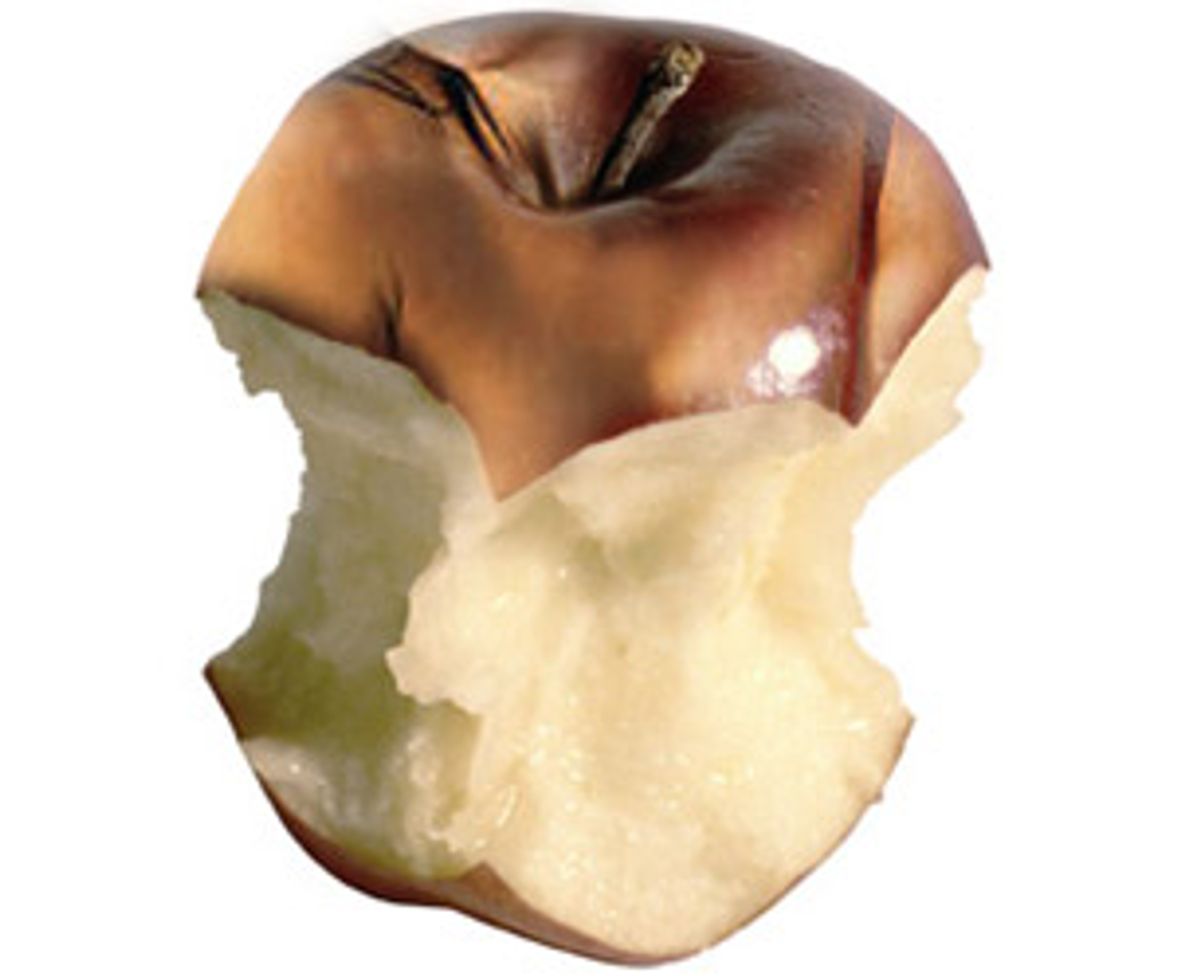
presence the whole of paradise isn't worth the price of an apple. She's
independent, mysterious, every wife's worst nightmare. Tradition maintains
that Lilith gives men wet dreams. She has all the talent, all the skill a
mistress needs to succeed at her art, which is just a polite way of saying that Lilith is the first narcissist.
She certainly isn't the the last one. Through the ages, mistresses have
practiced their narcissism, sometimes exquisitely tortured, other times
smashingly tragic, to rapt audiences and rave reviews. They've called it
"romance." They've called it "love." And some -- including Victoria Griffin
in "The Mistress: Histories, Myths and Interpretations of the 'Other
Woman'" -- have even enlisted Lilith herself to make their case.
After all, she's the one whose temptations lead to man's sexual awakening, the woman who, while Eve is busy making babies, taunts Adam by hovering forever at the vanishing point of erotic promise.
How pathetic, then, that the mistress -- smitten by self-love -- never
recognizes that she's as incidental as a midwife. True, by drawing Adam and
Eve from the Garden of Eden, Lilith makes possible their sexual union. But
that union is with each other, not with her.
The biblical term "to know" is more than a prudish euphemism. Adam knows Eve in every sense -- from bunny-fucking familiarity to lovey-dovey intimacy -- and all Lilith can hope for is to serve as a cheap bit of porn thrown into connubial foreplay. Lilith can only help Adam know Eve better: If Eve is Adam's wife, Lilith is their marital aid.
So why is the woman depicted by history, literature and art as a virtuoso
of deception so deceived by her own striptease as to believe that she loves
the man she services -- and that he loves her? That is the question that Griffin has put it upon herself to answer.
"My basic position," claims the author, "is that I stand alone and find
security only in myself. This is actually true for everyone, but it is not
generally recognized; the popular conception of marriage deliberately
blinds people to it, with the erroneous idea that security can be found in
another person and be guaranteed by legal and/or sacred contract."
It's hardly surprising that the mistress sets herself against the wife;
the mistress needs the wife to legitimize her role, to provide the
groundwork on which she can pitch her tent as "the other." What's
interesting is why the mistress needs that groundwork at all, why she so
desperately wants to camp out.
The reason is that the mistress sets possession in opposition to love. Taken seriously, marriage entails monogamy: The married woman agrees to be the possession of her husband, and the married man agrees to be the possession of his wife. They are shared property; only the mistress, living outside the marital bond, operates under no obligations whatsoever. Alas, what she never sees is that wedlock demands of love more than the periodic four-star triple-X orgasm.
To reduce love to sexual intercourse is to lose all context, to mistake
laying bricks for making a home. Bricks are cheap because they're interchangeable, whereas a home, made unique by the dirty, gritty effort of living in it, is priceless: To lose a home is emotionally devastating not because it entails losing a bunch of building supplies, but because it involves cutting short a narrative.
The monogamous love of marriage demands emotional engagement in the
absolute. That lifelong commitment, and all the dents and scratches it
acquires through the work of carrying it out for richer and poorer, through
sickness and health, gives anything that happens in marriage an emotional
depth of a magnitude unimaginable in a casual context. In a society
otherwise devoid of permanence, a world otherwise lacking any sense of
purpose whatsoever, married fighting is the most painful, married sex the
most pleasurable, married love the most meaningful.
Marriage stands alone against the ephemeral world, whereas the mistress, dead set against convention as she may declare herself, merely lives in it. At best, the mistress is like Lilith, a midwife to love, contributing to the cultural background noise that surrounds -- and lends meaning to -- the married couple's fidelity.
To attack marriage because it happens to be regulated by church or state,
as Griffin is wont to do, is beside the point: What matters is not governed by papal bull or federal statute, but rather by the law of what Kurt Vonnegut has called the "nation of two," that state of states in which the married couple alone holds citizenship.
To attack marriage as a clichi, to make a straw man of so-called conventionality, as Griffin does, is equally unjustifiable. If the mistress' overriding wish is to be pink-party-dress special, if distancing herself from the bourgeois norm to which she belongs is its own end, she'd accomplish just as much by standing on her head.
But still there persists that nagging suspicion: If he isn't free to leave
me, how do I know he loves me? Even Heloise, the 12th-century heroine whose letters to her estranged lover, Abelard, made her a poster child for romance, couldn't dismiss that concern. As Abelard depicted her feelings
in his Historia Calamitatum, "It would be dearer to her and more honorable
to me to be called my lover than my wife so that her charm alone would keep me for her ..."
Heloise believed that a mistress' love was more pure than a wife's because it was disinterested: While marriage was a matter of financial security, the only currency exchanged in the affair was love.
What has to be measured, though, is the worth of that currency. The
mistress and her lover give their love freely; the supply can be as
limitless as the number of potential partners on the planet, the number of
days in a lifetime. (To be fair, Griffin attempts to protect mistresses
from charges of promiscuity by suggesting a spending limit of one lover per
year, and budgeting herself even fewer than that; but her own laissez-faire
premise prevents her from providing any legitimate reason why anyone ought to be so frugal.)
So, what the mistress calls "love" has no cost. And without cost, it can hold no meaning, no more value than a gift of Confederate banknotes.
Marriage may not have the merit of an empirically sound love-
to a woman to have and to hold, and when a woman gives herself to a man,
both have put the highest possible value on their love: Possession in the
absolute. For the couple that marries honestly, for that nation of two
deadset against the world, the unit of love is life.
Not that the mistress is a fool. Mistressing may be emotionally bankrupt, but bankruptcy has its advantages: Gamble nothing of your own and you have
nothing to lose.
Because the mistress fears loss more than she desires love, what she seeks
is to eliminate emotional risk. "[I]t's far more exciting to be the mistress than the wife," Griffin claims. "There is far less chance of a relationship going stale when meetings are separated by gaps, or at least it will take much longer to reach that point." By which standard the great romantics of our day are insurance actuaries.
True, actuaries know one thing about love: They know that the likelihood
that any two people will be compatible (i.e., that they can without
incident go grocery shopping together, let alone spend the rest of their
lives in each other's arms) is only slightly greater than the chance that,
say, a world war will be begun over the assassination of an Austrian
archduke named Ferdinand.
There are so awfully many impediments: She snores. He wears mismatched plaids. That's why dating services, and roommate referral agencies, are so lucrative. The survival of most relationships depends on distance. Friendships, for example. And sexual liaisons. Where the formula goes awry, though, is in the calculus of love.
Love is not magnified friendship; it is its own lens on the world. Energy
is produced, not consumed, as inevitably happens when a mistress spends too long with her boy-toy. Two people in love hold a common point of
reference: Love in marriage is unique because it permits, because it demands, that total unity.
Falling in love does require taking a leap of faith, risking all manner of emotional carnage, compared to which the mistress' risks -- from STDs to serial abandonment -- are logistical pocket change. But the risk inherent in marriage is taken for something worth any amount of potential anguish -- worth it because, without that leap of faith, without that mad gamble, love, and life, is a lost cause.
Perhaps I'm being unfair to Griffin, implying that she's an emotional
coward without saying the same of her married lover. We don't know a lot
about him, but, given the occupational requirement that he lead multiple
lives, he might as well be H.G. Wells, commenting to a friend about his mistress, "Would I ruin myself for her? Would I even interrupt my work for her? 'Not a bit of it,' I said, 'for you or anyone.'" If the mistress reduces her emotional risk by keeping her bets to herself, her lover reduces his by shuffling up a game of three-card monte.
Wells, a man of many mistresses, undeniably represents the extreme, but
the psychological trick he plays on himself is demanded of any man who
wants his affection in stereo. In Wells' mind, his wife and various mistresses never meet: Each has her own space -- what Griffin aptly calls a "compartment" -- leaving him free to make mental housecalls.
Wells' women exist for him contiguously: When he turns on the lights in
one compartment, they go out in all the others -- and woe to the trollop
who ventures outside. How easy for big H.G. to stop paying the electrical
bills the moment any unreasonable demand is made, any real emotion
betrayed. Wells' women aren't women to him. He won't permit that. They're coin-operated nudie shows in a matinee porn theater.
What Griffin, intoxicated by the Wellsian formula, would like us to
believe is that the mistress' lack of involvement in her man's life is
paradoxically what brings them together. "A busy late twentieth-century
wife," she points out, "just does not have the time, even if she has the
inclination, to listen to the tales of her husband's day, to provide him
with the glass of wine, the soothing music, the sympathetic ear," from
which she concludes, "Maybe it's still true -- however unpalatable -- that
no woman can be everything to a man."
Or maybe, just maybe, love is something more than an exchange of services
that can be performed by any qualified sex worker, or rather -- in keeping
with the unequal pay endured by women in virtually every other line of
business -- by any two or more qualified sex workers. Maybe, just maybe,
the woman willing to trade in bordeaux and violins is engaged in an act of
pseudo-romantic self-delusion inappropriate even for a 14-year-old
trailer park tramp meeting her first big city john. And maybe, just maybe,
the man who collects his love like baseball cards, hoping to assemble a
dream team by buying up all the players with the right stats, is engaged in
an act of pseudo-dramatic self-amusement befitting a 6-year-old boy.
But who's to tell the difference? The remarkable thing about an affair is
that when both the mistress and her lover play their roles as they're
supposed to, love never changes hands: Why go through the trouble of loving someone else when you could love yourself instead?
To have multiple partners, to hold their interest and to hold his own, the
mistress' lover dare not fall in love with any of them. If Adam gave his
rib, H.G. Wells took it back.
The mistress, though, has it even worse. The skills a mistress needs to
succeed, cites Griffin, are skepticism, self-interestedness and, of
course, independence. In other words, the skills needed to be a good
mistress are those needed to be a good day trader. Can somebody so frigid
honestly be expected to fall in love with anybody? And if she does do
something so grossly unprofessional as to betray feeling, how can she still
play the role of mistress with any competence whatsoever? For the mistress,
love is an occupational safety hazard.
Yet, the mistress desperately wants to fall in love. (Otherwise why would
she go through all the trouble of cheap motel rooms when she could just
service men all night long at the neighborhood singles bar?) Her mistake is
that she forgets that "love," unlike "masturbate," is a transitive verb. She seeks love, but she neglects to include anyone else in the pursuit: She seeks love but not a beloved.
Is it any wonder that, standing alone in her emotion-proof compartment, the
only one the mistress winds up falling in love with is herself?
Shares