

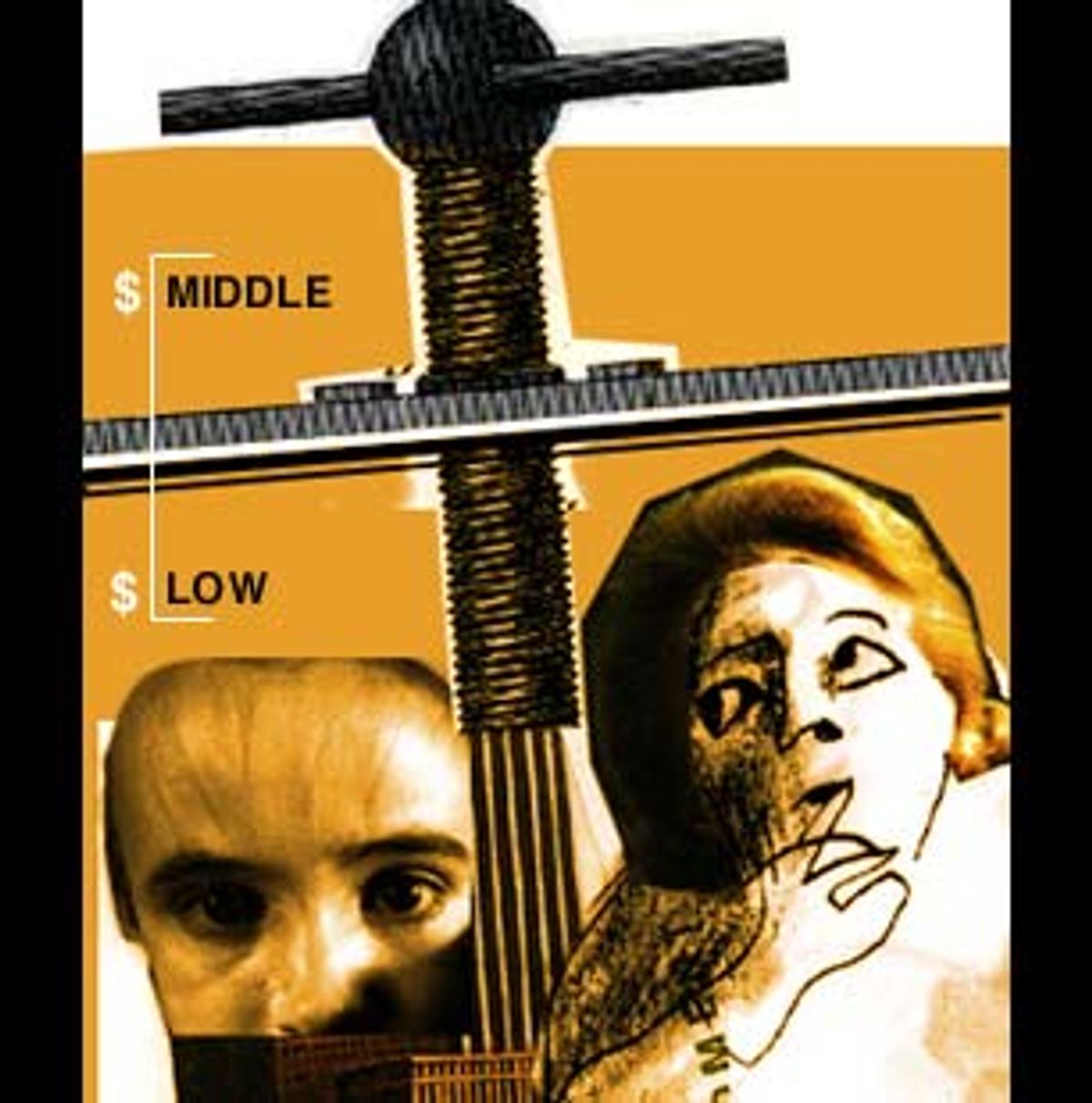
I am a never-married mother. My teenage son goes to a ghetto school. I graduated from college, I went to graduate school. We are poor enough to qualify for free school lunch. Do you think I must be bad, lazy, a drug addict, somehow worthy of poverty? If so, is my son worthy too?
The New York Times Magazine seems to think so.
I usually dismiss this magazine as being altogether irrelevant to our lives because of its blatant class bias. But in a recent issue, I thought that I saw a photograph of the apartment complex in upper Manhattan where my son and I live. The photo depicted a black boy on a bike, riding in the courtyard between two apartment towers. (As it turns out, it wasn't actually my building, but it could have been taken at another, similar complex three blocks from here.) The article by James Traub that accompanied the photograph was called "Schools Are Not the Answer" and represented yet another tired attempt by a middle-class writer to answer the question of what to do with other people's children -- the children of the poor.
Traub is writing about me and my 13-year-old son. Does he get it right? No, he does not.
The photo caption summarizes Traub's main point: "Education may not be enough to conquer the disadvantages impoverished children bring with them to school and return to at home." Traub argues that no matter how much "we" do to try to bring inner-city schools up to the level of suburban schools (the "we" in this article, as always in the New York Times, is the white, largely male, professional/managerial class) the poor children in those schools will be doomed to failure because of the bad influences of their families and neighborhoods.
Like many other middle-class pundits, Traub doesn't seem to be particularly concerned with family values, when the family in question happens to be poor. The article bemoans, more than once, the fact that "You can't take children away from their mothers." (Though one assumes that if you could, Traub would be all for it.) Fathers are never mentioned -- the unspoken assumption is that poor children don't have any. Traub dismisses any possibility of changing a child's lot in life by changing the family's environment (read: social class) since "directly addressing the environment through jobs programs, housing, health care or the adoption of a living wage survives only in the fringes of political discourse."
His solution is to inculcate "middle-class parenting practices" into the lives of poor families: "We have to unambiguously embrace the virtues of a middle-class parenting style." What does he mean by that? "Reading to your children, taking them on trips, using reason rather than the flat edict." Poor children -- in contrast to middle-class children -- he says, grow up in homes without books, "where their natural curiosity is regularly squashed."
In case you missed it, Traub's real subject is race. "Poor" in the article is shorthand for "black." (Traub takes pains to say that his arguments apply to affluent blacks as well; he cites studies that show middle-class blacks do far worse academically than middle-class whites.) It's as if he thinks white skin is sufficient inoculation against a poor outcome in life.
I'm particularly suited to blow the air out of Traub's tires, not because I am your (his) typical impoverished inner-city mother, but because I am not. My son and I are white. White and poor.
We live in a small apartment filled with books. I have read to my son since Day 1. He's traveled, not much, but enough to know there's a world outside the inner city: He's seen snow banks, mountains, deserts. He's had a computer since he was 7 years old. His curiosity isn't squashed. He got 99 percent on the city reading test.
I had my son a year after I became disabled. When my son was born, I was at the beginning of the long slow slide down the social ladder that usually accompanies disability in America. I'm not going to say that the experience of being disabled in America is the same as being black because I cannot speak for black people. I do know that the prejudice we experience every day is devastating to mind, body and soul.
But Traub never talks about prejudice and discrimination. He cites a Harvard sociologist who in l972 wrote that "Labor markets were so biased against blacks that academic success hardly paid off," only to point out, approvingly, that by 1998 the sociologist had changed his mind and now felt the solution to black poverty lay in changing the child's home environment.
Each day, I remember that I had a chance to buy my son a one-way ticket to the middle class. Yes, you can change mothers -- if you do it at birth. Many of us who became pregnant when we were single and without resources considered adoption, at least briefly. I could have given my son up. By definition, every couple seeking to adopt in America is middle class or better -- sometimes very much better -- since only middle-class couples can pass an agency's screening or afford a private adoption.
The cost of that ticket was that I would never see my son again. I would never know what happened to him. I thought the price was too high. In any case, I was unable to pay it. Anyway, I thought, using the classic flawed reasoning of desperate women, I loved my son and that meant he would be OK. Right? Love would conquer all.
Fourteen years later I believe, on most days, that I made the wrong choice. I see the evidence in front of my eyes. I think that James Traub would agree that I made the wrong choice in choosing to raise my son. And that is why Traub's article pushes my buttons: He plays on my worst fears and guilt. I love my son. But by choosing to keep him, I have greatly circumscribed his chances to succeed -- or even to survive -- in life.
Not because I have squashed his curiosity, or because he is not doing well in school. (He is.) Because he is poor. Because poverty hurts children, period, no matter what else they are born with -- or however much they are loved.
It takes more than love to raise a child. It takes what Traub, citing social scientists Theodore Shulz and James Coleman, calls "capital." Traub is interested in distinguishing between two kinds of capital: "human capital" and "social capital."
By human capital he means the kinds of things he thinks schools and "middle-class parenting practices" teach: "human capacities, developed by education, that can be used productively -- the capacity to deal in abstractions, recognize and adhere to rules, to use language at a high level." Human capital, he says -- like family fortunes -- takes generations to develop.
I strongly disagree. I wasn't raised by a mother practicing middle-class parenting, in fact quite the opposite. I was raised in a working-class household in which education was not a priority. I was the first person in my family ever to go to college. Someone always has to be the first, after all, if you believe -- as Traub obviously does -- that education can get you into the middle class. The catch is, according to him, it only gets you in if you're already there. All the middle-class professional parents he admires apparently had middle-class professional parents, and so on, going back forever, for Traub has no other explanation for how human capital develops.
I've got a simple one: We're all born with those human capacities, to a greater or lesser degree, and they're not correlated with skin color or income level. Traub comes, in my mind, dangerously close to saying children from poor families can never be smart. He implies that they don't, and can't, have these capacities: They don't have them because their parents and grandparents didn't have them, and they can't get them today because of their "child rearing habits and oppositional peer culture."
My son's got quite a lot of human capital. What my son hasn't got because he is poor is social capital: The "strong social bonds, social networks" which come from "the support of a strong community." According to Traub, social capital "hardly exists in the inner city" where children are isolated and "institutions have disintegrated."
What Traub won't acknowledge is that "social capital" is independent of, and can be lacking in the presence of, the type of "middle-class" parenting practices he advises. No amount of intellectual stimulation can make up for not having social capital, and without it, even smart children don't have much of a chance. Social capital is the network of privilege and mastery that middle-class people take for granted. It is connections. It is the safety net that lets you fall and get back up. It is the family who covers for you, the friend who gets you into school or offers a lead on a job, the someone who knows someone who can get you an apartment.
My son doesn't have any family but me. More than that, he doesn't have any other adult role models, male or female, who can teach him what I don't know -- how to find a place in the world. He doesn't know a single adult who works. "How do you get a job?" he asks. I can't answer that question to save my life. "What do you want to be when you grow up?" people ask him. He answers "I don't know."
I want to cry, because I have taught my son a lesson that most middle-class children never have to learn: It is possible to grow up to be nothing at all. It's not just that he doesn't have any idea of what kind of jobs are out there -- even if he did, he wouldn't dare to want one. He lacks the confidence that he can get what he wants and what he needs. You're either born into that kind of confidence, or you're not. This is the kind of confidence that -- unlike human capital -- does indeed develop over generations.
Moreover, social capital trumps human capital every time. Read the same New York Times Magazine for any amount of time, and you'll see periodic stories about the tricks middle-class parents will resort to, and the money they must spend -- to get their 4-year-old into private school, or their teenager's SAT scores up to snuff -- when the human capital the kid has accumulated just isn't sufficient to guarantee he doesn't fall out of the class he was born into.
As my son grows, I see that I have been unable to avoid bequeathing him some sort of capital, but it is the negative capital of poverty. No amount of reading or reasoning with him is going to change that. What I wish I had known 14 years ago is that poverty hurts children in ways I am powerless to prevent, despite my education, despite my love and good intentions.
Today I know the ways that poverty hurts children. I know things that a writer for the Times would not. Just one example, of many, will suffice.
For eight years, from the time my son was 4 until he was 12, I tried to find a better and cheaper place to live than our expensive, roach-infested, 400-square-foot slum tenement. I thought that my son should have his own room. I did the math and knew that with rent increases we'd become homeless sooner or later if we didn't move.
We looked at hundreds of apartments. No one would rent to me: They did their math and said I didn't have enough money to pay the rent -- even when the apartment was hundreds of dollars cheaper than the one we had. They wouldn't rent to someone without a job. I had no one to guarantee a lease. My son watched me try hard -- and fail -- to get the simplest thing, the thing that almost everybody else on earth seemed to have: a place to live. We came within a breath of homelessness and he knows it.
I don't know what this did to him. I know what it did to me. I know that I stood on 110th Street one day after a particularly humiliating interaction with a real estate broker and screamed at him, "Just go away! I can't take care of you!"
I know he hasn't forgotten this, even though they finally got to our name on the subsidized housing waiting list and had to take us in. Our new apartment isn't any bigger, but it's affordable. My son never got his own room. Neither of us expects that he ever will.
Poverty does not lower your child's test scores or make you a bad parent. Poverty teaches you, over and over, that you cannot have what you want or even what you need. You learn that you are not in control of your own life, in large ways and in small. You try to play by the rules -- work hard, try harder, be honest -- but the rules don't work for you. You learn that no matter how hard you try or how smart you are, it doesn't do much good. Eventually, you learn not to try. You try to learn not to want. You never expect.
If poverty hurts children, even or especially children who are what Traub calls "middle-class cognitive," then the solution is to get children out of poverty. The only way to do this is by addressing the economic needs of their (overwhelmingly single) mothers. Anything else is not going to be enough. Taking children away from poor mothers at birth to give them to middle-class mothers is a surefire solution, but not a workable, humane or politically feasible one.
That leaves us with housing, health care, child care, jobs programs -- the kind that provide a living wage and long-term employment. All of these solutions are dismissed early in Traub's article. (Oh yeah, some child support from my son's wealthy father would do nicely too, but the last time I was in family court, they were not bothering to enforce child-support orders.)
That would make a difference for us. Yes, that would do it, Mr. Traub and all you social scientists. You should have asked us ghetto mothers in the first place. Oh, right ... that would be too radical. If you ask us, we might want too much. We might tell you what our kids really need.
Shares