It was hard to look past the screaming headlines and scary conclusions of this week's stories about a possible link between time spent in child care and aggressive behavior in preschool and kindergarten children. As hot-button issues go, this one packs blistering heat: It's one of the most bitterly contested fronts in what has been described as "The Mommy Wars."
But anyone who could wade past the inconclusive, though intriguing, findings of the Early Child Care Report, funded by the National Institute of Child Health and Human Development, might be surprised to learn that the story is as much about the aggressive and defiant behavior of certain adults as it is about the behavior of children. And if there is a bully in the midst of the study's many "investigators," it is none other than the highest-profile researcher in the bunch: Jay Belsky.
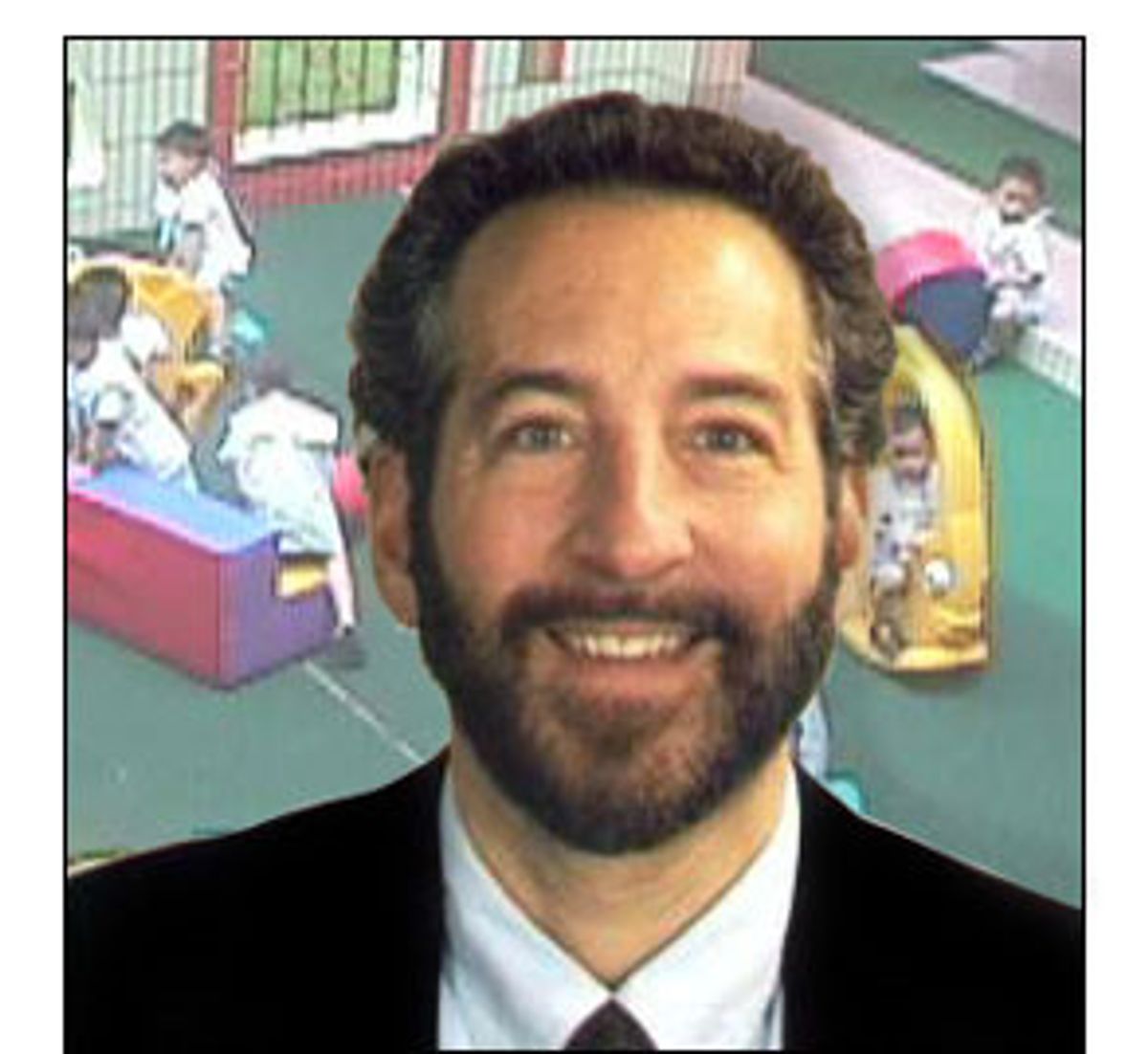
Belsky, once a professor at Penn State and now a professor of psychology at Birkbeck College in London, was mentioned in the first few lines of nearly every story in major metropolitan dailies about the NICHD report findings. The New York Times ran a profile of him over the weekend, and his name also came up frequently in reports about the findings on TV. Not only does Belsky have a far-ranging reputation in the area of chilling pronouncements about the impact of child care, but he is consistently identified as a "lead investigator" in the NICHD study. This makes him the go-to guy for reporters, some of whom have been following the child-care study since it was launched in 1991 at 10 data collection sites around the country.
Says Belsky about his role at center stage: "If I am monopolizing the press, it is only because I am speaking clearly and cleanly about our data and the press appreciates that."
The problem, according to several of Belsky's colleagues, is that Belsky's dire pronouncements are not based on conclusive data, and his identification as a "principal investigator" in the study is just plain wrong. His standout performance this week as the official bearer of bad news about child care and aggressive behavior not only caused familiar anxiety and seizures of guilt among parents but inflamed growing feelings of frustration and anger among Belsky's colleagues. Many of them are no longer on speaking terms with Belsky; at least one has suggested that the NICHD take disciplinary action against him.
(A spokesman for the National Institutes of Health said that disciplinary action can only be initiated if a written claim impugning Belsky's scientific integrity is submitted. The matter would then most likely be referred for investigation to the university where he is based.)
Belsky "is not a lead investigator," says Sarah Friedman, a psychologist at the NICHD and one of the 13 lead investigators in the study. "I understand that he identifies himself as that, but he is misinforming people and he knows better. It's a problem. He is not telling the whole story and is creating a panic."
The whole story is that the Early Child Care Study is not a controlled experiment but an observational study, which, by definition, does not yield the kind of data that researchers need to determine the actual causes for the behavior they observe. In a controlled experiment, scientists would control the random placement of children in child care or with their mothers, which, of course, for ethical reasons they cannot do. Instead, they, along with caregivers and mothers, observe the behavior of children in situations selected by their own families.
While some links between time in child care and certain behaviors have been noted by researchers, it is impossible to conclude that extended child care causes children to behave aggressively or defiantly. Researchers also stress that the percentage of children demonstrating aggressive behavior in the study was well within the normal range for any population.
Says Friedman, "We have no way in this study to attribute cause and effect. In the case of these findings, there is no way to attribute causality."
To be sure, it's entirely possible that extended child care may cause aggressive behavior. But the observational, nonrandomized nature of the study means that scientists cannot rule out the possibility that the observed correlation is due to an unknown co-factor, such as the possibility that parents are more likely to place aggressive children in day care. Such cofactors are themselves, of course, speculative.
Still, the actual findings of the study were not nearly as inflammatory as reported, according to Margaret Burchinal, a University of North Carolina researcher who oversaw the statistical side of the study. Burchinal said in a statement last week that the aggressive behaviors displayed by children in the study "were typical of what you'd expect for a normal 4-year-old. We're not seeing that child care produces super-aggressive kids."
And in a larger sense, the very nature of the study, plagued by such inevitable methodological problems as defining its subjective terms -- what is "aggression"? -- and the difficulty in assessing and factoring in intangible influences such as quality of family life and quality of child care, should caution researchers and the public alike against drawing sweeping conclusions.
In an e-mail to friends and colleagues sent after the findings were released, NICHD study coauthor Marsha Weinraub, a professor of psychology at Temple University, wrote, "We did not prepare a press release, because this report has not yet been peer reviewed and is not in press in any way. This was a series of reports to conference colleagues, something social scientists do all the time.
"Generally, however, scientists are pretty circumspect in reporting conference findings," she wrote, "but this week that was not the case. I'm sorry. That was something that was not in my control."
Weinraub's missive was not released to the press and Friedman's disclaimer, which has been reinforced by other participants in the study, has barely been audible in the din caused by Belsky's initial conclusions about the study. In fact, another finding from the study indicated positive links between child care and cognitive and language skills, as well as school preparedness. While it was mentioned sporadically in the press -- child care being said to produce "smarter and meaner" kids -- it was largely overwhelmed by the bad news.
Belsky, identified as "lead investigator," publicly announced that the NICHD study found that children who spend more than 30 hours a week in child care "scored higher on items like 'gets in lots of fights,' 'cruelty,' 'explosive behavior,' as well as 'talking too much,' 'argues a lot' and 'demands a lot of attention.'"
He went on to say, "If more time in all sorts of [child care] arrangements is predicting disconcerting outcomes, then if you want to reduce the probability of those outcomes, you reduce the time in care. Extend parental leave and part-time work."
Friedman attempted at the time to indicate that such a recommendation wasn't warranted, given that the study could not prove that child care caused aggressive behavior. "But Jay interrupted me and tried to put down what I was saying," says Friedman. "How come people just took his word? How come other voices weren't heard?"
In her e-mail Weinraub added, "Certainly, it is premature for anyone, least of all developmental researchers, to interpret the meaning of this finding for public policy in light of the information so far and the complicated issues it raises."
But prematurity hasn't ever stopped Belsky -- indeed, he would be the first to say so, although he characterizes it as prescience. Since he published a small newsletter article in 1986 suggesting that "a slow, steady trickle of evidence" had caused him to believe that child care might do psychological damage to children, in particular by compromising their bonds with their mothers, Belsky has been a lightning rod in the debate about child care. That article, titled "Infant Day Care: A Cause for Concern," brought a firestorm of criticism, much of it from his colleagues.
While Belsky characterized the reaction as predictable outrage from working mothers wrestling with feelings of guilt, the researchers who found fault with his conclusions say they were not bothered by what Belsky said was his "politically incorrect" position, they were bothered by his methodology.
"There were a lot of questions about his methodology," recalls Moncrieff Cochran, professor of human development at Cornell University, who was on Belsky's dissertation committee when Belsky was a graduate student there. "There were a number of other possible explanatory factors that he was unable to control for, most of which had to do with family characteristics. His was really the only study that came up with those conclusions about attachment and to some extent it was discounted in the course of this debate. It was a problem with limitations in the study, though, not a misuse of data."
Belsky continued to insist that his findings then -- and since then -- support the conclusion that extended child care has a negative impact on children, despite the absence of conclusive evidence to that effect. "What occurs to me based on my sideline view of this," says Cochran, who has studied child development and the effect of child care for some 30 years, "is that Jay is still smarting from the debates of the mid-'80s and now he has some data that he believes will justify the position he took then and, by God, he's going to flog the field with them."
Cochran is not alone in his observation that Belsky appears to have something to prove. Other researchers on the NICHD study have indicated, mostly off the record, that Belsky has been extremely dogged in his view that extended child care is a "peril."
For his part, Belsky complains loudly and often that other researchers in the field of child-care studies are professionally jealous and intimidated by what he regards as his vindicated prophesies about the negative impact of child care. "I am amazed they have any credibility at all," says Belsky of his colleagues. "What they said years ago turned out to be not so; they fail to acknowledge it and then blame me."
So why did the NICHD choose Belsky, the lonely and vociferous doomsayer in the group, to make its presentation about aggression and child care? "I know he differs from the group," says Friedman. "But I thought in this setting, he would behave himself. I thought that since he was invited to represent the story, he would represent the party line. It didn't occur to me that he would abuse the opportunity and advance his own cause.
"This is completely unprofessional," concludes Friedman, "but this is what he did and a lot of people in the study are upset with him. He didn't represent the truth, he represented his minority [view]."
For his part, Belsky is insistent that the ire of researchers is based upon their personal and political agendas, that they are inclined, "when it comes to disconcerting news about child care, to shoot the messenger." He concedes that he is not a lead investigator in the study, though he has been a principal investigator in the past, and suggests that it is a "presumption" that people are still ready to make. He has not attempted, however, to publicly correct this impression.
As to whether he is selectively using the data from the NICHD report to bolster his early findings, Belsky is unapologetic. He believes he was unfairly declared to be a cranky misogynist at the time he released his 1986 study and he is quick to point out that the data, if it doesn't prove him right now, will certainly prove him to be right at some point in the future.
"I wrote a paper 15 years ago that said that there were developmental risks associated with long-term child care that begins in the first year of life," says Belsky. "You can play divide and conquer here, but there is a pattern of results that are uncannily consistent with my findings of 15 years ago, when I was told I was off my rocker."
But other researchers in the field say the pattern that Belsky points to is essentially random and totally inconclusive until scientifically proven to be correct.
"I just don't think the scholarship that he has produced is as assiduously precise in all facets as is necessary in an area with such strong relevance for policy and programs," says Richard Lerner, who holds the Bergstrom Chair in applied developmental science at Tufts University and headed the search committee that first hired Belsky at Penn State. "His is a [scientifically] weak bias," says Lerner; "it is a distorted bias. There is data there, but there is a right way and a wrong way to deal with it and he is doing it the wrong way."
Belsky simply replies that "anyone who trusts what Richard Lerner says about me is a fool because Rich decided years ago for entirely personal reasons, which I never understood, to break off a close friendship."
Lerner acknowledges that he and Belsky have not been personal friends for some time, owing to a private falling out he will not discuss on the record. But Lerner says that his decision not to socialize with Belsky has had no impact on his observations about Belsky's work.
And Lerner is not the only colleague who is reluctant to endorse Belsky's findings or his approach to research. After Belsky's 1986 report indicating a negative effect of extended child care, a number of researchers brought up issues about what Lerner calls "shortcuts to his data." Many researchers believed that Belsky only looked at a particular data set that proved his case. They had questions about some technical issues of his data analysis, specifically Belsky's use of modification indices, which are used in statistical modeling procedures for cross-validation. Some researchers accused Belsky of using modification indices to find a conclusion that he didn't have before, instead of cross-checking his initial determination.
Belsky argues that these claims come out of a wish on the part of other researchers to mollify parents about their use of child care. He believes that the links between child care and negative behavior or affect are questioned and downplayed by other researchers, while findings about the positive effects of child care (increased cognitive and language skills, as well as enhanced school readiness) are framed as definitive conclusions and widely publicized.
"The fact that we rarely are cautious in telling the American people that the [positive] effects of quality [child care] are rather limited, may not be long lasting and cannot be assumed to be causal given the research design of our study is no less misleading and perhaps falsely encouraging," says Belsky. "But why is that OK?"
Says Cochran at Cornell, "His presentation of the data is not scientific in the sense that he isn't including any of the caveats, but that is the reason you have a large group of scientists. It is the responsibility of the other lead investigators to balance the perspective and I don't see that happening.
"Conclusions are drawn from a study like this on a number of different levels," continues Cochran. "I don't see why they would hesitate to acknowledge that this is a finding pretty deep down in these data, and that as scientists it is dangerous for them to go very far with something very deep in the study design."
In fact, Friedman and other researchers have tried to emphasize the inability of the study to attribute causes to their findings -- whether the findings are positive or negative. "We don't know what the implications are," said Friedman in a press conference. "We don't understand why we got these findings." And so, she concluded, "NICHD is not willing to get into policy recommendations."
In the same way that these provisos have not stopped Belsky from crowing about the validity of his early findings about child care, they have not stopped those who believe mothers should be home with their children from claiming a victory for their cause. Conservative Phyllis Schlafly wrote that the study's findings confirm her own conclusions about the scourge of feminism: "True science always verifies reality; it's only junk science that manufactures illusions based on ideologies." Belsky, she says, "didn't kowtow to the Politically Correct gestapo, as so many academics have done."
Lowell Ponte, in the right-wing FrontPage magazine, champions Belsky, whose 1986 article critical of child care, he says, "blew a gaping hole in Marxist and feminist dogmas about letting Hillary's collectivist 'village' raise our children so their mothers could pursue careers." If this study is right, if Belsky is right, says Ponte, mothers pursuing a career "may be failing as mothers by selfishly pursuing their careers while leaving their children in the hands of low-paid day-caring strangers." The guilt they feel is palpable, says Ponte: "You can smell the desperate self-delusion in the frenzied prose of feminist attacks against [the study]."
The fact is that the Early Child Care Study is the focus of a huge amount of anxiety and opinion and it has been suggested at least once in the press (a 1997 article by Arianna Huffington comes to mind) that the vast expense of the survey (an estimated $80 million at last count) is frivolous given the lack of conclusive results and the common-sense quality of the findings so far. Essentially, those findings are: first, that the better quality the child care, the better outcome for the child; and second, that the amount of day care is not as important as whether the child is neglected at home. It is possible that in grabbing the spotlight, Jay Belsky is not just enraging his colleagues' scientific sensibilities but bringing unwanted scrutiny to the study.
If nothing else, Belsky's premature pronouncement about the hazards of long-term day care does require the NICHD to emphasize the inconclusive nature of its findings, a fact that cannot be satisfying for parents nervously awaiting judgment and taxpayers paying the bill.
The other researchers, Cochran says, "have no reason to be afraid of Belsky. But I can imagine them not wanting to articulate the limitations in the design for fear of jeopardizing the whole thing. They might not want to shine the light on that."
By and large, however, all the researchers, including Belsky, believe that the study is important for its incremental findings and essential for what it ultimately may show about the effects of child care. And they all agree that the same standard must be applied to all the findings, good or bad: It must be conceded that child care cannot yet be identified as a concrete and exclusive cause for any of their findings, including those that Jay Belsky so passionately believes might vindicate him.
"The reality is that we don't need this study to tell us what to do, we know what to do," says Cochran. "Millions of Americans who work in this field can tell you what's needed. This is not rocket science: We're spending half as much money on early care and education than we should in the United States and we are trying to support that system on the backs of parents that can't afford the cost of quality care.
"What they can afford is the cost of mediocre care. I don't think we would ever dream of asking parents whose children are in public school to pay for that. There would be a huge revolt. But we do it with child care at the moment and it is not constructive."
Shares