

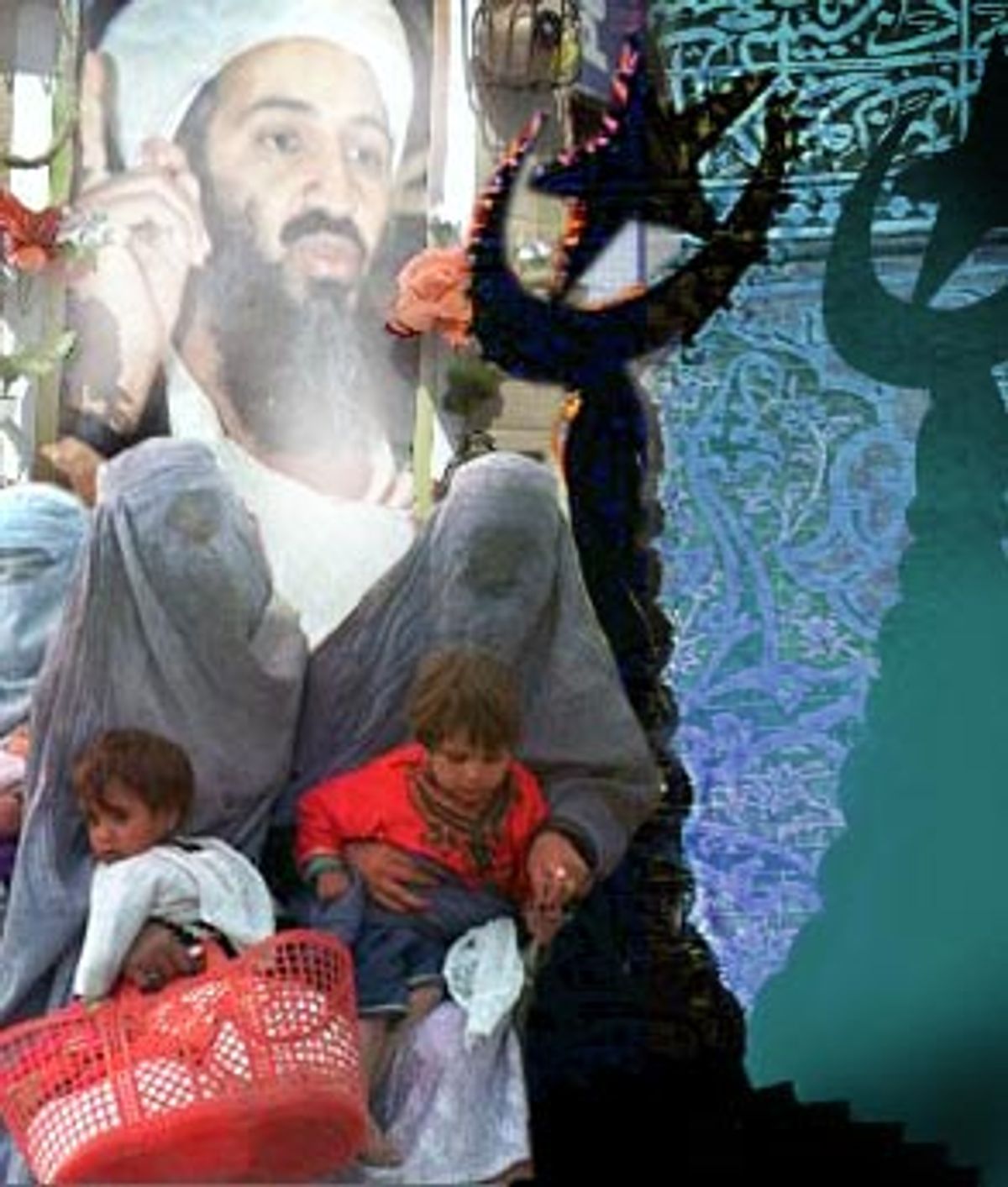
A woman living under Taliban rule in Afganistan can leave her home only for essential government-sanctioned activities. She must wear her burqa, a shroudlike gown that covers her entire body -- with a small mesh screen through which to see -- and she must be accompanied by a male relative. At home, she must live behind blackened windows. She cannot go to school, nor can she hold a job. Widows without a man to support them are forced to beg in the street to survive.
The Afghan woman cannot speak to men to whom she is not related by blood or marriage, which means she cannot visit a male doctor, so she might easily die from a treatable illness, because the female doctors she can visit are fleeing the country, and it is illegal to educate new ones.
If she wears nail polish, the top of her finger could be chopped off. If she is suspected of committing adultery, she can be publicly stoned to death. If she is suspected of disobeying any rule of modesty or decorum -- say, meeting the eyes of a male, or laughing in public -- she can be publicly beaten by the police who roam the streets under the authority of the Department for the Propagation of Virtue and the Suppression of Vice.
Feminists and human rights activists have been concerned about the Taliban's oppression of women for years, and in the aftermath of the World Trade Center attacks they might be expected to be having a "We told you so" moment. Eleanor Smeal, president of the Feminist Majority, warned three years ago of the potential danger to the rest of the world of Taliban fanaticism, demanding, in a petition organized with a coalition of feminists, that the U.S. government not recognize the Taliban government because of its treatment of women. (The United States, owing in part to this pressure, never recognized the Taliban government.) Smeal and her supporters were not merely complaining of sexism, but insisting that the oppression of women in Middle Eastern Muslim countries is a sign of a greater fanaticism that could be expected to use terrorism to attack its enemies.
"We argued that the Talibanization of society would not stop in Afghanistan. We could see it moving into Pakistan, into Algiers and all through the Middle East to Turkey," explains Smeal. "We argued that it would lead to regional instability, and that this had much larger world ramifications than just what is happening to women there."
The subjugation of women in extremist Islamic states like Afghanistan is carried out in the name of Islam, even though it does not have much basis in the religion itself. Instead, Islamic extremists simply pervert weak religious tenets for political expedience. The oppression of women serves a dual function -- it works as a demonstration of political might and as a convincing rejection of the West. What better way to show your defiance of the United States than by symbolically cloistering your female population from the "corruption" of the sexually liberated American woman, as seen in movies, advertising and TV?
Some Western critics have written Islam off as a sexist religion. The truth is far more complicated. In many countries, the Islamic woman's body has become a battleground for religion, history, local culture and global politics. The impoverished, politically unstable Middle East has frequently demonstrated its resentment of the United States through the bodies of the women that it can control. Indeed, those who have tried, often unsuccessfully, to draw attention to the plight of women in the Middle East have long believed that scrutinizing women's rights there -- and elsewhere in the world -- is one of the best ways to track anti-American sentiments and the potential for terrorism.
"Islam is used not so much as religion but as an ideology," explains Azar Nafisi, an Iranian professor and visiting fellow at Johns Hopkins University's School of Advanced International Studies. "It becomes a power thing where you can impose your own rule and a sort of uniformity upon the people and subjugate them under the name of religion.
"At the center of the troubles between what we call Islamic fundamentalism and its quarrel with the West is in fact the issue of women," says Nafisi. "If you want to judge whether there is open democracy in any of these countries, you should first look at the situation of the women and then decide."
Or, as Smeal puts it, "The link between the liberation of Afghan women and girls from the terrorist Taliban militia and preservation of democracy and freedom in America and worldwide has never been clearer."
When the religion of Islam was founded by the prophet Muhammed in the 7th century, it offered a degree of liberation to the downtrodden women of the Middle East, who were typically considered the chattel of their husbands. Not only did Islam guarantee women status in society as individuals and religious devotees, but it offered them property and inheritance rights. It granted women sexual openness within the sanctity of a marriage. Muhammed's own wives held jobs, fought in wars and lived relatively liberated lives.
The Muslim religion takes the writings of the Quran and the word of Muhammed as gospel truth; ostensibly there is no room for interpretation. However, Islamic law also includes a vast number of "hadith" -- sayings or rules that were collected after Muhammed's death from a variety of people who claimed to have seen or heard him speak. Islamic scholars rate the reliability of these hadith as "true," "good" or "weak." The hadith surround the religion itself as a kind of social policy, or rules for living, and religious leaders sift through them when coming up with guidelines for Muslim devotees.
While the Quran itself may be straightforward in its discussion of women, the voluminous and often conflicting hadith are where extremists locate their sexist rules. Islamic extremists, seeking to advance their radical agenda, will pick out a "weak" hadith that would seem to justify treating women like slaves -- even though the rest of Muhammed's teachings might appear to differ on the subject. Similarly, the ambiguity of the Arabic language is problematic. One particularly confusing passage in the Quran appears to endorse wife-beating, or "dharaba." However, the word could also mean "strike with a feather." Extremists choose the former definition; moderates, traditionalists and feminists, the latter. An uneducated population that hasn't read the Quran simply has to believe what it is told by the religious leaders in power.
"Many of the negative things that were said about women in the hadith are not really true hadith -- they are of the weakest type," explains Sharifa Alkhateeb, president of the North American Council for Muslim Women. "Yet when people repeat them they don't say that. Muslim males who are patriarchal -- who would like to turn women into servants who wait on men hand and foot -- like to repeat these things. But women were never supposed to be treated like that."
Using these weak hadith to justify their actions, extremists in many Arab Islamic states have done their best to curtail women's rights. As feminists, progressive clerics and politicians in the Middle East have battled for modernization in the last two decades, the world has also witnessed a growing strain of extremist Islam in countries like Saudi Arabia, Egypt, Palestine, Pakistan and Afghanistan, and even in more liberal countries like Jordan and Turkey, which are allied with the United States.
Until the war against the Soviet Union and subsequent civil conflicts tore Afghanistan apart, the country's constitution guaranteed basic rights to women. The country's comparively benign interpretation of Islam meant that until the 1990s, many devout Muslim women participated in public life. Half of the university students were women, and women made up 40 percent of the nation's doctors and 70 percent of its teachers. Women wore Islamic scarves covering their heads and long dresses, rather than the all-encompassing burqa.
But in 1992, when the mujahedin -- the loose group of militants from numerous Islamic Arabic nations who rallied to fight the Soviet occupation of Afghanistan in the 1980s -- came to power, they suspended the constitution and imposed their extreme religious doctrines on the country.
As the factions of the mujahedin battled each other for political supremacy, Afghan women lived under appalling conditions. Amnesty International called their plight a "human rights catastrophe." Women were regularly raped, abducted, sold into prostitution or killed.
The fundamentalist Taliban -- many of whom were actually from Saudi Arabia and Pakistan -- came to power in 1996 in part because they promised to put an end to the chaos and anarchy. Their ranks swiftly grew as the Taliban enlisted uneducated and impoverished youth and taught them an extremely conservative interpretation of Islam. And the movement did, indeed, halt the widespread rape and violence against the country's women. Unfortunately, they achieved this by essentially effacing women from society altogether, cloistering them behind the walls of their homes and underneath the burqa.
Taliban public relations consultant Laili Helms, the niece of former CIA director Richard Helms, is perhaps the regime's leading American apologist. She claims that women in Afghanistan have happily embraced the new rules. "Afghanistan was like a Mad Max scenario," she told the Village Voice earlier this year. "Anyone who had a gun and a pickup truck could abduct your women, rape them.... When the Taliban came and established security, the majority of Afghan women who suffered from the chaotic conditions were happy, because they could live, their children could live.'" Smeal, who has been doing human rights work in Afghanistan for years, strongly disagrees: "If they could vote the Taliban out they would do it in a minute."
Besides using the "for their own good" argument, the Taliban also invoked the laws of Islam as they banned women from society. They have boasted to the world that they are creating the "pure Islamic state," supposedly returning to a way of life not seen since the days of the prophet Muhammed.
But the current treatment of women in Afghanistan, most Muslim scholars argue, goes far beyond anything that can be found in the Quran. The Taliban's obligatory burqa, for example, has no roots in Islam. While the prophet Muhammed did request his own wives to wear veils, it was not a mandated requirement for women (rather, it was a solution for a specific domestic turmoil in his own house). In much of the Muslim world, this is interpreted to mean that the chador (a full-body gown and headdress that covers everything but the face) or head-coverings are optional forms of religious expression for women.
But this is just one of the Islamic suggestions that have morphed into the repressive rules of the Taliban. Other sexist laws -- such as those forbidding women to get an education or hold a job -- that the Taliban claims are "pure" Islamic teachings are actually antithetical to the Quran, which mandates that all Muslims -- male or female -- should get an education. Muhammed's first wife, in fact, was an international businesswoman and his employer; his daughter was a politician. This did not seem relevant to the Taliban when it banned women from the workplace.
"I believe they are using this form of religion as a cover," says Smeal. "It's a way for them to get rid of their enemies who were the educated class. If you make horrible rules attacking educated women, what does it do? It makes them and their husbands and relatives flee. It's depopulizing the zones that are threatening to you. [The Taliban] are drug traffickers and smugglers; they put religiosity on top of it and roll it all up."
The Taliban is hardly unique in its harsh treatment of women, though; the Middle Eastern Islamic world is rife with rules strictly regulating the behavior of women. (In the non-Arab Muslim countries, where four out of five Muslims live, fanaticism is also growing, but hasn't yet reached the levels of the Middle East). In fact, the Taliban is said to have based many of its mandates for women on those of Saudi Arabia, one of the United States' staunchest allies in the region.
In Saudi Arabia, where extremist Islam is endorsed by the ruling family, women are not allowed to drive cars. They can't rent hotel rooms. They can't work in any occupation where they have contact with men, with the exception of medicine. They are allowed an education only if their father gives them permission; if they do attend high school or college, they are segregated from men and receive their lectures via closed-circuit TV. They can't eat in a public place. If they are found on the street, they must prove that they have their male guardian's permission to be there.
A similar form of extreme fundamentalism also is evident in northwestern Pakistan, where the Associated Press reports that a Taliban-esque "moral code" is being imposed on the women of the region. Fundamentalists have bombed the offices of women's groups and claim that the women who run them are prostitutes; Islamic clerics preach against women's education and condemn their home-based businesses.
Even in more liberal Arab countries, the civil rights of women are in constant danger. Geraldine Brooks, whose book "The Nine Parts of Desire" examines the living conditions of Islamic women in Arab countries, observes that creeping extremism has helped discourage belly dancing in Egypt and inhibited female politicians in Kuwait. Islamic extremism has encouraged the "honor killing" of wayward wives and daughters in Palestine, and the practice of genital mutilation in Muslim northern Africa.
"The Taliban is a perversion of Islam," says Brooks. "But I think that there are other regimes that are considered allies of the United States, like Saudi Arabia, that aren't criticized or called to account for often very similar distortions. If the human rights abuses in Saudi Arabia were really scrutinized, you could see more clearly why this country has fostered an atmosphere friendly to terrorists. Most of the people who are suspects [in the Sept. 11 attacks] are Saudis, not Afghanis. We keep focusing on the Taliban. We should be asking why a modern ally like Saudi Arabia is allowing an atmosphere to flourish that encourages this kind of extremism."
So why is this kind of oppression of women, which has no real basis in the teachings of Muhammed, springing up all across the Arabian Islamic world? Many Middle Eastern scholars argue that the renewed religious extremism in the region is a kind of reaction to centuries of colonial rule, followed by decades of Western meddling in local affairs. Much of the Islamic Middle East loathes the American government, which has propped up oppressive totalitarian governments in the region and backed Israel in its bloody conflict against Palestinians. The recent uprisings against Western-backed regimes have typically been founded on religious fundamentalism -- both because it presents an alternative to corrupt secular governments, and because it is so completely opposite from everything that the West represents. "We have become the bad guys; they are blaming all of their economic ruin on the West," says Smeal. "They think we don't like Muslims, so instead, they become more fundamentalist: 'We'll show you, we'll be more Muslim.'"
And the first victims in this reactionary process often are women. Putting Islamic women behind a veil, cloistering them in their homes and forbidding them to speak to men is not only a way to maintain female honor, and therefore the honor of society in general, but is also a way to reject the corruption of America and its liberated "prostitutes."
As Brooks writes in "Nine Parts of Desire," "A fundamentalist revolution couldn't instantly fix a national economy, but it could order women into the veil."
Iran is a good example of this cycle. In 1979, when Iranians revolted against the Shah's U.S.-backed regime and embraced Ayatolla Khomeini, a religious fundamentalist who vilified the West as the "Great Satan," women willingly donned their chadors as an anti-American statement. After the revolution, however, extremists began imposing ever stricter rules on the country, and the chador was suddenly no longer an optional political statement for women. Instead, the clerics tried to send women back to their homes, legalized marriage to girls as young as 9 years old and lashed out against feminists.
Ultimately, however, the regime's more radical efforts to control women failed. Women who had already tasted modern life under the Shah refused to withdraw from society; instead, religious leaders -- both male and female -- who recognized the important role of women in the revolution began reforming the laws from within. Two decades later, although Iran is still a bastion of conservative religious practices, it also boasts a growing feminist movement, a number of female political leaders and a burgeoning culture of arts and education -- even if filmmakers critical of the government still struggle against censorship.
One could argue that, at their roots, almost all religions are sexist; the ancient texts that all religious devotees study as a guide to modern living were written centuries or millennia ago -- a time when slavery was widespread and female infanticide, polygamy and child brides were often the custom. Fundamentalist interpretations of Judaism and Christianity are just as sexist as fundamentalist interpretations of Islam. Simply look at the growing "surrendered wife" phenomenon in the United States to find the Western counterpart to the housebound Islamic wife. (Or, for that matter, to see our counterpart to the Taliban's reactionary pronouncements, simply recall Jerry Falwell's tirade that homosexuals, feminists and abortionists were at fault for the events of Sept. 11 because they have brought down God's wrath on an immoral America.)
But in the United States, unlike the Middle East, the stability of democracy and diversity of beliefs prevent religious fanaticism from prevailing. As Nafisi puts it, "I don't think that in the U.S. fundamentalism can be a danger as long as it is part of a large society that respects many different views. It becomes dangerous in Iran and Afghanistan when religion, and one specific interpretation of religion, becomes the state."
The United States can't merely write off the Taliban as a dangerous aberration. The suspects in the hijackings include Saudis, Egyptians and Pakistanis. They came from countries that are supposedly allies of the U.S. and yet anti-Westernism is rife there, and fanatical fundamentalist movements that oppress women continue to grow in popularity.
The Bush administration argues that in order to eradicate global terrorism, we'll need a multipronged war -- using intelligence, diplomacy, economic aid and military assault. Feminists believe that a strong defense of women's rights should be added to the list.
"If we're ever to get rid of this kind of terrorism, we need to build economically stable societies with consitutional democracies with a role for women's rights," says Smeal. "The overwhelming majority of women in a culture like [Afghanistan] are injured -- teachers don't exactly want to be begging in the streets in burqas. I beg the government to see [these women] as the natural people who would oppose such forces as the Taliban and Osama bin Laden."
Shares