

It would be tough to imagine an unlikelier vessel for Asbury Park's hard-rocking musical history than 24-year-old Carrie Potter. Born in Waco, Texas, Carrie was weaned on the music of John Denver and Simon & Garfunkel. "I was told that I needed to listen to good quality, moral music," she said recently by phone. Carrie knew the name Bruce Springsteen only "as part of my family's past" from way back in the late 1960s, when her grandfather Tom Potter and his then-wife Margaret had run an all-ages club in Asbury Park, N.J., called the Upstage.
Carrie wasn't even born until 1981, 10 years after the Potters had split up and Tom had left New Jersey for Florida in the wake of Asbury Park's race riots. He lived there, and then near Carrie's family in Texas, until his death from a heart attack when his granddaughter was in the 9th grade. His stories had sounded like big-fish family lore to her. "It was always like, 'Hey, my grandpa knew Bruce Springsteen. He played at his club,'" she said. "But you don't think anybody else really cares."
It wasn't until 2002, when she learned that the old Upstage building was still standing and for sale that Carrie first traveled north to the rundown shore town of Asbury Park. She talked her way into the abandoned club and found its psychedelic glory almost untouched after 35 years. It was then that she first encountered people who remembered her grandfather, his wife, their club, and how it had served as a refuge from the explosive politics of a country in crisis, and as an incubator for a music scene that was about to explode just as fiercely.
As Carrie began to get an inkling of what the Upstage had meant to the musical and social history of Asbury Park, she decided to try to reclaim it somehow. Allied with shore denizens Gary Wien and David Mieras, she attempted to get funding to buy the building and turn it into a rock museum that would preserve Asbury's fast-crumbling music history.
But the group could not get enough money together, and in 2004 the three-story building at 700 Cookman Avenue was purchased by New Jersey couple Irwin and Shiela Strauss for $1 million. "[Carrie and her partners] had the same opportunity to buy it as anyone else," said Ron Schrader, the agent who sold the building, adding, "I would have loved to see that place become a rock 'n' roll museum ... but nine out of 10 people would rather make a dollar than preserve something that's musically historical." After three decades in the economic dumps, Asbury Park is in the midst of another round of redevelopment. And while it may be the city's only chance at escaping poverty, it also means the demise of its architecture, its monuments, its blue-collar identity. In early 2006, the Strausses are reportedly scheduled to demolish the remains of the Upstage to build condominiums. Attempts to reach the couple for this story were unsuccessful.
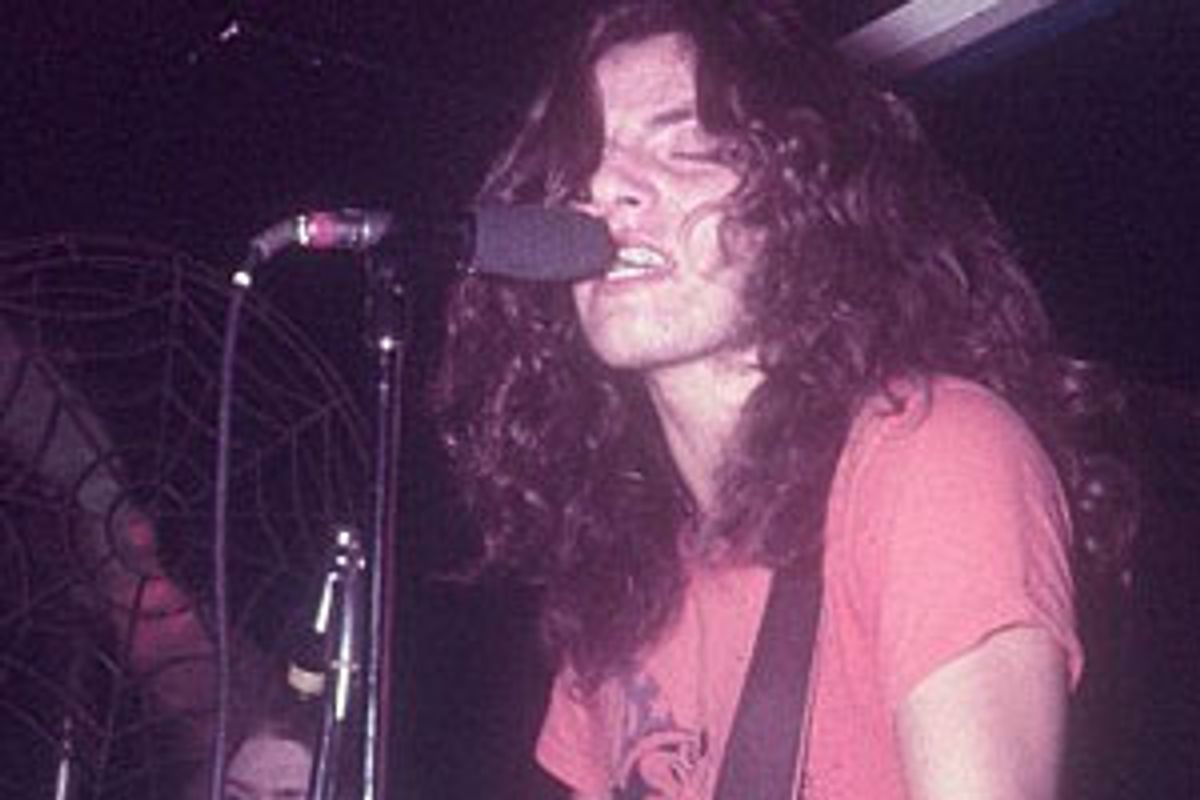
But just because Carrie's museum effort fell through doesn't mean she's done. Now the mother of a 10-month-old son, and no longer working with Mieras and Wien, she said she still hopes a miracle will save the building. But even if it doesn't, she is putting together a book of some of the 1,200 photos she inherited from her grandfather. The pictures, taken in the heyday of Tom and Margaret Potter's Upstage, from 1968-70, show Afros and hippie hair, burning buildings and riot squads, and teenage musicians who were on the verge of making Asbury Park immortal. Frolicking and strutting through Carrie's photos like bean-thin, big-haired puppies with guitars are kids like Springsteen, Garry Tallent, Steven Van Zandt, David Sancious, Danny Federici, Vini "Maddog" Lopez, Rick DeSarno, "Big Bad" Bobby Williams, Bill Chinnock and John "Southside Johnny" Lyon.
Few of Carrie's photos have been published before, but she hoped that as some of them become available, as they do in Salon today, they will jog the memories of those who recall what they were feeling and thinking when they were captured by her grandfather's camera in images that, to her 24-year-old eyes, "show the essence of what it was to be young back then -- like a movie, except it was all real every day for three years."
- - - - - - - - - - - -
Asbury Park is most famous as a stretch of sand across which have loped beach-bum boy prophets like Stephen Crane, Count Basie and Springsteen. But that wasn't its intended legacy.
The city was founded in 1870 by James Bradley, a devout Methodist brush manufacturer who, according to Daniel Wolff's history "4th of July, Asbury Park," created the community as a buffer between the religious retreat of Ocean Grove to the south and the sinful excesses of Long Branch to the north. Bradley's Asbury Park was supposed to be a middle ground: a Methodist resort and pleasure palace for the pious.
The piety didn't last long in the face of sand and sun, and Asbury Park's prosperity was in constant flux thanks to corrupt government and the ugly racial politics of the post-Civil War north. Through its history, the town's white tourist economy relied on a population of minority laborers who lived west of town: blacks, Jews, Germans and Italians. What Wolff dubs the "shadow city" was incorporated into Asbury Park in 1906, and over time, many of its immigrant populations were absorbed into the merchant class. Except, that is, for the black population. Segregation was the rule in Asbury Park through the first half of the 20th century, with blacks barred from sections of the boardwalk and forced to swim at the "mud hole" portion of the beach where the sewage emptied into the sea. In the 1920s, the Klan maintained a presence and attempted lynchings were not uncommon. The West Side was allowed to steadily rot. By the 1960s, poverty rates throughout the town were soaring and anger was high.
But by then, even the city's tourism had dropped off, leaving Asbury Park a nostalgia trip of a beach town, with calliopes, fortune-tellers and carousels lining its beat-up boardwalk. What Asbury Park did have in the mid-'60s was bars. "In 1966, there was a club on every corner of Asbury Park," remembered drummer Vini Lopez, who was 17 that year. "And there was a band in every club."
By phone, historian Wolff said, "The Asbury Park music scene partly happened because the city was in decline ... You could have boys who lived in an old surfboard factory where they could afford rent, hang out, and learn their craft." The boys who would wind up in that old surfboard factory included Springsteen, who turned 18 in 1967. But he wasn't alone. The city was populated with kids trying to get gigs in bars they were still too young to drink in.
Young musicians began to gather at Tom and Margaret Potter's apartment, above a hair salon. Tom was a hairdresser, owned a cafe called the Green Mermaid above the shoe store next door, and had two sons from a previous marriage. His younger wife had a band, Margaret and the Distractions.
"Margaret and Tom were true bohemians, beatniks," said Garry Tallent, bass guitarist for the E Street Band for over 30 years. They encouraged the kids who hung out with them to break out of commercial molds. Tallent explained that "bands in the bars would have to play the top 40 pop music. Then they would come over to the Potters after their gigs at 2, 3 in the morning." There, they riffed and experimented, playing blues and jazz and stuff they made up.
The nightly jam sessions gave Tom the idea of opening an all-ages, alcohol-free club next door above the Green Mermaid. Tom told the Asbury Park Press in 1968 that he intended to "cater to swingers 16 and up" at his "combination discotheque and coffeehouse." The Upstage opened at 9 p.m. for anyone over 16, closed for an hour at midnight and reopened at 1 for the older musicians who came over after their sets were done at the bars. It would stay open until 5 or 6 in the morning. Tom rigged a "sound wall" that was basically a board with as many speakers as he could find attached to it. The place had no windows, and was decorated in trippy neon murals and naked mannequins.
The Upstage was no ordinary open-mike joint. Tom Potter decided who played with whom, keeping guys like Tallent and Lopez on bass and drums, and leaving open spots for lead guitar and vocals. That meant fierce competition. "The Upstage became a kind of guitar-slinger Dodge City," said Tallent. "Every guitar player in at least a 20-mile radius heard about this place and showed up and tried to outdo each other."
"The competition just to get onstage raised the bar and the level of musicianship," said music journalist Robert Santelli, now the artistic director of the Experience Music Project in Seattle, but a local high school junior and senior during the Upstage's heyday. "I was 16 and in a band, but not good enough to get onstage," he recalled. But just being there, he said, "was like going to [music] college. Not just for me, but for the players onstage as well. They had to do the homework and prove themselves. It created this sense of community that Asbury Park did not have. You take out the Upstage and you don't have the Asbury Park music scene like you had it in the 1970s."
The late '60s was a volatile musical period, and that was reflected at the club. "In the beginning of the Upstage," said Tallent, "it was all about blues and jazz. And at the end it was all about Cream and Hendrix and how fast and how hard can you play. We weren't inventing it. We were just part of what was going on at the time. What was special was that we had a venue in which to do it."
Lopez agreed. "At the Upstage you were playing in front of people," he said. "If it hadn't been there, it would have been, 'Hey, Bruce, come down from Freehold to my garage!' Except I had no garage. I had no place to play. We were poor." In this, Lopez was like a lot of his buddies. And for them, the self-sufficiency of their clubhouse became a vital equalizer. "It was a place where a poor musician, some kid who owned a crummy guitar, could plug it into the stage because the amps were already there," Lopez explained. "All I needed was my drumsticks because there were drums already there."
For that, the kids had their boss Tom to thank, but many of their hearts belonged to Margaret. "Margaret was crazy about me and I was crazy about her," said Tallent. Margaret and the Distractions, he said, "wasn't the best band in the world, and Margaret wasn't the greatest singer in the world, but Tom was very supportive of Margaret wanting to play music." Santelli, who interviewed Margaret before her death in 1993, remembered, "The kids who hung out were hers. Margaret provided a place from them to play, she loaned them money, mothered them."
Margaret's ability, in Santelli's words, "to see in these kids potential and promise" inspired an affection strong enough to persuade 19- and 20-year-old guys to take care of the place: from taking out the garbage to painting the walls. Lopez felt so at home at the Upstage, he said, that he tried to go every night it was open.
- - - - - - - - - - - -
The musicians who forged connections at the Upstage included Springsteen, Lopez and organist Danny Federici, who would form Steel Mill, Springsteen's most famous pre-E Street outfit, as well as Tallent, Steven Van Zandt, and David Sancious, a black pianist who crossed color barriers to come to the Upstage. Tallent had been one of the only white musicians to play with a black band, Little Melvin and the Invaders, but mostly, white guys played by the beach and black guys played the West Side clubs. "Davey used to go to the Upstage to dance, not to play music," said Lopez. "But then they found out he was a musician and pressed him into service." All of these men would wind up in the early iterations of Springsteen's E Street Band.
In everyone's memory, there seemed no doubt that stringy, music-obsessed Springsteen was the one going places.
"We all figured that Bruce was the guy," said Lopez. "There was no doubt. He was writing these songs for Steel Mill in '68 and '69 that still hold up today." Lopez thinks they hold up so well, in fact, that this year he recorded "The Dead Sea Chronicles," a CD of Steel Mill songs he and Springsteen first performed as 19- and 20-year-olds. "This is stuff that we cut our teeth on," said Lopez, "and it rocks."
Though the crowd was predominantly white, the Upstage offered a place for some black musicians to encounter some white musicians and form relationships that would last. In Wolff's book, Sancious described the atmosphere at the Upstage: "Amongst that scene of people, especially the musicians ... there was no funky racial vibe at all."
Somehow, Asbury Park had managed to avoid the widespread national rioting that plagued Los Angeles, Detroit, Newark and other cities during the 1960s. But on July 4 weekend in 1970, 100 years after founder James Bradley had first ventured from Manhattan to Asbury Park's shores, the city's West Side erupted. The riots lasted for almost a week.
Lopez remembered being with Springsteen and other guys in the surfboard factory in Ocean township. "We went to a high area and you could look down toward Asbury Park," he said. "They burned the place down. They burned Springwood Avenue down, all the shops. You can still see all the empty spaces." No one was killed, but hundreds of civilians and police were injured.
The Upstage was, Santelli remembered, "a stone's throw, literally, from where the riots were occurring." "That was outside," said Tallent, "People were certainly aware of it, but life went on in the Upstage. It was more about music than any politics." Lopez remembered that the place was closed down. In "4th of July, Asbury Park," Wolff reports that the windows of the bottom-floor shoe store were broken by rioters, while the Green Mermaid and Upstage remained safe and empty. He quotes Van Zandt as hardly remembering the rioting, so obsessed was he with "getting at the mystery of [the music] -- learning how to do it -- that really took up almost all your time."
But if the guitar-slingers and rhythm section were determined not to let the violence outside touch their utopia, they could not shut it out forever. The riots, said Tallent, "put the kibosh" on Asbury's vibrancy.
The middle- and working-class tourists abandoned smoldering Asbury Park, taking with them the market for all those bands, all those amusements. White yearlong residents fled too, and the remaining black population wasn't treated any better by the city that was left to them. "The riots changed the economics of Asbury Park overnight," said Santelli. "It became a virtual no-man's-land. The tourist resort concept went away immediately, so the clubs started closing."
A bunch of the Upstage guys traveled to Richmond, a college town that had embraced the Asbury sound. Springsteen spent time in California. When he returned, he and Steel Mill played two farewell shows at the Upstage in January 1971, shortly before disbanding. Soon after those shows, the Upstage closed down, though no one can quite remember exactly when or how.
"The Upstage kind of just disappeared," said Tallent. "I think Tom and Margaret split up and Tom moved to Florida. And when Tom lost interest, that was it."
"I don't remember any official closing," said Santelli. "It kind of gradually just faded away." By 1971, Santelli said, Springsteen was playing other venues with other bands. By 1972, he had a contract for his first record, "Greetings From Asbury Park." The Potters had split, as Carrie recounted, because her grandfather "didn't want to live there anymore because the town had gone bust, but Margaret wanted to stay with her family, and the life they had there." Tom moved to Florida, and Margaret vacated the apartment they had shared over the salon, renting it to Springsteen and some friends. It was among the abandoned hair dryers and sinks in the shop below that Springsteen wrote the songs for "Greetings From Asbury Park."
The riots and the end of the Upstage were not Asbury Park's final chapter. As Springsteen began his slow ascent to his perch in the American imagination, there was a mini-revival of tourism to his adopted hometown. The Stone Pony opened at the site of an old bar called Mrs. Jay's in 1974. There, Springsteen and a lot of the old Upstage gang -- many now his recording band -- would spontaneously show up for jam sessions, or to try out new material before taking it on the road.
The Stone Pony is a lot more famous than the Upstage. But it wasn't the same thing. "You could come to the Stone Pony and jam if you were friends of the band or if you were Bruce Springsteen," said Tallent. "But most people couldn't get up onstage and play. And that was the true difference. Anybody who wanted to come down to the Upstage and jam was welcome. And they did come."
The resurgence of Springsteen-inspired music tourism wasn't enough to keep Asbury Park afloat through the '80s and '90s. It went through several attempts at redevelopment, some of which stalled halfway through, leaving hulking, half-built condominiums sitting empty next to the burned-out remains of older buildings. More recently, the town has become something of a gay enclave, and restoration work has been done on some of its old Victorian architecture. But mostly, as New York's Hamptons fill up and wealthy Manhattanites look toward the once-déclassé Jersey shore for their new summer playgrounds, the community is looking more delectable to buyers who might bolster the local economy, but also strip the area of its crumbling facades, its character and its artistic tradition. As Santelli put it, "No music community is going to spring up with condos and BMWs in the driveway. It's sad, sad, sad."
In 2003, there was a massive "Save Tillie" campaign to prevent developers Asbury Partners from razing the historic carousel building and the Palace Amusements arcade along with its famous mural of George "Tillie" Tilyou. It failed; in 2004, Palace Amusements was torn down. The Tillie mural was cut from the wall and preserved, and now sits in an unmarked building outside Asbury's sewage treatment plant.
- - - - - - - - - - - -
Carrie Potter has now spent quite a bit of time in Asbury Park. She understands a lot more about the power of the music her grandparents' club nursed than she did on her first visit, when she stood outside Convention Hall, watching shivering fans wait to catch a glimpse of Springsteen rehearsing a Christmas benefit, and thought, "This is ridiculous. It's not like it's Green Day!"
That day, Carrie, with the help of Lopez and some effective histrionics, managed to finagle her way past the crowds and into the rehearsal, hanging candy canes 10 feet from the stage where Springsteen was playing. It was all the proximity she needed to pounce.
"When I told him who I was he was surprised," said Carrie. "He looked like he saw a ghost. And he said, 'You're Tom Potter's granddaughter? Where the hell is he?'" Carrie told him that Tom had passed away after having lived in Florida and Texas. "Bruce just looked at me for a second and said, 'Why didn't he ever send me a postcard?'"
The past two years have seen the demise of Asbury Park's Palace, and of New York's Bottom Line, where Springsteen began to make his name nationally. After an unsuccessful protest led by Van Zandt, Manhattan punk temple CBGBs is scheduled to close in 2006.
Maybe, as Don Stine, the owner of Antic Hay bookstore across from the Upstage, said he hoped, the Historical Society will be able to get into the Upstage before it's gone. "We might try to get in and get some of the old artwork out of there," he said. Maybe they will save that old board full of holes where the speakers and amps used to go, or the bathroom stalls, still covered with graffiti from 1969.
But maybe they won't. And in a way, that's OK too.
When Bruce Springsteen was writing "Thunder Road" in 1974, he called it "Wings for Wheels." You can hear the original during a show he performed outside Philadelphia in February 1975, almost exactly four years after the Upstage faded away. The concert begins with late DJ Ed Sciaky welcoming Springsteen before he "goes off to conquer America and the world."
In a verse that never wound up in "Thunder Road," Springsteen sings: "The season's over/ It's getting cold/ I wish I could take you to some sandy beach/ Where we'd never get old." The long-excised lyric describes the impossible ideal that Springsteen, like many before him, has returned to over and over again: eternal youth.
The Upstage was only open for a couple of years. It never got old. It never got turned into a disco or a Hard Rock Cafe or a Starbucks. For 35 years it has been preserved, practically in amber. Soon, barring a last-minute miracle, it will become somebody's workout room. Tom and Margaret Potter are dead; the young musicians they nurtured are in their 50s and even 60s. But in Carrie's thousands of photographs, in the memories of the people who were there, and in the music that the club helped give birth to, those kids will live forever, captured in a brief flash of youth, and heat, and possibility.
Shares