

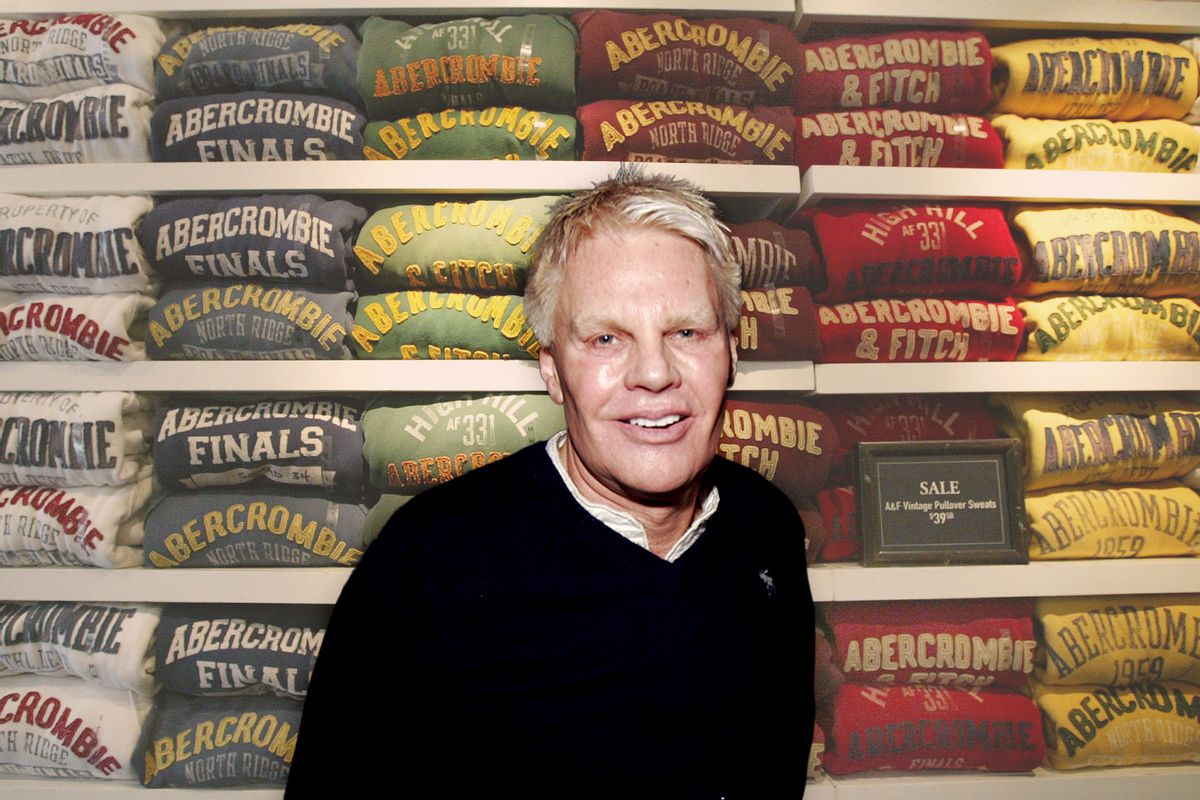
Mike Jeffries, the 61-year-old CEO of Abercrombie & Fitch, says "dude" a lot. He'll say, "What a cool idea, dude," or, when the jeans on a store's mannequin are too thin in the calves, "Let's make this dude look more like a dude," or, when I ask him why he dyes his hair blond, "Dude, I'm not an old fart who wears his jeans up at his shoulders."
This fall, on my second day at Abercrombie & Fitch's 300-acre headquarters in the Ohio woods, Jeffries – sporting torn Abercrombie jeans, a blue Abercrombie muscle polo, and Abercrombie flip-flops – stood behind me in the cafeteria line and said, "You're looking really A&F today, dude." (An enormous steel-clad barn with laminated wood accents, the cafeteria feels like an Olympic Village dining hall in the Swiss Alps.) I didn't have the heart to tell Jeffries that I was actually wearing American Eagle jeans. To Jeffries, the "A&F guy" is the best of what America has to offer: He's cool, he's beautiful, he's funny, he's masculine, he's optimistic, and he's certainly not "cynical" or "moody," two traits he finds wholly unattractive.
Jeffries' endorsement of my look was a step up from the previous day, when I made the mistake of dressing my age (30). I arrived in a dress shirt, khakis and dress shoes, prompting A&F spokesman Tom Lennox – at 39, he's a virtual senior citizen among Jeffries' youthful workforce – to look concerned and offer me a pair of flip-flops. Just about everyone at A&F headquarters wears flip-flops, torn Abercrombie jeans, and either a polo shirt or a sweater from Abercrombie or Hollister, Jeffries' brand aimed at high school students.
When I first arrived on "campus," as many A&F employees refer to it, I felt as if I had stepped into a pleasantly parallel universe. The idyllic compound took two years and $131 million to complete, and it was designed so nothing of the outside world can be seen or heard. Jeffries has banished the "cynicism" of the real world in favor of a cultlike immersion in his brand identity. The complex does feel like a kind of college campus, albeit one with a soundtrack you can't turn off. Dance music plays constantly in each of the airy, tin-roofed buildings, and when I entered the spacious front lobby, where a wooden canoe hangs from the ceiling, two attractive young men in Abercrombie polo shirts and torn Abercrombie jeans sat at the welcome desk, one checking his Friendster.com messages while the other swayed subtly to the Pet Shop Boys song "If Looks Could Kill."
If looks could kill, everyone here would be dead. Jeffries' employees are young, painfully attractive, and exceedingly eager, and they travel around the campus on playground scooters, stopping occasionally to chill out by the bonfire that burns most days in a pit at the center of campus. The outdoorsy, summer-camp feel of the place is accentuated by a treehouse conference room, barnlike building and sheds with gridded windows, and a plethora of wooden decks and porches. But the campus also feels oddly urban – and, at times, stark and unwelcoming. The pallid, neo-industrial two-story buildings are built around a winding cement road, reminding employees that this is a workplace, after all.
Inside, the airy and modern workspaces are designed to encourage communication and teamwork, and everywhere you look, smiley employees are brainstorming or eagerly recounting their weekends. "I'm not drinking again for a year," one young employee said to another as they passed me in the hall. There are few "offices" and even fewer doors at A&F central. Jeffries, for example, uses an airy conference room as his office, and he spends much of his days huddling with designers who come armed with their newest ideas and designs.
The press-shy Jeffries rarely grants interviews, but he invited me to A&F's Ohio headquarters to promote the opening of his first flagship store, a four-story, 23,000-square-foot behemoth across the street from Trump Tower in Manhattan. To celebrate the opening, in November Jeffries threw a packed, ritzy, invitation-only party at the store, at which slightly soused women paid $10 apiece to have Polaroids of themselves taken with shirtless A&F model Matt Ratliff. And why not throw a party? Life is good for Jeffries, who in 14 years has transformed Abercrombie & Fitch from a struggling retailer of "fuddy-duddy clothes" into the most dominant and imitated lifestyle-based brand for young men in America.
Valued at $5 billion, the company now has revenues approaching $2 billion a year rolling in from more than 800 stores and four successful brands. For the kids there's Abercrombie, aimed at middle schoolers who want to look like their cool older siblings. For high schoolers there's Hollister, a wildly popular surf-inspired look for "energetic and outgoing guys and girls" that has quickly become the brand of choice for Midwestern teens who wish they lived in Laguna Beach, Calif.
When the Hollister kids head off to college, Jeffries has a brand – the preppy and collegiate Abercrombie & Fitch – waiting for them there. And for the post-college professional who is still young at heart, Jeffries recently launched Ruehl, a casual sportswear line that targets 22- to 35-year-olds.
While Wall Street analysts and the companies' many critics gleefully predict A&F's impending demise every year or so, they have yet to be right. The company struggled some in the post-9/11 period, when, unlike other slumping retailers, it refused to offer discounts or promotions. But A&F's earnings have nonetheless increased for 52 straight quarters, excluding a one-time charge in 2004. "To me it's the most amazing record that exists in U.S. retailing, period," says A.G. Edwards analyst Robert Buchanan.
As his A&F brand has reached iconic status, Jeffries has raised prices, only to find that the brand's loyal fans will gladly pay whatever he asks. Total sales for November 2005 increased 34 percent over the year before, more than five times the gain made by A&F's main competitor, American Eagle. And while many retailers struggled during the Christmas season, Abercrombie thrived -- it scored year-over-year gains of 29 percent in December, compared to 1.5 percent for other specialty retail stores.
Next, Jeffries plans to open his first store overseas, in London, and continue the transformation of A&F from American frat-bro wear to luxury lifestyle brand. I wouldn't bet against him. If history is any indication, Jeffries won't let anyone – "girlcotting" high school feminists, humorless Asians, angry shareholders, thong-hating parents, lawsuit-happy minorities, nosy journalists, copycat competitors or uptight moralists -- get in his way.
Mike Jeffries is the Willie Wonka of the fashion industry. A quirky perfectionist and control freak, he guards his aspirational brands and his utopian chocolate factory with a highly effective zeal. Those who have worked with him tend to use the same words to describe him: driven, demanding, smart, intense, obsessive-compulsive, eccentric, flamboyant and, depending on whom you talk to, either slightly or very odd. "He's weird and probably insane, but he's also unbelievably driven and brilliant," says a former employee at Paul Harris, a Midwestern women's chain for which Jeffries worked before becoming CEO of Abercrombie & Fitch in 1992.
Examples of his strange behavior abound. According to Business Week, at A&F headquarters Jeffries always goes through revolving doors twice, never passes employees on stairwells, parks his Porsche every day at the same angle in the parking lot (keys between the seats, doors unlocked), and has a pair of "lucky shoes" he wears when reading financial reports.
His biggest obsession, though, is realizing his singular vision of idealized all-American youth. He wants desperately to look like his target customer (the casually flawless college kid), and in that pursuit he has aggressively transformed himself from a classically handsome man into a cartoonish physical specimen: dyed hair, perfectly white teeth, golden tan, bulging biceps, wrinkle-free face, and big, Angelina Jolie lips. But while he can't turn back the clock, he can – and has – done the next best thing, creating a parallel universe of beauty and exclusivity where his attractions and obsessions have made him millions, shaped modern culture's concepts of gender, masculinity and physical beauty, and made over himself and the world in his image, leaving them both just a little more bizarre than he found them.
Much more than just a brand, Abercrombie & Fitch successfully resuscitated a 1990s version of a 1950s ideal – the white, masculine "beefcake" – during a time of political correctness and rejection of '50s orthodoxy. But it did so with profound and significant differences. A&F aged the masculine ideal downward, celebrating young men in their teens and early 20s with smooth, gym-toned bodies and perfectly coifed hair. While feigning casualness (many of its clothes look like they've spent years in washing machine, then a hamper), Abercrombie actually celebrates the vain, highly constructed male. After all, there is nothing casual about an A&F sweatshirt worn over two A&F polos worn over an A&F T-shirt. (A&F has had less of a cultural impact on women's fashion. Its girls' line is preppy, sexy and popular, but the company has mostly remained focused on pleasing the all-American college boy.)
For many young men, to wear Abercrombie is to broadcast masculinity, athleticism and inclusion in the "cool boys club" without even having to open their mouths (that may be why the brand is so popular among some gay men who want desperately to announce their non-effeminacy). But because A&F's vision is so constructed and commodified (and because what A&F sells is not so much manhood but perennial boyhood), there is also something oddly emasculating about it. Compared to the 1950s ideal, A&F's version of maleness feels restrictive and claustrophobic. If becoming a man is about independence and growing up, then Abercrombie doesn't feel very masculine at all.
In that way, the brand is a lot like its creator. While Jeffries wears A&F clothes, the uniform doesn't succeed at making him seem boyish or particularly masculine. And for a man obsessed with creating a "sexy and emotional experience" for his customers, Jeffries comes off as oddly asexual. He is touchy-feely with some of his employees, both male and female, but the touch is decidedly paternal.
Remarkably little is known about Jeffries' personal life. There are few people who claim to know Jeffries well, and those who do wouldn't comment for this story. What is known is that Jeffries has a grown son, lives separately from his wife, and, according to Business Week, has a Herb Ritts photo of a toned male torso hanging over the fireplace in his bedroom.
Jeffries wouldn't discuss any of that with me, and he fidgeted nervously and grew visibly agitated when I asked about several of the many controversies and lawsuits he has weathered in his 14 years at the helm of A&F. Our first bump came when I mentioned the 2002 uproar over the company's thongs for middle-school girls, which had "Eye Candy" and "Wink Wink" printed on their fronts. "That was a bunch of bullshit," he said, sweating profusely. "People said we were cynical, that we were sexualizing little girls. But you know what? I still think those are cute underwear for little girls. And I think anybody who gets on a bandwagon about thongs for little girls is crazy. Just crazy! There's so much craziness about sex in this country. It's nuts! I can see getting upset about letting your girl hang out with a bunch of old pervs, but why would you let your girl hang out with a bunch of old pervs?"
Later I brought up the brouhaha surrounding the A&F Quarterly, which, until it was discontinued in 2003, boasted articles about the history of orgies and pictures of chiseled, mostly white, all-American boys and girls (but mostly boys) cavorting naked on horses, beaches, pianos, surfboards, statues and phallically suggestive tree trunks. The magalog so outraged the American Decency Association that it called for a boycott and started selling anti-Abercrombie T-shirts: "Ditch Fitch: Abercrombie Peddles Porn and Exploits Children." Meanwhile, gay men across America were eagerly collecting the magazines, lured by photographer Bruce Weber's taste for beautiful, masculine boys playfully pulling off each other's boxers.
Jeffries nearly fell over in exasperation when I mentioned the magalog, although I'm not sure which charge – that he sells sex to kids or that his advertising is homoerotic – bothered him more. "That's just so wrong!" he said. "I think that what we represent sexually is healthy. It's playful. It's not dark. It's not degrading! And it's not gay, and it's not straight, and it's not black, and it's not white. It's not about any labels. That would be cynical, and we're not cynical! It's all depicting this wonderful camaraderie, friendship, and playfulness that exist in this generation and, candidly, does not exist in the older generation."
Jeffries alternates his grumpy defensiveness with moments of surprising candor, making him at times oddly endearing. He admitted things out loud that some youth-focused retailers wouldn't (which may be why he panicked and pulled his cooperation from this story two days after I left A&F headquarters, offering no explanation). For example, when I ask him how important sex and sexual attraction are in what he calls the "emotional experience" he creates for his customers, he says, "It's almost everything. That's why we hire good-looking people in our stores. Because good-looking people attract other good-looking people, and we want to market to cool, good-looking people. We don't market to anyone other than that."
As far as Jeffries is concerned, America's unattractive, overweight or otherwise undesirable teens can shop elsewhere. "In every school there are the cool and popular kids, and then there are the not-so-cool kids," he says. "Candidly, we go after the cool kids. We go after the attractive all-American kid with a great attitude and a lot of friends. A lot of people don't belong [in our clothes], and they can't belong. Are we exclusionary? Absolutely. Those companies that are in trouble are trying to target everybody: young, old, fat, skinny. But then you become totally vanilla. You don't alienate anybody, but you don't excite anybody, either."
Jeffries' obsession with building brands began when he was 5. He grew up in Los Angeles, where his father owned a chain of party supply stores for which a young Jeffries liked to organize and design the windows and counters. "I would always say to my parents, 'We need another store. We need another!'" Jeffries recalls. "I always wanted to expand and get bigger, and I would get off on saying, 'Why do we do the fixtures like this? Why don't we do it another way?' That totally turned me on."
Jeffries says he had a "very classic American youth," although he was not good at sports. "I broke my dad's heart because I wasn't good at basketball," he says. In high school in the late 1950s, Jeffries always wore Levi's jeans. "Actually, don't write that," he tells me, laughing. "But Levi's was definitely the uniform back then, kind of like what A&F has become. If you didn't wear 501s you were considered weird."
No one cool wore Abercrombie & Fitch when Jeffries went off to Claremont McKenna College and then to Columbia University, where he earned a master's degree in business administration. In fact, the company's best years were long behind it. Founded in 1892, in its heyday it served Presidents Hoover and Eisenhower (they bought their fishing equipment there), Ernest Hemingway (guns), and Cole Porter (evening clothes). During prohibition A&F was where the in crowd went for its hip flasks. But by the 1970s it had become a fashion backwater, holding on for dear life.
Leslee O'Neill, A&F's executive vice president of planning and allocation, remembers what the company was like before Jeffries got there. "We had old clothes that no one liked," she says. "It was a mess, a total disaster. We had this old library at our headquarters with all these really old books. There were croquet sets lying around. It was very English."
The company, which since 1988 had been owned by the Limited, was losing $25 million a year when Jeffries arrived and announced that A&F could survive and prosper as a "young, hip, spirited company." "We're all there thinking, Oh yeah, right. Abercrombie & Fitch?" recalls O'Neill. "But in the end we were like, Well, why not? It can't get any worse." Jeffries, then in his late 40s, dressed in oxford shirts and corduroy pants. "He was a lot more normal back then," O'Neill says. "Today he's much more eccentric, obviously."
Maybe, although former co-workers at Paul Harris recall that Jeffries had an odd personal style even back then. "He wore the same outfit to work every day," recalls Thomas Yeo, a Paul Harris colleague. "Nearly worn-out suede loafers, a pair of gray flannel pants, and a double-breasted navy blazer. I don't think he ever changed his clothes. All that seemed to matter to him was the success of the brand."
Jan Woodruff, who also worked with Jeffries at Paul Harris, remembers him as a workaholic. "If he had a life outside work, it wasn't something people knew about," says Woodruff. But Woodruff and others say he has a superlative fashion mind. "It's so rare to find someone who is brilliant at both the creative and the business sides. But Jeffries is both. He's good at thinking in broad terms, but he's also obsessed with details. And I've never seen anyone as driven as Mike. I had no doubt he would be incredibly successful if he found the right venue. And he found it."
Soon after taking over A&F, Jeffries went looking early on for the right man to help him make A&F a sexy, aspirational brand. He settled on Bruce Weber, already a renowned photographer known for his male nudes. "But back then we couldn't afford him for an actual shoot," Jeffries told me, "so we bought one picture from him and hung it in a store window."
Fourteen years later, Jeffries' success is the envy of the fashion world. In a recent feature called "The Abercrombie Effect" in DNR, a newsmagazine about men's fashion and retail, the magazine noted that "not since Ralph Lauren's ascent in the 1980s has a single brand perfected a lifestyle-based look so often alluded to and imitated." Now Ralph Lauren's doing the imitating, opening a chain of collegiate, WASPy Polo knockoff stores called Rugby for young customers, featuring in-store grunge bands and beautiful salespeople.
"Imitation is the sincerest form of flattery," says Margaret Doerrer, national sales manager for young men at Union Bay, another youth-oriented label. "In the young men's market, for the longest time no one was creating a 'lifestyle.' Particularly in the department stores, everyone was focused on hip-hop and urban brands, and no one was creating that average, American Joe look. Jeffries never lost sight of who his customer is, and he created a quality brand that caters to the cool clique and has a sense of exclusivity, yet it still has a mass appeal, because people want to be a part of it. It's genius."
Maybe it's just the price of success, but it's not a normal day in America if someone isn't suing (or boycotting, or "girlcotting") Abercrombie & Fitch, which has become a lightning rod for both the left and the right. In 2004 A&F paid $40 million to settle a class-action suit brought by minority employees who said they were either denied employment or forced to work in back rooms, where they wouldn't be seen by customers. While A&F denied any wrongdoing, Jeffries said the suit taught him a lesson: "I don't think we were in any sense guilty of racism, but I think we just didn't work hard enough as a company to create more balance and diversity. And we have, and I think that's made us a better company. We have minority recruiters. And if you go into our stores you see great-looking kids of all races."
In the latest episode, last fall a group of high school girls from Allegheny County, Penn., made the rounds of television talk shows to protest the company's "offensive" T-shirts. Of particular concern were shirts that read "Who Needs a Brain When You Have These?" "Gentlemen Prefer Tig Ol' Bitties" and "Do I Make You Look Fat?"
"Abercrombie has a history of insensitivity," the group's well-spoken Emma Blackman-Mathis, 16, told me, "and there is no company with as big an impact on the standards of beauty. There are kids starving themselves so they can be the 'Abercrombie girl,' and there are guys who think they aren't worthy if they don't look exactly like the guys on the wall."
The protest (which resulted in A&F pulling "Who Needs a Brain When You Have These?" and "Gentlemen Prefer Tig Ol' Bitties" but retaining "Do I Make You Look Fat?" and others) began after my visit, so I couldn't ask Jeffries about it. But I did ask him about other T-shirt dust-ups, including "It's All Relative in West Virginia" (which West Virginia's governor didn't find funny), Bad Girls Chug. Good Girls Drink Quickly (which angered anti-addiction groups), and Wong Brothers Laundry Service -- Two Wongs Can Make It White (which triggered protests from Asian groups).
Remarkably, Jeffries says he has a "morals committee for T-shirts" whose job it is to make sure this sort of thing doesn't happen. "Sometimes they're on vacation," he admits with a smile. "Listen, do we go too far sometimes? Absolutely. But we push the envelope, and we try to be funny, and we try to stay authentic and relevant to our target customer. I really don't care what anyone other than our target customer thinks."
What about shareholders? Last year aggrieved Abercrombie shareholders filed a suit against the company alleging that Jeffries' compensation was excessive. (The suit was settled; his $12 million "stay bonus" was reduced to $6 million, and he gave up some stock options. In 2004 he made approximately $25 million.) Other suits, still pending, accuse Jeffries of misleading stockholders about the company's profits. "You settle because it's a distraction," Jeffries told me. "I can't let anybody be distracted here. Me included. We are passionate about what we do here on a daily basis, and if any of us is tied up with this nonsense, it's counterproductive. We're a very popular company. We have a lot of money. And we're targets."
Jeffries dismisses the idea that he courts controversy deliberately to sell clothes, although the endless complaints about Abercrombie perverting the minds of America's youth undoubtedly makes the brand even more appealing to them. Meanwhile, the slogan-free items, which are for the most part as unthreatening as those of any other, less controversial label, fly under the parental radar. "Abercrombie remains a very acceptable look for Mom," says Union Bay's Doerrer. "I don't think many mothers of 16-year-old boys dressed in Abercrombie will make them go upstairs and change."
- - - - - - - - - - - -
Jeffries says that A&F is a collaborative environment ("a diva-free zone," is how he put it to me), but in the end he makes every decision -- from the hiring of the models to the placement of every item of clothing in every store. There are model stores for each of the four brands at A&F headquarters, and he spends much of his time making sure they're perfect. When they are, everything is photographed and sent to individual outlets to be replicated to the last detail. If there's an A&F diva, it's Jeffries.
I got a firsthand look at his perfectionism in action when he invited me along for the final walk-through for the Christmas setup of his stores.
"How does a store look? How does it feel? How does it smell? That's what I'm obsessed with," Jeffries said as we walked quickly toward the Hollister model store surrounded by a handful of his top deputies, including Tom Mendenhall, a senior vice president whom Jeffries recently lured away from Gucci.
Inside the dimly lit Hollister store, which is designed to look like a cozy California beach house (there are surfboards, canoes, comfy chairs to lounge in, magazines to read, and two screens with live shots of Huntington Beach, courtesy of cameras permanently affixed to a pier), Jeffries paused in front of two mannequins and shook his head. "No, no, we're still not there, guys," he shouted over the No Doubt song "Spiderwebs," which blasted throughout the store. He stared at the jeans on the female mannequin. "The jeans are too high. I think she has to be lower."
A guy named Josh got down on his knees and started fidgeting with the jeans, trying to pull them down so they hung to the ground. "And we need to make the leg as skinny as we can," Jeffries said. "Should we clip the back of the leg in the knee?" Two employees scurried off to get clips. "We want it bigger at the top and skinnier at the legs. Yes, that's sexier. Much better. That's less butch." (Jeffries isn't a fan of the "butch" look, though when they were all the rage he grudgingly incorporated camouflage army pants into his Hollister line for girls.)
Jeffries then turned his attention to the male mannequin. "OK, how rugged and masculine can we make this guy?" he asked, prompting a couple of his assistants to fidget with the jeans, making them bigger in the leg. "Good, he looks cooler now. He's got more attitude. We love attitude."
There was more mannequin fixing at the A&F store, where a male one decked out in jeans wasn't looking very manly. "We have to fix this guy's package," Jeffries said. "We could stuff him," a girl suggested while a guy fiddled with the crotch, trying to make it poofier. With that fixed, Jeffries turned to a male mannequin in cargo pants. To make sure it looked realistic, he had a very attractive male employee put on a pair of the pants and stand next to the mannequin. "That looks great," he said as the young man did a 360, the pants sagging off his ass. Jeffries looked at the mannequin again. "Are the pants low enough? This guy's got it lower."
"They're right at the edge of falling off," said an assistant.
"OK, that's good," Jeffries said. "Let's get them as low as we can without them falling off. We don't want him looking like an old guy."
This story has been corrected since it was originally published.
Shares