

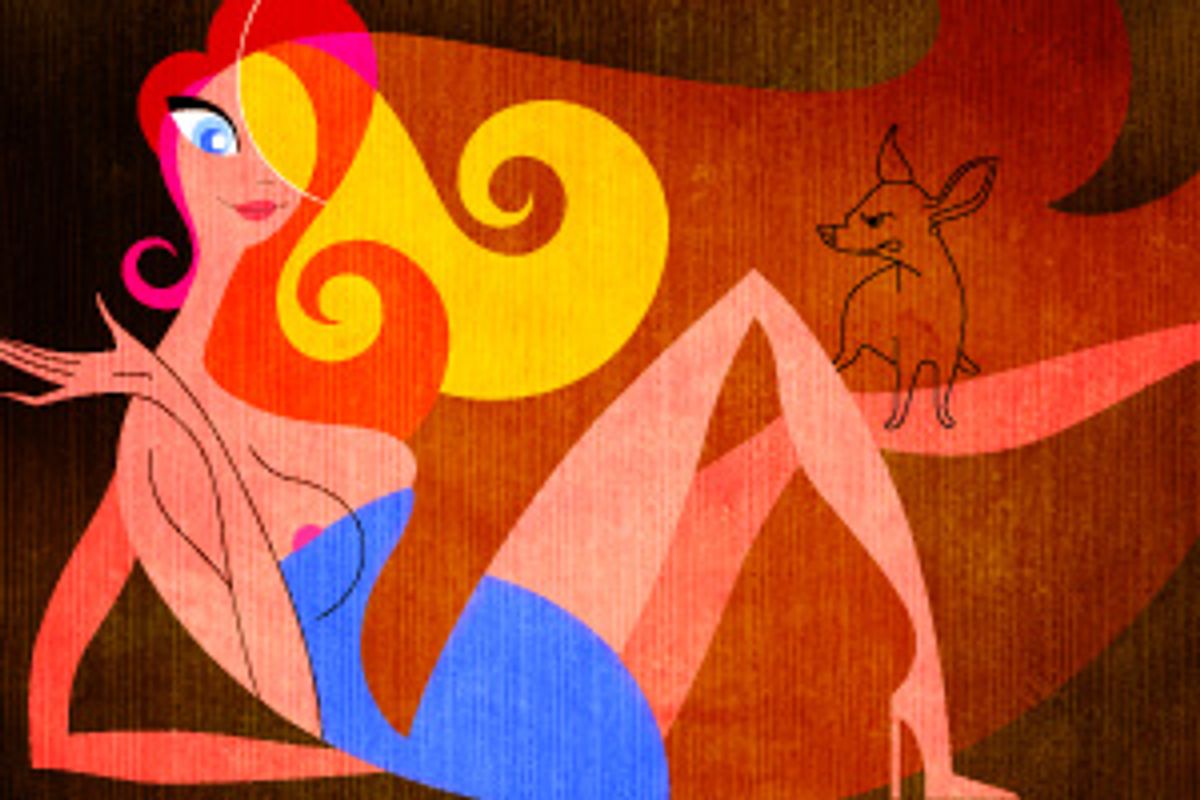
During the last week of April, Ellen DeGeneres welcomed Paris Hilton and her four Chihuahuas to her daytime talk show, ostensibly for a special episode about dogs. Once the host had the hotel heiress sitting down, however, she pressed her on a non-canine issue, asking whether she was hurt by Pink's video for "Stupid Girls," which mocks Hilton and her shopping-zombie peers for their essentially somnambulant behavior, and which two weeks earlier, DeGeneres had praised on her show. "I haven't even seen it yet," said the hotel heiress, in her flat monotone. "But I think ... it's just a form of flattery."
Any thinking person who has seen Pink's video, in which she sends up Jessica Simpson's "These Boots Were Made for Walking" video by humping a soapy car, imitates an Olsen twin in Montana-size sunglasses and Wyoming-size handbag walking straight into the plate-glass door of a boutique, and savagely mocks Hilton's appearance in a dingy night-vision sex tape, would not confuse the clip with any known form of flattery. Especially if that thinking person heard the "Stupid Girls" lyrics, which go, in part: "They travel in packs of two or three/ With their itsy-bitsy doggies and their teeny-weeny tees/ Where, oh where, have the smart people gone?"
But Hilton is not a thinking person. Or, if she is, she hasn't let on. For the purposes of the American public, she is chief Stupid Girl, unembarrassed to admit that she doesn't know what Wal-Mart is, to testify that she isn't aware that London is in the United Kingdom, or to get the name of her own video game wrong; Hilton is so vacant that her behavior recently inspired a new Page Six epithet: "celebutard." When DeGeneres pressed her on whether she felt any responsibility as a role model to young girls, Hilton averred: "I think I definitely am a role model? I work very hard. I came from a name, but I've done my own thing." DeGeneres neglected to point out that doing one's own thing in the face of terrible privilege is not the same as being a role model, especially when one's own thing involves trademarking the phrase "That's hot."
Listening to Hilton try to have a conversation, the wind whistling between her eardrums, makes it hard to ignore claims of cultural critics who have noticed an alarming new vogue for feminine vapidity. In addition to Pink's sharp-toothed treatise, the recent "American Idol" ascension of blond malapropism-spewing Kellie Pickler prompted a spate of stories about how playing dumb seems a sure way to get embraced by the American public. And Oprah recently summoned Pink, Naomi Wolf, "Female Chauvinist Pigs" author Ariel Levy and others for an episode called "Stupid Girls," which she kicked off by ominously announcing that culture is "devaluing an entire generation of young girls" by celebrating women as jiggly video stars, boobie-flashing twits, half-clad clotheshorses and label-whoring anorexics. To hear media watchdogs tell it, dumbness -- authentic or put on -- is rampant in pop-culture products being consumed by kids; it gets transmitted through their downy skin and into their bloodstreams through the books and magazines they read, the television they watch, the trends they analyze like stock reports, and the celebrities they aspire to be.
In an effort to find out exactly what signals teens could be picking up, I spent a couple of weeks as immersed in girl pop culture as an old-fogy 30-year-old can get -- reading sudsy high school novels and teen magazines, surfing MySpace, and watching MTV reality shows -- waiting to see if I'd be overtaken with the urge to don giant sunglasses and pretend not to understand math. I found myself pleasantly surprised at some of the teen media I encountered -- surprised enough to consider that the criticism we've been hearing may be vastly overblown by grown-ups who've forgotten the air-popped diversions of their own youth. But I was dismayed enough by the rest of it to acknowledge that the adults crying "fire" have a troubling point. Some of the images currently being retailed to teens illuminate both how far young women have come, and how easy it still is to cling to, recycle and sell outmoded yet comfortable images of unthreatening femininity.
I kicked off my inquiry into adolescent mindlessness at Barnes & Noble. I'd read Naomi Wolf's March New York Times essay about the objectified females with charge cards who populate the successful "Gossip Girl," "A-List" and "Clique" series and had been willing to believe it. Wolf had been appalled at the way the books' packagers (including 17th Street Productions, a part of Alloy Entertainment, the Y.A. advertising and marketing factory behind Kaavya Viswanathan's plagiarized "How Opal Mehta Got Kissed, Got Wild, and Got a Life") dressed their product in pastels to make them "look cute," so that "any parent -- including [her] -- might put them in the Barnes & Noble basket without a second glance," only to get home and find them full of "not the frank sexual exploration found in a Judy Blume novel, but teenage sexuality via Juicy Couture, blasé and entirely commodified." In truth, one look at the covers of the "Gossip Girl" books, many of which featured coltish females touching each other's butts or their own
I chose "I Like It Like That," mostly because the lipstick-application-cum-simulation-of-fellatio cover and a blurb promising "plenty of aprés-ski hot tub fun" seemed to be sound indicators that I would find Wolf's blasé and totally commodified teenage sexuality inside. Reader, I finished it. And, like, there was no sex. Don't get me wrong; "I Like It Like That" is a cheaply written book about spoiled teens who talk about sex, have apparently had sex in previous volumes, get angsty about virginity, smoke, drink, do drugs and drop brand names at an alarming per-sentence rate. (Study question: What is a Bogner ski suit and why is it a plot point in both "I Like It Like That" and Wendy Wasserstein's novel "The Elements of Style"?) But not once within the book's 202 pages do any of these kids get it on! In fact, one of the heroines, high school senior Blair (stop here if you're planning to read "I Like It Like That"), gets geared up to lose it to her best friend's older brother Erik, a super-foxy and rather sweet Brown freshman, but when they get naked, her knees sort of push him away. "I guess I'm not ready," she tells Erik, who smiles reassuringly and says, "Nah, you're ready. I'm just not the right guy, that's all." Alert the gatekeepers of virtue!
As far as mindlessness goes, "I Like it Like That" was far less aggressively anti-intellectual than what Wolf had prepared me for. Sure, the basic literary conceit and style are dopey, but since the books are about rich kids in Manhattan, the characters have expensive educations and highly developed senses of irony. If a Bogner ski suit nudges the story along, it's only fair to point out that so does a Marc Chagall painting in the Guggenheim. These kids refer to bulimia as "stress induced regurgitation" and wonder if a literary magazine called Red Letter was named in homage to Hester Prynne. Sure, these references are just signifiers of characters' elite places in the class pecking order, as one-dimensional as a pair of shorts with "Juicy" stamped across the ass. But if the fear is that kids are mapping out a pubescent path to brainless brand consumption by reading about (and being expected to understand the significance of) Prada, isn't it somewhat reassuring that they're also asked to recognize references to art and literature?
And while Wolf worried about the books' reproductions of a constant dilemma of young womanhood, that girls "are expected to compete with pornography, but can still be labeled sluts," I was actually impressed that the performances of objectified femininity were limited to a tight cashmere sweater here, a couple coats of lip gloss there. One of the most appealing women in the series has a shaved head.
"I Like It Like That" certainly doesn't tackle moral ambiguity with the sophistication of Dostoevski, or even of Blume. But if its readers have anything in common with its super-achieving characters they'll have read Dostoevski on their own. And if they haven't, chances are they're reading other books anyway; the young adult market is in the midst of a booming renaissance. "Gossip Girl" and its sisters seem to be filling out the time-honored "brain candy" category. Less pure but more readable than the Sweet Valley High novels of my youth, they're far cleaner than the vampirism of Anne Rice or the incest of V.C. Andrews. If those books didn't warp the kids who read them, I don't think we have to worry about the impact that "Gossip Girl" paperbacks are going to have on a generation that, it's worth remembering, spent their youth in midnight lines, waiting to get their paws on 800-page tomes about wizardry. Anyone who presumes that "Gossip Girl" is opening their wide eyes to the mercenary capitalism of high school has clearly never considered the differences between Cleansweep and Nimbus2000 broomsticks.
More problematic than teen literature is the craze for celebrity. Of all the evidence out there about the propagation of stupid-girl culture, it's most convincing to hear Pink talk about it. To begin with, she's 25. And her lyrics on the subject raise good questions: "Whatever happened to the dreams of a girl president?/ She's dancing in the video next to 50 Cent." In Entertainment Weekly, Pink pointed out that she doesn't actually think the women she goes after are truly stupid. "They've dumbed themselves down to be cute," she said. "I just feel like one image is being force-fed down people's throats. There's a lot of smart women. There's a lot of smart girls. Who is representing them?"
It's an excellent question. We have never been more soaked in celebrity culture. And yet, which celebrities hold teens in their thrall? There are women like skeletal Nicole Richie, who even venerable columnist Liz Smith recently took time to bemoan, "became a 'star' as soon as her weight dropped to scary skinny, [and who is] famous for being thin." There's Lohan, who may or may not be a good actress, but whose craft has come second to carousing and the development of her handbag collection. Even the Olsen twins, kajillionaires whose business acumen was widely touted when they were preteens, seemed to shrivel when they hit their 18th birthday. Now, their reputations as precocious entrepreneurs are shadowed by their profiles as consumptive, shabby-chic munchkins: little, dim and more famous than ever.
The video clips that played behind Winfrey's dirge for the emancipated female at the start of her show amplified concerns about the dearth of female role models: There were Lohan, Richie and Jessica Simpson, "Video Vixen" Karrine Steffans, a "rose ceremony" from desperate-mate-foraging spectacle "The Bachelor," along with anachronistic shots of senescent stars like Madonna and J.Lo showing off their attenuated limbs and bubblicious booty, respectively. In a taped interview for Oprah, a worked-up Wolf said, "What's beaming at young teenage girls is unfortunately an image of celebrity perfection which is pretty mindless."
Pink told Oprah that she and her friends could name only three celebrity women her age and under who were known for being bright; they were Natalie Portman, Reese Witherspoon and Angelina Jolie, though both Witherspoon and Jolie are over 30. There are a few other young favorites who could have qualified for the list: Maggie Gyllenhaal, Alicia Keys and Pink herself, who was recently reported to be reading Maya Angelou's "I Know Why the Caged Bird Sings" and Levy's "Female Chauvinist Pigs," and whose bristling ditty "Dear Mr. President" is smart enough to be getting banned in high schools across the country. But basically, the pickings are slim.
And while vacuous pink-fleshed icons of privilege would seem to hold sway mostly on white-girl culture, the picture isn't much brighter on African-American radar, where celebrity and material aspiration is embodied by mute, bling-laden, gyrating "video girls," the most famous of whom is Karrine Steffans. Steffans' recent tell-all, "Confessions of a Video Vixen," earned her a place on Oprah's couch, where she cried about the way she had been objectified by the rappers she danced for and slept with. But her book isn't being read as a cautionary tale; it's become a cult hit with young readers who refer to it as "Superhead," the nickname Steffans earned in her years as a dancer, presumably by administering super head to a variety of famous men. Days after she appeared on Oprah, it was reported in the New York Post that Steffans would be moving on to porn.
If there were anywhere I would have expected to find an airhead ethos come alive, it would have been in the crop of teen magazines I'd always considered beauty-obsessed gateway drugs to full-blown fashion addiction. A stack of these volumes, with their citrus typeface and cotton-candy cover lines, seemed to promise unthreatening vapidity inside, right down to Pink herself on the cover of Seventeen, next to the thunder-stealing headline: "I'm a stupid girl every other day."
Inside, the magazines confirmed some of my suspicions with expensive fashion spreads, headlines that read, "So You Want to Be Sienna Miller," and the occasional, lame deployment of teenage patois like "for realz." But to my surprise, the same issue of (recently defunct) ElleGirl that printed those words also featured book reviews under the headline "Word: Reading Comprehension Is Sexy." CosmoGirl interviewed "Napoleon Dynamite" star Jon Heder, who advised, "Guys love smart girls, so don't act dumber than you are," and published love advice from "Saturday Night Live" eggheads Tina Fey and Amy Poehler.
Most startling were the "Real Life" pages over at Seventeen, one of which explained threats to American privacy. "After 9/11, Congress passed the USA Patriot Act, which lets the Feds look at your private medical and financial records," read the text. "Plus, it just came out that the National Security Agency has been eavesdropping on people's phone calls since 2002 -- without warrants!" A later section on "anti-American feelings" explained that "The US is very wealthy compared with other nations and has a lot more resources and weapons. Many people ... feel we use this power to help our own interests -- like they believe we invaded Iraq to get cheaper oil -- and that we don't respect or care about their way of life."
So it's not Susan Sontag. But it's a hell of a lot closer than the "plaids are in for fall" pap I remember reading as a 12- or 13-year-old (17-year-olds do not read Seventeen). Yes, teen magazines are riddled with images of richly swaddled urchins who look a couple of PowerBars short of a healthy Body Mass Index. But the editorial content presented a serious progression. The reason that the late magazine Sassy is so revered by women my age is because it treated its readers like human beings with interests: in their own health, in music, books, movies, politics. Now, it seems, Sassy's mainstream sisters have begun treating young women with a similar regard.
My attempt at honest immersion in teenage-girl land necessarily stalled online, specifically on MySpace. I spent hours in the maze of profiles and messages; I saw dishabille Lolitas beckoning to Web-savvy Humbert Humberts, suggestively Sapphic images on the home pages of girls who claimed to be 15 and 16, several teens who listed "The South Beach Diet" as their favorite book. But I also visited pages of 17- and 18-year-olds decorated with teddy bears and pictures of horses. Teen women use MySpace to post enunciations of their devotion to field hockey, feminism, God and Kanye West. MySpace is a country unto itself. Finding the evidence for any argument you'd like to make about American teens is possible: A search mechanism will dredge up any predilection or bad habit or nickname. Reading public expressions that would only recently have been private -- cringey blogs chronicling breakups and bad grades, extensive online exchanges about girls cashing in their "v-cards" and plotting to get wine coolers for sleepovers -- will confuse anyone who ever thought of a diary as something that had a lock and key, or who threaded a phone cord up the stairs and down the hall and under a door so that they could trade whispered secrets with friends, far out of earshot.
But my perplexity at the "Hiya! LOL! XO!" genre of communication was based in a lack of context for what I was watching, context I didn't lack when I turned on my television and found "My Super Sweet Sixteen." A reality show on MTV, the program chronicles the celebratory excesses of 15-year-old girls (and boys) who persuade their parents to shower them with adulation and automobiles as they make the profound passage between teenager and incrementally older teenager. Watching this orgy of consumption on a couple of occasions, before beginning this story, is the closest I have come to fearing that the end of the world is near. These kids get carried into their parties on litters; they get dropped from helicopters; invitations are handed out by manservants.
"Super Sweet's" new sister show is "Tiara Girls," which follows beauty pageant contestants. The pageant circuit, on the opposite side of the culture war divide from some of the lavish, celebrity-studded events featured on "My Super Sweet Sixteen," is no less materialistic. Contestants discuss the amount of money they spend on dresses; they hire pageant coaches; and whatever the current line on pageantry is, there is no focus on the female intellect. In one episode, an aspiring Miss Louisiana Queen of Hope prepared for the interview segment with a little quizzing from her coach. What, asked the coach, is the vice president's name? "Wait," the contestant said, stalling. "His name's Kennedy, right?" It's a knee-slapper that apparently never gets old; the "Tiara Girls" season finale has been advertised by a clip of another pageant entrant flubbing the name of the commander in chief himself, then grumping to the camera: "It's a beauty pageant; what does it matter who the president is?" In one episode, a contestant's father ordered her to stop doing her homework to prepare for competition. "But I want to do my homework," the young woman said hopelessly to the camera.
"Sweet Sixteen" and "Tiara Girls" are transmitting aggressively mixed signals to their viewers. On one hand, they're car wrecks that mock their subjects in strict accordance with the basest class and cultural assumptions out there. The hyper-affluent party throwers on "Sweet Sixteen" come across as empty-headed, entitled brats, while the mostly lower-class beauty contestants appear simultaneously thick and shallow. But the degradation of the subjects is the backbeat to the melody being broadcast to kids: This is what you are supposed to look like; this is what you do look like; these are our expectations of you; if you fulfill them, you too can be on television.
Both shows demonstrate the complicity of parents in their kids' exploitation. If it long ago ceased to astound me that any kid could survive seeing their own avarice and vapidity broadcast on national television, the question remains: Why on earth would their parents participate? But on "Super Sweet Sixteen" and "Tiara Girls," parents seem to be seeking the same cable-television spotlight that must motivate their children to self-exposure, without any concern that a nation (let alone their neighbors) will get to see them pushing their daughters to get collagen lip injections, or enabling their offspring's insatiable greed by never setting limits and getting them two cars.
When describing what's problematic in trashy teen fiction, Wolf wrote of the good old days, when the fictional younger generation's role was to poke holes in their parents' social artifice and find their own paths. Today, Wolf complained, teenage heroines "try on adult values and customs as though they were going to wear them forever. The narratives offer the perks of the adult world not as escapist fantasy but in a creepily photorealistic way."
The tension between adolescent and adult has always been a tricky mix of imitation and rejection. Vexing her elders, adopting ill-advised role models and cleaving to habits that will most aggravate her parents is basically the job description of a teenager. But we're in a period when adult and teenage worlds seem to be meshing, making Wolf's implied wish -- that teenagers would crumple up and jettison parental mores -- a complicated proposition. Adults push children to learn and socialize earlier than ever; we rush them with Baby Einstein videos, obsess over their achievements and wail over their failures. We treat them as mini-me's at the same time that we infantalize them, fretting over just about every message that's been transmitted to them from the moment they are expelled from the womb, except for the ones we set for them by example.
Adults have made careless consumption the crowning American pursuit. We have invented and happily consume magalogs full of luxury items. Teenagers didn't create Paris Hilton. In fact, they wouldn't have any idea who she was if adults hadn't elevated her from a dull table-dancing heiress by circulating a porn tape and giving her a reality show. Teenage girls don't write the "Gossip Girl" books; 35-year-old Cecily von Ziegesar does. And consider the cabal of studio heads, publicists, club owners, photographers, designers and magazine publishers who have colluded to make Lindsay Lohan famous, drunk and ubiquitous so that she can sell their magazines, movies and handbags to teens who might rightly get the impression that they should live like her. Eliot Spitzer, of all people, recently accused the grown-ups over at Lohan's record company of goosing her popularity by bribing radio stations and MTV to play her music. It's all in the name of legitimate American enterprise, sure. But how can we be surprised when the kids we are hustling take our cues and mimic even our most corrupt behaviors?
And how about the fact that it's not just teens photo-realistically aping the adults, but adults who are aping their own teens? The Alcotts and Austens and Brontës that Wolf recalls with deserved reverence would have blanched had they encountered the slice of the maternal population currently striving to look and dress like their daughters. Which is more alarming -- reading about Lohan drinking too much and collapsing from "exhaustion," or reading about her mother, Dina, sponging off her daughter's success and cavorting with her beyond every velvet rope? It's fair to ask, as Pink does, how many girls long to mimic Lohan. But it's also reasonable to wonder whether any of their mothers long to live like Dina?
The current wave of flaky-chic is no more potent than other historical iterations of American worship of the dumb blonde, which has venerable roots with Marilyn Monroe and Judy Holliday. Teens (and adults, for that matter) have never fallen for celebrity heroes based on their great calculus grades. But that particular mold of femininity was one of the constructs from which women's liberation was supposed to deliver us. What does it mean that in 2004, Jessica Simpson got famous for being flummoxed by a can of Chicken of the Sea tuna on "Newlyweds," and that in 2006, Kellie Pickler became a star by asking, "What's a ballsy?" For one thing, it means that the same young women who had hung on Simpson's every word about staying a virgin till marriage and who were calling in their votes for Pickler were also getting the message that it's funny and attractive to be an idiot.
MTV News producer Jim Fraenkel told the New York Post's Farrah Weinstein in a piece about Pickler that he "wouldn't necessarily say that she's so savvy she's tapped into the idea that America loves a stupid girl, so much as that she may think of herself as Jessica Simpson was." But aren't both realizations pretty much the same thing? And aren't they both an embarrassing sign that we haven't come very far at all, baby?
Yes, they are. But modern women, like generations of men before them, now have many areas in which to hunt for role models. They receive instructions that directly contradict the Pickler-Simpson Principle of Sexy Vacancy every day: achieve, go to school, work, make money, compete. Retro visions of stupid appeal are answered by fresh acknowledgment of energetic female sexuality that is far more open -- if dangerously commodified in its own way, critics argue -- than ever before. None of it is in perfect balance; women are punished for their progress all the time, in media and politics and in classrooms. Adolescent girls still have no female president to look up to, and too few artists and tycoons and athletes and activists. But there is no denying the past half-century's earth-shaking and positive shifts in the gender terrain. As has been widely reported (with varying degrees of rancor) women now make up more than half the country's collegiate student body.
But these new, varied and wildly threatening options help to explain and undergird a rejuvenated craze for dumb chic. Perhaps, as social progress propels women slowly but undeniably forward into public spheres of influence, baser human impulses -- erotic desire, capitalist greed -- dig in, summoning and then clinging to a dusty daydream of the fast-fading ideal woman of yesteryear.
Working on this story, I received an e-mail from a Harvard graduate student who told me that while he'd dated only smart girls, he "liked the 'idea' of dating a dumb girl." The fantasy, the student explained, "is almost certainly formed for us by the media representations of ... celebrities [like Hilton, Lohan, and Simpson]. Blonde dumb girls are sexy. And won't talk back. Add in various shades of male ego/guaranteed superiority notions, and you've pretty much got it." In a world in which male superiority is no longer guaranteed, it becomes a lascivious desire that can be gratified, performatively if need be, by willing women. As Pink trills, mockingly, "Maybe if I act like that/ that guy will call me back."
But it's time to put that transactional model for romance out of its misery, and make room in the pop firmament for examples that sound more like Pink's self-assessment: "I'm so glad that I'll never fit in/ That will never be me/ Outcasts and girls with ambition/ That's what I wanna see."
Shares