As a young, new, Christian parent, Meggan Judge, 26, of Anchorage, Alaska, was looking for guidance in raising "Godly children." She found advice that clicked for her when a friend loaned her a popular -- and controversial -- Christian parenting book called "To Train Up a Child," written in 1994 by Tennessee pastor Michael Pearl with his wife, Debi, who claim to have raised five "whineless" children. At the book's core is the notion that when parents "train" a child to obey early on, even before he or she is able to make conscious, or conscience-based, decisions, home will be a place of peace and harmony. Here, the term "train" is a reference to Proverbs 22:6: "Train up a child in the way he should go, and when he is old he will not depart from it."
Neither Pearl has advanced training in child development or a related field. "These truths," the tall, white-beaded Michael Pearl, 60, writes in his book, "are not new, deep insights from the professional world of research, [but] rather, the same principles the Amish use to train their stubborn mules, the same technique God uses to train his children."
As you may have guessed, the Amish do not train their mules by giving them "timeouts." Judge and her husband followed the Pearls' advice when trying to train their infant son Noah not to grab forbidden objects: "Switch their hand once and simultaneously say, 'No.' Remember, you are not disciplining, you are training. One spat with a little switch is enough," reads the book. "They will again pull back their hand and consider the relationship between the object, their desire, the command and the little reinforcing pain. It may take several times, but if you are consistent, they will learn to consistently obey, even in your absence."
Problem was, Noah didn't learn so fast. By the time he was almost 2, neither the word "no" nor a swat on the hand were getting through to him. "I remember thinking how stubborn he was, and that he was a smart baby and should understand what we were doing. He was obviously being defiant. Obviously, I wasn't switching him enough," Judge says sarcastically. "So I did it more." Contrary to the Pearls' advice to use an object and never, ever to strike in anger, Judge used her hand, so as to better gauge the strength of the blows. When her hand got sore, she used a wooden spoon.
By this point, Judge had another baby -- and, though she didn't realize it at the time, a case of postpartum depression. One summer day it became clear to her that the Pearls' advice and her own rages were a toxic combination: Judge had to lock Noah in a separate room for fear she would "beat him senseless," she says. "I just wanted to know when that damn 'peace' the Pearls talk about was going to come."
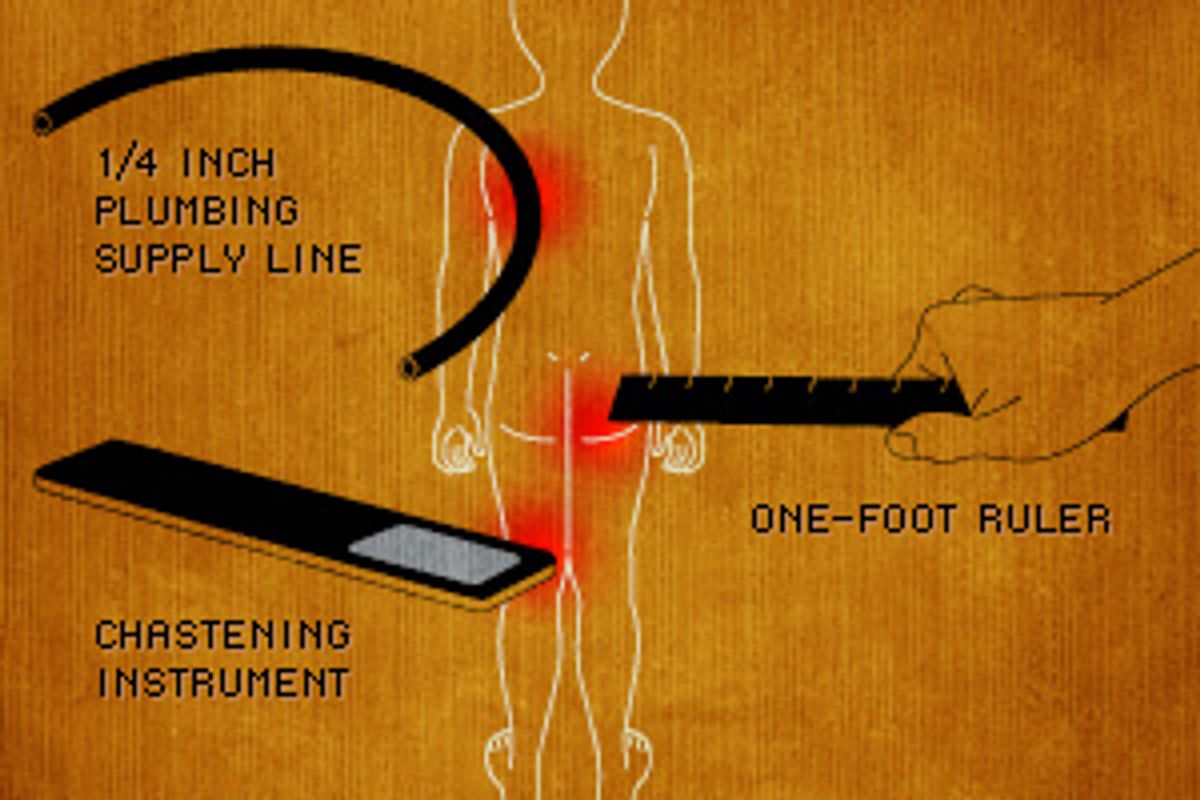
While the Pearls are well known in fundamentalist Christian circles, they were largely unknown to the secular world until March, when their discipline methods were tied to the death of a North Carolina boy and the alleged abuse of two of his siblings. As reported by Mandy Locke of the Raleigh News & Observer, the children's adoptive mother, Lynn Paddock, 45, a devotee of the Pearls' teachings, is currently behind bars. She is charged with first-degree murder in the death of 4-year-old Sean, who suffocated when wrapped tightly in blankets, reportedly to keep him from hopping out of bed. She is also charged with felony child abuse in connection with welts found on two of Sean's other five siblings. Nowhere in the Pearls' book do they advocate restraining with blankets; however, Sean's siblings had apparently been struck with a particular type of "rod" recommended by the Pearls: a length of quarter-inch plumbing supply line.
Paddock's attorney, Michael Reece, confirmed to Salon that Paddock owned "To Train Up a Child" and was a devotee of the Pearls' teachings. He maintains that Sean's death was accidental and that there's a difference between corporal punishment -- which he acknowledges may be "unpopular" -- and abuse. And actually, Paddock's connection to the Pearls may serve as part of Reece's defense of his client. "She's following a recognized philosophy even if it's not a mainstream one. The only one who advocates the PVC pipe is Pearl, " he says. "You can pull a switch off a tree all day long. There's no other reason to buy a PVC pipe -- that's clearly from him."
For the Pearls and advocates of Christian child "training," obedience is next to godliness. For their detractors, fellow Christians and home-schoolers among them, corporal punishment is akin to child abuse -- and to them, the Paddock case proves it. ("Christian," here and throughout, indicates fundamentalist or evangelical Protestants.) Outrage sparked by the case has fired up the blogosphere, bringing impassioned new attention to what is actually not an entirely new debate. Parents, religious and otherwise, have argued the merits and dangers of spanking since the invention of children. When it comes to physical "training" as essential to "biblical" child-raising, the Pearls are neither pioneers nor renegades; for fundamentalist Christians, corporal punishment -- or, as the Pearls prefer, "chastisement" -- is neither a fresh nor a fringe concept. But what's clear is that today, the controversy over biblical child-rearing is more than a family matter. Especially to its supporters, child "training" is yet another battleground in the culture wars.
As the Pearls, their advocates, and supporters of similar Christian parenting approaches appear to see it, child "training" serves, in part, as a bulwark against "modern," liberal, secular, permissive, "child-centered" parenting -- the touchy-feely stuff of timeouts that, they suggest, spoils children into believing in a boundary-free world that revolves around them. "Pearl and others in their camp associate permissive parenting and the assumed moral laxity that it produces with non-biblical, humanist or naive understandings of human nature. It's 'us,' the true believers, against 'them,' the secularists and anyone else who has fallen under their influence," says Mark Justad, senior lecturer in religion and society and executive director of the Center for the Study of Religion and Culture at Vanderbilt University. "It's all part of the larger picture of returning our whole culture to godliness." Or at least preserving godliness in one's own family, safe from the "crusade" launched by "spanking abolitionists," safe from the influence of the corrupt, and corrupting, secular world.
"If you want a child who will integrate into the New World Order and wait his turn in line for condoms, a government funded abortion, sexually transmitted disease treatment, psychological evaluation and a mark on the forehead," writes Pearl in "To Train Up a Child," "then follow the popular guidelines in education, entertainment and discipline, but if you want a son or daughter of God, you will have to do it God's way."
Michael Pearl's rural church is tiny, and his home base so remote that, with no broadband access, Internet connections require a satellite hookup, says their business manager, Mel Cohen. Still, the Pearls' 18-employee nonprofit company, No Greater Joy ministries, is big business. According to Cohen, much of the ministries' $1.5 million annual earnings go right back out the door via product donations as well as financial support for missionaries in nine countries. The Pearls have sold or donated -- to churches, military families and community groups -- more than 1,000,000 copies of their books, CDs, DVDs and other materials related to the Christian family. Their bimonthly newsletter has 74,000 subscribers, a number that's growing each month. "To Train Up a Child," in particular, is frequently sold or passed around via church groups and home-schooling conferences.
While the Pearls are not in direct competition with Christian media juggernauts such as Veggie Tales or "The Purpose-Driven Life," they are part of the booming religious publishing and products market, which hit $7.3 billion in 2005 -- a 28 percent increase since 2002, according to an April 2006 report by Packaged Facts, the publishing division of MarketResearch.com. Among Christian books, the "Christian Living" subcategory, which includes parenting, is one of the most popular sub-segments; products for children are expanding as well. The Packaged Facts report, titled "The Religious Product Market in the U.S.," cites "the culture wars" as being one reason for this overall growth. "What has until recently frustrated evangelicals is their difficulty in translating political power into social and cultural clout," states the report. "In addressing and attempting to redress this problem, evangelicals are increasingly turning to publishing."
As for their position on corporal "chastisement," the Pearls are following in the footsteps of their forebears -- and are not out of step with most of their peers. "The tradition of 'breaking the child's will' using physical punishment is long-standing among evangelical, fundamentalist, Pentecostal and charismatic Protestants," says retired Rutgers University historian Philip Greven, author of "Spare the Child: The Religious Roots of Punishment and the Psychological Impact of Child Abuse." "It's associated with a very strong patriarchal authoritarian tradition," he adds, along with a belief in the literal truth of the Bible. Greven found calls to physically punish children in 17th and 18th century American Protestant texts; he was surprised, in the course of his research, to see that they'd persisted into the20th century and even today.
Indeed, not sparing the rod is the norm among Christian parenting books. Ted Tripp's 1995 book "Shepherding a Child's Heart," which endorses judicious spanking, was recently at No. 37 on Christian Retailing magazine's list of bestsellers; the same magazine, last October, called W Publishing "one of the first major Christian publishing houses to publish a book that is opposed to spanking children." (The book is "Grace-Based Parenting" by Dr. Tim Kimmel.) And today, there are not only texts, but also products, such as "The Rod of Discipline" (see Proverbs 22:15 ) and a plastic "chastening instrument" said to "fit easily into purse or travel bag."
The Pearls, who almost never give interviews, declined to speak with Salon. Their business manager, Mel Cohen, essentially said that they rely on their publicly available writings to speak for themselves. Indeed, a thorough read of "To Train Up a Child" -- along with "In Defense of Biblical Chastisement," Parts 1 and 2, on the Pearls' Web site -- says quite a bit. Much of the Pearls' instruction is not about "switching," but simply about raising cheerful, creative children, who value adventure and accomplishment, and enjoy a close bond with both parents -- "Plan your life's trade so as to maximize your role as father," Pearl admonishes men. "Fathers who become absorbed in their success in business will make lousy fathers" -- and who know they are loved.
Still, as the Pearls define it, "training" is considered a means of showing love. "Training" children to obey unconditionally is much more than training them, say, not to bother Mommy. It is training them to submit to the will of God. "When the child is young, the parents are the only 'god' he knows. As he awakens to Divine realities, it is through his earthly father that he understands his heavenly Father," Pearl writes in the book. "As the child relates to the figurehead of authority (his parents), in like manner he will later be prone to relate to God. If, when the parents say, 'No,' they do not mean 'No,' then the 'thou shalt not' of God will not be taken seriously either."
And yes, "training" -- as with a puppy or mule -- involves asserting one's dominance, even inflicting small, non-injurious amounts of pain. Pearl is extremely precise in such prescriptions: hitting or spanking must never, ever be done in anger or as punishment, but rather only as a means of calm, consistent, reasoned, loving conditioning. And never with the hand.
"Select your instrument according to the child's size," writes Pearl. "For the under one year old, a little, ten to twelve-inch long, willowy branch (stripped of any knots that might break the skin) about one-eighth inch diameter is sufficient. Sometimes alternatives have to be sought. A one-foot ruler, or its equivalent in a paddle, is a sufficient alternative. For the larger child, a belt or larger tree branch is effective." Additional advice from their Web site: Switching with a length of quarter-inch plumbing supply line is a "real attention-getter."
"Hands," by contrast, "are for loving and helping," Pearl writes.
Yet again, in a sense, so is the switch. "The parent holds in his hand (in the form of a little switch) the power to absolve the child of guilt, cleanse his soul, instruct his spirit, strengthen his resolve, and give him a fresh start through a confidence that all indebtedness is paid..." writes Pearl. "After a short explanation about bad attitudes and the need to love, patiently and calmly apply the rod to his back-side. Somehow, after eight or ten licks, the poison is transformed into gushing love and contentment. The world becomes a beautiful place. A brand new child emerges. It makes an adult stare at the rod in wonder, trying to see what magic is contained therein."
"Training," as Pearl defines it, is practically the polar opposite of abuse, which goes more like this: "The child is rebellious. The parent suddenly loses it and screams out. Like a whirlwind, the child is snatched up by the arm and given several bangs on the bottom. The parent's eyes burn. The brow hardens. The pulse rate soars ... 'You will do what I say. You are not going to do this to me, little girl,'" he writes, concluding: "There is no place for that selfish vindictive streak in the discipline of children."
A parent concerned that he or she is crossing the line should ask the opinion of respected friends -- and look upon the face of his or her child. "If your child is broken in spirit, cowed and subdued, you have a problem," he writes on his Web site. The advice there: "Get counsel in a hurry." In his book, he shows less patience. Pearl sarcastically offers abusive parents "The Millstone Award," which is a pretty threatening reference to Matthew 18:6: "But whoso shall offend one of these little ones which believe in me, it were better for him that a millstone were hanged about his neck and that he were drowned in the depth of the sea."
Many Pearl supporters were unwilling to speak on the record, wary of their opinions being taken out of context. But Lauren and Joel Killion of Wilson, N.C., along with Meggan Judge, were interviewed by Locke of the News & Observer, and then by Salon. The Killions received "To Train Up a Child" in a "welcome wagon" basket from a community group when their daughter Moriah was born. The Killions now attribute Moriah's obedience, patience and good cheer to the principles in the book -- though it wasn't easy to apply them at first. "It was so hard not to always let her get her way when she cried," recalls Lauren, 27, a former kindergarten teacher who now stays at home with her daughter. She recalls wincing when her husband switched Moriah lightly with a small twig from a tree, which they tested on themselves first. Now that their daughter is all of 2, Lauren says, they seldom use it; if anything, they simply walk toward where it's kept and Moriah straightens right out. "The rod in the hands of a loving parent is the right thing," Lauren now says with assurance. It's hard not to notice that while Lauren is talking on the phone, and fixing supper, Moriah is chattering happily in the background. Only once during a 30-minute conversation does she interrupt Mom with a request for a favorite video, and only once does Mom have to say no.
"We're only treating our child the way God would treat us," adds Lauren's husband, Joel, 26, a banker. "As in Hebrews 12, He chastens those whom he loves. If I love my child, I am going to train her. Others don't have to believe that, but I do."
Yes, but precisely where in the Bible do we find mention of quarter-inch plumbing supply lines? First, it should be noted that the oft-quoted expression "Spare the rod, spoil the child," frequently assumed to appear in the Bible, actually appears in Samuel Butler's 17th century satiric poem "Hudibras." But that doesn't mean that biblical references to "the rod," many of which occur in Proverbs, are altogether pretty: "Chasten thy son while there is hope, and let not thy soul spare for his crying" (Proverbs 19:18); "Thou shalt beat him with the rod, and shalt deliver his soul from hell" (Proverbs 23:14). For some, such passages are eternal, universal precepts for child-raising. Others reduce the passages to their historical context, reading them as nothing more than King Solomon's personal parenting primer. Still others note that the word "rod" appears throughout the Bible, translated from several different Hebrew words, one of which connotes the rod a shepherd might use -- not to strike his sheep, but to guide them.
In any regard, for believers in child-training, causing the child palpable harm is antithetical to their mission. Child Training Resources offers this disclaimer with its "chastening instrument": "Though each instrument includes instructions for proper use, we highly recommend parents train themselves by reading and discussing Biblically-based parenting books together. Child Training Resources stands firmly against any and all child abuse and is not responsible for misuse of this product."
Likewise, the Pearl camp considers the Paddock case an aberration. "How that can be traced to the Pearls seems a little ridiculous to me," says Pearl business manager Cohen. "There's nowhere in the book that says, 'Here's how to smother your child.' I look at it this way: A doctor says, 'One ounce of red wine a day will do your heart good.' Then someone drinks five quarts and runs somebody over -- you can't go back and blame the doctor for recommending one ounce. To blame the Pearls here is really a stretch."
While supporters of child-training see the Paddock case as a tragic misuse and misrepresentation of Pearl principles, some of their opponents have taken it as a call to arms. Recent protest has perhaps been loudest and most organized among home-schoolers. "Most home-schoolers, secular and Christian, are familiar with the Pearls, and speaking out never made a difference. Now a child has died and public scrutiny is on the Pearls. Strike while the fire is hot," says a home-schooling Oregon mother of 16-year-old triplets who blogs under the name "Doc Smith." (She requested that her real name not be used because of the threatening comments she and others have received in response to their anti-Pearl posts.)
Following in the footsteps of a British blogger known as Carlotta -- who, pre-Paddock case, worked to draw attention to the association between the Old Schoolhouse Magazine, a popular Christian quarterly for home-schoolers, and the Pearls' ministry, one of its advertisers -- Doc launched a boycott of the magazine and its partner blog services, Homeschoolblogger.com and Homesteadblogger.com. Other bloggers picked up the banner. (One printed anti-Pearl T-shirts. ) As a result of such efforts, Doc estimates, at least 250 bloggers have left Homeschoolblogger.com. Rumors abound that the Old Schoolhouse's subscriptions have dropped since the boycott -- its current readership is around 100,000 -- but according to the magazine, business is booming. "Subscriptions are actually up," says Nancy Carter, marketing manager. "With bad P.R. I think you also get folks saying, 'Hey, we want to show you we support you.'"
Doc admits that this boycott is but a "small battle" in the fight against child abuse. Ideally, she'd like to see the Old Schoolhouse -- a major market source for an often-isolated community -- stop printing articles by the Pearls and advertising their wares. But she hopes at the very least to draw attention to the methods espoused by the Pearls -- and distinguish them from other branches of the home-schooling community. "When a secular person/parent whips a kid, they're doing it because they're ignorant or just a jerk. They don't say God gave them permission or commanded them to do it," she says. "Home-schoolers who beat their kids make all home-schoolers look like freaks."
One home-schooling/blogging mother went so far as to buy the plumbing hose and try it on herself. "What I did was take the small supposedly 'harmless' tube and LIGHTLY tap myself on the forearm with it," she reports. "Not only did it sting like an SOB but it also left welts on my arm for TWO hours afterwards."
As for Christian parents who disavow "child training," many ask, in effect, What kid would Jesus hit? As Susan Lawrence, a devout Lutheran home-schooler and founder of StoptheRod.net, told Beliefnet, spanking children is "against the Golden Rule, the number one rule that Jesus gave us for human relationships. You're supposed to treat other people the way you want to be treated yourself." (Lawrence did not respond to an interview request from Salon.)
Some Christian parents have tried to find a middle ground between "punitive" and "attachment" parenting; others distance themselves from physical child-training while stopping short of overtly criticizing their peers. "I believe that Christian parents from both approaches love their children deeply and have a heart's desire to follow God and to raise their children for His glory, and I have no desire to create further division in the Christian parenting community," says Jeri Carr, 35, a home-schooling mother of four in Washington state. Initially, however, Carr had trouble finding a place there for herself. She founded the Web site Gentle Christian Mothers nine years ago after determining that other Christian parenting resources ran counter to her "God-given mothering intuition." There was no Christian support for many of the "gentle parenting choices," such as feeding in response to hunger, as opposed to on a schedule, that she believed in, she says. "I felt very alone. "
Then Carr came across a technique called attachment parenting, a "secular" style promoted by other Christian parenting Web sites such as Arms of Love Family Fellowship. "I began mothering my little one more responsively and from the heart, making more gentle choices," she says. "I had always planned on spanking my children, but I began to realize that I didn't have to spank in order to please God, and God led my husband and me to discipline our children without spanking them."
But what about all those verses in Proverbs? "The 'rod,' or staff, our Shepherd holds is one that He uses to comfort us, guide us, lead us, protect us," Carr says. "As Christian parents we desire to show God to our children through our relationship with them, a God who is loving and gracious, who is always there for us and who answers our cries and treats us with gentleness and kindness."
Gentle Christian Mothers has also become, in part, a support community for mothers like Meggan Judge, who was at first convinced that Noah's recalcitrance was entirely her fault. "They tell us that if parents would only spank 'correctly,' parents will get the results -- the first-time, happy obedience -- that they desire," says Carr. "When it doesn't 'work' parents can end up feeling very guilty and worried that they are doing it wrong and are failing to do it the biblical way. They may worry that they'll wind up with out-of-control children, so they try harder to do it 'right,' and the battle continues. Children may end up bitter and angry, and deeply hurt, with a warped picture in their mind of who our gracious God truly is."
Of course, it's not only certain home-schoolers and Christians who oppose corporal punishment for children (often referred to as "spanking," which is understood as a catch-all term for physical discipline). Though they do not necessarily evaluate the kind of highly routinized "discipline" described by the Pearls, copious studies attest to the short- and long-term damage spanking, in its various forms, can do. "The evidence is that any corporal punishment, on average, is harmful down the road," says leading family violence researcher Murray Straus, professor of sociology and co-director of the Family Research Laboratory at the University of New Hampshire. Among other problems, it has the potential to threaten the parent-child bond, inhibit the development of conscience, lead to juvenile delinquency, and even partner violence, Straus says. (Some disagree, saying -- for example -- that children who grow up with an understanding or fear of "consequences" are less likely to get into trouble down the road.) "There are now three very good studies showing that the more someone was spanked as a child, the more likely they are to hit their partner as an adult," says Straus. (Some suspect that spanking at home, or paddling at school, may be particularly harmful to girls.)
According to Straus, even the controlled, limited, non-anger-based spanking associated with child-training can be a matter of concern. "It's better in the sense that it has a morally correct purpose," he says. "But it's worse in the sense that it teaches you that it's morally correct to hit."
And what of people who say, "I was spanked and I'm OK! I love my parents, I'm not a delinquent, I never hit my wife"? "They're telling the truth," Straus says. "It's about probability. One-third of heavy smokers will die of lung cancer, say, but two-thirds will not. That doesn't mean smoking doesn't cause lung cancer. The implication to me is that people who were spanked and are OK are, like that other two-thirds, the lucky ones."
All of that said, experts are not unanimous on the issue of spanking. Those who say it can have its place, expert or parent, are not necessarily making their case from a Christian perspective. Its advocates -- even those who peddle paddles -- are, like the Pearls, exceedingly careful to articulate a clear distinction between discipline and abuse, between spanking, say, and beating. Occasional swats, perhaps as a last resort, accompanied by an explanation: yes. Impulsive, enraged, indiscriminate wallops: no. For their part, opponents of corporal punishment make clear that no spanking (or very rare spanking) does not mean no discipline, that even "positive" parenting teaches boundaries.
One person Straus might call "lucky" is Rebekah Pearl Anast, 32 one of the Pearls' grown daughters, who did agree to speak to Salon. "I have a wonderful life. I think that the fact that all five of us are very happy, balanced people with great marriages and happy kids is evidence that my parents did the right thing," says Anast, who lives on a Navajo reservation in New Mexico and who runs, with her husband, the wellness Web sites Beeyoutiful.com and WellTellMe.com. "And my memories are full of being with my dad, going fishing, exploring the Mississippi River bottoms -- just being with my parents. The most significant factor in who I am is that my parents gave me themselves."
Yes, and they also gave you spankings, no? "I never received a spanking that left bruises or broken skin, and more importantly, I was never punished with one of my parents being angry," she says. She recalls only one spanking incident in particular -- one she says she deserved. "I'd done some sort of prank that I don't remember, something dangerous, but also funny," she recalls. "Mom was giving the spanking, and Dad was laughing, though he was trying not to. So was I. But the spanking wasn't pleasant -- they still managed to communicate, 'Don't do this ever again because you could hurt someone -- and here is your just reward.'"
More often than not, though, "just rewards" were not physical. Often she and her siblings would be sentenced to do some sort of household job that no one would call fun, but that would also offer a sense of accomplishment -- and that simply reinforced the idea that no bad behavior went without consequences. "My parents were very creative," Anast laughs.
Does Anast "train" her own three kids? Yes, though "98 percent of the time" she and her husband rely on the more "creative" penalties she remembers from her childhood. If they do spank, they use a "tiny little switch the size of a chopstick," she says. "It's a little swat on the back of the hand that says, 'Don't touch that,' or a swat on the back of the calf that says, 'Stop crying, buck up, be a happy girl.' It never breaks the skin or leaves a mark. It's not like 'going out to the barn for a beating.'"
Anast believes that the controversy over her parents, and those who espouse similar methods, arises in part from people who -- because of their own experiences -- cannot reconcile spanking with loving parenting. "Many of these people were abused," she says. "They had angry parents who struck them in anger or who abused them verbally or emotionally. When they hear about a parent who spanks their children it's just not in their realm of experience to imagine striking a child in love.
"I can't blame these people. I regret the way they were raised. But at the same time you can't take away the rights of balanced and emotionally sound individuals in order to cater to the fears of people who've had their own trauma," she says. And yes, she does feel that such rights are in danger: They're threatened by the anti-spanking forces as well as by those who support laws increasing minors' autonomy (such as those that would lower the age of sexual consent). "There's a real effort to take away the rights of parents so that children are unprotected," she says.
Her father goes farther. "Don't be so indiscreet as to spank your children in public -- including the church restroom," he writes on his Web site. But discretion, here, is more than just the better part of embarrassing your kid. "I get letters regularly telling of trouble with in-laws who threaten to report them to the authorities," he goes on. "Parents have called the Gestapo on their married children. Church friends who have noses longer than the pews on which they perch can cause a world of trouble. If you cannot get [your children] trained before going out in public, stay home and read our four books again. If the Federal or State agencies take me to court over advocating corporal chastisement, this will be part of my defense: 'He that spareth his rod hateth his son: but he that loveth him chasteneth him betimes (Prov. 13:24).'"
For similar reasons, the Home School Legal Defense Association recommends spanking only in private. (The HSLDA is a Christian organization, though it serves home-schoolers without regard to affiliation. It is dedicated to preserving the "fundamental right of parents to choose home educations, free of over-zealous government officials and intrusive laws.")
Indeed, if anything will spark ardent debate, it's religion. And if anything else will, it's child-rearing. Put them together in the context of today's "culture wars," and you've got yet another "us vs. them" struggle that will never be settled by studies and statistics -- whether "they" are "the authorities," or simply other parents.
"My wife has seen how kids are, and I have too, and we're not impressed. They're the byproduct of parents who believe in 'positive reinforcement' and the 'timeout' concept -- and those kids are wild. They want their way, and now," says Joel Killion, the North Carolina dad. "I think time will tell, far as whose concepts work and whose don't. We can all look at each other's children in a couple of years and see who is the role model for the future."
This story has been corrected since it was originally published.
Shares