

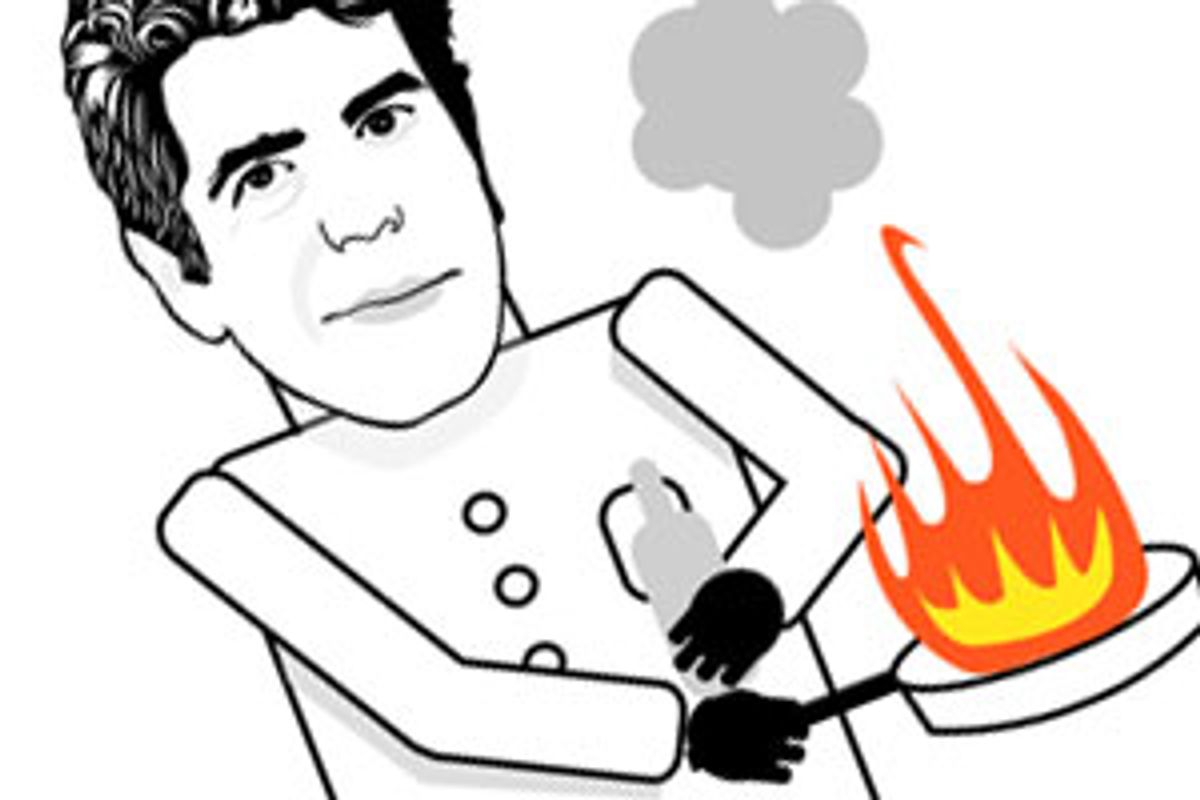
"I don't think there was a mouthful of food I had in two days that didn't have sand, fur or shit in it." Celebrity chef Anthony Bourdain has a lot to say about his recent trip to Namibia, where he filmed a segment for his Travel Channel show, "No Reservations" -- and where he didn't exactly get the Brangelina treatment.
"I was staying with the Bushmen in the Kalahari," Bourdain says, "and the food is wart hog, pretty much on the hoof. They hack it up, scoop it out -- not under the most hygienic of circumstances -- and throw it in the fire, fur and all."
Not that that's a bad thing. These days, braving the world's most extreme cuisine is just part of Bourdain's job. In the six years since the breakout publication of "Kitchen Confidential," Bourdain's macho memoir-cum-food-industry exposé, the restaurant veteran has traded kitchen life for more glamorous work as a globe-trotting writer and TV host.
Despite his success, Bourdain tries not to seem too pampered. "You don't want to hear me gloating about nibbling Ibérico ham with Ferran Adrià at a table in the back of a little Spanish ham shop," he writes in his newest book, a collection of essays titled "The Nasty Bits: Collected Varietal Cuts, Usable Trim, Scraps, and Bones." "You want to picture me crawling across a cold tile floor, coughing stomach lining into something that only the hotel manager could refer to as a toilet." Bourdain may enjoy an enviably jet-setting second career, but he's smart enough to know that it's his willingness to sample sandy wart hog -- or raw seal brains, or a still-beating cobra heart -- that keeps viewers coming back for more.
It helps that Bourdain brings the same appealingly dark humor to all his ventures, whether yachting in the Caribbean or exploring the Mall of America. His caustic commentary on swimming with piranhas and drinking local Mexican beverages "with the consistency of snot" is most of the fun of "No Reservations." Bourdain's also refreshingly frank about his foibles, including his former cocaine and heroin addiction. On the other hand, he can be fiercely intolerant of American tourists, vegetarians and many of his fellow celebrity chefs (among other populations), and his brand of bombast isn't for everyone; food writer Jeffrey Steingarten once sniped that Bourdain was "clever with obscenities" but had "the values and tastes of a British soccer hoodlum."
Considering Bourdain's surly reputation, "The Nasty Bits" is surprisingly upbeat. It offers charitable views on Las Vegas restaurants, overworked wait staff and Bourdain's one-time whipping boy, chef Emeril Lagasse. Bourdain even reflects on the braggadocio of his own early writing, admitting that, "like an aging guy worried about his penis who suddenly buys a too-fast-for-him sports car, I think I was overcompensating." Unfortunately, despite these moments of graciousness, "Nasty Bits" suffers from an uneven mingling of great and mediocre material. Even Bourdain acknowledges that he wrote the essays in part because, as he puts it, "I always think for sure the next book or the next show will tank, and I better make some fucking money while I can." Still, many of the scraps -- as when Bourdain goes into an unhinged rage over Woody Harrelson's raw-food activism -- will have readers snorting with laughter as they read them.
Salon met Bourdain at the Commonwealth Club in San Francisco, where he took a break from his book tour to talk about his hatred for TV chef Rachael Ray, his fondness for foie gras and the worst meal he ever had.
"The Nasty Bits" finishes with some explanatory, sometimes even apologetic, endnotes about the essays. Are you happy with way the book turned out?
Yes. There was a review that said "what a rip-off, it's old stuff!" Well, that's why I called it "The Nasty Bits." How explicit could I be? Collected, varietal cuts, scraps, bones -- that's what it is. I'm happy I got the chance to do an afterword, to realize, OK, that was an entertaining piece, but I don't believe that anymore. Or even, it's an entertaining piece, but what asshole wrote this?
I always entertain the notion that I'm wrong, or that I'll have to revise my opinion. Most of the time that feels good; sometimes it really hurts and is embarrassing. But it's not a problem for me to change positions. For instance, I think that beating up on Emeril was turning into shtick. He looks like [legendary chef Georges Auguste] Escoffier now compared to some of the bobble-heads who are on that network.
Bobble-heads! Care to name names?
Rachael Ray. She's paid more and is more popular [than Emeril], and I see a day when the executives say, we don't need Emeril anymore, even though he built their network. They'll replace him with some industry-created freakozoid who's been grown from a seedling into a recognized brand. When you look at Sandra Lee or Rachael Ray or some of the new shows like "Calorie Commando" that are just vomit-inducing -- at least Emeril worked his way up and has a real restaurant empire.
And he has been nice to me, shown incredible good humor about me calling him an Ewok. I went out drinking in New Orleans years ago with a lot of his cooks and employees, and they said he's a good boss, a fair guy who looks after his people.
I still hate the show! But even the show, compared to Rocco DiSpirito, is Shakespeare. Rocco's a really talented cook, way more talented than I ever was. But he wanted, with such an unholy fervor, to be on TV, to be loved by strangers.
Which isn't really your approach?
I truly don't give a fuck.
What do you make of the celebrity-chef craze? Why are audiences so obsessed with cooking shows now?
I think maybe it comes from a sense of dislocation; if you've left home and moved to a big city, you yearn for some kind of normal, stabilizing, nurturing kind of experience. I dunno, I'm guessing.
I think most chefs I've spoken to don't really understand it. How come they like us now? When I started cooking, a bad customer would come in, abuse the waiter, send the soup back, and a line cook in a good restaurant could feel free to spit in the soup. And the chef would see it, and everyone would laugh, because there was no pride; there was no hope; there was no expectation of any kind of future success or prestige. So the celebrity-chef thing, for whatever reason it happened, I think has been good for diners. It's certainly been good for chefs!
Will we see you in a year saying, "Oh, I had drinks with Rachael Ray, and actually, she's all right"?
Yeah, right. "After the hot-tub incident, I've changed my mind." You know, listen, like I said, I could be wrong. Unlikely. But maybe she's nice to puppies.
Sure, sure -- you haven't seen her kicking any old people lately.
Actually, that would be cool. If I ever saw her getting trashed on Old Crow, pistol-whipping a vegan after a bar crawl, I would think, "That's an interesting woman. I would like to know her."
You've never had much love for vegans, and that doesn't seem to be something you've revised your opinion on.
Never. They're rude! People's choice to become vegan, from people I've spoken to, seems motivated by fear. Like, "it's possibly toxic, or ungroovy, or poisonous, or loaded with chemicals or some kind of harmful things that'll make me less healthy." I certainly don't see that as a good reason to do anything, certainly not a good reason to be rude to your host.
How can you travel? Before you've even left home, you've already decided, "I reject most of the world's bounty and the expression of their hopes and dreams and culture." Some nice, possibly impoverished Vietnamese rice farmer is nice enough to offer you the one chicken he can kill a month, or a week, and you say, "Sorry, I can't"? It just seems antihuman. It's antisocial.
And for anyone who says that everyone should eat like that -- it completely ignores the fact that, well, we can't afford to. We've got hungry people in this world. Go stay with the Bushmen for a week. Ninety-eight percent of their diet is meat. [Chuckles darkly.] That would be a funny reality show.
But what about vegans who follow that diet because they're concerned about environmental destruction or feeding the world's people more efficiently?
Hmm. That's an unthinkable scenario. Like, what, that the planet will survive longer if there are more vegans?
Well, it would be better for the planet, but I think the idea is also that the human race would survive longer.
What's so great about that? I'm a radical environmentalist; I think the sooner we asphyxiate in our own filth, the better. The world will do better without us. Maybe some fuzzy animals will go with us, but there'll be plenty of other animals, and they'll be back. The world will do better without us, when the blight of humanity is removed. That would be my academic argument to that.
You're pretty tough on obese people, too, though.
I just don't see [obesity] as a lifestyle decision. If you need a support system, if you're blocking egress from a burning building or taking up half my seat on a plane, that is not a lifestyle choice. That is a menace to society.
What's sad is that so few obese people are even getting big on good food. They're chawing themselves listlessly to death on crap. I don't think people should be encouraged to look like Kate Moss; I think that's unreasonable. I think the normal human body should be glorified. By the same token, if you need a stick to wash yourself, you're not healthy.
You've spoken out against the recent bans on foie gras, but you're also opposed to animal cruelty in general. Would you support banning other practices that are regarded as cruel, like those practiced by the industrial poultry industry?
No. It would be nice to think that people know the difference between a crap chicken and a good chicken. If you can afford a good-quality free-range chicken, it's nice that you have options. A lot of people in the world can't afford that.
I like the idea that we could live in an agrarian wonderland, where there are heritage animals wandering freely and making delicious farm-fresh eggs, but that ain't gonna happen; there are too many hungry people in the world.
I love Whole Foods talking about lobster and clam cruelty, when people are being fucked to death, kidnapped, starved, bombed. [The grocery chain recently stopped selling some live shellfish on the grounds that the practice is inhumane.] There is so much cruelty to humans -- so much cruelty to animals -- in this world. And people are worried about a fucking mollusk. Unbelievable.
Are you just as skeptical about organic products, or the movement to eat locally grown food?
No, I think that's good. I admire people who want to cook only regional; any time you focus on quality, I think that's good.
Just don't pretend that we can all do that, or that it's not going to be expensive. To eat like our peasant ancestors, the simple things that they took for granted -- only the rich will be able to afford those things.
You also suggest that the relentless focus on safety and sanitation in kitchens is a bad thing. Why?
I think fear of dirt is often indistinguishable from the fear of unnamed dirty people. There's something kind of racist about it, about people who are hesitant to try street food in another country. [The food] is part and parcel of culture; it's an expression of identity.
And I think the notion that the government or somebody owes you absolute safety and security in everything you eat is a destructive one, with cheese being the easiest example. With cheese having to be pasteurized or aged to a certain degree, none of us will ever experience a real brie, or how good that used to be. There are laws that you have to sign a release, or at least read a warning statement, before you eat a rare burger. I think we've slipped over into the twilight zone here. Does McDonald's really have to label their coffee cups to say "Danger: Will cause burning if poured on genitals"?
I think it's destructive to quality, and pleasure, and tradition. So I'm skeptical, to say the least, if not hostile to that kind of thinking.
You've said that the U.S. should open the borders to let more workers from countries to the south of us get work and populate the kitchens.
[Laughs.]
Am I getting that right?
Ooh, I got a lot of mail over that. Listen, in 25 years, I don't remember ever seeing an American-born kid of any income level walk into my restaurant, or any restaurant owned by any of my friends, and ask, Do you have a dishwasher job, or a prep job, or a job for a kitchen porter? We're not willing to do it. If somebody else wants to come over here and do it, that's fine with me.
And yeah, I think we should open our borders, for a variety of reasons. First of all, we've got plenty of work for people, apparently. People say "they're taking our jobs" -- well, no one's asking for those jobs.
I also like the idea of people from other places coming to our country and multiplying. It makes for better food, higher expectations, more diversity and cuter people. Foreigners should come to our country and have sex with our womenfolk.
Hey, why can't they come have sex with our menfolk?
That, too!
Fair enough. But you've observed that professional kitchen culture is often unfriendly to women. Do you think it will always be that way?
Probably. Understand, people who work in restaurants, it's a mix. It's not just a bunch of stupid guys standing around talking shit like they're in a locker room, though there is that. It's people who are coming from the rural, piss-poor areas of Europe, Latin America, Central Asia, the Middle East -- people with different ideas about things than you or I might have. It was traditionally not only a male profession but one that was actively hostile to women.
The first women chefs in New York, they were absolute warriors. I can't imagine what women like Anne Rosenzweig had to go through. Women of that era had to work twice as hard. Now, when a woman graduates culinary school and goes into a restaurant, chances are, the pastry chef is no longer the only woman.
But [even as more women join kitchens], I'd like to think that the level of discourse will stay the same, and just as offensive, and just as crude. I think it's great that kitchens are maybe the last meritocracy, the last workplace where men and women can speak to each other honestly, however offensively that might be, where your value is only in how well you do your job and how well you can talk shit back at somebody. I see that as an admirable quality. I don't like the idea of tiptoeing around each other. I think that if you say something stupid and offensive, somebody should get right up in your face and say, "That was incredibly stupid and offensive, and fuck you too!" Once you enforce it, bring in the human resources department, everybody goes home to their own neighborhoods, and we never really talk.
You write that viewers can tell how poorly one of your shows is going by how many penis jokes you make. Are there clues that signal to viewers that you're politely choking down food you're not enjoying?
If I have to be polite on camera to someone poor who's offering me food, I will temper my remarks in voice-over. If it's the worst meal ever, I will find a way to say it.
You'll see me eating the wart hog in the Namibia show, and the chief is offering it to me, and when he has turned away, I'm looking at my shooters, like, "Do you have the shot, are we done, can you get me out of here, please?"
What was your worst meal ever?
Certainly the vegan meal I had in Berkeley was soul-destroying, and just frightening. I've had some pretty bad food with some really great people, in some really amazing places. I'll remember those as great meals. The duck in the Mekong Delta with former Viet Cong was a great, pinch-me meal that I'll always, always remember, and the duck wasn't really that good. Didn't matter.
Same thing: If you're eating not very good food with just abominable people in a terrible situation, that's the worst meal ever. A little piece of your heart gets chipped away by people who frighten or dismay you.
Your bio always says, "He lives, and always will live, in New York City." Is that still true?
[Long pause.] I don't know anymore. I don't know if I can even stay still anymore; I start to fidget and freak after a couple of weeks in one place.
I was always reasonably comfortable in New York because I was always busy, always driven. I didn't have the luxury of time to contemplate the big issues. Now I have plenty of time to think about things, and it's not as comfortable.
Asia really ruined me. I went up to Indonesia for the first time a few weeks ago, and what absolutely devastated me was the call to prayer, the sound of bamboo wind chimes, people chanting in the fields, that kind of [singing] "bing bong bong bong." What do you do after you've heard that?
I don't know if there's a place I can stay and be content and calm and happy. But I think, like love, it's probably something that hits you upside the head. Like the perfect meal, it's not something you go after or advertising for. It just sandbags you when you're least prepared.
Shares