

Homework. For many of us, the word still sounds like a drag. Nights spent hunched over algebra books, memorizing vocab lists and filling out graph-paper lab reports while the smell of burning fall leaves and a cool October breeze teased just outside our bedroom window. Homework was spinach: We did it because it was good for us, because it made us smarter, because it taught us how to study, because it prepared us for college, and because if we didn't do it we'd get detention.
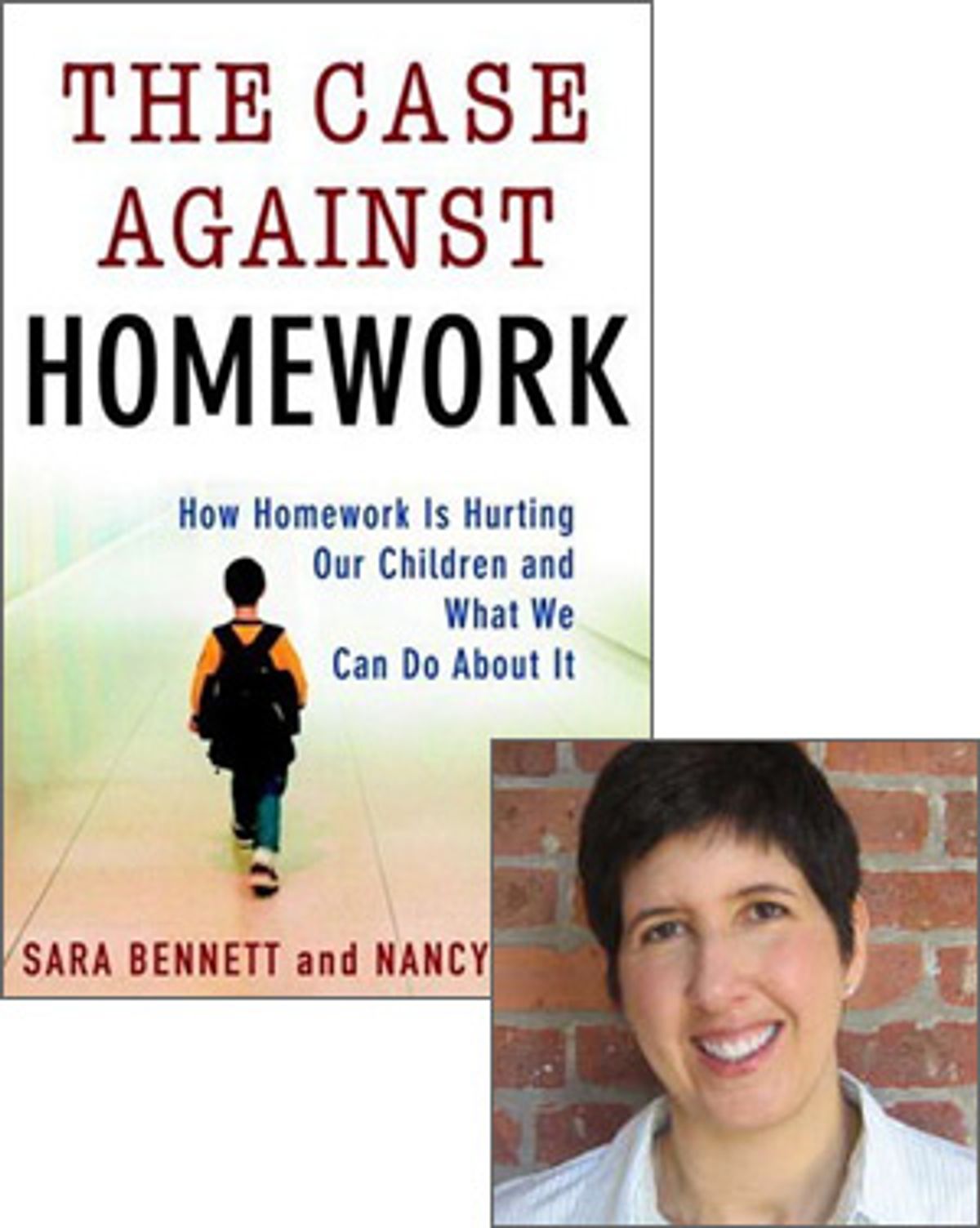
But this fall, as students across the country load their JanSports with textbooks and start down the road to lower-back pain, a group of parents and educators are desperately trying to send a message that maybe nights spent cuddling the periodic table aren't so fortifying after all. This month, two books about homework and its discontents are on shelves: "The Case Against Homework: How Homework Is Hurting Our Children and What We Can Do About It" by Sara Bennett and Nancy Kalish and "The Homework Myth: Why Our Kids Get Too Much of a Bad Thing" by Alfie Kohn.
To hear these homework protesters tell it, recent years have seen an almost comical inflation of the work kids are bringing home from school. Kindergartners and first graders, those squirmy squirts who can barely make it through "Blues Clues," are being asked to do 30 minutes to an hour of studying a night, while middle and high schoolers are forced to slog through four and five and six hours of the stuff. And some of the assignments sound like something out of a Fellini movie: translating arithmetic problems into alphanumeric code and plotting them on a graph to look like Abraham Lincoln, building popsicle-stick replicas of the Pentagon and baking cakes in the shape of Roman ruins.
Salon recently spoke by phone to Nancy Kalish, coauthor of "The Case Against Homework." This Brooklyn, N.Y., journalist and mother of one said her eyes were opened to the scourge of homework when her daughter hit middle school. Kalish teamed with former legal aid attorney and mother of two Sara Bennett to research and write the book, which argues that homework is actually diminishing children's educational experience, turning kids off learning, putting strains on families, turning students into "homework potatoes" and stunting cognitive and social development.
Is this the kind of book that the left and the right are likely to respond to differently?
Well, Time magazine ran a story about this issue last week and it was positive; the New York Post reviewed the book and it was negative. Homework has gone through ups and downs throughout history. In the early 1900s it was banned for a period because it was thought to be bad for kids' health to make them stay inside. The most recent step-up came in 1983, when there was a study called "A Nation at Risk" that specifically called for more homework. It was the first time that kids' achievement in school had been linked to the state of the global economy. Now, it has been proven that there is zero correlation between kids' academic achievement and the economy. At Penn State there are two guys [David Baker and Gerald LeTendre] who did research and discovered many countries that give lots of homework and do worse. The Japanese actually do less homework than we do. It's B.S. that there's a connection. But the belief continues to be put forth by business people and politicians, and of course by our lovely president, that basically it's all the kids' fault and we're not as competitive as countries who give kids more homework; that's why people think homework is such a necessary thing, that if we don't give homework, we're undermining our entire country.
If that's the socioeconomic angle, how does it play out in family attitudes?
It filters down to the parents, along with how hypercompetitive and tough it is to get our kids into college. In New York City and other places it's tough to get them into preschool, so there is an attitude that more is better. Parents mistakenly assume that a lot of homework shows that a school is rigorous, and if the school is rigorous it's going to give their kids an edge. I was one of those parents.
What changed your mind?
Well, I was very lucky. Because now they start overloading kids in kindergarten, dealing with an hour's work each night. My daughter didn't get overloaded until middle school, but then suddenly she was doing four hours a night, which really was excessive.
What were the ill effects?
Her love of learning started to plummet. Her grades didn't dip, but her enjoyment of the whole process went downhill. At the time, I was doing assignments for parenting magazines about how to get your kids to knuckle down and do homework. I just assumed it was a good thing, and assumed schools knew what they were doing or they wouldn't put us through it. Then I met Sara Bennett, my coauthor, and I started to research it and found out the research doesn't back this up at all. All my assumptions were challenged. We've been going along with it because we assume homework is good for our kids. It turns out that it's not.
Do you believe there is no correlation between academic success and homework?
I had an eye-opening interview with Harris Cooper at Duke University. He looked at 180 studies on homework and found that there was only a very tiny correlation between homework and achievement in elementary school, measured either in grades or on achievement tests; a minor correlation in middle school; and still only a moderate correlation in high school. And after kids started doing more than two hours a night, [even the moderate correlation] plummeted. It's very counterintuitive. It's hard to get parents and teachers to accept; you think more has to be better. Not true.
The other thing Harris Cooper told me is that teachers are not trained in homework. They're winging it. I interviewed [Baker and LeTendre] and we interviewed people from Stanford and Harvard. No one has a course specifically on homework. We surveyed hundreds and hundreds of teachers, and only one claimed ever to have taken a course on homework. They are taught general "purposes" of homework: that it reinforces lessons, builds study skills. But teachers are not taught how to make assignments. We learned that only 35 percent of schools have written homework policies. Teachers are trying their very best. They want what's best for the kids, but they really don't have the tools that they need.
What other tools are they missing?
What happens in typical teacher's day, especially with ever-shrinking budgets, is that they have cafeteria duty, bus duty, after-school programs. They don't have any planning periods left. As a result they can't give homework assignments a lot of thought; they just use what's there. They still have these mimeographed worksheets that kids can't even read anymore. And a lot of these teachers are not parents. So they really don't know what it's like to make a first grader do homework, what havoc it's wreaking in households across the country. And competitive parents are afraid to admit it's a problem. They don't want to admit it to other parents, don't want to admit it to teachers, because they feel like they'll be saying, "My kid can't hack it." But teachers can't solve the problem if they don't know about it. Go in and tell the teacher what it's like in your house every night. Usually, if you say, "My kid is starting to hate school because she's overwhelmed; she has no time to come to the dinner table or have play dates with her friends," the teacher makes changes.
I have to press you on the point that teachers who aren't parents don't know what it's like to wrestle a 6-year-old into doing work -- don't they wrestle them into doing work all day?
That's true, but one second-grade teacher told us, "Of course the kids are wiped when they're made to work all day, but I didn't realize what it was like when they got home and were made to do it all over again." She didn't know how much more tired they were going to be when they got home.
What about the tough-noogies argument: Too bad if they're tired and don't like it, they've got to suck it up and do it?
They stop loving learning. For instance, in first grade, a typical assignment is the reading log, where you have to write down what you read: the author and illustrator and the publisher and how many pages. Sounds really innocent, great idea, right? I can't tell you how many parents told us how many kids didn't want to read anymore because it was so tedious to write all that stuff down afterwards. It takes longer often for a first grader to write that information out than to have another book read to him. So maybe it should just be "Read with your child." Learning all this was like a light bulb illuminating things that on the surface seem responsibility building, study-skill building but, when you start to examine under the surface, aren't great. The sense that it builds independence -- when a kid can't face doing his homework without his mother by his side, that's not building independence!
But maybe parents are overinvested in the work their kids should be doing on their own?
Absolutely there are overinvolved parents who could be less involved with their kids' homework and don't know when to back off. But from our surveys we learned that parents don't feel like they have a choice. The quantity is so overwhelming that kids are not able to face it on their own without parental involvement. You have to ask your kids every single day, "How much homework do you have?" Homework is controlling their night. As a mother you're thinking, "Will we have time to have dinner together? Will we have time to go to the concert that little sister is in?" Homework is dictating everything. There's also an expectation that parents will teach kids skills. In San Diego there is a teacher who gives a math class for parents every Monday night to teach them the math that their kids are learning so that they can help.
That actually sounds good to me.
Sure. At first. But no parent should be in the position of having to teach their kids math. There is also this idea that homework is such a great way to get involved in the kids' education. But then you hear about some of these huge projects -- my favorite was the one where they had to bake a cake in the shape of a Roman aqueduct ...
Or the kid who had to build a reproduction of San Francisco's Mission out of penne ...
Exactly. And this is where some overinvolved competitiveness comes out and you end up with a project that could be in Architectural Digest, not something a kid could do on his own. These projects should be done at school, where the parent doesn't have the ability to take over, a teacher has to accept what a 10-year-old can actually do, and the 10-year-old can be proud of his project because he did it himself. A mother from Westchester [N.Y.] actually told me she wouldn't let her kid bring in a project he had done on his own because it would shame him. It would be ego threatening. What have we come to that we can't accept what a third grader can actually do?
How does homework relate to class? The fear that a kid would be ego threatened sounds like a middle-class concern, as does the idea that evenings should be used to do enriching things besides homework. In poorer communities where there might not be as many healthy and enriching evening activities to take advantage of, mightn't homework offer a constructive activity for kids?
We talked to a lot of lower-income parents, for instance, kids in charter schools where they really pile on homework, and they are suffering in exactly the same ways as wealthier families. For any kid, no matter what the income level, there is a point where homework is positive and keeps them occupied, and then there's the point where it's too much work. A solution would be after-school programs that include not only homework but other things like play. There are neighborhoods that are so dangerous that when kids get home from school, parents say, "You can't go outside to play," and so they sit inside and watch television or do homework, neither of which is good for them. There should be good after-school programs supervised by teachers that have other things that kids are missing out on, like exercise, which ironically is so important to cognitive development.
And homework is hampering children's playing life?
The play dates that kids have these days are not running outside and playing games and learning to share and cooperate. The only play dates that they can fit in are ones where they sit and study side by side. There's not a whole lot of value in that. It's really sad. The kids are really suffering. [We found that] 9-year-olds are saying, "I wish I were dead"; they're developing facial tics, scratching themselves, gaining weight, which is a huge hidden result of homework. As adults, we're constantly telling ourselves to take time for ourselves, to balance, not to take work home from the office, and yet we're doing this stuff to our kids and they're not up to it; it's too much for them.
So what is the ideal amount of homework?
Some people will not want their kids to do any homework at all after reading this book. But we think that it would be great if schools were made to stick to 10 minutes per grade level per night total. So 10 minutes total for first grade, 20 minutes for second grade. When you got to higher grades, multiple teachers would have to coordinate. But that's a good thing because so much homework is of extremely poor quality, like spelling mazes and 40 math problems and the reading logs. If teachers knew that they had a total of 10 minutes per night per grade level, they'd think: What do I most want my students to learn tonight? What would be the most valuable way of teaching them that in a short amount of time? For parents, the message is that they don't know you're suffering until you tell them. Teachers are trying to do what's best for kids. You need to tell them what it's doing to your child's love of learning; no teacher wants kids to start to hate school.
How will kids be prepared to do independent academic work in college if they don't have experience doing homework?
Kids get into independent learning on their own. Everyone is afraid that the first thing they're going to do if they don't have homework is sit in front of the TV for hours. I'm sure that for a few kids, that will happen. But often what happens is they use the time to get into their own thing, into their music, into photography. They learn independently and apply themselves to things they're really interested in. So I absolutely believe they'll be prepared. I don't subscribe to the theory that we need to toughen them up because the world is so tough. Because when you follow that, they're toughening up kindergartners. I spoke to a kindergarten teacher in a small town outside of Orlando [Fla.] where they have eliminated nap time and snack time, and she assigns homework and by lunchtime the kids are crying. In the past two years, there have been more 3- and 4-year-olds and kindergartners expelled than ever before. It's so developmentally inappropriate to expect kids to sit still all day and then come home and do it again. They're acting out like crazy and getting expelled.
But aren't some kinds of homework necessary? Maybe not the kindergarten homework or penne architectural replicas, but reading ahead to prepare for class discussion?
Reading is absolutely valuable. The problem is, as my daughter would tell you, when you have a bunch of questions at the end of the chapter, kids read [the book] only for answers to the questions, so they're not getting so much out of it. Types of assignments really do make a difference. One assignment teachers give all the time is tons of math problems. First of all, five problems is enough. If a child knows how to do five problems of a particular type, doing 40 of them is very tedious and a turnoff. If a child doesn't know how to do it and does it incorrectly 40 times, he will have cemented the incorrect method into his head. If you have 30 kids in class doing 50 math problems, then that's 1,500 math problems that the teacher has to correct. No teacher gets to those 1,500 math problems. When kids fall behind, it's precisely because they're given so much to do and they are practicing incorrectly. As soon as you think about it, it all makes perfect sense, but nobody ever goes there. I think that's what we want to accomplish -- to get people to think about it and to not accept that it's just this God-given rule that kids have to do so much homework.
Shares