

You see them downtown: teenagers with punk haircuts and chains, hanging out in parks and under highway overpasses. They scowl at each other and sometimes at you. But you take for granted that though young and troubled, they're likely harmless.
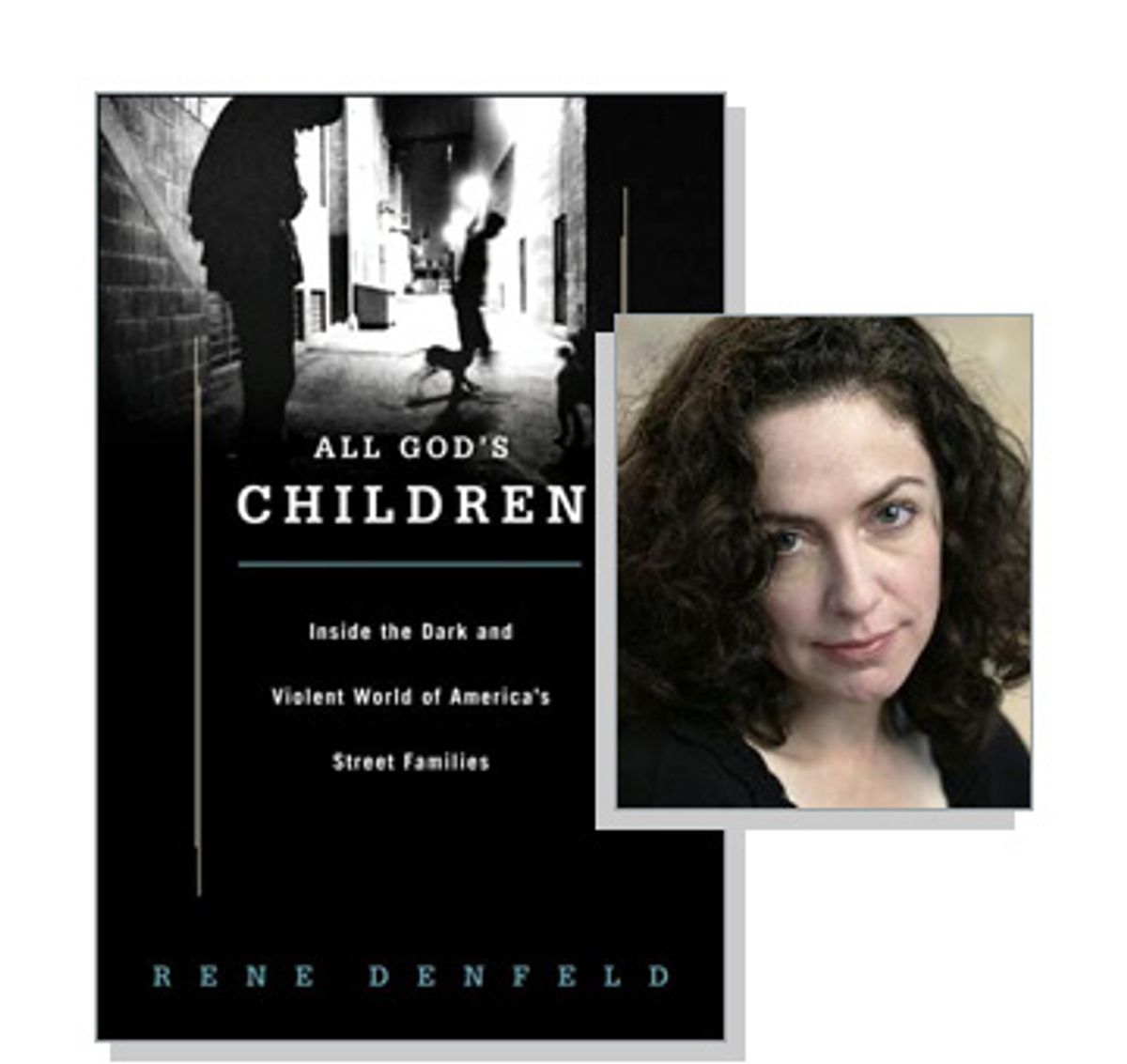
Rene Denfeld begs to differ. A feminist writer and the mother of three adopted children from the Oregon foster care system, Denfeld began to investigate the world of street kids after the widely publicized 2003 murder of a developmentally disabled young adult named Jessica Williams by members of a Portland street family. Her latest book, "All God's Children: Inside the Dark and Violent World of Street Families," is the result of that research. Using the Williams case as a prism, Denfeld crafts a chilling portrait of street culture -- one that will turn your assumptions about these kids and their lives inside out.
While reporting, Denfeld immersed herself in street culture. She discovered that since the 1990s, organized groups with names like Nihilistic Gutter Punks and the Sick Boys have risen to rule the homeless youth communities of America's urban centers. Controlled by self-appointed "moms" and "dads," these "families" are often far more rigid, controlling and violent than those the kids fled. Members commit muggings, deal drugs and participate in gay-bashing incidents. Still, police in many cities pay them little attention, instead focusing their energies on more traditional gangs.
While estimates of their number vary, most child welfare advocates estimate that there are approximately 1.5 million street kids in the United States and that the majority belong to a street family. Denfeld believes the social causes behind the growth of such groups are numerous -- ranging from the economic breakdown of blue-collar America to the influence of fantasy games on youth culture. Crackdowns on teenage prostitution are also implicated, since by making the streets safer, municipalities may have unwittingly created an environment conducive to the development of proto-adolescent societies. "The cleaned-up streets offered a new playground" for these kids, Denfeld explains. "Isolated from other influences, they create a fantasy world all of their own."
Salon spoke to Denfeld by phone about the role that racism plays in street violence, the influence of the Internet and fantasy games on street kids, and why we should take their threats seriously.
What is a street family?
We all know street kids. They're the kids that hang out in Tompkins Square Park or the university area of Seattle or in downtown Portland. What a lot of people don't realize is that these street kids have created their own subculture. They've organized into tight-knit groups that have a lot in common with gangs. They have group affiliations. They have street names. They have their own language. It is a society with a lot of rules and codes, a great deal of secrecy. And often, they're frankly just incomprehensibly violent.
When did individual street kids begin to form street families?
The shift began happening in the late 1980s when a lot of cities began taking child prostitution very seriously. There was a focus on giving homeless youth services, whether it was showers or food or job programs. But they didn't eradicate the presence of young people in the street. Instead it enabled a different kind of subculture to grow. The youth weren't reliant on prostitution anymore. Instead they were fed and clothed and remained unsupervised. They began kind of creating their own subculture.
What impels these kids to live on the streets?
There are a lot of genuinely homeless youth. A couple of the kids involved in the assault on Jessica Williams had terrible histories. But when I first began researching, I expected that most of the youth involved in the murder of Jessica Williams would have backgrounds of foster care, abuse and neglect. In fact, the opposite was the case. Many of them came from very adequate families, even very loving homes. One was a college student who walked out of her dorm room and a scholarship. Another young man had a mother who had been a police officer. I think a lot of them hit the streets because it sounds romantic.
How old are these kids?
In the 1980s, 14-, 15- and 16-year-olds were on the street. That's our perception of what we call street kids: They're actual kids. But in reality, the majority of these youths are now adults. Ages have risen to the point where in one shelter review I found, the majority of the youth intakes were ages 18 to 20. They aren't minors. A street kid is a defined social identity. It's the same as saying, "I'm a Crip" or "I'm a Blood" or "I'm a Skinhead who belongs to the Aryan Nation."
So, you see similarities between gangs and street families?
Both gangs and street families are organized groups with a strong group affiliation. Street kids in families are very loyal to their leaders. Their leaders are identified as Mom and Dad. The youths identify each other as Brother and Sister. There are very strict codes of conduct, a highly developed hierarchal system. Like gangs, these kids have a very strong identity just to that particular group. And there are very savage punishments if you break their code.
The difference is that a lot of African-American and Mexican gangs tend to still have strong ties with a particular community. They might still go home to Grandma's house or be living with their mom. But the street-family culture really encourages the youth to completely severe all ties with their original families and their communities. I think that has profound psychological impact on them. The street family becomes their reality.
Still, the police don't seem to take street families as seriously as gangs. Why?
Historically the focus with drug dealing and criminal activity has been on African-American and Mexican gangs. Here in Portland, the gang task force -- like other city gang task forces -- has overlooked the role of street kids. Part of it is a public-perception problem. People have a very romantic notion of street kids. In some cases, when police did crack down on the crimes of these street families, they were criticized for doing so. People aren't generally aware that street families exist or that they commit a lot of crimes and violence.
Does racism influence our perception of street families?
I wouldn't say it's overt racism. But perhaps partially because these youths are Caucasian, we just think that they're teenagers in mohawks hanging out in the street. I think if African-American youth were hanging out in our square or in the East Village or any of these cities and had formed into packs and given themselves names and organized a very elaborate, often brutal subculture, we would say, "That's a gang," and would rush to intervene.
Is it just a few bad players who give street families a bad reputation?
I found an amazing amount of violence within this subculture. A lot of the youth are armed. They carry knives or what they call smiley chains, which are chains that are linked into a circle. If you actually talk to them, they speak with ease about the violence they commit. It wasn't just the one particular street family I followed. I documented hundreds of crimes that other street families in the area had committed, often very violent crimes like muggings and hate crimes against gays. They call it "rolling trolls," which is their term for mugging gay men.
But don't you worry that you might be tarring street families with a broad brush by using a murder to examine their society?
That's something a lot of advocates came out and said when the Jessica Williams murder happened. They said, This is an anomaly. This is an aberration. This is very rare. But my reporting found that violence is not rare. In fact, violence is the defining aspect of the culture. It's how they keep each other in line. Violence is at the core of the fantasy games that they play to occupy themselves and to give themselves a sense of group identity. If they didn't have their fantasies and their games and their "code," as they call their rules, there wouldn't be much to actually hold these youths together on the streets. It gives them identity.
Where does that violent urge come from?
It's a natural outcome of having a lot of teenagers and young people running around on the streets unsupervised. Traditionally, most societies recognize that between the ages of, say, 18 to 20, young adults still need some guidance to help them develop strong morals and ethics. It's an age of energy and ambition. What really struck me was that the kids just have nothing to do. They're fed and clothed by shelters, and then they have the rest of the day to hang out and panhandle and do whatever. So it's not that surprising that they spiral into a savage society.
Does the economy play a role?
One girl named Sara fascinated me, because she was 20 and from a blue-collar background. In the past, she would have expected to get a solid job, marry, buy a house, raise a family. But we don't expect or even desire that from our young adults anymore. We've continuously moved the age of adulthood up to the point where there's a vacuum from the late teens to early 20s, particularly for young people who aren't going to college. They're bored. They don't have meaningful work. And we don't particularly want them to have kids that young. They're looking for a sense of identity and something to consume the incredible energy and risk-taking behavior of their age, and they can end up on the street.
And then there is the white supremacist influence...
Because we have a higher and higher number of young people sentenced to jail or juvenile homes, there's a trickle down between the criminal justice system and the street culture. And what you have in prison is a very racist, segregated and violent society. A lot of street-family culture is influenced by that. These are not benign, progressive sorts of kids. They're often very racist and very homophobic and very sexist, and they're open and accepting about it.
You say the Internet plays a role in street-kid culture, too. How so?
A lot of street kids are very computer savvy. I was surprised to meet kids that not only carried cellphones but also have laptops in their backpack. Through Web sites like Digihitch.com, a street kid can walk into a shelter, sit down at a computer, and within seconds be contacting and communicating with street kids in other cities. The Web has helped street kids become uniform in their subculture. So, whether you go to Seattle or New York or Minneapolis or any other place, you'll find that street kids are all talking in the same language and all have the same codes and the same rules.
What impact do drugs have on street families?
Drugs have made a huge impact on the street culture. Portland is a very meth-affected city. And meth is well documented for inducing psychosis. Some street kids have become heavy methamphetamine users. Many of them deal methamphetamine as well as other drugs. It has made them a lot more violent, a lot more criminal. And it's also the kind of a drug that will facilitate a lot of their paranoia and fantasy games.
Can you explain that a bit more? You talk a great deal about the influence that fantasy-gaming culture has had on street families.
Over the past decade, through "Dungeons & Dragons" and computer fantasy play and gaming, it's becoming increasingly acceptable for people in their 20s to spend hours a day engaged in adopting mythical characters or pretending they are part of a medieval society. A lot of young people are taking this fascination and acceptance of fantasy play with them into street culture. They will get engaged in elaborate, real-time fantasy games as part of this culture. They might perform rescue missions or decide that somebody offended them and have a mission to go punish the perpetrator.
Once they get on the streets, these youths take street names that are very important to them. In this particular case, the kids took names like Shadowcat and Gambit and Neo. They become absolutely enmeshed, sometimes to the point where I suspect that they really had trouble discerning reality, and started identifying exclusively by their fantasy name. Frankly, I was bowled over that the social service agencies that serve the youths will call them by their made-up, fantasy names.
Do you think that's a problem?
I do have a problem with it. Say you have a 19-year-old methamphetamine user who wants you to call him Gambit. My sense as a parent is you say, "Excuse me. Your name's Steve, and you need to get a job." If my kids were teenagers who showed up in a youth shelter and said, "Call me Shadowcat -- I'm part of a street family," I'd want that agency to pick up the phone and tell me to come get my kid. But the agencies go along with a lot of these fantasies and run the danger of really perpetuating the culture and endorsing it, making it acceptable.
It seems like you're not alone in that feeling. In the book, you speak with one district attorney who is vehement that social service agencies, by offering these kids food and shelter, "enable" street culture.
You know, honestly, I've wrestled with that. I think it's an easy assumption to make, because these agencies do in fact feed and clothe these youth -- and in many cases don't hold them accountable or truly supervise them. On the other hand, there are really strong street-family cultures in towns and cities without a lot of youth agencies. One example is Tempe, Arizona, where a really big street-family culture has sprung up without a single youth agency in town. A lot of street kids support themselves very well through panhandling and drug dealing. But my feeling from my reporting is that if agencies were a little more skeptical in serving youth who are not genuinely homeless, youth who are using their services to support a criminal lifestyle, it would probably be a good step in fighting this subculture.
Did you find anything good in the street-family culture?
No. What is really striking about it is in the past we had hippie cultures and the punk cultures. And there were certainly a lot of criminals that intersected those cultures, but they were largely about something kind of productive and exciting and artistic. I think that today any energy that street families have is consumed by crime, meth and fantasy games. Anything that is happening creatively is far outweighed by the dangers that these youth pose to themselves and to each other.
What's the future for street families?
It's a culture that is growing and has solidified into a very solid, permanent subculture. My concern is that it's going to become more and more violent as these youths commit crimes and violence, go away to prison, then get back out on the streets.
Shares