

Steve Martin used to do a routine that went like this: "You too can be a millionaire! It's easy: First, get a million dollars. Now..."
If you put that routine between hard covers, you'd have "The Secret," the self-help manifesto and bottle of minty-fresh snake oil currently topping the bestseller lists. "The Secret" espouses a "philosophy" patched together by an Australian talk-show producer named Rhonda Byrne. Though "The Secret" unabashedly appropriates and mishmashes familiar self-help clichés, it was still the subject of two recent episodes of "The Oprah Winfrey Show" featuring a dream team of self-help gurus, all of whom contributed to the project.
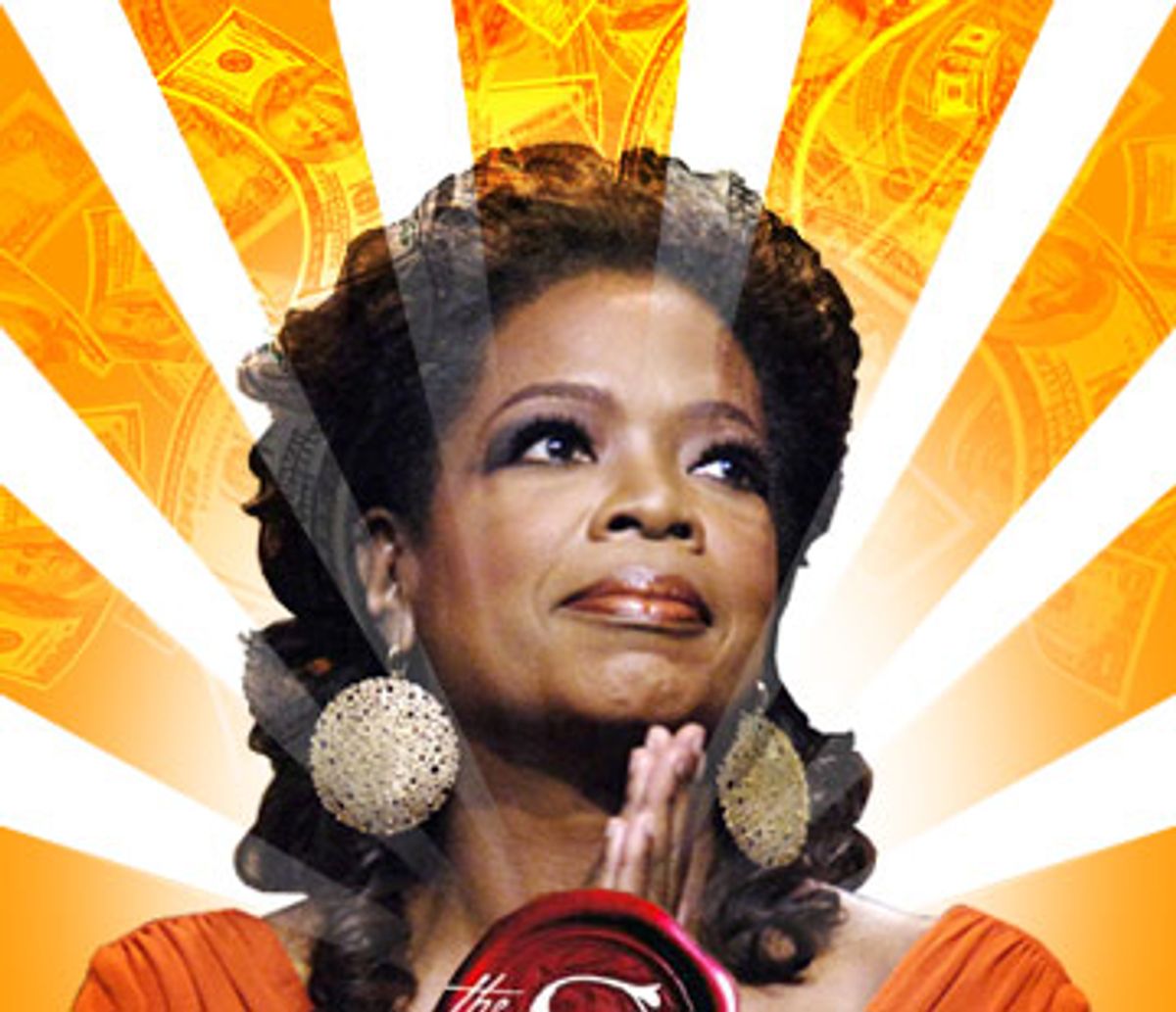
The main idea of "The Secret" is that people need only visualize what they want in order to get it -- and the book certainly has created instant wealth, at least for Rhonda Byrne and her partners-in-con. And the marketing idea behind it -- the enlisting of that dream team, in what is essentially a massive, cross-promotional pyramid scheme -- is brilliant. But what really makes "The Secret" more than a variation on an old theme is the involvement of Oprah Winfrey, who lends the whole enterprise more prestige, and, because of that prestige, more venality, than any previous self-help scam. Oprah hasn't just endorsed "The Secret"; she's championed it, put herself at the apex of its pyramid, and helped create a symbiotic economy of New Age quacks that almost puts OPEC to shame.
Why "venality"? Because, with survivors of Auschwitz still alive, Oprah writes this about "The Secret" on her Web site, "the energy you put into the world -- both good and bad -- is exactly what comes back to you. This means you create the circumstances of your life with the choices you make every day." "Venality," because Oprah, in the age of AIDS, is advertising a book that says, "You cannot 'catch' anything unless you think you can, and thinking you can is inviting it to you with your thought." "Venality," because Oprah, from a studio within walking distance of Chicago's notorious Cabrini Green Projects, pitches a book that says, "The only reason any person does not have enough money is because they are blocking money from coming to them with their thoughts."
Worse than "The Secret's" blame-the-victim idiocy is its baldfaced bullshitting. The titular "secret" of the book is something the authors call the Law of Attraction. They maintain that the universe is governed by the principle that "like attracts like" and that our thoughts are like magnets: Positive thoughts attract positive events and negative thoughts attract negative events. Of course, magnets do exactly the opposite -- positively charged magnets attract negatively charged particles -- and the rest of "The Secret" has a similar relationship to the truth. Here it is on biblical history: "Abraham, Isaac, Jacob, Joseph, Moses, and Jesus were not only prosperity teachers, but also millionaires themselves, with more affluent lifestyles than many present-day millionaires could conceive of." And worse than the idiocy and the bullshitting is its anti-intellectualism, because that's at the root of the other two. Here's "The Secret" on reading and, um, electricity: "When I discovered 'The Secret' I made a decision that I would not watch the news or read newspapers anymore, because it did not make me feel good," and, "How does it work? Nobody knows. Just like nobody knows how electricity works. I don't, do you?" And worst of all is the craven consumerist worldview at the heart of "The Secret," because it's why the book exists: "[The Secret] is like having the Universe as your catalogue. You flip through it and say, 'I'd like to have this experience and I'd like to have that product and I'd like to have a person like that.' It is you placing your order with the Universe. It's really that easy." That's from Dr. Joe Vitale, former Amway executive and contributor to "The Secret," on Oprah.com.
Oprah Winfrey is one of the richest women in the world, and one of the most influential. Her imprimatur has helped the authors of "The Secret" sell 2 million books (and 1 million DVDs), putting it ahead of the new Harry Potter book on the Amazon bestseller list. In the time Oprah spent advertising the lies in "The Secret," she could have been exposing them to an audience that otherwise might have believed them. So why didn't she? If James Frey deserved to be raked over the coals for lying about how drunk he was, doesn't Oprah deserve some scrutiny for pitching the meretricious nonsense in "The Secret"?
Oprah has a reputation for doing good -- she probably has more perceived moral authority than anyone in this country -- and she has done a lot of good. But in light of her zealous support of a book that says, in this time of entrenched, systemic, institutionalized poverty, this time of no-bid contracts for war profiteers and heckuva-job governance, that "you can have, be, or do anything," isn't it reasonable to ask about why she does what she does, and the way she does it?
Oprah recently opened, with much fanfare, the Oprah Winfrey Leadership Academy in South Africa, and as I watched the network news stories about it, I couldn't get "The Secret" out of my mind. I kept wondering what would happen if professor Sam Mhlongo, South Africa's chief family practitioner who famously said that HIV doesn't cause AIDS, read about Oprah's connection to "The Secret" and found support there for his claim. I wondered if the students of the academy would read "The Secret" and start to believe that their parents deserved to be poor, or that the people of Darfur summoned the Janjaweed with "bad thoughts." Will the heavier girls be told, as readers of "The Secret" are, that food doesn't cause weight gain -- thinking about weight gain does? Will they be told to not even look at fat people, as "The Secret" advises? Oprah is already promoting these ideas to her television audience. Why wouldn't she espouse them to her students?
In many ways the Leadership Academy is a wonderful project, a school that will provide impoverished girls an education they otherwise might not have gotten. But it also seems to be the product, unavoidably, of the faux-spiritual, anti-intellectual, hyper-materialistic worldview expressed in "The Secret," the book that the school's founder has called "life changing."
The academy is a controversial enough project in South Africa that the government withdrew its support, because of the amount of money that's been spent on its well-reported, lavish design -- money that could have gone instead to creating perfectly fine schools that served many, many more students than the 350 who will be making use of spa facilities at the academy. But, when I watched Oprah's prime-time special about interviewing candidates for the school, it seemed to me that she wasn't nearly as excited about providing an education to the girls as she was about providing a "Secret"-like "transformative experience." (And not just for the girls, for herself; the first thing she said to the family members at the opening ceremony wasn't, "Welcome to a great moment in your daughters' lives," it was, "Welcome to the proudest moment of my life.")
On the special, Oprah talked far more about what the school would do for the girls' self-esteem and material lives than what it would do for their intellects -- sometimes sounding as if she was reading directly from "The Secret." And in discussing what she was looking for in prospective students, she didn't talk about finding the next Eleanor Roosevelt or Sally Ride or Jane Smiley. Instead she used "Entertainment Tonight" language like "It Girl" to describe her ideal candidate. She praised the girls for their spirit, for how much they "shined" and "glowed," but never for their ideas or insights. Oprah puts a lot of energy and money into aesthetics -- on her show, in her magazine, at her school. The publishers of "The Secret" have learned well from their sponsor and are just as visually savvy. They have created a look for their books, DVDs, CDs and marketing materials that conjures a "Da Vinci Code" aesthetic, full of pretty faux parchment, quill-and-ink fonts and wax seals.
Oprah's TV special about the Leadership Academy, essentially an hourlong infomercial, was just as well-coiffed and "visuals"-heavy. In fact, when Oprah was choosing her students, her important criteria must have included their television interview skills. On-camera interviews with the girls were the centerpiece of the special, but as one spunky, telegenic candidate after another beamed her smile at the camera, I couldn't help wondering how Joyce Carol Oates or Gertrude Stein or Madame Curie would have fared -- would they have "shined" and "glowed," or more likely talked in non-sound-bite-friendly paragraphs and maybe even, God forbid, the sometimes "dark" tones of authentic people, and been rejected. Sadly, the girls themselves (and who can blame them, desperate 12-year-olds trying to flatter their potential benefactor) parroted banal Oprah-isms, like "I want to be the best me I can be," and "Be a leader not a follower" and "Don't blend in, blend out," with smiley gusto.
When the special was over, I found myself equally impressed and queasy, one part hopeful, one part worried. I was happy the school was there, but disturbed by the way it created an instant upper class out of the students, in a country that doesn't exactly need any more segregation into haves and have-nots. I was hopeful for the students but nervous about what, exactly, they will be taught in a place called the Oprah Winfrey Leadership Academy. Will it be more "best me I can be" bromides? Will "The Secret" be on the syllabus? Oprah herself is going to teach "leadership classes" at the school, after all.
Has Oprah ever done anything that didn't leave people with mixed feelings?
And at what point do we stop feeling like we have to take the good with the craven when it comes to Oprah, and the culture she's helped to create? I get nauseated when I think of people in South Africa being taught they don't have enough money because they're "blocking it with their thoughts." I'm already sickened by an American culture that teaches people, as "The Secret" does, that they "create the circumstances of their lives with the choices they make every day," a culture that elected a president who cried tears of self-congratulation at his inauguration, rejects intellectualism, and believes he can intuit the trustworthiness of world leaders by looking into their eyes. I'm sickened by a culture in which the tenets of the Oprah philosophy have become conventional wisdom, in which genuine self-actualization has been confused with self-aggrandizement, reality is whatever you want it to be, and mammon is queen.
One of Oprah's signature gimmicks has been giving stuff away to her audience ("giving" here means announcing the passing of stuff from corporate sponsors to audience members), most notably in a popular segment called "My Favorite Things." These bits have revealed an Oprah who truly revels in consumer culture, and who can seem astonishingly oblivious to the way most people live and what they can afford. She seems to celebrate every event and milestone with extravagant stuff, indeed to not know how to celebrate without it. Oprah has explained the expensive appointments of her Leadership Academy by saying, "Beauty inspires." True enough. But hasn't the lack of beauty inspired some pretty great work? And aren't there are all kinds of beauty?
You might expect a powerful person who thinks of herself as "deeply spiritual" to have a less worldly conception of it, and you might hope that she would encourage her followers to do the same, instead of urging them to buy books that call Jesus a "prosperity teacher."
But, far more than "spiritual growth" or "empowerment," Oprah and the authors of "The Secret" focus on imparting the message of getting rich. Even the biographies of the authors of "The Secret" on Oprah's Web site are revealingly fixated on their rags-to-riches stories. James Arthur Ray is described as someone who was "almost going bankrupt, [which] forced him to focus on the life he truly wanted. Now he runs a multimillion-dollar corporation dedicated to teaching people how to create wealth in all areas of their lives." The bio for Lisa Nichols says, "After hitting rock bottom at age 19, Lisa prayed for a better life. Now, she has made her fortune by motivating more than 60,000 teenagers to make better choices in their own lives." And the one for "Chicken Soup for the Soul" creator Jack Canfield reads, he "was deep in debt before he made it big. Now his best-selling books have sold more than 100 million copies worldwide, and Jack travels the country teaching 'The Secret' of his success."
There's no doubt that Oprah's doing a lot of good with her South African project, and with many other charitable works. And yeah, I know, her book club "gets people to read," and yadda yadda yadda. But there's also no doubt that a lot of us have been making forgiving disclaimers like that about Oprah for years. And that maybe they amount to trains-running-on-time arguments. Maybe it's time to stop. After reading "The Secret," it seemed to me that there were basically three possibilities: 1) Oprah really believes this stuff, and we should be very worried about her opening a school for anyone. 2) Oprah doesn't believe this stuff and we should be very, very worried about her opening a school for anyone. 3) Oprah doesn't know that any of this stuff is in the book or on her Web site and in a perfect world she wouldn't be allowed to open a school for anyone.
The things that Oprah does, like promoting "The Secret," can seem deceptively trivial, but it's precisely because they're silly that we should be concerned about their promotion by someone who is deadly earnest and deeply trusted by millions of people. It's important to start taking a look at Oprah because her philosophy has in many ways become the dominant one in our culture, even for people who would never consider themselves disciples. Somebody is buying enough copies of "The Secret" to make it No. 1 on the Amazon bestseller list. Those somebodies may be religious zealots or atheists, Republicans or Democrats, but they are all believers, to one degree or another, and, perhaps unwittingly, in aspects of the Oprah/"Secret" culture. And yes, sure, a lot of the believing they do is harmless fun -- everybody's got some kind of rabbit's foot in his pocket -- but we're not talking about rabbits' feet here, we're talking about whole, live rabbits pulled out of hats, and an audience that doesn't think it's being tricked.
"Secret"-style belief is a perfect product. Like Coca-Cola, it goes down easy and makes the consumer thirsty for more. It's unthreateningly simple, and a lot more facile, sentimental and, perhaps paradoxically, intractable than the old-fashioned kind of belief. Like Amway, it enlists its consumers as unofficial salespeople, and the people who constitute its market feel like they're part of a fold. It's indistinguishable from, and inextricably bound up in, the Oprah idea of self-esteem, the kind of confidence you get not from testing yourself, but from "believing" in yourself. This modern idea of faith isn't arrived at the old-fashioned way, by asking questions, but by getting answers. Instead of inquiry we have born-again epiphanies and cheesy self-help books -- we have excuses for not engaging in inquiry at all. Let other people schlep down the road to Damascus; we'll have Amazon send Damascus to us.
That "Secret"-style faith, whether it's in God, or in one's own preordained destiny to be an "American Idol," which takes all of a moment to achieve, is perhaps its most important selling point. Here's "The Secret" on arriving at faith: "Ask once, believe you have received, and all you have to do to receive is feel good." The kind of faith that couldn't be reached by shortcut, the confidence of the great doubters and worriers, of Moses and Abraham Lincoln and Jesus Christ, has been replaced by the insta-certainty and inflated "self-esteem" of "The Secret's" believers.
Books like "The Secret" have created, and are feeding, an enormously diverse market of disciples, and they're thriving in every corner of the culture, in megachurches and movies, politics and pop music, in sports arenas and state boards of education. Oprah has far more in common with George Bush than either would like to admit, and so do the psychics of Marin County, Calif., and the creationists of Kansas. The believers come from all walks of life, but they work the same way -- mostly by bastardizing and warping source materials, from the Bible to the Bhagavad Gita, to make them fit their worldview. On Page 23 of "The Secret" you'll find this revealing doozy: "Meditation quiets the mind, helps you control your thoughts." Of course, the goal of meditation is precisely the opposite -- it is to be conscious, to observe your thoughts honestly and clearly. But that's the last thing the believers want to encourage. The authors of "The Secret" sell "control" in the form of "empowerment" and "quiet" in the form of belief, not consciousness.
The promises of Oprah culture can seem irresistible, and its hallmarks are becoming ubiquitous. Believers may be separated into tribes according to what they believe, but they do it in pretty much the same way, relying on a "Secret"-style conception of "intuition" --- which seems to amount to the sneaking suspicion that they're always right -- to arrive at their tenets. Instead of the world as it is, constantly changing and full of contradiction, they see a fixed and fantastical place, where good things come to those who believe, whether it's belief in a diet, a God, or a Habit of Successful People. These believers may believe in the healing power of homeopathy, or Scripture or organizational skills -- in intelligent design, astrology or privatization. They all trust that their devotion will be rewarded with money and boyfriends and job promotions, with hockey championships and apartments. And most of all they believe -- they really, really believe -- in themselves.
For these believers, self-knowledge is much less important than self-"love." But the question they never seem to ask themselves is: If you wouldn't tell another person you loved her before you got to know her, why would you do that to yourself? Skipping the getting-to-know-you part has given us what we deserve: the Oprah culture. It's a culture where superstition is "spirituality," illiteracy is "authenticity," and schoolmarm moralism is "character." It's a culture where people apologize by saying, "I'm sorry you took offense at what I said," and forgive by saying, "I'm not angry at you anymore, I'm grateful to you for teaching me not to trust shitheads like you." And that's the part that should bother us most: the diminishing, even implicit mocking, of genuine goodness, and of authentic spiritual concerns and practices. Engagement, curiosity and active awe are in short supply these days, and it's sickening to see them devalued and misrepresented.
Not that any of this is new. Aimee Semple McPherson, "The Power of Positive Thinking," Father Coughlin, est, James Van Praagh -- pick your influential snake-oil salesman or snake oil. They were all cut from the same cloth as Oprah and "The Secret." The big, big difference is, well, the bigness. The infinitely bigger reach of the Oprah empire and its emissaries. They make their predecessors look like kids with lemonade stands. It would be stupidly dangerous to dismiss Oprah and "The Secret" as silly, or ultimately meaningless. They're reaching more people than Harry Potter, for God-force's sake. That's why what Oprah does matters, and stinks. If you reach more people than Bill O'Reilly, if you have better name recognition than Nelson Mandela, if the books you endorse sell more than Stephen King's, you should take some responsibility for your effect on the culture. The most powerful woman in the world is taking advantage of people who are desperate for meaning, by passionately championing a product that mocks the very idea of a meaningful life.
That means something.
Shares