

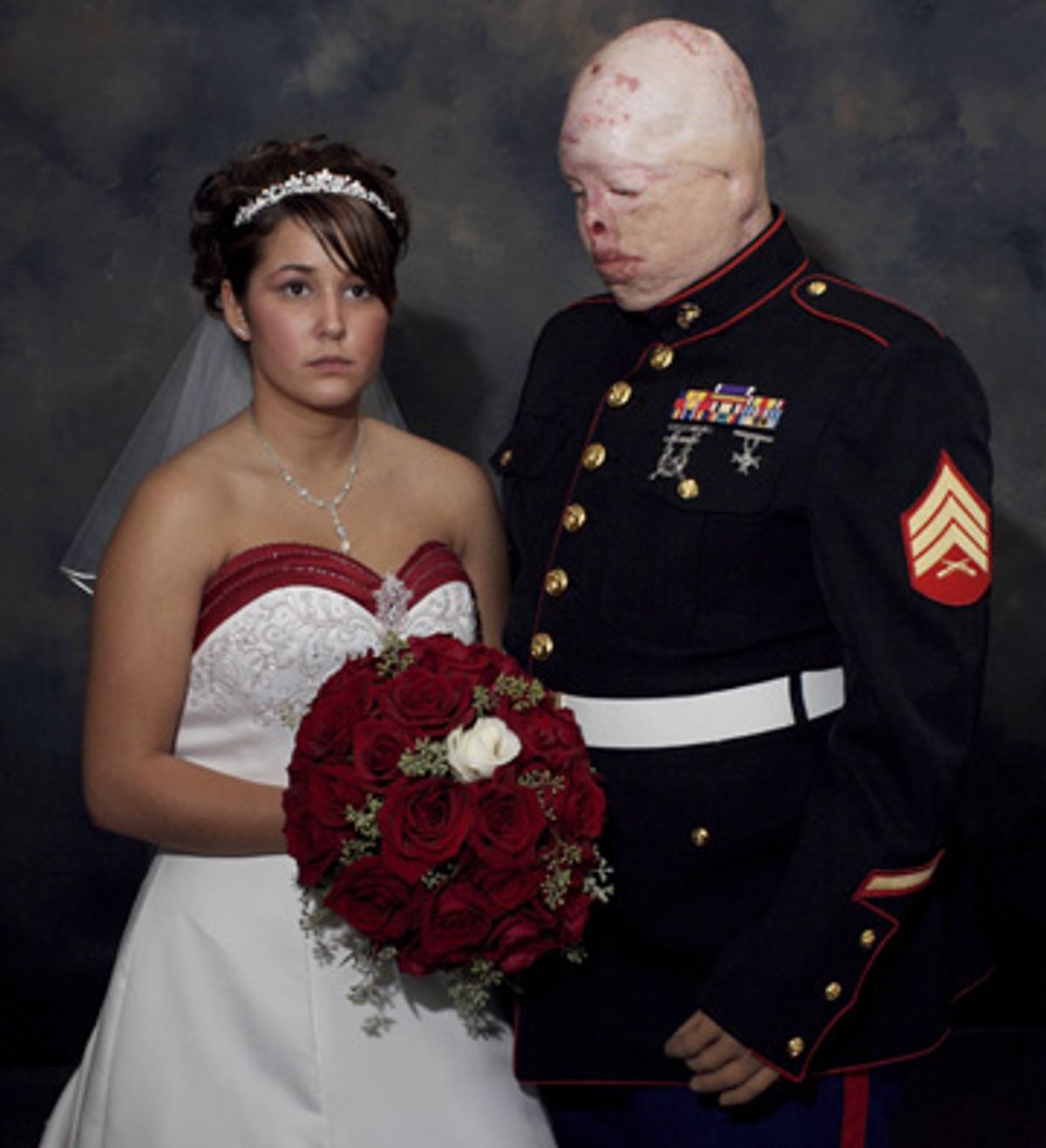
One of the most iconic images of the Iraq war was taken by Nina Berman in a commercial portrait studio in small-town Illinois. You've probably seen the photograph. A young couple stands side by side facing the camera. There are all the usual accouterments: the frosted, school-photo backdrop, the red bouquet precisely matched to the red trim on the bride's white gown. The groom wears a decorated dress uniform. It could be any couple in any town -- except that the groom's features have literally been melted off. He has no nose, no chin, no ears and no hair. His head appears to attach directly to his shoulders, and his face is so badly burned that it's a struggle to decipher his expression.
The bride's expression is equally opaque. Some people think she looks stunned. Others describe her expression as anxious, or even fearful. Her mouth turns down slightly at the edges, but her wide brown eyes gaze straight ahead and something about the set of her jaw suggests resolve. Some viewers strenuously deny that there's anything unusual about the young woman's countenance at all.
The portrait is just one of a much larger series Berman shot on assignment for People magazine showing Marine Sgt. Ty Ziegel's recovery, homecoming and wedding day. Berman was sent to Brooke Army Medical Center in Texas to meet Ty, and his fiancée, Renee Kline. At the time, Ty was 24 and Renee wasn't quite 21. The two had been high school sweethearts and were engaged before Ty's second tour in Iraq. But in 2004, Ty's tour was cut short when a suicide bomber blew up near his truck during a routine patrol. The searing heat melted most of the skin off Ty's body and left him blind in one eye. His skull was so badly shattered that doctors had to replace it with plastic. Ty was taken to Brooke Army Medical Center, where he underwent 19 surgeries. Berman completed the series over the course of three separate visits, first chronicling Ty's convalescence, and then, following his release, the couple's marriage in late 2006.
Four weeks ago, Berman's wedding portrait, "Wounded U.S. Marine Returns Home From Iraq to Marry," won the World Press Photo competition for portraiture in 2006. The World Press Photo competition is the most prestigious international award for photojournalism. Since then, the image has been viewed online hundreds of thousands of times, sparked countless blog posts and endless comment threads. Everyone sees something different.
Salon reached Nina Berman by phone to talk about the story behind her haunting image.
Can you describe the circumstances under which the prizewinning photo was taken?
It was their wedding day. Before they went to the high school where they were married, they went to a commercial portrait studio. I normally don't find those commercial studio pictures very interesting. They seem fake. People just put on a happy face. But then I thought, this is a different wedding picture, isn't it? So I kind of stepped back. I thought, it's the same as having someone with their body blasted off in a high school yearbook.
Rituals like this, young people getting married, if this doesn't say that this war is having an impact, I don't know what does. It just cries out to people -- hey, this war is real. There's a very palpable reality to this war in certain communities. It's right there, not in the cities or on the coasts. Most people in the media and the cultural elite don't know anyone in the military. My whole goal is to say, hey, this war is not some kind of abstract thing.
How would you describe the photo?
It's a very static picture. It's a moment stopped in time. That picture said to me that this was a moment of reflection and quiet. A break from the wedding day craziness.
In the portrait, Renee has a kind of haunted or overwhelmed look. And she seems to have that same haunted expression in several of the photos in the series, like the shot of the two of them on the porch. Did you see that same expression on her face at different times when you were shooting the series?
I did. I was looking for a way into her soul. To see into her eyes, if she was thinking about something else than what was happening right in front of her. But I never asked her about it. I felt like she could have offered it up. Sometimes I feel free to ask probing questions, but not this time.
How would you describe the expression on Renee's face?
I don't know. That's what's so interesting about it. It suggests something different for everyone. For me, it seemed like this one brief moment to take stock.
Some people have asked whether the expression was just some kind of fluke, whether it might have been unrelated to the wedding or Ty's disability --
Yes, you can say, "She was exhausted," or "They were hung over" -- they were -- or "They just wanted to get this over with and get out of there so they could have fun." That's part of it too. But that's not what makes pictures interesting. What makes pictures interesting is that they provide the space for the viewers to contemplate.
What's the public response been to the picture?
I've published photos that generated a lot of response before. But this time, there was this crazy cyber-response. A hundred thousand people saw it through Fark in one day.
Has the reaction been generally positive?
What other people bring to the picture is extraordinary. I got linked to by everyone from pro-war sites to antiwar sites to sites dedicated to love and Valentine's Day. Then there were other people who were interested in the picture as photographers.
No one's said that it was a cheap shot. Most people are heartbroken. That's what sort of shocked me. They'll say, "I cried for days," or "I've never seen anything like this." Personally, I didn't feel any of those things.
How many frames did you shoot of the couple in that pose?
Just one frame of that pose. I also shot some from the side. I thought those were a little more artful, a little softer. Then I came around to the front. I liked the flatness to it. I like that it had almost a snapshot feel. It didn't require a lot of technique to take that picture. It's a standard wedding photograph, but something's different. The war is affecting our rituals, our daily rituals. Look around.
When did you first meet Ty?
I met Ty at Brooke Army in Texas. He was near the end of what was a 19-month recovery there. Renee, his fiancée, was down there and his mom, Becky, was there with him as well.
Was Renee living with Ty at the hospital?
They were all camped out at this place called Fisher House, which is a nonprofit group that provides housing for military families whose loved ones are receiving medical care. One of the issues in this war is that many of the wounded are really, really badly wounded -- they don't need one surgery, they need 30 surgeries that can go on for over a year. So in order for a family to be with a wounded loved one that whole time, they might have to quit their jobs and move -- and the government doesn't pay for that. Maybe it'll pay for a week, and that's it. Fisher House helps them stay longer.
What did you think when you first met the couple?
The first time I [met them] I was shocked. I was scared about the assignment. I had photographed really burned vets before, but [this] was a People magazine story, and I was concerned that they picked someone who was so shocking-looking that it was going to be a super-sensationalist piece. I was afraid viewers weren't going to be able to look at Ty, so when I first saw him I was put off, for maybe five minutes. But then his disfigurement just sort of faded away. I would watch and see how the rest of the public looked at him. In some pictures you can see that.
Like the shot of the little girl in the candy store?
Yes. I asked Ty, what do little kids say? Do little kids get scared? In my book, I'd photographed a really severely burned soldier. And when I was with him I'd see kids shy away and he would smile at them.
Ty would just laugh -- he's got a great sense of humor. Kids would say, "What happened to your ears?" and he'd say, "The bad guys took 'em." They'd say, "What happened to your nose?" and he'd say, "The bad guys took it." I guess he tried to make some little game out of it to deal with it.
Did you get a real sense of what Ty was like as a person?
It was difficult for me to know what was Ty before the injury and what was Ty after the injury. Because he's got an almost aloof manner. He's not that communicative, and he's got an acid sense of humor. He was closed up at Brooke Army. I never really saw him smile much. When he went home to Illinois I started to see more expressions -- which as a photographer I was always looking for. But because of his burns and the way his face is, it's hard to see expressions.
So the injuries and his burns made his face somewhat inscrutable?
Yeah. I was always looking for signs of life in his face. And then one day, once he was back in Illinois, I went to this thing with him. He and his friends really like this Ultimate Fighting Championship show on TV. This one day, he was with all his old friends from high school and he was like one of the guys. You could see the personality coming back and you saw the smile as he'd stand up pumping his fist for his favorite guy. You started to see the person come back in his face.
Does his family see him as the same guy?
They see him as kind of the same guy. I know when he was at Brooke Army he was super-depressed. During my visit there he was really itching to leave, but things were being held up. He'd sit in there and watch a lot of TV, and he was kind of aloof to his family. I was really surprised by that, but his mom and Renee would laugh it off and go, "Oh, that's Ty." But I think when he got home, his personality came back, which is kind of remarkable.
He had a reputation at Brooke Army of being this super-positive character. He would go in to the other soldiers and Marines who would come in really sick and cheer them up. All his therapists said he was a completely remarkable person for surviving and having a very positive attitude. He seems to be the kind of guy who always looks forward, doesn't look back. He's not super-reflective about his experience. Never talks politics. I asked him if he ever watched the news or read the papers and he said, "No, I figure that if I need to know something, someone will tell me."
Can he get work?
No, there's no work -- though he can drive fine and I think mentally he's all there. He can concentrate. He can certainly hold a conversation and all that. They pulled a toe and gave him a thumb from his toe, but he's lost several fingers on his good hand, and he wears a prosthesis on the other side.
I was in Illinois the day his medical discharge came in and Ty was really sad. He would very much have liked to have stayed in the Marine Corps. For a lot of these guys it's a very hard moment when they realize that their life in the military, which they put so much stake in, is finished.
What's Ty's plan for the future?
He wants to raise a family, he wants to have kids. He wants to be a dad. That's his big dream for the future.
What's Renee like?
Renee is a 21-year-old who has been through so much in the past couple of years. Her dad was killed in a quad-bike accident shortly before Ty's injury. I'd say she's fairly outgoing and honest. Renee comes from an even smaller town than Ty. They live about two hours from Chicago, but if you asked them how to get to Chicago, they couldn't really tell you. They couldn't tell me. They live in a community where people don't leave. They're not worldly characters.
I don't think she ever doubted that she was going to stay with him. They were high school sweethearts. I think it's common in that town to get married young. And I don't think she could have conceived of a future living in that town having decided not to be with him. But I also think she really loves him. They remind me of a married couple that has been married for 30 years. They weren't very romantic with each other at all, but there was a real bond there.
Do Ty and Renee do the usual stuff that 20-something couples do socially?
Yeah, they go out drinking. She's more active than he is. They go out. Everyone there drinks a lot.
How did you get interested in photographing wounded veterans?
Looking back I guess it's been something that's always been of interest to me. I've been a photographer for over 15 years. I've worked for a lot of different magazines, here and in Europe. But I was a print journalist before I was a photographer. In 1987 I followed a group of Vietnam vets on one of their first trips back to Vietnam. I got very in-depth with one or two of those soldiers and saw the psychological battle and also the physical battle. Some of them had Agent Orange poisoning and various other issues. It was clear to me that war goes on long after the armies leave.
Since the war in Iraq began, I've spent a lot of my time photographing the war wounded -- physically wounded and mentally wounded. That work turned into a book called "Purple Hearts Back From Iraq." The series with Ty and Renee was an outgrowth of that work.
Are you ever shocked by what your pictures reveal?
I am shocked sometimes. That's why photography can be such an intimate art. People are always trying to put masks on and defenses on. In this picture, we're seeing the moment that those two are experiencing, and they are experiencing it alone -- that's what I got from their body language. No one's around. The other members of the bridal party have moved away from them. It's before the wedding photographer steps up. They're standing together, they're clearly united. They're going to be joined for life. But the way their eyes are, you can tell they're not looking at each other. No matter how in love you are, you're always alone.
When I did my other work on wounded soldiers, I thought really carefully about how I wanted to present them. I almost always photographed them alone, even if they had loving parents or girlfriends or wives. That was a choice because I wanted to show how lonely and isolating it can be for them. I realized when I took this picture that sometimes you can show being alone much better when there's another person in the frame.
A lot of powerful pictures, and a lot of gory pictures, have come out of the Iraq war -- but this one seems to have a unique effect on people. Why do you think that is?
It's funny the things that will make people stop and look around. Sometimes it's just the surface things. I think the picture challenges a myth that's out there, which is that that we take care of our own. Anyone who has worked with soldiers and vets knows that's bullshit. But people buy it. The idea is he's at Walter Reed and he's going to be OK. They put their magnets on their cars. A lot of committed journalists have been punching holes in that myth for a long time. But you still see the stories about everything's great because there's a guy at Walter Reed with a computerized leg.
It took mold on a wall to blow the whole Walter Reed thing open. But mold, that's just on the surface. I was at Walter Reed in October 2004. I knew about the place, that they couldn't take care of all the guys they were sending in. There were so many bigger things compared to the dingy rooms. It's very peculiar what sets people off, what just gets people to look around.
The response to the photo reaffirms my belief in the power of photography. My photograph became a way for people to discuss issues and to feel things. Maybe somehow this picture will be a wake-up call.
Shares