

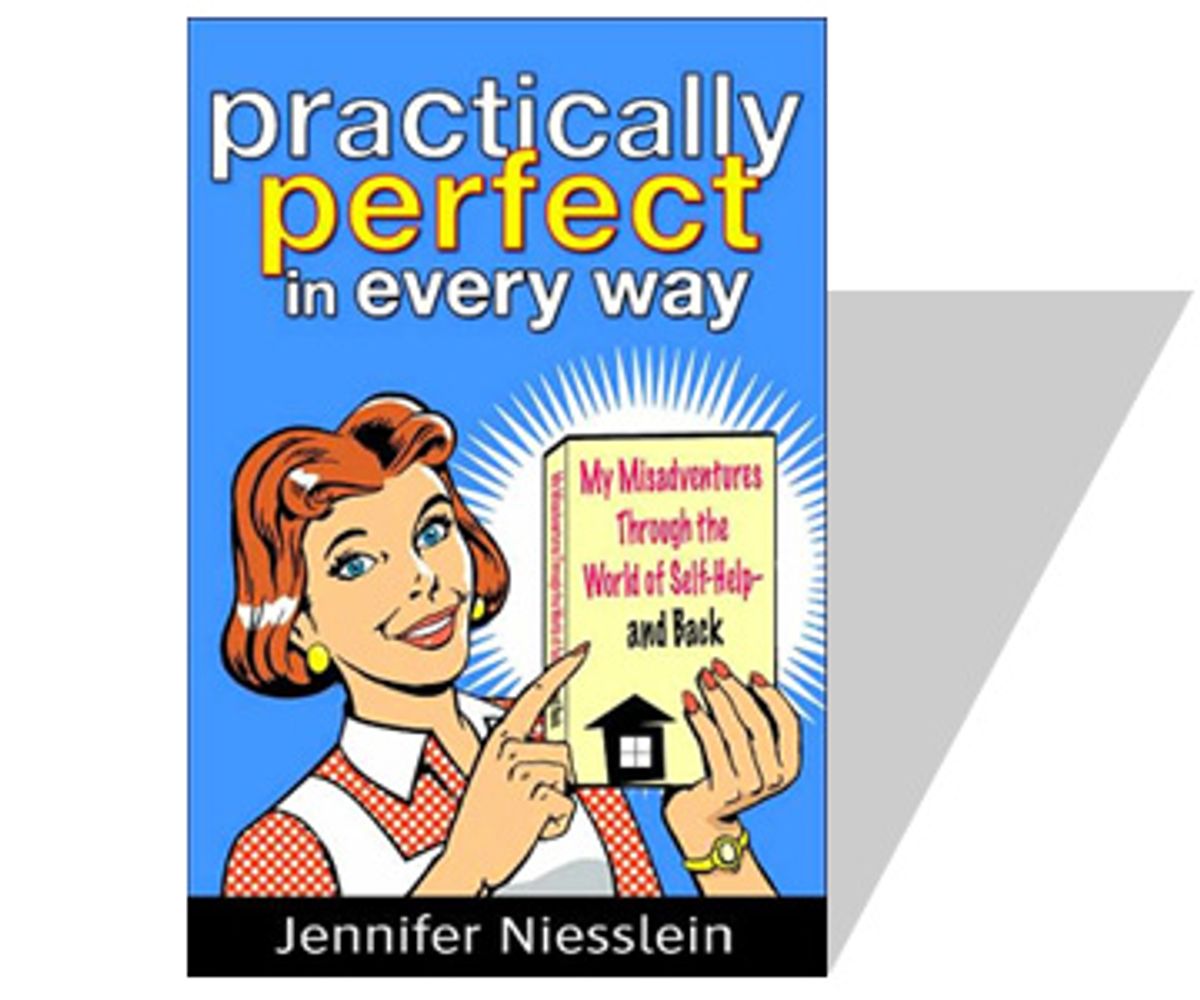
Jennifer Niesslein was living the kind of life people have in mind when they talk about the American dream. At age 32, she had a nice husband, a son, a big new house, a creative career and a growing business as co-editor and co-founder of the alternative parenting magazine Brain, Child -- and enough money that, well, her family didn't have to worry much about money.
Still, she wasn't quite satisfied. The house was a mess. She found herself overreacting to trivial things. Her kid had typical kid problems. She hadn't given much thought to retirement planning. She thought she could stand to lose a few pounds. It wasn't that she was unhappy, exactly -- but was she really, truly happy?
In search of an answer, Niesslein did what many Americans do when their lives need a few tweaks or an all-out overhaul: She turned to self-help experts. A slew of them, in fact, including personal-finance guru Suze Orman; natural health advocate Dr. Andrew Weil; relationship advisors Drs. Phil McGraw and Laura Schlessinger; and the granddaddy of self-help himself, Dale Carnegie, author of the 1936 "How to Win Friends and Influence People."
For two years, Niesslein followed her self-help advisors hoping to improve her housekeeping, financial security, marriage, parenting skills, emotional state, fitness -- and even her spiritual life. Her new book, "Practically Perfect in Every Way," is a part-critique, part-memoir account of that experiment.
The book's tone is conversational and funny (Orman, the author notes, "seems to blink less often than the average person," and Weil's distinctive white beard is "somewhere between Santa and Jerry Garcia") but also, at times, serious and contemplative. Niesslein recounts how one decluttering expert suggested she walk around her house clapping her hands in the corners of rooms to "disperse stagnant energy." And she gives special thanks to her remarkably cooperative husband, Brandon, who dutifully took part in the daily relationship exercises Dr. Phil prescribed -- though both parties admitted feeling silly. (Brandon on Day 11: "It seems like Dr. Phil doesn't really expect anyone to make it this far in the book. He's just making stuff up at this point.") In the end, Niesslein says, self-help made her life both a little more perfect, and a little less so.
Salon caught up with Niesslein in Evanston, Ill., where she was giving a bookstore reading. Sporting red Dr. Martens and an irreverent sense of humor, she's now cheerfully unapologetic about her own little flaws: a figure that's not model-skinny, a temper she can't always keep from flaring, a smoking habit she doesn't feel like giving up. Practically perfect, Niesslein seems to have decided, is close enough.
What inspired your experiment?
Well, my dog was dying -- isn't that how all good stories start out [laughs] -- and it was my first real brush with mortality. It's clichéd, but it made me think, "What sort of person am I? What am I doing with my life?" I felt like there was some serious room for improvement.
But it really came to a head when I was watching "Oprah" and she said something I didn't quite understand. She said, "The first thing about fixing your life is owning the truth about your life." I was like, "I don't know what that means." But everybody on the show seemed to be really grooving on it. So I thought, "Maybe this is what's wrong with me, that I'm so dismissive of things I haven't even tried." I figured: Self-help has worked for some people. I thought I'd be the guinea pig and do the experiments on myself.
So you suspended your skepticism about self-help for the sake of the project?
I didn't completely suspend it. I wasn't going to be a sponge and just take everything in. I went into it with two minds, so that I would still use my common sense, but also suspend my disbelief about the awfulness of the prose and things like that.
Had you tried any self-help before?
Not very much. Like everybody else, when I was pregnant I read "What to Expect When You're Expecting." But by the time Stephanie [Wilkinson, Niesslein's co-editor and co-founder] and I started Brain, Child, I had a bad attitude about being told what to do. It becomes apparent pretty quickly that it's difficult to separate regular, factual advice -- like how often you should feed a baby -- from larger philosophical things.
Still, as a writer, I thought self-help was full of interesting ideas. It sounds like a fluffy topic, but the whole idea of individualism, of luck, of happiness -- it is really rich subject matter. Things like: Can an individual really make significant changes all on her own? How much of anyone's success is a result of action and how much is just circumstance and dumb luck? In some ways, this project appealed to me in the same way that Brain, Child did when we started it: as a way to take a subject that, at the moment in our culture, is considered "lite" -- whether motherhood or self-help -- and see what else was there. And sure enough, some of the books I wound up disliking immensely, and others I wound up really liking and respecting.
What made the difference?
Well, my favorites are the ones that don't force you to navel-gaze so much. They focus on the inside and the outside. Martin Seligman [psychologist and author of "Authentic Happiness" and other books on "positive psychology"] does that. And Oprah -- I think that is actually one of the great things that she does, when you look at the balance of her show.
The thing is, even among the authors I really liked, there is still this underlying idea that, with enough get-up-and-go, you can fix things by yourself. And for some things, that's probably true. But there is also such a thing as luck. One of the big ideas in self-help right now is that there's no such thing as luck. Or as "The Secret" [Rhonda Byrne's recent bestseller] says: You put out positive thoughts and it will come back to you. It's a lovely idea, and I think it's a very American idea. But I don't think it makes it true.
It seems like the foundation of the self-help concept is this idea that personalities are infinitely malleable. But isn't it possible that we're not as changeable as self-help experts like to, or pretend to, think?
Yes, exactly. Even in the best self-help, just by virtue of it being self-help, you have to believe that you can change things. But there are some things, I think, that are part of your temperament. And then there are some things that you can't change by yourself. Having job security, for example, would really improve quality of life for a lot of people. But one individual can't decide, "I will have job security."
I also think people change in ways that they don't necessarily intend to. During my experiment, I wound up having panic attacks, which I'd never had before in my life. I wound up sleepwalking more. I could chalk some of those things up to the self-help, but it might have been [the result of] other events in my life during that time, too. I called it an experiment but, you know, there was no control group.
But you did see a possible connection between those problems and your two years of very intense self-focus?
I did. These books say you'll have all this knowledge, you'll be empowered, you'll be the master of your destiny. But the flip side of that is that you become acutely aware of all the burdens that you have, too, and your responsibilities. You're responsible for your financial destiny, and especially according to the folks [I was reading], women are responsible for what's going on in their relationships.
Yes, I found it interesting that you mention in both your marriage chapter and your housecleaning and organizing chapter that most of the burden of improvement tends to fall on the woman.
Self-help is very old-school in that way. I think it's changing, in the same way that our culture is changing -- women are moving into the traditional men's realm, but it's taking a lot more time for men to move into the traditional women's realm, into the domestic stuff. When you look at the financial advice, there's a lot targeted to women these days. But housecleaning and relationship advice is still very much targeted to women. When I was taking the Fly Lady's [housekeeping] advice, I got 15 e-mails a day, and some of them were testimonials. And one that really struck me was from this guy, who said, "Thank you for teaching my wife how to clean house. I've been trying for years to teach her."
But he took no responsibility for it himself.
Yeah, and that is why I stopped following the Fly Lady's advice. Because I realized that I was the only one in the house who was very interested in it.
You note something similar, though less overt, with Dr. Phil and his relationship books.
Dr. Phil is very careful to use the gender-neutral "your partner," or "your mate." But I think we all know who's actually going to be reading this. And at one point he has a note to his women readers, saying that his wife, Robin, the long-suffering Robin, fixed their relationship with no help from him, [mimics patronizing tone] "and you women readers can do it, too."
You write at one point that your own life is "practically perfect in every way." I'm sure you were being a bit ironic, but you do have a good life. How different do you think the experience would be for people who have more serious problems?
I wonder about that. Because on the one hand, I know there are probably people who would think of me as a whiner. I have everything I need to be happy. And I wasn't desperately unhappy. But I felt that something could have been better. On the other hand, I have a lot of resources, in terms of money and time and motivation, to do this. And yet I still felt like I failed in many regards.
You feel like you failed, or like the programs failed?
Well, I think the programs did -- but the emotional takeaway is still that you've failed.
There's some comfort in having somebody tell you what to do, somebody who supposedly knows what they're talking about. But do you think self-help also breeds a sense of helplessness in people, in the sense that they aren't able to function in their ordinary lives without the advice of experts?
For me, it did. I really started to unravel during this project during the parenting and marriage chapters, where I was thinking about every single thing I did before I did it, including in my own home and with the people I'm closest to. It really undermined my confidence as a parent.
What was the best advice you received?
Generally, I wound up liking any sort of advice that split the focus between your inner life and the larger world. I really liked when Martin Seligman said, "Focus on your strengths, and use them to compensate for your flaws."
What was the worst advice?
There are so many ways that advice can go wrong. I think the worst advice is advice that doesn't have an escape hatch, that doesn't say, "You know what? This might not work for you." That's what drives me crazy.
Were there any lasting results or advice that you've kept in your life?
I got a retirement account set up. I lost 10 pounds. And now I have methods for avoiding getting all fired up about very petty things. I find them very difficult to apply in the moment, but I can do it afterward, to talk myself out of a bad mood.
How did your husband and son feel about the experience?
Brandon, was a very, very good sport about it all. Though I know he was very happy when the marriage chapter was done.
Shares