

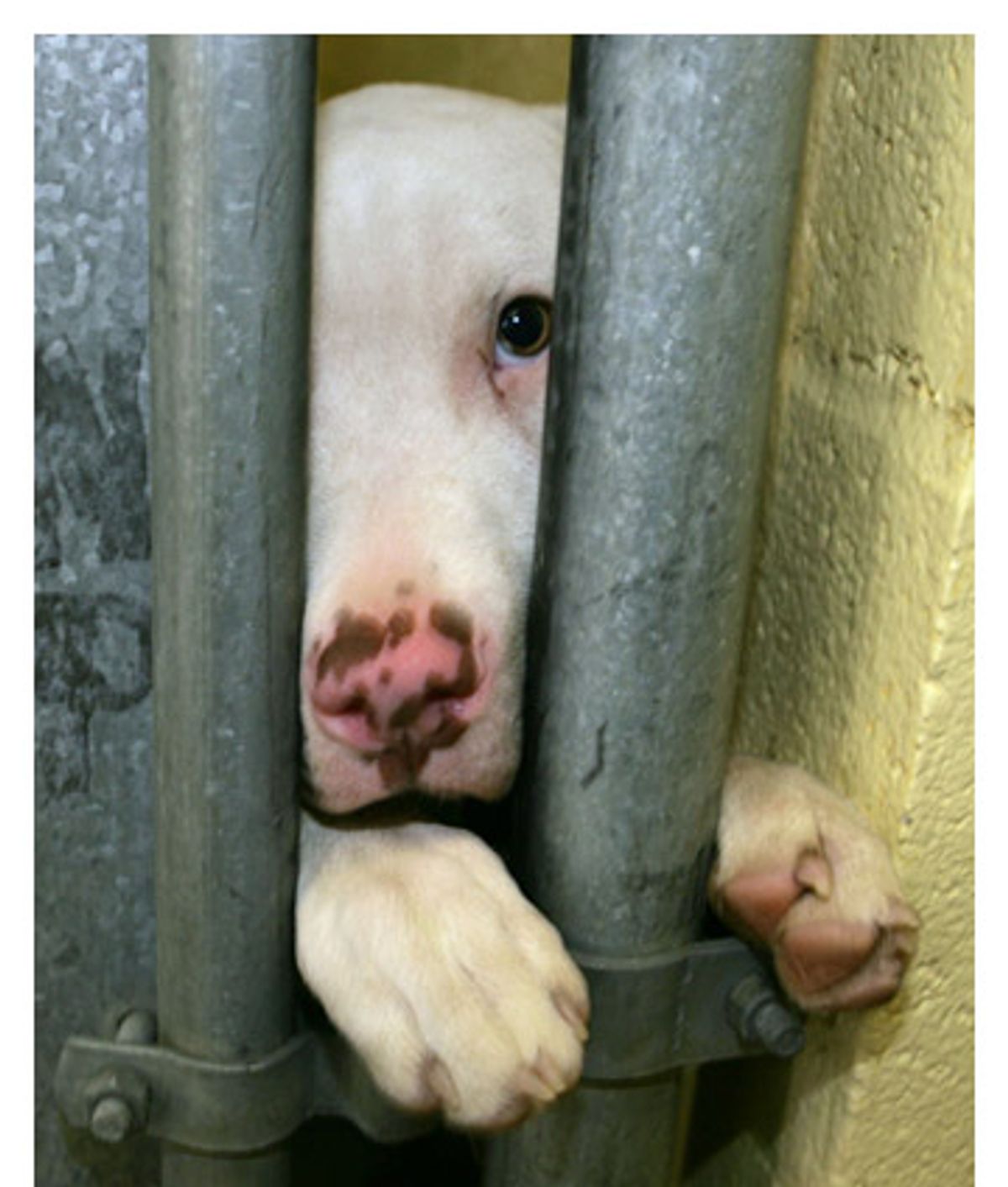
When you fall in love with a pit bull, you need to be prepared for a lot of abuse from strangers -- a lot of accusations, a lot of glares. Walking down the street with my dog, Sula, cars slow down as they pass. People cross to the other side of the street, as if my canine is a convicted killer or I am an associate of Michael Vick. In a vet's office on the other side of town, people talk trash about Sula while she waits motionless on the waiting room floor, her legs splayed out behind her like a roast. "I guess you like those dangerous dogs," a woman offers as a conversation starter.
"She's too nice to be a pit bull," a friend said on the day I found Sula as a stray. One eye was torn open, there was a crack across her nose from being hit with a stick, she was in heat and her heart was infested with worms. I was living in Florida at the time and called all the local animal shelters -- none would take her, except to put her to sleep. I brought her home, temporarily I thought, and then we fell in love. I already had a pit bull mix that I had adopted in Manhattan, where the shelter had registered him as a shepherd mix. "We don't want the city knocking on your door," they said, worried that the city might come to get my dog if a pit bull ban was passed.
No one came knocking on our door, but six years later, New York City is once again considering breed-specific legislation. The idea of targeting specific breeds -- and their owners -- is spreading to city councils across the nation. Here is the Bush-era logic: By limiting or banning pit bulls altogether, they will not only reduce what is frequently (but inaccurately) termed a "dog bite epidemic" but also rid the community of the unsavory characters associated with these dogs -- as if drug dealers, gang members, and dogfighters will all disappear once the corrupting element, the American Pit Bull, is banned. This concept sounds too idiotic to make it through the courts, yet breed-specific legislation (known as BSL) is coming to a town near you. Among the municipalities that are currently or have recently considered some form of BSL: San Francisco, Boston, Chicago, Baton Rouge, La., Baltimore and virtually the entire state of Ohio. In fact, there isn't a state in the country where BSL is not being considered, even if, as in New York, there is a state law preventing legislation that identifies dangerous dogs strictly by appearance rather than individual temperament.
The terms of the legislation vary from mandatory spay/neuter and higher licensing fees to mandatory euthanasia. And while the primary target is the American Pit Bull, in many cases the list of evil breeds includes Akitas, boxers, chow-chows, Dobermans, mastiffs and German shepherds. In Ontario, after legislators successfully banned the pit bull, word spread (though was later discredited) that the government was also considering a ban on Labrador and Lab mixes, since -- due to their popularity -- they are responsible for more bites in the province than any other breed. The goal, according to the politicians who endorse BSL, is keeping people safe. They don't seem to care that the ASPCA disagrees. The American Veterinary Medical Association disagrees. The American Kennel Club disagrees. And the Centers for Disease Control disagrees, although an old CDC study on dog bites is frequently misquoted for the purpose of supporting the idea of targeting specific kinds of dogs.
Two years ago, Denver began enforcing its own ban, which had been on the books for 17 years. Pit bull owners had to give up their dog to be euthanized, or they had to get out of town. At a Border's cafe just across from Columbine High School, I huddled with several pit bull owners who spoke in whispers and looked over their shoulders, making sure no one could overhear. Over the phone, I spoke with a Denver journalist who told me about a secret society of pit bull owners who had defied the law and kept their dogs in town; she knew about the group because she was one of them. And I met Mike and Toni, who sheltered dogs from the Denver exodus on their property, named Mariah's Promise. The night we spoke, they checked into a Super 8 Motel with two of their dogs and were awakened by a knock on the door -- someone had seen pit bulls enter the room and called the cops. From what I can tell, this is what BSL accomplishes -- it makes dog owners fearful, it drives them into hiding, and it does nothing to stop anyone who is truly breaking the law.
One problem with enforcing BSL is that no one is entirely sure of what a "pit bull" is. The American Kennel Club recognizes no such breed, while the United Kennel Club (a separate organization) recognizes the American Pit Bull Terrier. But the generic term "pit bull" is used to refer to any number of variations of the bully breeds: boxers, American bulldogs, mastiffs, etc. And so the laws are written broadly, so that no dog is excluded: The definition generally includes American Staffordshire terriers, American Pit Bull Terriers, pit bull mixes and ... any dog that looks like it might be in some way related to a pit. One Mississippi ordinance specifically stipulates that just because a dog might not demonstrate any of the characteristics in its definition of a pit bull, that doesn't mean it can't declare it a pit bull.
So demonized are pit bulls that it's often assumed if a dog committed violence, it must have been a pit. Recently, when a man died on the property of actor Ving Rhames, it was reported he had been mauled by a pit bull that went psycho. Eventually the dogs were identified by the police as "friendly" mastiffs, and the cause of death was declared unrelated to any dog attack -- but the story of the pit bull mauling lives on. And last summer, the Chicago Tribune ran a series of articles in which they followed up on a pit bull attack from the previous year. The term "pit bull" was used in the headlines, and throughout the stories, even though the dog was ultimately identified as another kind of mix, a yard-bred dog whose aggression had gone unaddressed by his owner.
I have a T-shirt that says "I Love My Pit Bull" in groovy 1970s-style lettering. Actually, I have three of these shirts, so that I know that there is always one that is clean and ready to wear. People see me wearing it and ask where I got it, or they point and say, "That's funny!" because they know pit bulls as dogs that are undeserving of anyone's love. "But I do love my pit bull," I tell them, and their smile fades. Pit bulls, to them, are ghetto trash, drug dealers' props, trailer park ornaments, symbols of desperation and anger. "There's only one kind of person who owns a pit bull," these people say, and often I imagine that the person they are thinking of is poor and black.
It would be a mistake to assume that pit bulls are a hallmark of poverty. Around the corner from me there's a house on the market for $750,000, and the real estate listing features the current tenant -- a pit bull -- proudly sprawled in the middle of the exquisitely appointed rooms. Gorgeous celebrities own pit bulls: Jessica Beal, Adam Brody and Rachael Ray are just a few who can be found walking their beasts in the pages of supermarket tabloids. But there is an economic component to the pit bull's popularity. When you live in an area so poor that even the police don't bother responding, you may want to have a little protection, and while any dog is likely to defend its owners from intruders, a pit bull at the door sends the message a bit quicker than the miniature schnauzer. And breeding just two litters of pit bulls in your yard can bring nearly as much cash as working full-time in Wal-Mart for a year. And then there is dogfighting, an illegal sport driven by gambling that has been around for centuries, but only recently seems to have made the news, through the power of Michael Vick's celebrity.
- - - - - - - - - - - -
It wasn't always this way. If you look into the history of the American Pit Bull, you'll find that a century ago, the breed occupied a far more elevated status in American culture. In 1903, a stray pit bull named Bud became a national celebrity when Horatio Jackson plucked him from the side of the road and took him on the first cross-country road trip. During WWI, it was the pit bull, then referred to as the American Bull Terrier, that was placed prominently on a series of American propaganda posters. In one, the pit bull, wearing a U.S. flag around his neck, is surrounded by the Russian wolfhound, the French bulldog, the German dachshund and the English bulldog; the caption reads, "I'm Neutral, but not afraid of any of them." Later, Buster Brown sold children's clothing and white bread with the help of his "American Bull Terrier" Tige. The pit bull was also featured in ads for sheet music, perfume, nearly anything offered for sale. Children got dressed in fancy outfits to pose with pit bulls in photographers' studios. A pit named Petey starred with a group of children in the "Our Gang" comedies.
When did the tide turn? In "The Pit Bull Placebo," Karen Delise suggests the dog's image was forever changed after a 1987 Sports Illustrated cover featuring a snarling, nearly unidentifiable dog with the headline "Beware of This Dog." News stories began slipping the term into headlines as shorthand for dangerous dog, even if it was a different breed involved in that particular crime. "Pit bull" entered the mainstream as an adjective, as in "I hope you've gotten yourself a pit bull attorney." Yet, when two Florida lawyers used a pit bull in an ad a few years ago, they were reprimanded by the Florida Bar for dragging the profession down to the level of these animals.
Self-appointed experts will tell you that fighting is in the blood. And dogfighters use this cliché to support their "sport." It would be cruel to keep them from fighting, they say. Yet if fighting were purely dictated by genetics, there would be no need to feed dogs gunpowder, insert glass shards beneath their skin, or to engage in any of the other cruel forms of "training" in the underworld of dogfighting. And if it were true that pit bulls, through their bad breeding, are prone to unexpectedly attack, the streets of New York City would be littered with victims of its estimated 300,000 pit bulls. It is easier to believe that the dogs are somehow to blame, rather than their human counterparts. It is easier to point to faults in the DNA.
The dog world is ruled by bloodlines, whether for fighting or for show. The AKC now offers DNA tests that can establish the parenthood of purebred dogs, but they insist that the test cannot determine or identify the breed. No matter, several private companies have stepped up to offer that service. The Mars Wisdom Panel MX Mixed Breed Analysis "identifies more than 130 AKC-recognized breeds that may be present." While the advertised purpose of the tests is to better understand the health and behavior of your mutt, it isn't a stretch to imagine that the test might eventually be brought into courts and animal control offices, where your 10 percent bully breed will be stuck on death row with the rest. And, since dogs are often used in trials for procedures that eventually get approval for humans, we may eventually see Orwellian courts being ruled by blood tests that can determine the criminal intent present in the defendant's DNA.
Does the fact that my pit bull love is forbidden make it that much more intense? Possibly -- because I know that I saved her life. And, like all forbidden love, from "Romeo and Juliet" on down the line, each time anyone questions or disapproves of our love, we defiantly love each other even more than before. But I think, like most other pit bull owners I know, that my love of Sula has more to do with this: She makes me laugh; she doesn't hesitate to turn and run away from bad music on the street; she likes to hug. And she loves to play practical jokes like hiding my glasses when I'm not looking. We even have our own song: Corinne Bailey Rae's "Like a Star" was, I am certain, written for us.
We are not immune to nepotism. I put Sula on the cover of my last book, because ... well, because I could. And I wondered if it might be the wrong thing to do, since the pit bull image is so loaded with dread. But instead of alienating consumers, Sula lured them in. I was taken aback by the number of people who told me, "I bought the book because I have never seen my dog on the cover of a book before." What they had seen, up to then, was their dog as the image of pure evil, on the news, in movies, on TV.
In Los Angeles, on the first stop of my book tour, two enormous pit bulls joined the crowd at Skylight Books. In Portland, Ore., I arrived at Powell's early to discover several rows in the front occupied by some nice suburban women all talking about their pit bulls. In Tallahassee, at a reading in a crowded and darkened warehouse, I asked for questions and was greeted by an enthusiastic yip from a pit bull that emerged from the back of the house. Even at a stop in a small public library in Michigan, I arrived to find a pit bull named Rose waiting for me in the stacks. People bring me photographs: their pit bull and their cat, their son's pit bull, the photo of a pit bull who died years ago but is still missed.
Pit bulls are loyal. They are known to sing, proudly, in ridiculously operatic voices. I know pit bulls who have nursed kittens and another who adopted a piglet as its own. And this I know from photographs of them in New Orleans wading through water up to their necks: When you take away their unmistakable dog bodies, their round skulls and even-set eyes make them look remarkably like infants or old, bald men, or occasionally like the overly pancaked face of Judy Garland in decline. And like infants, old men and Judy Garland, pit bulls are capable of expressing anguish and despair, as well as their euphoric joy at being alive.
In fact, I wonder if these very human characteristics somehow inspire their abuse.
Shares