


To listen to a podcast of the interview, click here.
To subscribe: Click here to add Conversations to iTunes or cut and paste the URL into your podcasting software:

On Labor Day weekend, a midwife's favorite holiday, Louise Sloan, a 41-year-old lesbian, had semen Fed Exed to her mother's summer place in Kennebunkport, Maine. Sloan, a magazine writer and editor, had always imagined she'd become a mother as part of a couple. Instead, here she was, a single woman accepting delivery of a stranger's sperm at the summer home of her 70-year-old Republican Southern mother, then informing the prospective grandmother that she was headed upstairs by herself to "baste." (Think: turkey baster.)
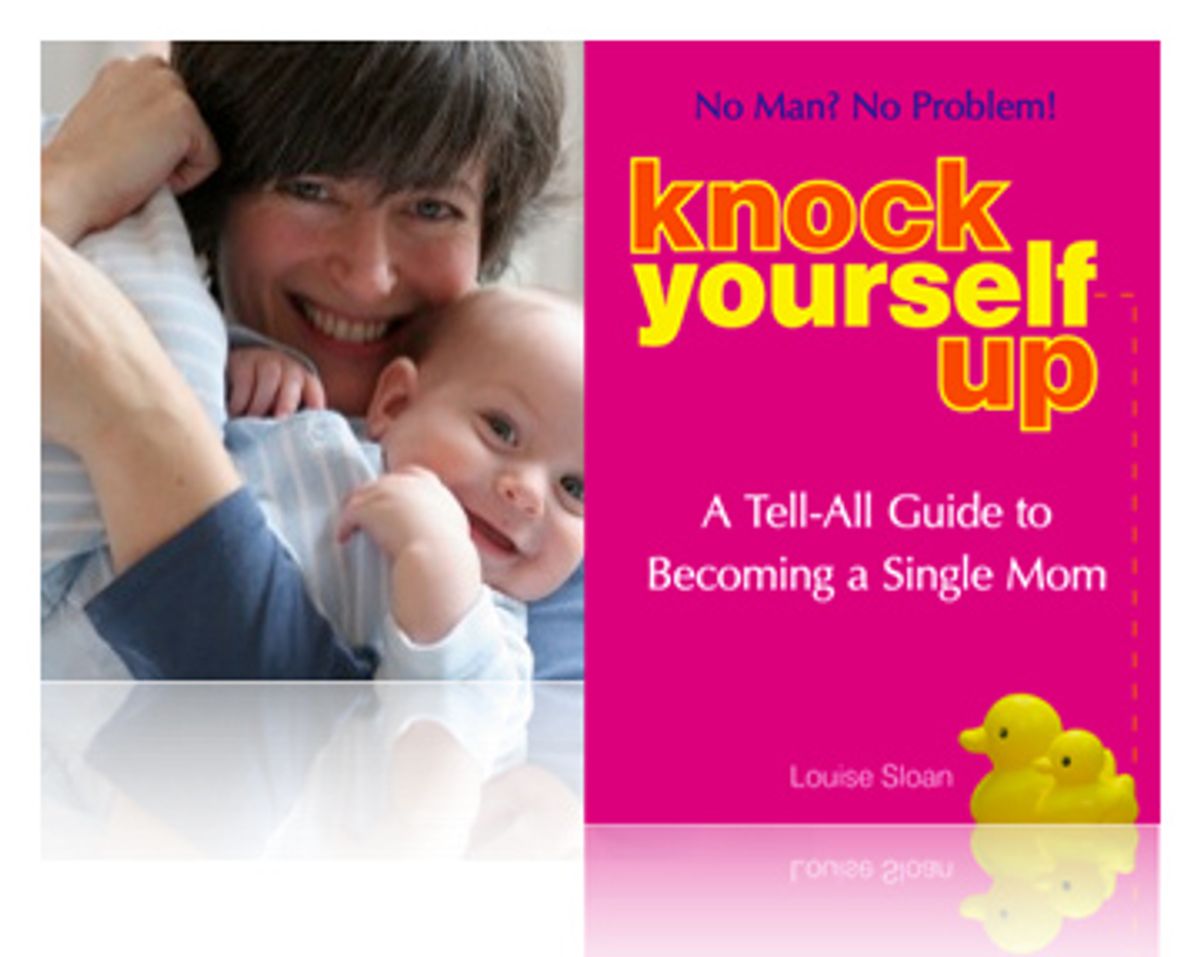
Sloan interviewed dozens of self-described "single mothers by choice" -- both straight and gay -- for her new book, "Knock Yourself Up: A Tell-All Guide to Becoming a Single Mom." Like many of them, for Sloan, fulfilling the dream of having a child meant more than holding out to find a life partner to start that family with. In her early 40s, she writes, her biological clock had begun to sound like a "car alarm." So she decided to try to have a baby, while it was still a possibility for her, and hope to meet the love of her life later on.
In the book, Sloan weaves together the experiences of other mothers who made the same choice she did, ranging from a Navy officer stationed in Georgia to a Manhattan nonprofit manager who has twins. She briefly surveys the limited research on how such children fare, but mostly she dishes up advice to potential single mothers on everything from cyber-stalking your sperm donor -- not recommended -- to deciding if you should list your child in the Donor Sibling Registry, where kids can meet their biological half-siblings on the father's side.
Of course, a book with the cheeky slogan "No man? No problem!" emblazoned on its pink cover above a rubber ducky is bound to raise the ire of social conservatives. Remember the Dan Quayle vs. "Murphy Brown" imbroglio, in which the vice president sanctimoniously scolded the TV character for bearing a child alone? Yet, ripping on the moral character of such moms did not go out of fashion with the Bush-Quayle administration. In 2006, syndicated columnist Kathleen Parker accused such mothers of treating men as "only as good as their sperm count" and children "as accessories to adult lives." In 2007, columnist Mark Davis wrote that any justification for purposefully bringing a child into the world without a father amounts to so much "selfish twaddle."
But what's most heartening about the women's stories in "Knock Yourself Up" is how often disapproving ideology melts away when doubting family members, friends and acquaintances encounter a happy, thriving child. Sloan's own blue-blooded mother spent eight weeks with her daughter and then newborn grandson, Scott, teaching Sloan all the words to "Tea for Two," and offering a grandmotherly heap of unsolicited parenting advice. What could be more traditional?
Salon spoke with Sloan, now 44, by phone from her home office in Brooklyn, N.Y., where she lives with her 15-month-old son, about what single motherhood by choice means for the moms and their kids. (Listen to the interview here.)
How did you decide to have a baby on your own?
I wanted kids when I was 28. I had a partner, and I was very seriously planning on having kids in the next year or two. And I kept on being put off by my partner for two more years, two more years, two more years. Then we broke up after an eight-year relationship. And in every relationship since then the idea of kids has been a big part of the discussions, but those relationships did not survive either.
What did you have to go through to get pregnant on your own?
I ended up having really bad luck with a sperm bank. It turns out that the first donor that I used had sperm that just wasn't working for anybody, and I used that donor for eight tries. I ended up getting pregnant with the second donor on the second try.
That was actually try No. 10, and I had a miscarriage. Then I got pregnant with my son, Scott, on the second or third try after the miscarriage.
In what form did you receive the sperm?
Mostly I did inseminations at the doctor's office, because an intrauterine insemination is more successful statistically than using frozen sperm at home. But there were times when my doctor's office was closed for a holiday, and I did home inseminations.
The sperm comes in a liquid nitrogen tank that kind of looks like a bomb. I had one experience where I had to go pick it up from a Fed Ex office, and the woman there starts lugging the tank back from behind the counter, and saying, "It's always you semen people who have late deliveries." She was used to getting shipments to veterinarians and animal breeders, and so she assumed I was breeding animals, not myself.
Do most single mothers by choice use a sperm bank, or do most use a so-called known donor, like a friend?
Most use a sperm bank, and the reason is that using a known donor is much more legally and emotionally risky. It's actually what I wanted to do. I wanted to have a father figure for my child. I did ask a couple of close friends, but they didn't agree to it. They felt like they would be creating a distant father experience for the child. One of my friends felt like he would feel responsible if I fell on hard times with the baby.
How much were you able to find out about the donor you did use, and how much did you want to know?
I wanted to know everything. I would have wanted to meet him. There are some egg donors with whom you can arrange a coffee interview before you sign up to use their egg. That's not the case with sperm donors, although I just heard that somebody is talking about doing a bank that has identity-release donors, where you have their adult picture.
What identity release means is the donor has agreed in advance to have his identity released should the child request it at age 18. I wanted that option for my child, and at the time that I was looking at sperm banks that was not at all standard. There were only a few sperm banks in the country; most of them were pretty small sperm banks that offered the open-identity option. Those sperm banks happened to be ones that had fewer other products. With some sperm banks you can get an audio interview with the donor. You can get a long essay that he's written. You can get various adult photos, childhood photos. I didn't have access to most of that kind of information.
I had a two-page form that he had filled out with really only two lines for each question. And then I had a rather lengthy family health history that he had filled out with the help of someone at the sperm bank. And I also had two photos of him when he was probably 7 or 8, so that was great.
But I felt like I knew hardly anything about this guy, and it was very difficult to make the decision to go ahead and to have a child who would be 50 percent from the genes of someone that I hadn't met, and that I knew so very little about. I had a conversation once with one of the women who worked at the sperm bank, who happened to run into him in the coffee break room the day before, which she recounted, and he sounded very charming. That was one of the most valuable pieces of information.
How many different women can a single sperm donor give to?
It's not regulated, so it depends on which sperm bank you use as to what their policy is. The sperm bank I used allowed 15 families.
In an open-identity donor situation isn't there some concern that when your child calls the donor at age 18, the donor will have already heard from many, many other children?
Absolutely. I don't know how these guys are really going to emotionally deal with that. Having kids knock on your door or call you up 18 years later must be pretty overwhelming.
I wanted to use a donor who had not had a lot of pregnancies result yet, because I wanted my kid to be one of the first in line. Of course, it turns out the first donor I used, one of the reasons he didn't have pregnancies is that he wasn't getting anyone pregnant.
What's your response to people who wonder why you didn't just adopt?
I would ask: Why doesn't anybody just adopt? I think that adoption is in many ways a better thing to do for anyone, single or married. But, like many women, I really wanted the experience of being pregnant, of having a biological link to my child. It's just the way that I always dreamed of doing it, so that was my choice.
Do you think that single mothers who actively choose to have a baby face more or less social stigma than women who just happen to be single mothers?
I expected to find outside of places like New York City or Los Angeles or San Francisco that women were really struggling socially. I expected to hear tales of discrimination and woe, and I really didn't. Even speaking to people in the South and in the Midwest in fairly conservative communities, I found that the communities around those people were really quite supportive. Even when they were fairly conservative religious families, they may have been shocked at first, but since they knew the woman involved, and knew that she'd make a great mom, and knew that she had thought really carefully about it, they were surprisingly supportive of her choice to become a single mom.
Why do you think that it's important to "come out" as a single mother by choice?
I think that if you have reservations or shame around having become a single mother and having chosen to be an alternative family in that way, that shame is going to be transmitted to the people you speak to about it, and it's also going to come through to your child.
I think that it's really important to make sure that your child feels that the way that she or he came into this world was a positive and happy thing. And so you need to have that attitude yourself. Also, in speaking to other people, if you present it as a weird, questionable thing, you're more likely to get a negative reaction.
I'm sure that you read the recent news story about a 60-year-old, single Japanese woman who is pregnant with a donated egg.
Oh my goodness. Yeah.
I just wondered what you thought when you read that.
I don't know that I want to necessarily be quoted as criticizing other women for their reproductive choices, but certainly at age 60 I would have serious concerns about my longevity and my ability to be around for that kid. It's not a choice that I would have made, but I don't know the specific circumstances of her and her life. And I probably have the same knee-jerk response as most people do. I was worried about being too old at age 40, so let's just leave it at that.
Since your son is so young, what have you learned from the experiences of other women who have older children about how being a single mother has impacted their children?
I agonized before having my son about his only having one parent, and not knowing his father. Things like that seemed very painful to me, because I experienced that kind of pain growing up without a father myself; he died when I was not quite 2. It was often painful and sad for me not to have a father, and I did experience a longing to know a father that I would say I still have to this day.
It's not that it's not an issue at all for the kids of single moms, but it's not an issue in the same way as it is for someone like me who actually had a dad and lost him. And that's reassuring, because that was really my biggest worry. It seems to be by and large good news that if you create a healthy, loving home environment for a child, the child will flourish.
And has there been much psychological research on children conceived this way and raised in single-mother homes since infancy?
There's been some. The research that has been done shows basically that if there is strife in the home the child will suffer, but if there is a supportive, loving environment the child does pretty well.
One study showed that the kids who had just a single mother tended to have more arguments with the mother when they were teenagers. The suggestion there was that in the families that had fathers it was the father who was the disciplinarian, and so it was natural that the mothers in the families that didn't have a father would end up having a few more of those disciplinarian arguments with their teenagers.
So you have a few teenage fights to look forward to?
Exactly! Maybe so. I hope not.
What do you think is the biggest public misconception about women who decide to have a child on their own?
You know, I don't know what the biggest public misconception is, but I can tell you what the biggest misconception is according to me.
I just went and filled in for someone teaching a workshop on choosing single motherhood. Even though the women I know who have done it are attractive, successful, great women, even though I hope that I fit into that description as well, and I don't feel like there is anything wrong with me, I went into that workshop expecting to see a bunch of losers. And I was surprised to see a bunch of really attractive, articulate, educated, successful women. And when I realized I was surprised, I thought: "What is the matter with you?"
Obviously, even though I've talked to a million great women on the phone, I still have this assumption that something went wrong somewhere for someone considering this course of action. And I think that what went wrong somewhere is really nothing. We're living in a different world, where women are pursuing careers and not getting married in their 20s as they used to. Also, women are not accepting and staying in bad relationships just to have kids.
What's one piece of advice you would give a woman who is thinking about doing this?
Well, my first piece of advice is be really, really sure you want kids. I think that there is way too much pressure on women to have kids -- pressure from society, pressure from prospective grandparents.
Go out and talk to women who have done it. Join a support group, which I didn't really do. I think it would have made it a lot easier to clarify my feelings about it, and to get past some of my fears. For some women, talking to women who have done it clarifies their decision not to do it.
Do you feel like you are personally Dan Quayle's worst nightmare?
If Dan Quayle met me and met my son, Scott, and saw our happy family and saw us in the context of my extended Republican family -- I certainly didn't vote for him, but probably most of my family did -- I think he would be pretty supportive of it.
When you take something like this down to the level of one-on-one interaction, I think it's a lot harder to demonize.
Bring it on, Dan!
Shares