


To listen to a podcast of the interview, click here.
To subscribe: Click here to add Conversations to iTunes or cut and paste the URL into your podcasting software:

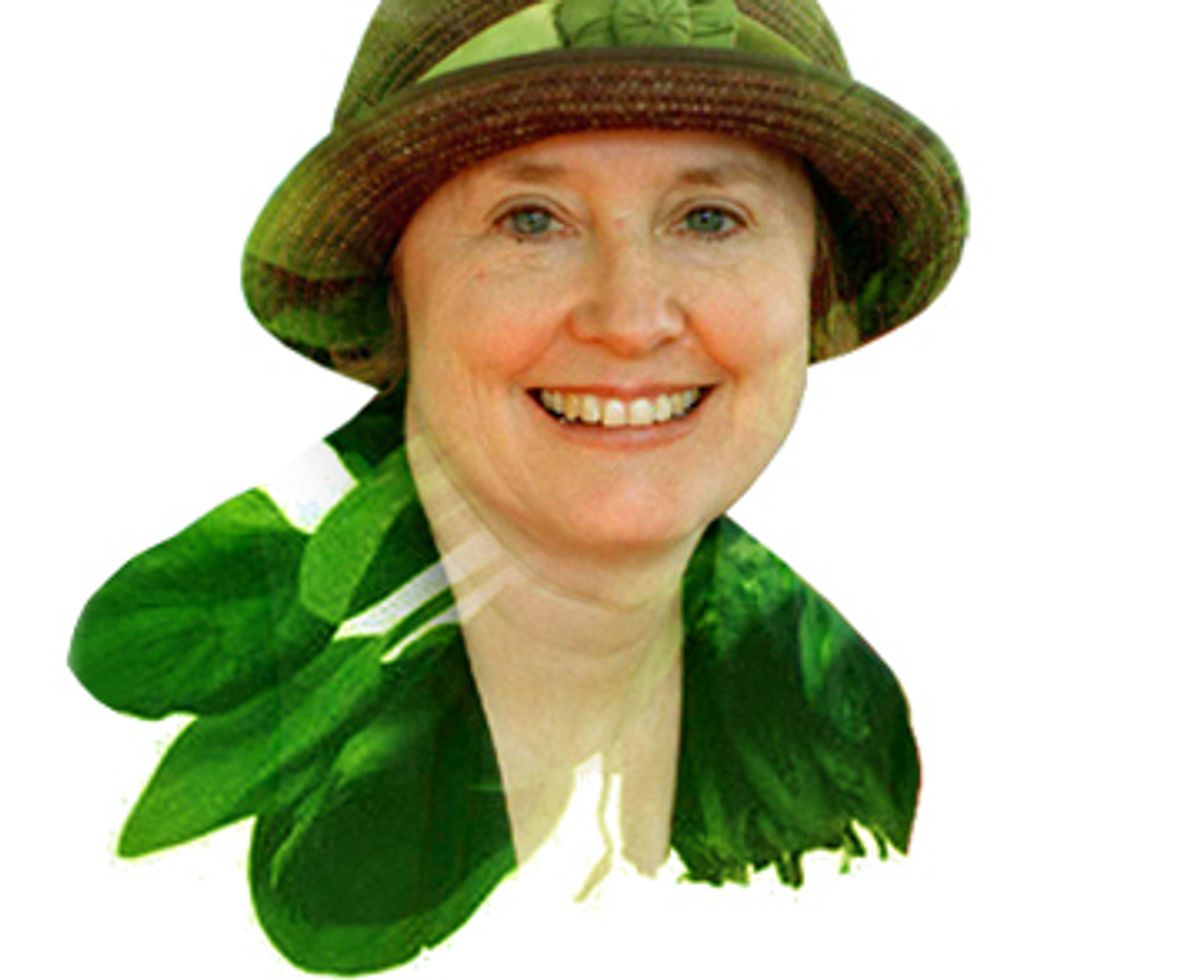
I had been prepared to skewer Alice Waters. Though I have eaten some of the best food I've ever encountered at her Berkeley restaurant Chez Panisse, and though I have generally tried to live by the gastronomic principles that she's become famous championing, and though I believe that the world would be better off in nearly every way if more people listened to her, there is a limit to what can be expected of us -- of me! -- and I wanted to tell her, Alice Waters, you just want too much.
Alice Waters is not content for you to simply eat organic produce. No, no. It's got to be organic and local and seasonal, and really, for it to be any good at all, you have to get it from the farmer who pulled it out of the earth. And ideally that farmer would be a friend of yours. You and he would discuss the soil and seasons and his search for heirloom varieties, and he would give you tips for your own garden, where, of course, you'd spend many of your weekends.
Alice Waters doesn't want you to use store-bought stock, or mayonnaise from a jar, anything frozen (even peas!), or salad that comes in a bag. She would rather you stay away from nearly every kitchen appliance, including a blender -- a food mill or a Japanese mortar and pestle called a suribachi is wholly preferable.
Consider the eggs Alice Waters wants you to buy, the eggs she serves at Chez Panisse: eggs from chickens raised on a pasture, chickens who enjoy, among other humane conditions, freedom from having their beaks trimmed by their handlers. This is a practice performed at nearly every egg farm in the country, including the ones that sell the $4-a-dozen eggs you buy at so-called responsible stores like Whole Foods. Even in the San Francisco Bay Area, it is extremely difficult to find Waters-approved eggs -- for long periods of the year, production is so low that farms impose rationing and stop supplying most stores; you have to wake up very early even to find them at the farmers' market. "People don't have enough time for this!" I would tell Alice Waters. We don't have enough money, either. It's just too much.
And then I opened her new book, "The Art of Simple Food: Notes, Lessons, and Recipes From a Delicious Revolution," and I fell into Alice Waters' world. Waters is known for the rhapsodic manner in which she talks about food, but her writing is every bit as engaging. "Poached eggs perched on a buttered toasted slice of tender bread is the perfect breakfast," she writes, and at that moment you'd move mountains to get those eggs to make such a breakfast.
More remarkable, though, is that she makes it seem, if not easy, at least not daunting. The book begins with a set of principles by which to live -- among them to eat locally and sustainably, eat seasonally, eat together with friends and family, and most important, to remember that "food should never be taken for granted." In the rest of it, Waters outlines straightforward ways that most of us can reach those goals. The most basic thing is this: Go to the farmers' market. Go often, go early, spend a long time there.
I spent several weeks cooking by the book, preparing Waters' recipes with the sort of ingredients she favors. I won't say it was easy -- especially when I couldn't get out of work to get to the market. It wasn't cheap, either, but it wasn't expensive. Every meal I made cost more than $10, but none cost more than $20.
Many times, I cheated in small ways. I bought a suribachi, but I also used the blender. In a risotto, I added frozen peas. In a polenta torta, I used conventional imported Parmigiano-Reggiano ($14 a pound) rather than organic ($24 a pound). I used organic canned tomatoes instead of fresh tomatoes in a pasta sauce, but Waters says that's OK to do out of tomato season.
The food was wonderful. If Waters' methods can be fussy, if her objectives can sometimes seem unattainably pure, the end result is inarguably fantastic. A Caesar salad I made from romaine I bought during an epiphanic morning at the farmers' market was as delicious as any salad I remember having at Chez Panisse. More amazing was that it came together in about 20 minutes, dressing and all. Linguine with clams in a tomato sauce spiked with fennel took three pots and an hour, but was so well worth it that I made it again the next day.
Earlier this week, I visited Waters at her office, which is set in a charming, woodsy annex building off Chez Panisse. She's in the middle of a long book tour, and had come into town briefly. She looked harried. The office buzzed with young assistants getting her set up to fly off to her next reading locations. I found her, as expected, unyielding -- this is a woman who believes food should be the No. 1 issue of the presidential campaign.
And yet, after buying and cooking and eating the sort of food she hails, you really can't help feeling that maybe it wouldn't be so hard to change your whole life around -- or at least to try. (You can listen to the interview here.)
You definitely have a goal for this book beyond recipes and technique. What is your objective?
I want people to focus on where the ingredients come from. That's really what's important to me. It's not so much what they're cooking, it's with what ingredients they're cooking. It can be a hot dog -- but where's that hot dog from? What kind of ranches are producing the meat? Are the animals being fed hormones and antibiotics out there on the range? Are they in feedlots? Are they enjoying the natural resources of the region? You know, what's in the hot dog? What's in the bun? What's in the mustard? What's in the ketchup?
That's what I'm interested in. Because every decision we make about the food that we eat has consequences. And they aren't just about people's personal health. There are consequences in terms of the healthcare system for all of us if people eat food that makes them sick. And there are environmental consequences. But I think the thing that people don't understand is that there are cultural consequences.
When we're eating fast food, we're not just eating the food, we're eating a set of values that comes with the food. And it's telling us that food should be cheap. It's telling us that food should be the same no matter where we are on the planet. It's telling us that advertising confers value. That it's OK to eat 24 hours a day. That there are unlimited resources. It's telling us that the work of the people who grow or raise the food is unimportant -- in fact we don't even need to know. And all of those values are informing what's happening in the world around us. We're ending up with malls instead of beautiful places to live in.
I've been cooking from this book for about a month now.
You have? Tell me, did the recipes work?
Yeah, they were wonderful. But as you say, it's less about the recipes than your ideas of where to get the food. And I've been following those ideas too. I went to the farmers' market several times.
You know this would be any old book of recipes if it weren't for the philosophy of food at the beginning. If you're just going into the store and buying those ingredients, if you're really a good cook you could probably make something. But what is beautiful is that this changes your life. It brings you into the whole community of people and hopefully brings you back to the dinner table.
I agree. But, some things I've noticed. First of all, it's not easy to do this. I'm a writer so I have a lot of free time. I can take Tuesday afternoon off and go to the farmers' market. So it was relatively easy for me to do it compared to someone who has to punch a clock. What do those people do?
I think there are lots of ways, actually. I think you have to decide you're going to work at this a little bit. To begin with, you set aside a day that you might want to eat with your family. It doesn't have to be a dinner or a complicated thing -- it could be an afternoon tea. It could be a Saturday lunch. It could be a breakfast. But hopefully you will decide the following week you can do it twice a week. That's the beginning.
I think you have to plan ahead. When I go to the market on a Saturday and I'm buying for family and friends I'm thinking about what I'm going to eat on the weekend but also about what I'm going to make for the following week. You know those tomatoes, I'm not getting them dead ripe unless I'm eating them for lunch -- I might get them a little firm so that by Wednesday I can have them in a salad. I've always got something in the pantry -- I talk a lot about what you can cook when you just have a closet full of pasta and grains.
So how often would you go to the farmers' market in a week?
Twice. I mean, if I could I'd go every day, but I go on Saturday when I can buy a lot of things, and on Tuesday. And then I'll go get other things in the regular market as a sort of backup.
You recognize, though, that it takes more time to do it this way than going to the store.
I do absolutely recognize it takes more time. But this is all part of fast food values. Let's do it quickly. Let's get it over with. Let's let the machines do it for us, because kitchen work is drudgery and so is garden work. Let somebody else do that.
Get out of that mind-set and tell yourself cooking is a meditation. I like to do it. It's relaxing for me to come home -- it truly is! -- and wash the salad. I love to see the salad in the sink. To spin the salad. I like to dry it. I like to pound to make a vinaigrette with my mortar and pestle. I enjoy grinding coffee and putting it in the filter and warming up the milk. It's part of a ritual that gives my life meaning and beauty.
I feel particularly like this on my book tour, that this is a crazy kind of life. It's over before you know it. And so you have to find ways of slowing it down. And this is an everyday delightful way to slow it down. Take time. Take a moment. The most important value of this book aside from nourishment is that there's pleasure in the doing. It's pleasure in work. It's something that we don't understand in this country. Work is over there and pleasure's over here, and we work our whole lives so that we can go on a cruise ship. It's just insanity, and some people don't even make it to the cruise ship.
So we have to figure out about everyday pleasure. It's trying to bring people back to their senses. Put the smells in the house. Make the chicken stock so it makes people hungry. Burn the rosemary, make the farro, make the bread. These are all aromatic ways to bring people back to the table.
In addition to time, it's costlier to do it this way. One of the reasons that people eat fast food is because that's all they can afford.
For some people that is true. But I would say that you have to decide -- it's not going to be cheap but it can be affordable. And that's where this book comes in. When polenta costs $6 for a hundred portions, I'm pretty certain that I can make something tasty for less money than a fast food dinner for my family.
So you're saying it's more but it's not prohibitive?
That's right. You just decide, OK, well, maybe I won't rent that DVD.
I was struck often in making the recipes by how simple they were. So the buying of the food was more time-consuming than the cooking --
That's right. When you spend time buying tasty things you hardly have to cook them. You just slice a little piece of fig and some fresh cheese, and, voilà!
We have to demystify this whole idea -- many restaurants are complicated for the sake of complication. And I think that leads people to believe that they can't cook it. I'm trying to empower people in the kitchen. It isn't anything but slicing a tomato. You can do this. You can do this.
What do you make of the mass-market, luxury organic food movement -- people getting their organic food from places like Whole Foods?
They're trying to use fast-food values to eat organic food. They're trying still to do it in a minute, and they're not thinking about what it really means. Going to the farmers' market, being present, talking to the farmers, reporting back on how the produce was, encouraging them so they stay in business.
I've heard you describe yourself as an optimist about this stuff but from the way you're discussing it, it doesn't seem that you're very optimistic.
I've been a little pessimistic today. But I am an optimist because I see the potential of feeding children in the public schools. And with good food comes the values that could change the world.
I'm focused on the next generation, because I think it's very hard to break the habit of adults who've got salt and sugar addictions and just ways of being in this world. It's very hard even for the most enlightened people at famous universities that are very wealthy to spend the money that it takes to feed the students something delicious.
We've been working in Berkeley with the Edible Schoolyard for 10 years, and we have a sister program in New Orleans. It's the idea of teaching gastronomy -- "eco-gastronomy" if you will, edible education. It's changing the pedagogy of public education with an interactive school lunch program.
Way back when, the president of the United States said, We want our children to be physically fit, and he put physical education into the core curriculum of the school system. We built gymnasiums, we hired teachers, we got equipment, and every child had to take it. And they got credit for taking it. And now we want them to take eco-gastronomy and get credit for eating it.
Because when they grow it and they cook it, they all eat it -- that's the lesson of the Edible Schoolyard. They want to do it because it's a kind of pride in the process. They have been involved in it since the seed when it was in the ground. They love to give it to their friends. It gives them a kind of pleasure.
The big discussion about kids and food usually focuses on obesity and health. That's not something you focus on directly.
I've never focused on that directly. I think health is the outcome of finding a balance and some satisfaction at the table.
You think that if people eat this way, good health will be a natural outcome.
This isn't a new philosophy. This isn't mine -- it's been around since the beginning of time. Eat what's locally available. Eat with your family and friends. Buy from a nearby market. Eat what's exactly in season. These are all understood by people around the world.
You've been traveling around the country recently. I'm sure one of the things people who are not in our West Coast climate wonder about is --
Everybody asks that question. I was waiting for you to ask it. "It's all fine and good in California, but how are we going to do this and other places?" Well, I've visited Yale University, which is a pretty difficult climate. They have 300 varieties of fruits and vegetables in their garden including artichokes, radicchio lettuces and a whole lot of things that don't grow in California. They have to use greenhouses, and that's very important. Everybody on this planet is going to have to do greenhousing because of global warming.
We serve root vegetables here at Chez Panisse in the wintertime. We only have fresh tomatoes here for four months. That's it. It's not nine months or 12 months. Likewise with eggplants and peppers and corn on the cob. These aren't things that grow here. We can have salad outside all winter long, but it's a different kind of salad. Escarole. My mint dies out, my lemon verbena's gone. I have rosemary and thyme but it's different tasting in the winter than the summer.
What do they do in the winter in the Midwest?
You have to think of a different kind of menu. You eat dried fruit and nuts. You make pasta sauces out of canned tomatoes. And you're eating different kinds of grains -- farro with root vegetables. All the root vegetables are there, and now because of all the heirloom varieties you can have a beautiful winter palette just the way the summer palette is beautiful.
There are turnips of every color and shape! Carrots that are white and red and orange and pink! You have different preparations of long-cooking meat. Beautiful eggs and cheese. There are wonderful things to eat in the winter. Cabbages! Cauliflower! We just have to learn to cook these things -- there are cuisines like Italian and Indian that cook these vegetables in such extraordinary ways. We just continue to boil up Brussels sprouts and wonder why we aren't happy.
You told the New York Times that you're disappointed with the presidential candidates.
I am disappointed because nobody is talking about food and agriculture. They're talking about the diets of children, but they're talking about Band-Aids. We're not seeing a vision.
What would you like one of them to say?
I'd like one of them to say -- this is what Richardson just said -- "In my first hundred days I'm going to make public education a No. 1 priority. I'm going to rebuild schools." I know that a lot of them feel strongly about local food and helping farmers but I'm really looking for a big vision that helps us to dramatically change things.
Someone should at least put it out as an issue that's important.
As the issue. The No. 1 issue. Not one of 10. This is No. 1. It's what we all have in common, what we all do every day, and it has consequences that affect everybody's lives. It's not like this is the same thing as crime in the streets -- no, this is more important than crime in the streets. This is not like homeland security -- this actually is the ultimate homeland security. This is more important than anything else.
It seems rather unlikely that any one of them would put this out as a major issue.
I know. But that's because we have been thoroughly indoctrinated to believe that food is not important.
One more thing. I saw that you have an iPhone. That seems like a departure.
I am an extremely non-tech person, and they have an e-mail on that iPhone that I can actually do. And so I use it for that purpose. And I also use it to take pictures of food and places and ideas. And I use it as a phone. And I wish I could just throw it out the window, but when I'm on book tours it's a little hard to throw it out the window. But I intend to at some point.
I was surprised considering you say that the only appliance that you use in the kitchen is a toaster.
I don't have any justification other than ... I mean I hate it. I really find it annoying. And I find myself feeling like it's necessary. Answering the phone, answering messages that people have left you. Worrying that they aren't calling when they leave a message. Why didn't they call? Or when you have 20 messages and you can't answer all. The whole trip of it is kind of insane. The worst part of all is that people are sitting on their laps playing with their cellphones when they're eating dinner at a table or listening to you at a lecture. Nobody's paying attention to anybody fully. You can see this happening all over.
I sometimes get the sense that you're kind of advocating for returning to a time long ago.
No, I'm not, not really. Because a time long ago, they were very much locked into a hard life, a narrow life in terms what was being eaten. I think we now have a way of sharing a lot of information that makes the growing of food and the cooking of food and the preparing of food much more diverse and healthy and tasty. So I'm not ready to go back to the diet of gruel.
I was just thinking about something Brillat-Savarin said. "The destiny of nations depends on how we feed ourselves."
That's a really important thing. I want whoever's running for president to say that. The destiny of our nation depends on how we nourish ourselves.
Shares