

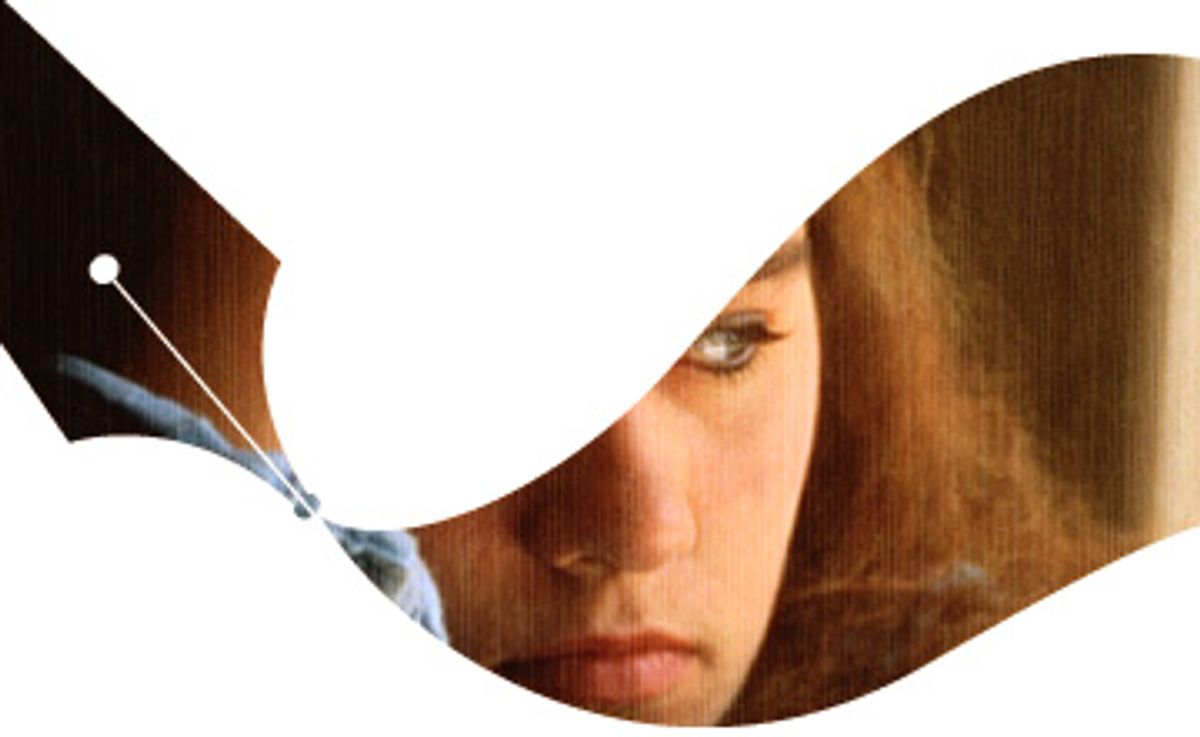
It's easy to assume that we know what teenagers are thinking; after all, we've been there and have the clichés to prove it. We know about the rage and boys and clothes, eating disorders and fast cars and slammed doors.
Those sleepy-looking, weirdly outfitted creatures who pass us on the street, or in our own homes? They don't know anything that we don't. Except, of course, for the things that differentiate their generation from ours, and scare us: the hook-up culture and the short attention spans and the MySpace and the IMs!
Despite the simultaneous familiarity and exoticism of teens, their universe is one that doesn't often hold much appeal for adults. It's a life-stage best forgotten, a time we hope our loved ones move through with safety, grace and as much speed as possible. I'll admit that when I got a copy of the book "Red: The Next Generation of American Writers -- Teenage Girls -- on What Fires Up Their Lives Today," I opened it grudgingly, figuring I knew what was in there.
But in the introduction to "Red," editor Amy Goldwasser makes the case that her book offers 58 stories from a generation, "perhaps the first, of writers." Between blogging and Facebook and e-mailing and texting, Goldwasser writes, these are kids who are regularly "generating a body of intimate written work."
Goldwasser is right, and it shows in these essays. I was stunned by speed with which each of these stories pulled me in, whether they were about the high-drama, very special episodes of adolescence (cutting, criminal boyfriends) or what Ginia Bellafante recently described in a New York Times story about the late great "My So-Called Life" as the "everyday indignities" of teen life: "overhearing people talk behind your back, the plop of a grim-looking lump of mashed potato on a pallid cafeteria tray."
It was tough to choose only four of these 58 stories for Salon. There's 17-year-old Carey Dunne's "Gym at Riverton," which made me laugh out loud with its dry depiction of one of life's most disenchanting experiences: gym class. Anyone looking for hand-wringing about the loose morals and ambient sexuality of kids today will wallow in 16-year-old Eliza Appleton's ode to grinding. Emma Considine, a gimlet-eyed 16-year-old, doesn't spare an ounce of her fury and sadness over her parents' separation. And 19-year-old Deborah Kim, forced to move frequently, understands with disarming clarity that while adults may go years without seeing their friends, for teens the bond is "lost because people change, especially if you're fifteen. There are too many new things that matter: different favorite color, new crush, new car. Suddenly you don't know that person anymore."
Enjoy these four essays, and know that there are many others like them out there: funny, smart, dark, observant. If "Red" is any indication, the kids are alright. --Rebecca Traister
- - - - - - - - - - - -
"Gym at Riverton" by Carey Dunne, 17
I started going to a school called Riverton, in a really white area of the Bronx, in seventh grade. Before that I was going to a school I liked, on 17th Street in Manhattan, but my mom thought it was pulling me in a bad direction. She said, "You need fields and openness." Riverton had fields, so I went there. Turns out the worst parts of my Riverton experience were probably spent on the fields. Except for maybe the parts spent in the gym, like school dances. I once danced there with a kid named James Pinky. He had a perfect bowl cut.
At Riverton there were mandatory gym uniforms that were revolting and uncomfortable. Mine got washed maybe once a semester. The sweatpants had nipple-high waistbands; the crotch started at your knees. They were tight and scrunched around the calves, then baggy in the thighs and butt so that you looked like a blown-up rubber glove waddling around trying to kick things.
Gym was like war. I was forced to battle all these suburban beasts. Half the kids there were from Riverdale or Westchester, so they were athletes since birth. Greta Stein was an example. Her motto was "Blood makes the turf grow -- kill, kill, kill!!!!" Each time she touched grass she became an animal or a Viking. She actually gnashed her teeth at people and would grunt heavily. She could punt a soccer ball and make it explode. Whenever I was around her, I wished for a metal shield or sword.
My biceps are seven inches around when flexed; this is smaller than some people's wrists. I'm retardedly uncoordinated, or maybe just unmotivated when it comes to sports, so I would try to be as neutral as possible in gym games. I'd stand on the side like a stump. Some days we played flag football, which was really obscene-looking. You had to wear a belt with streamers hanging over your butt, and the tagging was like butt-grabbing instead of just tapping. You had to yank the belt off the person's waist. The gym teacher was a creep who wasn't afraid to talk about people's torsos.
The swim coach, Kunkel, looked like a hammerhead shark. He always shouted "Dunne, look alive!" His voice was insanely deep. It was like talking to a truck. Swimming at Riverton was a whole new level of torture, like a private-school hazing ritual. They made you swim every single day for two weeks in a pool you could tell was sweaty. It was co-ed. I was really pale and scrawny. It was freezing, and when you got out you had to look at all the other pasty, weird kids in bathing suits and also be looked at in yours. In ninth grade I looked like Gollum. Not much has changed, really, but in ninth grade it was more like fetal Gollum. Swimming at school was the most awkward thing I've ever done. Obviously there were girls who liked it, liked to be in bathing suits in front of everyone. It made me want to pee in the pool to screw them over.
Moira was my sole ally at Riverton. She had brown hair, and her left eyebrow swirled upward at the end, like an eyebrow cowlick. Instead of running, she trotted, because she had a passion for horses. One day she led me to a secret bathroom she had discovered in a secluded wing of campus. It had a pleasant windowsill for sitting, and Moira and I became a pair. Hiding was our main activity, and no one ever looked for us, which is lucky for them because had they found us, we would have shunned them in a traumatizing way.
When swimming time came around, Moira told Coach Kunkel she was hydrophobic, to the point where she pukes. He was either brainless enough or nice enough to believe her and let her skip. I wasn't as suave as Moira, so I had to face my foes alone. I imagined her lying in some grass, in a comfortable turtleneck and long pants, being dry. This angered me. I would do the 18 required laps as fast as possible in order to get out of the pool and into clothing.
Coach Kunkel must have mistaken my haste and horror for talent. "Dunne, you're a shark! Join the team," he'd say, and I would get really awkward and mumble "no thanks." Then he would start blathering how my torso was a prime swim-team torso. I knew this meant it was disproportionate to my legs. I was a long slimy fish with little stubby flipper legs. I was scared of diving since it clogged my ears. When we had to try fancy flip turns I rammed my head into the pool wall. But that didn't stop Coach Kunkel. Soon his hassling went beyond the pool area. He'd see me in the halls and boom "Dunne the shark!" and I would turn red and flip out. Then he called my mom and told her about me needing to get on the team. She was all for it. She valued team mentality. I didn't join the swim team.
Like swimming, CPR class was mandatory. It was taught by Coach Gratch, who was as fierce as her name sounded. In CPR we gave mouth-to-mouth to mannequins, life-size limbless torsos with heads. Some of them were black and some of them were white, except for a few that had black heads paired with white bodies or vice versa. Riverton was constantly talking about the importance of diversity in education.
When you pushed on the mannequins' stomachs, they made clicking noises. Coach Gratch told us that in a real-life procedure, two or three ribs usually break—but you have to ignore that and keep going to save the person's life. CPR was a fun class. But when the certification exam finally came around, it took me two tries to pass. I'm still not sure what I did wrong the first time, but whatever it was, I know it was embarrassing because it involved making out with a mannequin in front of my entire grade.
"Cribs" by Eliza Appleton, 16
Grinding is the most basic form of dance, requiring no skill or coordination. Multiple kids can rub against each other in a grinding chain, although I suppose that's very middle school. Grinding is sexual yet harmless. It takes you to a different place. Suddenly all you can hear is the music -- the techno, the rap, the reggae -- and all you can feel is the breath on your neck of the person you are with. You know everyone is watching you, you attached to your guy. You hope to god they don't pay attention and that they do.
Your friends come over and whisper, "He's a cutie" into your ear, followed by his friends who say, loudly, "She's hot!" Looking forward to the phone calls after the party ("Who was that boy you were on tonight?"), you focus back on him.
"You're a good dancer."
"Thanks."
You feel the rush of it all, the human part, as the bass fades and you can no longer hear the lyrics: Work that, let me see you drip sweat. I'm really, really hot. It's a natural high, but sometimes a guilty one because of how much your parents would disapprove. Your mother had said, "Inches apart! You shouldn't give up your body like that." You can't even think what your older brother would come out with, but you know you would be ripped away from the guy. Still, that was sexy.
I had a Super Sweet 16 party with 100 of my "closest" friends. This included boys I didn't know well -- most of the varsity hockey team's juniors and seniors, along with some football players -- who'd been invited without my permission by desperate girls. Great, I thought, this is going to be a nightmare. What were my parents going to think about the kids who'd show up wasted? The ones who'll bring alcohol and share it? I could imagine cleaning up after drunks with my upset mother.
"Oh Eliza, will there be dirty dancing? Sorry, will there be grinding?" she'd asked me the day before. Of course there would be, and of course she was going to be disturbed by it. I always laughed at her use of "dirty dancing." How obsolete. "My goodness," she'd said, quite seriously, "I hope you don't do that, Eliza."
Waiting for the guests to arrive, I paced around the club. My party had to be the coolest Sweet 16 this whole year. I wanted my parents and the other chaperones (mostly my friends' parents) out of the picture so they wouldn't bother me about the way we dance. I wanted to have fun. I wanted every hockey player to say hi to me at school. I wanted to hear someone say, "Eliza Appleton is a legend."
Kids started showing up, and I became increasingly worried. Recently at my school there'd been a dance that got so out of control the police came and shut it down at 9:30. Condensation seemed to drip from the ceiling there as people danced, drank, did drugs, and basically sexually assaulted each other. What if the law broke up my birthday party?
Various scenarios were giving me a headache, and I realized it was better not thinking about things I couldn't control. I tried to remain calm: Grinding is not illegal. Then the music played faster and grew more interesting. Suddenly, many girls were dancing like sluts. I, of course, did not, because my parents were watching, and chaperones were everywhere. Boys grabbed barely dressed girls and groped them as they moved in sync. My best friend's father leaned over and whispered to me, "If that 300-pound football player doesn't get off of that little sophomore, I will punch him."
Bang! It hit the parents hard: What would all the sexual dancing lead to? Had they asked me, I'd have told them that it wouldn't lead to anything. Dancing can be thought of as an art, as expression, perhaps even as make-believe sex. Make-believe. The most exciting thing about grinding is being able to tell your friends afterward that you danced with 10 different guys. That you're an excellent grinder and know many ways to do it. Grinding is about feeling good. It isn't harmful, nor is it serious. So why do grown-ups freak out about it so much?
I find parents to be truly funny. I'm sure they were wild and crazy -- smoking weed, doing drugs, having sex -- when they were our age, a lot more than dancing. I learned in my history class that 2,500 years ago, the ancient Greeks worried that their children would come to no good, that they wouldn't work, or marry. I guess human nature, or at least parents' human nature, hasn't changed over the centuries. I can understand parents being concerned, because of physical and emotional dangers, if their child is having sex. But why are they so worked up about grinding? Is it because they fear other parents will judge them to be too lenient? Some parents (not mine) want to appear cool to the kids, and a few even to the other adults. Some are plain-old strict, fearing our fun will lead to trouble. They scare us by telling us not to get too close to boys, not to dance like that -- but then how will we look cool to the kids? How are we supposed to gain experience? How will we learn when to say no, and when not to? It seems to me as though adults are afraid of our sexuality and give us no credit for having good sense and self-control. Some kids may need to be restrained, but most of us know when to stop.
Sex education at my school is geared toward making every physical connection between a man and a woman into a disease. No kissing boys, you'll get mono. No having sex, or you will get chlamydia, syphilis, and AIDS. In one class we had to come up with every slang word for the reproductive organs, including pussy, beaver, stick, wood and 60 more. I wanted to ask what the point is of learning these terms if we're not supposed to use them. Condoms are more than 99 percent effective, but the teachers at my school always say the best way to avoid getting pregnant and STDs is to be abstinent. I guess that's true. But while grinding I'm still abstaining, right?
I think that if toddlers were taught about the world the way we're taught about sex in school, they would never leave their cribs. I know it's important to be informed about the risks that go with sex, but shouldn't we also learn about it in a positive way? At a dance when I was a freshman, one of the chaperones felt she had to have a word with several girls about grinding. "It's like you're giving the boys a lap dance," she said. "They're just using you to rub up against them. What's in it for you? It's demeaning and very inappropriate. It's like sex with clothes on."
The adult missed the point: The good part is that grinding is sex with clothes on. And we girls like it, too. Girls are allowed to enjoy sex as much as boys do, right? I suppose the consequences of sex are potentially worse for girls than for boys -- but then doesn't that make grinding the great equalizer? Venereal diseases are not transmitted through pants!
A week or so after my party, while my father was still talking about the secret drinking and the "dirty dancing" every night on the phone with his friends -- turns out he's a bigger gossip than I am -- I found myself lost, dancing with a boy at another Sweet 16. As I moved with him to the low beat, I couldn't have been more sold on the beauty of grinding. Until I looked next to me to find a senior boy all over a sophomore girl, grabbing her in all sorts of places her parents would be unhappy about. My mom had once asked me if I danced "like a whore." Certainly not like that, I thought. Dancing like a whore is one thing; acting like a whore is something totally different. I winced with some disgust, but then smiled as I sunk back into the rhythm of dancing and realized thank God my parents don't follow me around to parties.
"Bloody Red Heart" by Emma Considine, 16
The separated family is a seemingly taboo topic, morally wrong. But look around, everyone's doing it, it's a fucking fad! Take my family for instance. It is the reason for lost earrings, homework assignments left unfinished because the textbook is at Dad's, and aching legs due to walking from one cramped house to another five times a day. My separated family wouldn't function without 20 phone calls a day, concerning Geico, school tuition, and what Emma wants for Christmas. It smells like stress and is the reason for my unhappy elementary school years. My expensive family, my impractical family, my idiotic family, my depressed family, my dysfunctional family, my embarrassing family.
The basic separation comes with the following accessories: two rent checks, a miserable 10-year-old, a nosy babysitter, unsigned divorce papers, lots and lots of phones (three cell, four cordless), one pissed-off wife, cat food, adultery, one lonely husband, eight confusing Thanksgivings and counting, two guilty parents, a move, a car, a slamming door, a mouth.
The daughter of separated parents is not easy to spot. She can wear expensive jeans and speak English, just like her friends whose parents live under the same roof. Oddly enough, she looks like a regular 16-year-old. Her epidermis is still showing, and she has a functioning bloody red heart. However, according to statistics, she may not be able to use it as well as some of her friends.
Getting out of the car, he picked me up and put me on his shoulders like I'd begged him to. In my hands was a book on Helen Keller. Even though I was only 4, I loved reading more than anything else. That and when my parents got along.
"Be careful," she warned, lifting grocery bags out of the trunk.
Almost as if in a demented sitcom, he tripped on a stone just as she said it. He fell slowly, landing on his knees and scraping them on the pavement, not able to make his collapse graceful because he was holding so tightly onto my legs. I remember starting to cry, not because I was traumatized or hurt, but because he was bleeding on his hands and knees.
She rushed over. "I told you to be careful!" she hissed at him.
Then she grabbed my hand and opened the door to the house. "Are you OK, sweetie?" she asked. I could hardly look at her. She'd left him outside bleeding on the ground, when it was obvious that I was fine.
"Stop!" I cried and pushed away from her, running.
"Always going to daddy," she said, rolling her eyes. "Never listening to me."
The separated family has many uses. It's a way to get more presents, sneak out of the house, guilt-trip parents, become 40 dollars richer, get out of a homework assignment, and have a good cry. The separated family is all over the nation, in every 7-Eleven, public school, volleyball tournament and perfume store.
It splits up friends, ruins Christmas, and makes money tight. People sympathize, and the occasional friend wishes that her parents were divorced too. No she doesn't. It takes weeks, months, years to get over the fact that you will never have a family that's intact again. Your mom is never going to marry some architect with five kids and start her own little Brady Bunch, and even if she did, you wouldn't be fine with it. You'd cry. You'd ditch the wedding. You'd be sent to a therapist.
Every divorced family contains at least three brains. Handy, but two of those brains are the reason you can't hire a tutor for 200 dollars a session. (Your parents have to pay twice the rent now.) Those brains ruined second, third and fourth grades. Those brains agree on the Bush administration, the science department at your school and cats. Those brains don't agree on what's for dinner, who's going to park the car, and my grandpa's cancer. One has to outweigh the other.
That's why the third brain is so sad, why it feels so cut off. Its parents screwed it over. Some doctors did a lot of tests and determined that brains with divorced parents face a 70 percent greater chance of having a failed relationship when they grow up. It doesn't make sense. It was eight years ago. The times they are a-changin'. How will my mom's stupid mistakes account for my future? What a bitch.
"Packing" by Deborah Kim, 19
I'm trying to breathe.
The bathroom light's dim and I'm staring at the mirror. My mouth's twisted at the corners in an ugly grimace. I'd laugh at how I look, but it's not funny. My eyes sting.
It's April, I'm 15, and my parents tell me we're moving in July. "San Diego will be wonderful," my mother says in Korean, as if she expects me to grab that sentence like a present, squeeze it tightly.
I define my life by the schools I've gone to. It's the only way I can remember how many times I've moved. I've lived in more than eight cities, usually only one or two years each, most dotting the breadth of Southern California: Los Angeles' graffiti-stained streets to Riverside's sweet suburban orange groves to Pasadena, home of the Rose Parade. And once, for only six months, in Dayton, Ohio, crisply folded in snow and bordered by woods. I'd started fourth grade in September with everyone else in California, then had to move that winter and finish off the school year in Ohio.
I've learned how to pack my life neatly into cardboard boxes. But there are always things I lose, no matter how hard I try. The worst thing is the people. Somewhere there must be a how-to book on letting teenage friendships go: Step one, announce you're leaving. Step two, not-so-bittersweet gatherings, all softened by vehement promises to keep in touch. Step three, move away. Step four, write and write, and realize that you can't possibly record your life in these envelopes. Still, I eagerly pick new kinds of stationery, collect e-mail addresses.
"Dear Deborah, How are you? I am fine. Remember that one time you gave me that sticker, well I got one for you this time. Also, I got a new dog!!! I miss you. Write back!!! Love,"
They all go something like this. It's not sad, not really, because my life goes on, too, but it's troubling. I only remember faint, vaguely rosy details of each city. This is six months of Ohio: Drew was hilarious and grinned a lot, tan skin, a round face, hair shaved so his scalp showed. "You used to be quiet, now you're so loud!" he'd said at the end of the year. Beth: rectangular-rimmed thick glasses, mousy hair in unruly waves, pointed nose, pale. My favorite friend, because she was as quiet as I was, at least on the surface. I think I made her cry once with my bossiness. I wish I could reach back, say I'm sorry again. We must have made up, like kids do, "sorry" and "it's OK," apologies in the form of orange Popsicles. This is troubling, too: my friends forever frozen as they were when I left them, even though I know they've moved on.
People get replaced on both sides, and somehow everything ends up being cut apart like packing tape. Or maybe that's not the right analogy, not always; maybe it's more like a hunk of cheese, grated away until it's gone. You nick the skin on a knuckle. To my parents, not seeing someone for months, even for a few years, they're still friends in the adult world. But to me, a friend must stay constant; we must thrive. If we grow apart, it's lost because people change, especially if you're 15. There are too many things that matter: different favorite color, new crush, new car. Suddenly you don't know that person anymore.
My friend Zul, from fifth and sixth grade, Riverside, sent me a letter a few years ago with a photo: her as a cheerleader, fierce, grinning, proud, with cheerful teeth and dark hair pulled tight from her face into a smart ponytail. Did I suspect she would become a cheerleader? Sure, of course she would. Not the ditzy giggling type, but a warrior, assured and capable. But it's not enough because people will never tell you the exact details that make up their life, just things that occur to them. "I have some of your pictures," she writes. "I hope you still draw." I do still draw, but I don't bother to tell her this, and that letter is one of the last times I'll hear from her.
My father is an ordained minister of the United Methodist Church, which means our family relocates whenever the bishop assigns him to another congregation. I'm a P.K., a Preacher's Kid, which is strange to announce at a new school because it has loaded connotations. Oh, goody two-shoes most people think and immediately censor their R-rated swearing, as if I'll call down the Almighty Wrath of God to scorch the soles of their feet.
I never thought I'd get used to Barstow -- that little tourist stop on the way to Las Vegas, in California's Mojave Desert, dry and mercilessly hot. Miles of dusty sand, brush and rock cramp it from all corners. It's literally in the middle of nowhere. But I did get used to it, somehow. I got used to 110 degrees in late May and driving 40 miles to reach the next city.
I made it past the painful first day of school, the nerve-racking routine of invading a place where everyone else has jostled shoulders and built up kingdoms of nicknames. I'd done it so often that I know how to square myself. I find an open spot at the lonely end of a lunch table and eat quietly, waiting for someone to talk to me. This is why I've always been a nose-burier in books: I can distract myself and make friends effortlessly -- war-painted animals, doomsday viruses, kid heroes.
Lunch that day was abrasive, I remember: A Mexican girl in front of me in line shoved her face near mine and demanded, "You China?" I wanted to cross it out in midair, in bright red ink: China. Chinese. I wasn't a country by myself.
"No," I said, "I'm Korean." Would she really care to know that I'd never been to South Korea or that I'd been born in California? I was American, just as she was, but Barstow was a smaller community than what I'd been used to. There were so few Asian kids that we were distinct and instantly recognizable. In the last class of my first day, I befriended a girl, Annie, with curly strawberry blonde hair and a bright grin. She was a P.K., too, and knew about moving because her dad was a U.S. Army chaplain. They moved her to Japan the next year, and for a while I got her letters in equally curly red handwriting and sent letters back until they stopped.
- - - - - - - - - - - -
"The new church needs your father," my mother says. "It's very small."
I run from her and slam the door -- even though I know. I know that whatever staggering inconvenience this is to me, I have no choice. I drag an arm roughly across my face. Some part of me says maybe there's a reason we're moving. Maybe God wants this for us. Maybe it'll be better there.
I take another breath.
I think of the changes. I think of the constants. I think of what stays with me -- my family. They have taught me never to take things for granted, to be perpetually thankful. To value people, always, to read books, do your best, be happy, we love you.
And with each move there is more and more comfort in the intangible, the digital. I've found that the Internet isn't stuffed full of seedy 60-year-old perverts but people like me -- who live wherever, doesn't matter -- posting adamantly about favorite bands, books, movies, arguing video game nuances. I'm not going to lose these friends: If they change, I'll change with them.
I looked up a few childhood names on Facebook some time ago. I immediately found profiles that I recognized, but I didn't message them. I just grinned to myself in a wave of warmth, wondering how they were doing, how much they'd changed, what they were into now. Then I closed the window.
I won't ever be completely ready to move. But coping with all these changes will help me face the adult world head-on. I'll continue to adapt, to grow, to learn. I just have to trust that. I close my eyes and tell myself, in another bathroom that soon won't be mine, it'll be OK. I flick off the light.
Shares