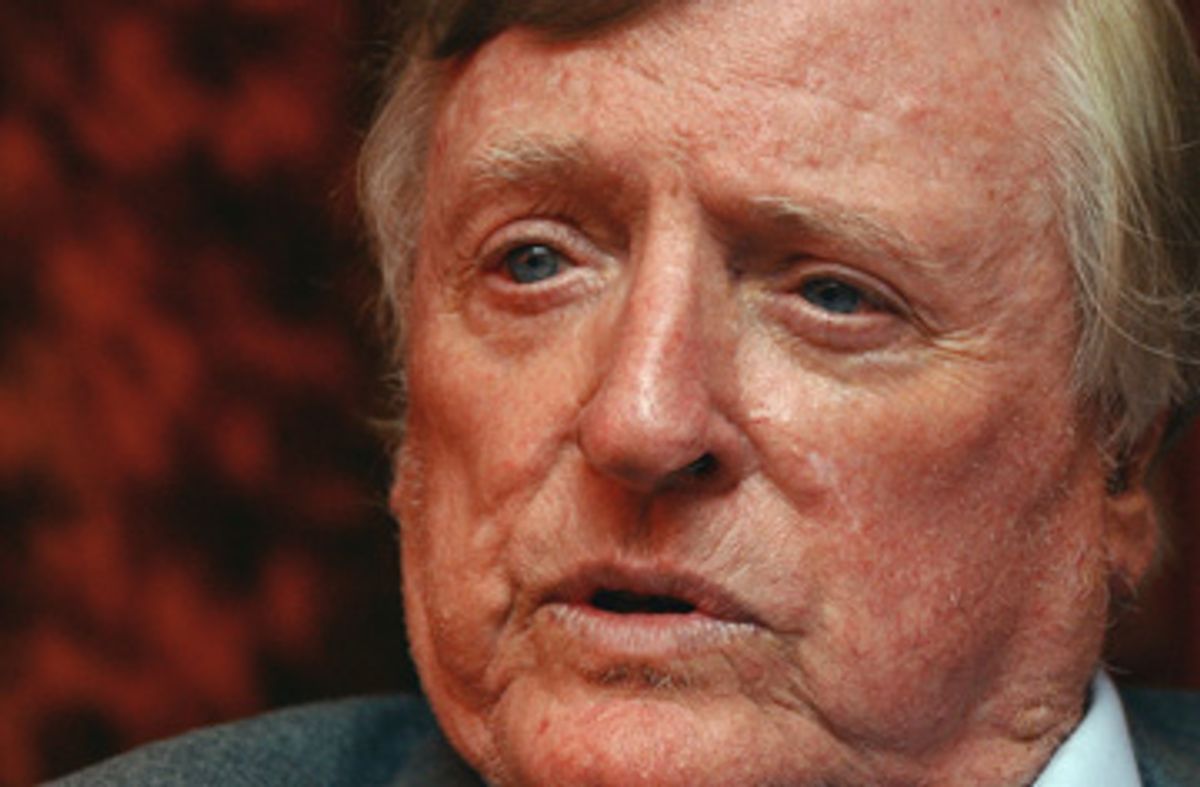
Mike Wallace, broadcast journalist: Cold War prescription
There were new voices being heard on the political landscape in the mid-fifties, and "Night Beat" tuned in on them ... One such guest was an erudite and self-assured young man named William F. Buckley, then just emerging as the most engaging spokesman for the conservative cause. In those days as now, the overriding foreign policy concern was the aggressive designs of the Soviet Union, and I asked Buckley what steps we should take to gain the upper hand in what was still known as the Cold War:
BUCKLEY: By accepting certain goals and preparing for those goals irrespective of the cost. To list a simple program: Liberate Albania. Unification of Korea, Extirpation of Communist influence in Syria. Unification of Germany. (New York)
From "Close Encounters: Mike Wallace's Own Story," by Mike Wallace and Gary Paul Gates (William Morrow, 1984)
Irv Kupcinet, columnist and broadcaster: Wonderful guest
There were innumerable great arguments on the show ["Kup's Show"].
William Buckley would argue about anything with anybody. I seldom agreed with him, but he was always a wonderful guest and I'm frankly proud that we were the first to invite him on this kind of show when he was just starting his National Review. (Chicago, 1955)
From "Kup: A Man, an Era, a City," by Irv Kupcinet with Paul Neimark (Bonus Books, 1988)
Garry Wills, journalist and author: Pleasant company
That higher bounce of a voice he saves for the telephone: "This is Bill Buckley. I read what you sent us, and love it and will run it soon. Could you come to New York and see us?" ...
Luckily National Review's first office (later abandoned), though cramped and slovenly, was air-conditioned. I waited in a little cubicle for visitors, glassed off from the one large room, with little stalls along the sides, that housed this busy small world of editors. Stuck in my bowl, I took a goldfish view of bustle in and out of stalls, stray interweavings in the middle of the room. My first impression was of youth; but that did not carry over to the man who came to pull me out of my bowl.
I was surprised, for some reason, to find him tall -- less preppy-looking than his book-jacket picture had led me to expect; pleasantly disheveled and informal, despite the rich prance and neighing of his voice. Today many people who meet Buckley for the first time have seen and heard him on TV; but I knew him only, by repute, as a Wunderkind; and this tall 32-year-old seemed somehow more normal and adult than the image I had formed of him.
When we went into his office, though, he seemed a bit boyish in the company of fellow editors, each his senior by decades -- James Burnham, John Chamberlain, Willmoore Kendall. Buckley sat on his desk, tucked his legs under him, and continued discussion of some policy matter. He showed a deference to others that might belie his superiority on the review's masthead; but he showed the same deference when the conversation circled toward my chair. Buckley asked my opinion. I don't remember what the subject was, but I fear I answered confidently. The others went through the motions, at least, of seriously considering an opinion from this stranger off the street. Those around Bill pick up his manners, acknowledging each other's presence and giving all a hearing. It is one of the things that makes his company so pleasant. (New York, 1957)
From "Confessions of a Conservative," by Garry Wills (Doubleday, 1979)
James Michener, novelist: Funny, delightful, outrageous
The [United States Information Service] board that [Frank] Shakespeare assembled was evaluated as "unquestionably the most effective and best-run advisory board in the nation." ... the rare skill demonstrated by its chairman, Frank Stanton ...
His number two man when I came aboard was William F. Buckley, Jr., the right-wing ideologue and one of the funniest, most delightful and outrageous men in the nation. He and I were about as far apart politically as two men could be, but I held him in the warmest regard. Savagely brilliant and devastating in his witty dismissal of bores, he was one of the young men most influential in helping swing the nation far to the right, a sinful performance for which I suppose God will forgive him, for he convinced me that God was of course both a Catholic and a conservative. (Washington, D.C., late 1950s)
From "The World Is My Home: A Memoir," by James A. Michener (Random House, 1992)
Pierre Berton, broadcaster, journalist and historian: Commitment
The strength of [CBC's] Front Page Challenge in its early years lay in its glittering array of international guests, from Eleanor Roosevelt to Mary Pickford, from Jacques Cousteau to Aleksandr Kerensky, [who] occupied the [mystery] guest's panelist's chair ... William F. Buckley, who believed in keeping appointments, turned up at the last moment, bedraggled and unshaven, delayed by storms that forced him to change his flight schedule again and again. He had been traveling for 24 hours when he finally reached the studio, but to him a commitment was a commitment. "Bring me a six-pack of beer," he begged. He got it, and the show went on. (Toronto, early 1960s)
From "My Times: Living With History 1947-1995," by Pierre Berton (Doubleday Canada, 1995)
André Schiffrin, book publisher: Looking for debating points
Asked by a group at Rensselaer Polytechnic Institute -- a college in Troy, New York -- if I would be willing to engage William F. Buckley, Jr. in a public debate. Buckley was at the height of his fame. Someone there must have thought it would be interesting to have these two Yale alumni who were at such opposite ends of the spectrum meet for the first time.
I prepared meticulously for the debate, reading Buckley's published works and making careful note of his viewpoints and arguments, until finally I felt ready to meet them head-on. Buckley was, as always, suave and debonair. I felt more awkward, wearing a hand-me-down, unfashionable double-breasted suit. Yet when we met onstage, I noticed that he seemed strangely nervous. Presumably, losing the debate to me in front of the several hundred people in the vast RPI auditorium would have been humiliating. Accordingly, he focused on making his debating points rather than sticking to his old viewpoints. Buckley's main argument -- in Troy, New York, of all places -- was that there was no poverty in the United States. I had a hard time persuading the middle-class audience that poverty was still a major factor in our collective lives. Meanwhile, all my notes were in vain, since Buckley was quick to abandon his positions whenever necessary. I tried to point out these tactics to the audience, but the debate ended in an ambiguous draw. (Early 1960s)
From "A Political Education: Coming of Age in Paris and New York," by André Schiffrin (Melville House Publishing, 2007)
Bob Avakian, Berkeley student and later leader of Revolutionary Communist Party: Antics of distraction
It was kind of a spring thaw, a lot of things were bursting loose, a lot of intellectual and cultural ferment was going on. The Beats were breaking out -- they had started up in Greenwich Village in Manhattan and had come out to North Beach in San Francisco. I remember William Buckley came to debate some liberal about the first amendment, loyalty oaths and all that kind of stuff, and Buckley started these disgusting antics to distract the audience while the liberal was talking. At the time, I was of course still strongly opposed to communism and accepted all the conventional wisdom, or "un-wisdom," about communism and how horrible it was. (Early 1960s)
From "Ike to Mao and Beyond: My Journey from Mainstream America to Revolutionary Communist," by Bob Avakian (Insight Press, 2005)
Tom Brokaw, broadcast journalist and author: Long balls to deep right
I met and interviewed [for an Omaha television station] Bill Buckley, who filled the role of the national conservative intellectual as a columnist and editor of the magazine he had founded, National Review. When I tried my best fastball questions on him, he was like Ted Williams in the batting cage, flicking them away to deep right field. I came away thoroughly chastened and utterly charmed. (Mid-1960s)
From "Boom! Voices of the Sixties: Personal Reflections on the '60s and Today," by Tom Brokaw (Random House, 2007)
Jackie Robinson, baseball player: On the defensive
I joined the national headquarters of Republicans for [Lyndon] Johnson, based in New York, and accepted speaking assignments whenever I could to tell black and white and mixed audiences how deeply I felt that [Barry] Goldwater must be overwhelmingly repudiated. It was during the [1964 presidential] Johnson-Goldwater campaign that I had one of my confrontations with the articulate, eyebrow-raising William Buckley, owner of National Review magazine and star of the controversial "Firing Line" television show.
I was booked on a television Conservatism panel which included Bill Buckley, Shelley Winters and myself. When my friends and family learned I had consented to participate, they were aghast ...
I was glad to receive these warnings. I didn't have the slightest intention of backing out, although I already had a healthy respect for Buckley's craft as a debater. The apprehensions of my friends made me create an advance strategy which I otherwise might not have employed. I lifted it strictly out of my sports background. When you know that you are going to face a tough, tricky opponent, you don't let him get the first lick. Jump him before he can do anything and stay on him, keeping him on the defensive. Never let up and you rattle him effectively. When the show opened up -- before Buckley could get into his devastating act of using snide remarks, big words and the superior manner -- I lit right into him with the charge that many influential Goldwaterites were racists. Shelley Winters piled in behind me, and Buckley scarcely got a chance to collect his considerable wit. A man who prides himself on coming out of verbal battle cool, smiling and victorious, he lost his calm, became snappish and irritated, and, when the show was over and everyone else was shaking hands, got up and strode angrily out of the studio.
From "I Never Had It Made: An Autobiography of Jackie Robinson," by Jackie Robinson with Alfred Duckett (Ecco/HarperCollins, 1995)
Andrea Dworkin, feminist and author: Elegant, brilliant and wrong
I think it's worth everything to say what you believe. There are always consequences, and one must be prepared to face them. In this context there is no free speech and there never will be.
I think especially of watching William Buckley, on his "Firing Line" television program in the 1960s, debate the writer James Baldwin on segregation. Buckley was elegant and brilliant and wrong; Baldwin was passionate and brilliant and wore his heart on his sleeve -- he was also right. But Buckley won the debate; Baldwin lost it. I'll never forget how much I learned from the confrontation: Be Baldwin, not Buckley.
From "Heartbreak: The Political Memoir of a Feminist Militant," by Andrea Dworkin (Basic Books/Perseus, 2002)
Larry L. King, journalist and novelist: Sprightly verbal show
The William Buckley piece, [a profile] ... in Harper's, got me tagged as "controversial" ... I had great fun researching the Buckley piece, which included interviews with such writers as Murray Kempton, James Wechsler, Michael Harrington, Irving Howe, Norman Mailer and (by telephone) my old benefactor John Kenneth Galbraith. And I enjoyed, too, the sprightly verbal show toward which Mr. Buckley is inclined. He also treated me to a scary ride up Park Avenue at rush hour, from downtown to midtown Manhattan, perched behind him on a motor scooter while I hugged him for dear life. In matters of politics and the world's realities, however, I suppose my piece judged the conservative iconoclast as a bit blockheaded. Mr. Buckley naturally was not taken with that evaluation, and refused an ad in his own National Review which Willie Morris hoped to place there to advertise my Harper's piece ... (Late 1960s)
From "None But a Blockhead: On Being a Writer," by Larry L. King (Viking, 1986)
Larry King, radio and television talk show host: Couldn't escape me
Miami is a personality town, and in Miami, I was a personality. In addition to working at WIOD, where I was also the color man for the Miami Dolphins, I had a television interview show on WTYJ and a daily newspaper column -- first in The Miami Herald, then in The Miami News, and finally in The Miami Beach Sun-Reporter. During the 1968 Republican convention William Buckley was in town, and I had him on the television show. He said jokingly that he was afraid to come back to Miami because he couldn't escape me; I was everywhere he turned.
From "Larry King," by Larry King with Emily Yoffee (Simon and Schuster, 1982)
George Leonard, magazine journalist: Conservatives were in
Fifteen senior journalists from the nation's most influential media descending from the sky in a luxurious jetliner and being swept away to the centers of the nation's worst ghettos -- seven ghettos in seven days. This junket to the Third World culture within our own borders was cosponsored by the National Urban League and Time-Life ...
We took off from Chicago around lunchtime on Saturday ... Bill Buckley sat nearby at a table next to the cockpit door, typing away at his newspaper column ...
Our tour ended in Washington ... We had elected Newsweek editor Oz Elliott to present our "findings." In the middle of Elliott's summary, Bill Buckley was spirited off for a tête-à-tête with President Nixon at the White House. The conservatives were in, no fooling. (1969)
From "Walking on the Edge of the World: A Memoir of the Sixties and Beyond, by George Leonard (Houghton Mifflin, 1988)
Mary Daly, philosopher and feminist: Getting the last word
"The Church and the Second Sex" came out ... My American publisher, Harper & Row, sent me on publicity tours involving live appearances on television. I was literally hurled before the TV camera with golden opportunities either to perform brilliantly or fall on my face in front of millions of viewers ... I debated with William F. Buckley, Jr., on his videotaped show, "Firing Line." Buckley attempted to discuss my book without having familiarized himself with its contents. Although he lacked the wit to cover his ignorance, he did display considerable skill in getting the last word just before each commercial break. However, after each "pause" I managed to come back with a refutation of his ill-logic. After the show, friends seated in the studio audience told me that they saw him pushing a button under his seat whenever he decided it was the opportune time for a "break." Although I could not see this, it did not seem improbable, since the commercial seemed invariably to immediately follow his punch lines. (New York, 1969)
From "Outercourse: The Be-Dazzling Voyage," by Mary Daly (Harper San Francisco, 1992)
Howard Zinn, radical historian: Debate
I was invited to Tufts University to debate William F. Buckley, the well-known writer-columnist-conservative. (I was offered $300, which impressed me; I was accustomed to getting nothing. I learned later that Buckley got $3,000 -- but I suppressed my resentment.) The Tufts gymnasium was packed that night with thousands of students, and thousands more were turned away. Obviously, it was not my presence but the famous Buckley who was attracting them.
When we were introduced by a Tufts philosophy professor the applause seemed fairly even for both Buckley and myself. As the debate went on, however, the applause diminished for Buckley, grew louder for me. I knew this was not because I was a superior debater, but that my arguments simply made more sense to a student body that had itself decided the [Vietnam] war was wrong.
At a certain point I glanced over at Buckley, who had a reputation for debonair coolness, and I saw he was sweating. Before the question period was declared at an end, he rose and said he had to go. In a column he wrote after the debate he said how appalled he was that American students should applaud such opposition to their own government as they heard that evening. I found it curious that Buckley did not seem to understand that unsparing criticism of government is an essential element of a democratic society. (Medford, Mass., 1970)
From "You Can't Be Neutral on a Moving Train: A Personal History of Our Times," by Howard Zinn (Beacon Press, 1994)
Oliver North, Army officer and Iran-Contra scandal protagonist: Poor posture, good vocabulary
Seymour Hersh, the reporter who first broke the My Lai story, came out with a book about the incident in which he suggested that war crimes were commonplace in Vietnam. After Hersh appeared on William F. Buckley's "Firing Line," three of us who taught at Quantico [Marine Corps University] ... wrote a letter to Mr. Buckley, expressing our outrage at Hersh's insinuations.
Not only did Buckley write back, but he invited us to appear on "Firing Line," to discuss the issue ...
We taped the show at American University in Washington. I was struck by Buckley's posture: he slouched so badly that I thought he was about to fall off his chair. I have never been nervous about speaking in public, and the prospect of appearing on any other television show would not have bothered me. But to be interviewed by William F. Buckley was more than a little intimidating. Should I bring along a dictionary? Not having gone to Yale, I was not incontrovertibly certain that I would comprehend the copious elongated locutions he was inclined to approbate. In the end, I managed to understand most of Buckley's vocabulary and all of his questions. (1971)
From "Under Fire: An American Story," by Oliver L. North with William Novak (HarperCollins, 1991)
E.J. Kahn Jr., magazine journalist: Pounding a piano
I once spent a night at his Connecticut home, after a sybaritic cruise up the coast on his yacht. Didn't get much sleep, because Pat Buckley wanted to play gin rummy, and she and I sat up till all hours, and Bill sat up just as long, pounding a piano at the other end of their living room until we called it quits. (1970s)
From "Year of Change: More About the New Yorker & Me," by E.J. Kahn Jr. (Viking, 1988)
Barbara Frum, broadcast journalist: Gooey caramel
Buckley had come to the CBC studios in New York City to talk to me about his experiences as a delegate to the United Nations. At the end of that interview I couldn't resist asking what he thought about the succession of pratfalls, CIA dirty tricks, and general foul-ups which had been plaguing the folks on Pennsylvania Avenue, the same folks who had appointed him to the UN mission ...
Why I thought I'd get useful insight on the issue of paranoia from Bill Buckley I don't know. Buckley is the master of the obfuscating, complexifying, convulstiforming sentence. His words and phrases are like gooey caramel; they pour over you, suffocating you till you can't even breathe anymore -- never mind remembering where you wanted to go with your next question. This time, to my amazement, he was almost brusque. He rebuffed my probes about government conspiracy, insisting with his traditional open-mindedness that the only conspiracy worth the name was of the left-wing variety.
His pique is understandable, of course. After all, the Right had been digging out the Communist Conspiracy for years, unthanked. Buckley revels in his role as the exquisite lance of the investigators. He wasn't about to let some Canadian interviewer cast him as defender of the investigated. (1974)
From "As It Happened," by Barbara Frum (McClelland and Stewart, 1976)
Shana Alexander, magazine journalist and news commentator: Magisterial manner
To debate Bill Buckley on the Merv Griffin program. Cecelia [Ager, her mother] sat in the front row. I'd once termed Buckley a "closet liberal," and he'd been gunning for me since. Today's topic was civil rights, and when I mentioned the crucial 1954 Supreme Court Brown vs. Board of Education decision, Buckley said I had my facts all wrong. His magisterial manner withered me, and I shut up for the rest of the program. But I'd been right, Cecelia said later, and had just fallen for a cheap trick the snake Buckley had picked up on the Yale debating team. I felt much better. (New York, 1976)
From "Happy Days: My Mother, My Father, My Sister & Me," by Shana Alexander (Doubleday 1995)
Susan Mulcahy, gossip columnist: Shit-listed
"Though Page Six [of the New York Post] functioned separately from the news desk, it couldn't escape some of the internal decisions that affected all editorial departments. Like the shit list.
The shit list -- containing the names of people who were Not Our Friends ...
Conservative editor and writer William F. Buckley, Jr., whose syndicated column ran in the Post, hit the shit list when he defected to the Daily News. I was told that Buckley's name was not to be mentioned in the paper, and wasn't, intentionally, for quite some time. In a case of guilt by matrimonial association, the name of his wife, Pat Buckley, was also stricken from the Post's record, which made life complicated for those covering society functions. The Buckleys are one of the most social couples in New York. They attend, and she sometimes organizes, many of New York's big galas. When one occurred, and the Buckleys were in attendance, they were not listed among the guests in the Post's post-party coverage. (Early 1980s)
From "My Lips Are Sealed: Confessions of a Gossip Columnist," by Susan Mulcahy (Dolphin/Doubleday, 1988)
Arthur M. Schlesinger Jr., historian and author: Old gladiator in genial decline
Bill Buckley and I appeared on "The Charlie Rose Show" [in 1995]. Our performances must have disappointed all those who looked forward to a slam-bang, no-holds-barred fight. Indeed, as I saw the show myself (it was taped at 6 P.M. and shown at 11), I thought that here were a couple of old gladiators who in their genial decline were substituting jollity for combat.
Thirty years ago Bill Buckley and I went on occasion from city to city like a couple of professional wrestlers. We really disliked each other then, and no holds were barred. Once, out of my own sense of mischief, I entered a National Review contest of some sort and won a prize. Buckley, out of his bolder sense of mischief, awarded me a live donkey, which lived in our backyard on Irving Street for a couple of days until I hired someone to take it away. Our relationship in those times was one of incessant -- and heartfelt -- reciprocal insult.
Then I came to New York. I liked Pat Buckley. Bill liked Alexandra. [A mutual friend] took it on as his mission to bring us together. Bill's views moderated; today he would no longer defend Joe McCarthy, as he did 40 years ago. My attitudes mellowed with age. I developed a regard for Bill's wit, his passion for the harpsichord, his human decency, even for his compulsion to épater the liberals (which is about all that remains from the wrathful conservatism of his youth). So now we are friends -- and go easy on each other.
From "Journals 1952-2000," by Arthur M. Schlesinger Jr. (Penguin Press, 2007)
Ted Koppel, broadcast journalist: Renaissance man
I spent the afternoon in New York watching William F. Buckley Jr. record the last two episodes of his interview program, "Firing Line." Then he and I sat together and recorded this evening's "Nightline." We had pulled together a setup piece that was largely a celebration of Bill's 33 years on the air, interwoven with a scanty profile that gives a limited sense of his extraordinary background. He had hosted his own television program longer than any other person has hosted a program.
Buckley, however, is one of the very few people of our time whom it is fair to describe as a Renaissance Man -- gifted pianist, prolific author of both fiction and nonfiction, world-class sailor who developed his own method of celestial navigation. Most of all, though, Bill will be remembered as the popularizer of modern American conservatism. He has done this largely through his newspaper columns, the conservative journal, National Review, that he created and, of course, the television program ...
He could be mean, dismissive and cantankerous, but he is too prodigiously bright and researched his opponents so carefully that he was rarely defeated in debate. Indeed, it can be fairly said that Buckley helped make conservatism part of the American political mainstream. (New York, 1999)
From "Off Camera: Private Thoughts Made Public," by Ted Koppel (Alfred A. Knopf, 2000)
Shares