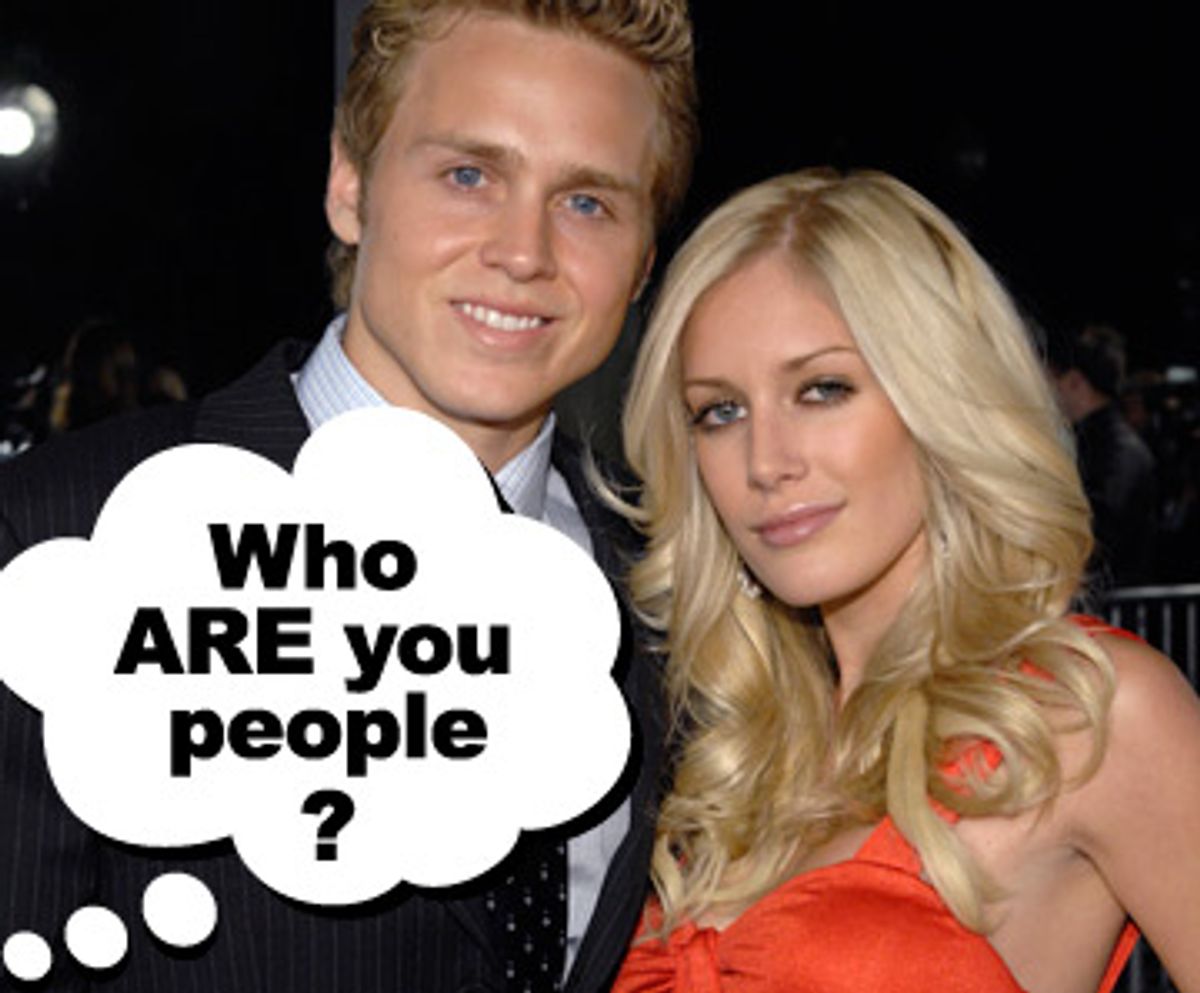
It would seem the most incidental of choices: Before boarding a recent night flight across the Atlantic Ocean, I stepped into a newsstand at John F. Kennedy airport and left without buying a single glossy gossip magazine for my trip. Planes are my top favorite place in which to indulge in the brain-cleansing pleasures of People, US Weekly, In Touch, and even the occasional Star magazine. But on this particular flight -- on my way to an indulgent (if not brain-cleansing) vacation, no less -- all I could do was stare at my candy-colored cover choices, recognize in some dazed way that I didn't know what a Heidi or a Spencer was, and proceed to the register with only a bottle of water and the Atlantic Monthly.
By the time I boarded a return flight a week later, the next issue of the Atlantic Monthly was on the stands, bearing on its cover an image of embattled pop tart Britney Spears; it sat next to a new issue of US Weekly, whose cover bleated news of an interview with presidential candidate Barack Obama in which he refused to say whether or not he wears boxers or briefs; a few days later, US published an online interview with Camille Paglia, in which she held forth on Howard Wolfson, Harold Ickes and Hillary Clinton's "60 Minutes" appearance.
What the hell has happened to our national gossip business?
In the past decade, the rag trade had exploded, bringing vaguely shameful joy to millions of transatlantic travelers, subway commuters, grocery store shoppers and those languishing in doctors' offices. But now it seems a confluence of events has changed the manner in which America gobbles its vapid information about celebrities. The pleasure we take in snurfling through the trash bins of those more rich and famous than we seems to be waning, leaving me a little sad -- bereft of mindless reading material when hanging out in major transportation hubs -- but perhaps, at the end of the day, just a little less dumb.
So what has changed about America's relationship to celebrity gossip? Lots. First, there's the pull of a political season too compelling to ignore, a contest so heated that it's leading us -- mirabile dictu! -- to step away from the celebrity crack pipe and focus, at least briefly, on the race for president. Then there's the eagerness on the part of traditional news sources -- places that, historically, have been too journalistically prudish (or legit) to wallow in the messy detritus of the stars -- to start dealing a little of the crack themselves. We can now get our Hollywood hearsay from the New York Times and CNN, weakening the control the glossies have on the market. Perhaps the biggest shift in how we ingest our gossip, though, is the feeling of over-saturation and over-stimulation. We have gorged ourselves on nip-slips and sex tapes and divorce proceedings to the point of queasiness at the idea of consuming another morsel of celebrity meat. Or maybe that's just me.
Except it's not. Three years ago, at the height of the celebrity weekly craze, there were eight titles battling to break news about Lindsay Lohan's late nights or Kevin Federline's Vegas vacations. At least two of those magazines -- Celebrity Living and Inside TV -- have folded. And according to Audit Bureau of Circulations statistics, sales of four others -- In Touch, Life & Style, Star and People -- leveled off or declined in the second half of 2007. Only US Weekly -- chronicler of Obama and his underwear -- and OK! continued to grow.
And two weeks ago, venerable gossip Liz Smith ended one of her syndicated newspaper columns by quoting a producer of a celebrity-driven television show as observing, "There's nothing going on in celebrity land. There's no news, no gossip, no scandal. The Oscars showed how dull things are. People are only interested in politics." Smith herself wondered if the slackening appetite for star news wasn't also about the fact that "we are being dished up loads of stuff about people we have never heard of and don't care about."
Surely some of Smith's befuddlement -- and, to a degree, my own -- comes from aging out of a pop culture sweet spot. As a tidal wave of young people make their way through high schools and into the magazine-buying readership, their idols are naturally inscrutable to us. But the age differential doesn't tell the whole story; after all, I may not care about Miley Cyrus or Zac Efron or the Jonas brothers, but I have some idea of who they are. The same cannot be said for the unnavigable armies of interchangeable beauties who have sprung from reality shows or cable. Brittany Snow! Colbie Caillat! Audrina Patridge! Julianne Hough! Who?
* * * * *
There has been a market for entertainment gossip ever since there has been entertainment. Whether it came packaged by the studios in Photoplay, or prettied up by People, or presented uncut and dangerous by true tabloids like the National Enquirer, America has long nourished a culture of celebrity voyeurism.
But for a period after the advent of television and cable and the fall of the studio system, Hollywood became a primordial soup, in which a slew of midlevel actors might hoist themselves into the pages of People magazine for having a splashy wedding or opening a movie, or get tarnished in a local column like Page Six, but in which they were only likely to make really juicy national headlines if they did something incontrovertibly nutty, hopefully in front of a wandering photographer: Julia Roberts ditching Keifer Sutherland before their wedding, Rob Lowe bedding an underage chick at the Democratic convention, married Bruce Springsteen cavorting in his skivvies with the girl in his band on a Rome rooftop.
But soon after the new millennium dawned, Bonnie Fuller took over an ailing US Weekly and kicked off what would turn out to be the salad days of empty-calorie celebrity consumption.
The US Weekly formula, which was soon mimicked by copycats like Life & Style, In Touch and Star (an old-style tabloid that Fuller revamped after leaving US in the capable hands of evil genius editor Janice Min), was to turn the world of a few movie, television and music stars into a roiling tableau of soap-operatic narrative, with a few lucky matinee idols tapped to play lead roles in the public performance of their private lives.
Week after week, these magazines doled out installments about the love affairs, breakups, real estate deals and party habits of an appealing group of characters. There were the schmoes who were just happy to be included (Ben Affleck), the ravishing sirens (Angelina Jolie), the leading men (Brad Pitt, George Clooney), the girlfriends (Jennifers Aniston and Lopez), the sweet-kid couples (Reese Witherspoon and Ryan Phillippe, Jake Gyllenhaal and Kirsten Dunst), and the empty-headed bad girls (Paris Hilton, Tara Reid, Lindsay Lohan).
There they were, dating, dancing on banquettes, and buying soy milk on a stage that had its own landmarks and signifiers: Bungalow 8 and the Ivy and Ralph's and the Coffee Bean & Tea Leaf. The serialized narratives might turn on photos of them emerging from each other's apartments in the morning, avoiding eye contact at a movie premiere, wearing blousy shirts that left room for us to wonder what -- extra weight, or progeny? -- they might be hiding under there.
Every once in a while a slam-bam terrific plot development -- Pitt's abandonment of Aniston for Jolie was probably the apotheosis of celeb-weekly euphoria -- would shake up the whole tableau, allowing the character descriptions to become fluid: stud could transform into cuckold; nice girl into tramp; a blood-obsessed, tattooed husband-stealer could even become a mother earth figure.
These narrative high points thrilled and titillated us, sure, but the distinguishing quality of this revivified gossip culture was that it didn't need a weekly denouement. It just needed photos, and tantalizing interrogative headlines: "Heading for a breakup?" "Baby on the way?" "Together again?" Hell, it didn't matter that the magazines didn't offer answers to these questions; the questions alone were enough to entice readers to flip through the pages, absorbing and speculating about the meaning of whatever new images and information had been presented -- They're adding an extra room to the house! She wasn't drinking on a recent vacation! He didn't thank her in his acceptance speech! The weeklies turned a nation's worth of readers, male and female (but mostly female), into a sewing circle, kibitzing about the wombs, ring fingers and marital intentions of people they'd never met. So engaging were these tales that every once in a while, a magazine would run a photo of, say, Affleck and Lopez eagerly reading the yarns about themselves.
Mostly, these serials chronicled the mundane concerns and habits of the professionally tanned, and sometimes the details formed patterns from which could be divined plot developments. But even while waiting for something exciting to happen to the characters, readers could count on enjoying lots of evidence that famous people did things like take their kids to school, spill water on themselves, chew food and drive cars! Oh my god, they were just like us! The combination -- of the impossibly glamorous people doing impossibly ordinary things -- allowed readers to feel involved in their lives, to the point of bestowing nicknames on favorite characters -- J.Lo, LiLo -- and couples -- Bennifer, Brangelina, TomKat.
But at some point, the fizziness of the whole experience began to go a little flat. Perhaps the shift in tone could be pinned on the release of Hilton's sex tape. Hilton, famous for nothing but being famous in the tradition of Charo or the Gabor sisters, did not initially appear to be the horsewoman of the celebrity apocalypse. But that unearned fame, and her willingness to be mocked and overexposed and marketed to the point of postmodern corelessness, soon began to eclipse the renown of her celebrity peers with, say, jobs … or talent … or skills.
Part of the fantasy traction of gossip magazines is that they, and their readers, are catching their famous prey -- those we imagine have important and fancy things to do other than being photographed -- off-guard. But Hilton, and her partner in vapidity, Nicole Richie, guilelessly offered themselves up only as a feast. They plied a trade of mere visibility, nothing more, nothing less. They opened the door for scores of d-listers whose only skill -- only job, in fact -- is to make their bodies, hookups, breakups and terrible outfits available to a celebrity press that will in turn feature them in its pages and make them "famous."
The possibility of gaining renown through relentless overexposure, rather than through work or even a lucky break at Schraft's, was heightened by the proliferation of Internet gossip sources, all hungry for material that would draw eyeballs and clicks. In its own way, the ever-intensifying competition between gossip outlets further poisoned what was never a very pure pool to begin with: Stars and wannabe stars developed a precise idea how to court coverage, and they or their publicists chummed Hollywood waters for cameras by amplifying their antics.
These characters -- from Hilton to Lohan to Spears to Amy Winehouse -- weren't just dancing on the odd table anymore -- naughty, naughty! -- they were getting in car accidents, hurting themselves, having breakdowns, beating the press with umbrellas, shaving their heads, flashing beav; there were rocks of cocaine hanging out of nostrils, videos of crack smoking, trips to prison, straitjackets. In chasing any story, there must be some crumb of unknowable mystery -- the elusive answers to those invented questions -- prompting you to turn the next page. Once everyone's been stripped to their dingy undergarments (and beyond!) what else is left, really? What heart of celebrity darkness is there to be exposed?
How could readers not become desensitized, and more than a little fatigued, especially when the plot twists stopped being fun, or funny, or anything other than scary and sad, even on the harshest of schadenfreude scales.
Add to this the fact that as the market for celebrity gossip grew, so did the number of celebrities. Anyone -- chefs and designers and models and weight-loss champions, Gossip Girls and Real Housewives -- can be famous, and picking up an US Weekly no longer guarantees a visit with a cast of familiar characters, but a roster of mysterious names: Minka Kelly, Benji Madden, Stacy Keibler -- who the hell are these people and what are they doing in my imagined celebrity neighborhood?
And to read up on those names I do recognize, I no longer need to turn to the tabloids. Not when Wall Street Journal writer Asra Nomani is writing Op-Eds for the L.A. Times about Britney Spears, or the Atlantic is putting her on its cover. That iconic photo of a blubbering Paris Hilton getting carted back to jail was not snapped by a paparazzo, but by Nick Ut, the Pulitzer Prize-winning photographer who famously photographed children running naked down a street after a napalm attack near Trang Beng in Vietnam. When Heath Ledger died in his Manhattan apartment, it was the New York Times that led the coverage of the story, and by the time the celebrity weeklies hit stands after the death of Anna Nicole Smith, CNN had been covering the story for four days in a row, with more vigor than it might apply even to a tight primary contest.
If CNN and the New York Times are covering gossip like it's politics, perhaps it's not so crazy for the weeklies to cover politics like it's gossip -- not a difficult imaginative leap with the Spitzers, McGreeveys and Patersons of the political world making more sleazy headlines than the sisters Simpson. Janice Min at US is doing just that, giving Hillary Clinton and Barack Obama the full Us treatment. Clinton was recently asked by Min to take a tour through her past fashion disasters, while Obama made aforementioned headlines by asserting that the briefs or boxers question doesn't matter, because he looks good in either one. Also, he loves hot sauce. And his wife, Michelle, reads Us. Natch. Silly, sure. But Min's unerring sense of the zeitgeist is what keeps her publication ploughing steadily forward while the numbers for her gossip brethren reflect exactly the kind of celebrity ennui that I feel when I stare at a newsstand.
So where does that leave those of us who enjoyed a few halcyon years of mindless celebrity coverage? For one thing, I find myself longing for a return to some old-fashioned canned stories cooked up by publicists and pegged to movie releases. I'm over stars being just like me, or worse off than me. I would like them to be different, and more glamorous, and better at not spilling food on themselves than me. I would like to read about their attractive homes and perfect relationships and healthy but satisfying Zone diets and think to myself: "Well, easy for them! They're celebrities!"
People recently published a calming cover story about Drew Barrymore -- how she lost 20 pounds, gave a million dollars to world hunger relief, and is just as blissfully in love with her new boyfriend (they're talking babies!) as she has been with every other guy she's fallen blissfully in love with. This story made me happy, in precisely the same way that a 1950s Photoplay story about Debbie Reynolds and Eddie Fisher might have: I don't care if it's crap. For the course of my morning subway ride, I was perfectly entertained.
Shares