
To listen to a podcast of the interview, click here.
To subscribe: Click here to add Conversations to iTunes or cut and paste the URL into your podcasting software:

Oh, Linus, how childhood has changed. If Charles Schulz's security-blanket-toting tot were a kid today, would he even recognize a baby blanket? In today's infant product marketplace, the humble blankie has been reengineered, upgraded and allegedly improved.
To comfort the squalling newborn, there's now the Miracle Blanket ($29.99) and the Kiddopotamus SwaddleMe ($9.99) with specially designed flaps for snug newborn-wrapping; both claim to be a one-stop swaddling solution that will soothe a fussing little one. To protect the sleeping baby from sudden infant death syndrome, there's the Halo SleepSack Wearable Blanket ( $19.99), which zips baby in tight, so she won't be at risk of inadvertently suffocating under her blanket during the night. Even that seemingly timeless icon of infancy, the baby blanket, just isn't that simple anymore.
The clever, bizarre and sometimes insidious ways that marketers capitalize on today's parents' fears and aspirations for their children is the subject of a new exposé by journalist Pamela Paul titled "Parenting, Inc." Paul documents how, in recent years, the market for baby products, services and equipment has ballooned like a giant inflatable bounce house. In 2005, baby soap sales alone raked in almost $100 million, an increase of 17 percent in just one year. That's a lot for soap bubbles.
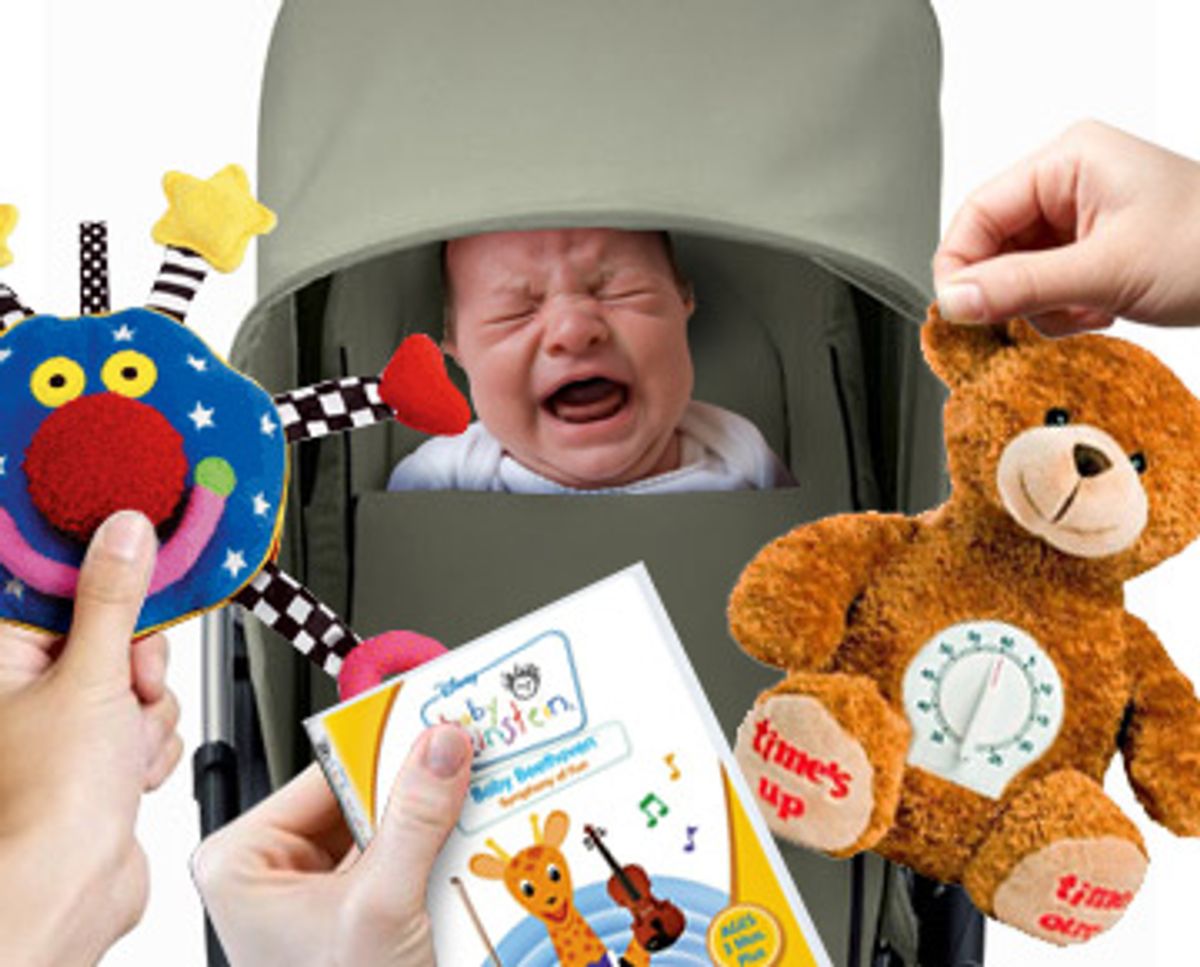
As a mother of two young kids, Paul, whose previous books were about starter marriages and porn, found that she was not immune to the seductions of the burgeoning parenting industrial complex, from baby sign language classes for babies who hear just fine to infant sleeping positioners. Surveying the staggering array of products, classes and services that are available for today's tiny tots, Paul found much to skewer, including professional baby-proofers, fetal and infant education and the Time's Up/Time Out Teddy Bear, which promises to comfort a child banished to his room with a timer that soothingly counts down the minutes until the punishment is over.
Salon spoke with Paul, who has a 3-year-old daughter and a 16-month-old son, by phone from her home office in New York.
Where did the $800 Bugaboo stroller come from?
The Bugaboo stroller was the brainchild of a marketing director for Bugaboo North America, named Kari Boiler. She was living abroad, and this is a European stroller that's par for the course among a certain set in Northern and Western Europe.
Before Bugaboo, there was this sort of understanding that no one would spend more than $300 on a stroller. That actually makes no sense, because certain moms spend $200 or $300 on a pair of shoes, something that is much more ephemeral. So, Boiler basically blew the cap off of what was supposedly the maximum of what any parent would spend.
At first there was a lot of resistance and joking that nobody was going to buy this insanely highly priced stroller, but as it turns out they were completely wrong. Now, there are more expensive models available. There's the Stokke XPlory for $1,000, so you can break that four-figure mark if you want to. All of the other stroller manufacturers were smacked awake by what Bugaboo did: "Well, wait a minute, if they're changing $800 for their strollers, why are we only charging $100?" There aren't as many cheap strollers out there as there once were.
Yet, there's been an upscaling phenomenon in everything from designer chocolate to handbags to over-the-top weddings. Are luxury goods for baby really any different from these other luxuries?
It's much easier to rationalize. It's not for you. You bought it for your child, and that's because you want the absolute best for your child. I think that we have professionalized parenting, and in a consumer society that becomes translated into buying a lot of things. Parents aren't as worried about spending too much as they are about not spending enough. It's what I call the anxiety of under-spending: "Wait a minute. Why didn't I get that for my child? All these other kids are getting it, and if I don't have it what does that mean for my kid?"
How have toys changed in the last 20 years ?
Hugely. When you think back to the '60s and '70s, all the right-thinking progressive parents thought toys should be natural and open-ended. Crayola and Kinder Blocks and Lego were considered raise-your-kid-smart toys. Then, all this data that came out which said that kids need to be stimulated. They need sound! They need multi-sensory experiences! Now, the more bells and whistles a toy has, the supposedly better it is.
Our parents' generation actually had it right. The less the toy does, the better. Everyone thinks: "Toys need to be interactive." No, toys don't need to be interactive. Children need to interact with toys. The best toys are 90 percent kid, 10 percent toy, the kind of thing that you can use 20 different ways, not because it has 20 different buttons to press, but because the kid, when they're 6 months old is going to chew on it, and toss it, but when they're a year they're going to start stacking it.
There's also a misunderstanding of what's worthwhile to do with your child and what's not. Doing the things that our supposedly neglectful parents did, like toting us around town, from the dry cleaner to the grocery store, that's all incredibly informative and worthwhile for kids. It's better to do that with your kid than plant them on the floor with a Fisher-Price learning table that has 25 noise-making buttons, while you're checking your e-mail.
Is the problem with these so-called educational toys that they really can't teach what they claim to, or is it more insidious? Do they actually inhibit learning somehow?
It's both. They do actively inhibit learning. There have been lab studies that show that once a kid figures out how a toy works, they're done with that toy. A toy that goes "Ring!" when the kid presses a button is really exciting at first, but once the kid figures that out, where is there to go with that? And bad toys ruin the good toys. I talked to teachers, educators and psychologists who are finding that kids are less interested in the good toys, because they seem relatively boring.
How did this idea take hold that babies' brains won't develop properly if they're not given this incessant barrage of stimulation?
A series of events took place in the '80s and '90s that convinced parents that they need to stimulate their kids. A lot of people remember the Romanian orphan crisis. These orphans were incredibly screwed up developmentally for life, because they had been languishing in cribs without any stimulation. This taught child development experts that there is a window where kids really need to be stimulated in order to thrive.
But just because kids aren't supposed to be under-stimulated, doesn't mean that over-stimulation is necessary. All those kids needed was adults holding them and singing to them and talking to them and reading to them. That's enough. It's not like the more you stimulate your child, the more you can sort of propel them to greater heights.
What is your objection to classes for babies like Gymboree?
I think, and child development experts agree with this: Child classes for babies should be called child classes for parents.
The parents need to get out of the house. They need to meet other parents. They need to get out of a rut. Those things are all valid. I'm not saying parents shouldn't be doing these things with their babies, but you have to recognize that despite all of the promotional materials that these classes have that say your child is going to learn greater spatial relations and gross motor skills, essentially, it's not for your baby. It's for the parents, and so you really need to adjust your expectations. They may as well be called: Come on, get out of the house, meet some moms in the 'hood class.
But I'm sure a lot of parents would object: "My baby is never around other children. So, she gets to be around other children if she goes to a class."
Kids are pretty unaware of other kids for the first 9 months of their life. But you could also have your friends come over with their kids, or get together with kids in the neighborhood for free. You don't actually have to spend a lot of money and expose your kid to massive amounts of stimulation.
What do you make of parenting consultants, like sleep trainers, doulas and "booty camp" toilet trainers?
There have been a lot of media stories out there about "outsourcing parenthood." Parents can go overboard in hiring out other people to do various tasks of child rearing that kids' parents once did, but I was a lot more appreciative of these services than I thought I would be.
A lot of the people who are sleep trainers, or postpartum doulas, don't make a lot of money. They generally tend to be nurses, social workers and former teachers. For example, you can hire a sleep consultant to help you by phone, or to come and help you in person for an afternoon, and then follow up with you by e-mail and by phone for a month, which costs something like $400. When you parse it out at an hourly basis, the people aren't charging that much, and the actual difference that it can make in a parent's life to have a child who is sleeping through the night and napping well is so huge. If you think about that versus the amount that a parent might spend on products, you're getting a lot more for your money.
It sounds so incredibly indulgent to have this person, a postpartum doula, who is going to come over and mother the mother for six weeks after you give birth. But in the U.K. and in France the government provides people to do that, state paid, and it's considered the natural course of things. And in a society in which people's extended family often live very far away, and in which mothers are increasingly expected if not to go back to work right away to be available on the BlackBerry and the phone almost immediately after birth, people need help right after they have a child. That, to me, is a lot more understandable and worthwhile than spending $800 on a stroller.
Why do you think there is a demand for these parenting consultants?
I think that parents are either far away from their extended family, or their extended family is often not able to provide the kind of help that they need. The grandparents themselves sort of feel hapless: "Whoa! I don't know anything about breast-feeding. We did formula feeding." Seventy-five percent of moms in 1970 formula fed. Today, most moms intend to breast-feed, and their parents aren't able to help them, so you kind of need lactation consultants.
I think that parents have more demands on their time, particularly work-wise. There was a Census report that came out last month that said that 40 years ago 17 percent of moms went back to work within a year of having a child, and today it's 64 percent. If you need to go back to work after two or three months, and your child is still waking up three times a night, how can you function in the workplace? You're just a zombie.
Which services do you think are excessive?
The baby-proofing industry completely preys on parents' worst anxieties and fears. It really doesn't take a brain surgeon to baby-proof a house, and every store has the "Wall of Death" with like 10,000 products in it that you can affix to any potentially sharp surface in your house, if you choose to go that route.
There's absolutely no reason to hire someone to do this for you, and yet these baby-proofing services have just proliferated. Their marketing tactics are some of the most insidious, because they're like: "Your child can die in 67 new ways in the kitchen alone!" It makes you feel incredibly negligent if you don't hire them.
The American Academy of Pediatrics edict is no TV for kids under age 2, but this rule is roundly ignored by the majority of today's parents. Why?
It's funny. The playpen is something that all of our parents used. You plopped the kid in it, and then you ran to take the laundry out of the washing machine, and throw it in the dryer, or to return a call to your girlfriend. Today, the playpen is considered totally verboten. You never put your kid in a playpen. How could you limit their exploration? How could you deprive them of the stimulation? You may as well be spanking your kid roundly every day for no reason whatsoever. But what is Baby Einstein really, but a modern playpen? It's a way to have your kid occupied, while you get to go do something else.
Baby Einstein used to say this quite openly in their marketing: "Go take a shower, while your kid is learning about Noah's Ark." Now, they're much more careful about their wording, and they say: "This is an interactive experience for you to watch with your child." But you talk to most parents, and the last thing that they want to do is watch Baby Einstein. It's incredibly annoying.
We assume for kids that it's totally fascinating because they're glued to it, but as a neuroscientist will tell you, a baby's brain at this stage is actually trained to look at anything that moves or changes within specific time periods, which is what Baby Einstein does.
Parents are saying: "Oh my God, my child is mesmerized. He loves it!" Maybe. We don't know what is going on inside their brain. Maybe they're like Alex in "A Clockwork Orange," and they're forced to watch these images that they want nothing to do with, and yet they can't move.
Baby Einstein is one of the most successful marketing bamboozlings of the American parenting marketplace. There is absolutely no evidence that Baby Einstein makes your baby smarter. We forget that 20 years ago, there was no programming for babies. If you wanted to really occupy your kid, if you didn't have a playpen, or if that wasn't enticing, you just turned on the TV and stuck them in front of "Days of Our Lives," and they would stare at it. The fact is that they may even have gotten more from "Days of Our Lives" than they would from Baby Einstein, because it was actual human faces emoting, as opposed to these random blaring images.
If Baby Einstein had been called "Couch Potato Kiddie," and the marketing had been "Get your child started on the joys of watching television as early as possible," that would have been honest marketing, and that really is what parents are buying.
What's the story with baby sign language?
Baby sign language sounds ludicrous, and then you have kids, and it sounds reasonable. When you first hear it, you're like: "That's completely insane. Why would you teach a baby who can hopefully hear perfectly well how to speak sign language?" Then, you have a baby, and you're like, "My baby has been crying for 20 minutes and grunting, and I have no idea if it's because he is constipated or he is hungry." So, why not teach him baby sign language? They learn all these cute little signs about how to say "I've had enough " or "I want more" or "Give me a grape."
It's an enormous industry. There are classes, there are DVDs, there are books. The Internet has a whole baby sign language universe on it. Some of the research on the face of it sounds really promising: If your baby uses baby sign language by age 8 their I.Q. will be 12 points higher! The truth is, any gains these babies have over babies who don't learn to sign are minimal and ephemeral.
There may be a period of like 2 months where the baby who signed is a little bit more talky than the one who didn't, but then they're all caught up by the age of 2 and a half. It's a diversion that they don't really need. The truth is, a lot of the things that we do with babies, they are often better off left alone.
This is one of the lessons that parents who have more than one kid eventually learn. You're totally in your first kid's face, and you've got the whoozit over them, and you're putting them under the stimulation mobile.
You're incredibly in their face the entire time. When you have two kids that is no longer possible, and what happens when you have a second kid is you notice that actually that kid is being ignored, and they're OK. They're surviving, and in fact, they're probably doing a lot more interesting things of their own volition than the first baby was when you were throwing things in their face constantly.
Do you think that parents now are more susceptible to this kind of marketing, or is there just so much marketing that it's not surprising that many parents are being taken in by it?
I think it's both. Parents are definitely more susceptible. We're more time strapped. Both parents are often working. They're often working more than one job. Their hours are longer. When they're home, they're not entirely home, because they're on e-mail, they're on the phone, they're on the Internet. There are so many distractions.
What that means is that we want anything that is going to make our lives easier, and it also means that we feel incredibly guilty about any moment that we're not paying attention to our kids, or when we're not there. What the parenting industry has done is created products and services to allegedly take care of those fears and needs.
The parenting industry has also gotten a lot bigger and a lot more sophisticated. If you want to find out what you should do about spanking, it's not like you flip open your Dr. Spock anymore. There are 10,000 books and Web sites, so many sources of information and experts out there that can tell you what to do about spanking. They all contradict each other, but you can basically devote three weeks of your life to reading about spanking, whereas parents didn't have those resources before.
Isn't it the parents' job to be able to differentiate hype from substance in the sea of marketing? And aren't we supposed to be arming our children with the ability to do the same as they get older?
Well, yeah, sure. But we're not doing it. And I think that we're not teaching our kids to do it. We're actually teaching our children inadvertent lessons. The growth in the luxury market for babies has just been astounding in the last 10 years. If you buy luxury clothes for your child, you think: "What's the harm in that? What does a baby know anyway?"
And yet, psychologists say children learn brand identification at an incredibly young age, well before they're able to articulate it. A lot of these messages are subconscious, and what we're teaching kids by inundating them with luxury gear is what is worthwhile about life. If a parent is working around the clock to make money in order to be able to afford Giorgio Armani Bambino clothes, what kind of values are we instilling in them?
What is your advice to parents who want to avoid being suckered?
At the most basic level reuse, recycle, repurpose. The average American child gets 70 new toys a year. That is just so far beyond what is necessary. Most child gear, toys, books are a lot cheaper, relatively speaking, than they were decades ago. In the aggregate it ends up being a lot more expensive, because we're buying a lot more of it, but kids just don't need that many toys. Kids lose out when things become less special.
There is this feeling that if I don't do everything that I can for my child I'm cheaping out on my kid, and I'm not giving them all the advantages. Underpinning this is a huge amount of economic anxiety. We're incredibly fearful that for the next generation things are going to be a lot tougher, in a seriously competitive, not very rewarding global marketplace. Question before you make any purchase whether what you're doing is to assuage your angst, guilt and fear, and if it's actually going to make a material difference for your child.
Shares