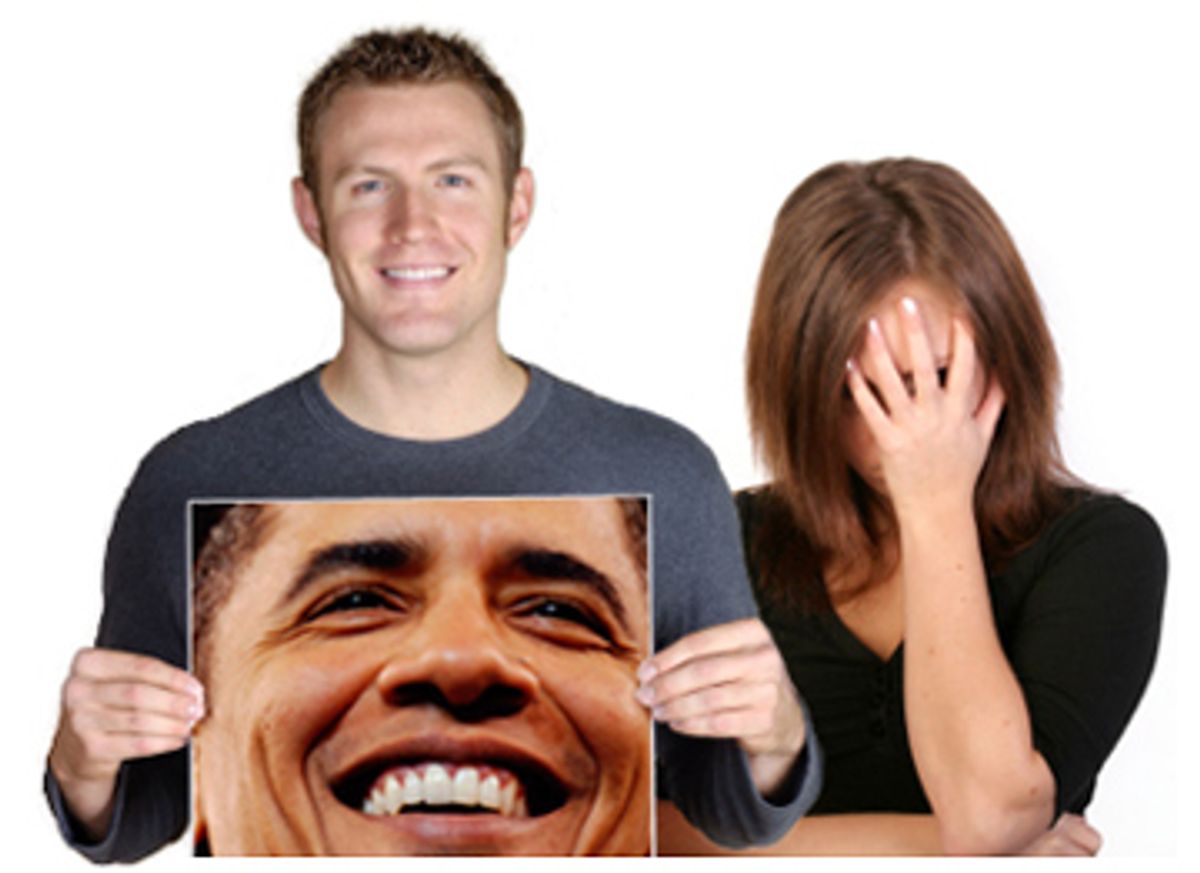
Dana Lossia, a 29-year-old labor lawyer in Brooklyn, describes herself as a "pretty big Obama supporter. " She worked for a year at Michelle Obama's Public Allies Chicago, where she met Barack a few times. She called him "the most inspiring, amazing person, a different kind of politician." Of Hillary Clinton, whom Lossia supported in her Senate runs, Lossia said, "I just think she's acted badly during this campaign."
And yet, as Lossia wrote in a recent e-mail, "I've been really bothered by what I perceive as sexism [among some male Obama supporters] and have spent hours defending [Clinton] ... A lot of guys just can't stand Hillary, and it's the intensity of their irritation with her that disturbs me more than their devotion to Obama."
This riveting Democratic primary campaign has provided us with its own stock characters: There are the young "Daily Show"-watching Obama-maniacs getting over their irony addiction by falling earnestly in love with the senator from Illinois. There are the pissed-off second-wave feminists, uptight and out of touch, howling as their dream of seeing a woman in the Oval Office fades. And then there are the young women caught between them.
According to the media script, these cool young customers have embodied their elders' worst nightmare of a generation that takes feminism's victories for granted by throwing over Hillary Clinton for her challenger faster than you can say "I've got a crush on Obama." These young women are way over feminism, we're told, and perceive gender bias to be an antiquated notion. They are embarrassed and annoyed by the public entreaties of warhorses like Gloria Steinem and Robin Morgan. Pressure from their forebears only serves to alienate them from the second wave and drive them further into the disheveled embrace of the "Yes We Can!" dude down the block.
There is truth to this exaggerated electoral tableau. Young people are voting for Obama; Clinton is a troubling candidate for many women and men; and there is a sense that younger women feel more distant from second-wave feminist leaders than ever before.
Yet some female voters have begun to express nearly as much disenchantment with the Obama-mania of their peers as with their Clinton-promoting mothers. And even while they voice dismay over the retro tone of the pro-Clinton feminist whine, a growing number of young women are struggling to describe a gut conviction that there is something dark and funky, and probably not so female-friendly, running below the frantic fanaticism of their Obama-loving compatriots.
I began reporting this story in part because, as a 32-year-old woman who is more liberal than either candidate, and who was quite torn until Super Tuesday, I had found myself increasingly defensive of Clinton in the face of the Obama worship that rules the mostly white, liberal, well-educated circles in which I work and travel. I was confused by the saucer-eyed, unquestioning devotion shown by my formerly cynical cohorts, especially when it was accompanied, as it often was, by a sharp renunciation of Hillary Clinton, whose policies are so similar to her opponent's. I was horrified by the frequent proclamations that if Obama did not win the nomination, his supporters would abstain from voting in the general election, or even vote for John McCain. I was suspicious of the cultlike commitment to an undeniably brilliant and inspiring man –- but one whom even his wife calls "just a man."
I am a loud feminist and a longtime Clinton skeptic who was suddenly feeling that I needed to rationalize, apologize for, or even just stay quiet about my increasing unease with the way Clinton was being discussed. Meanwhile, I was getting e-mails from men I didn't know well who approached me as a go-to feminist to whom they could express their hatred of Hillary and their anger at her staying in the race -- an anger that seemed to build with every one of her victories. One of my closest girlfriends, an Obama voter, told me of a drink she'd had with a politically progressive man who made a series of legitimate complaints about Clinton's policies before adding that when he hears the senator's voice, he's overcome by an urge to punch her in the face.
A few weeks ago, my friend Becca O'Brien, a lawyer and policy advisor in New Orleans, visited me. She told me about her experience on the morning of the Louisiana primary. O'Brien had been openly torn between Obama and Clinton, and perhaps as a result, she received five phone calls from male friends around the country, urging her to vote for Obama. They were, she understood, just campaigning for their candidate; they didn't realize how many calls she was receiving, or that taken together, they were making her furious. As O'Brien saw it, "The presumption was that I was undecided because I was a young woman, and they could talk some sense into me if they were the last ones I spoke to before I went into the voting booth."
O'Brien told me she'd heard similar reports of irritation from female friends around the country. I asked her to send them my way, and I put out feelers on my own. Not since I wrote a story about the book "He's Just Not That Into You" have I received such a tremendous response.
The women who contacted me were almost exclusively well-educated and professional, a culturally and politically elite demographic, to be sure. But they all echoed each other in their complaints, complaints that complicate the dominant narrative about how young female voters are experiencing this presidential election.
I received e-mails and phone calls from women voicing various strains of frustration: They told me about the sexism they felt coming from their brothers and husbands and friends and boyfriends; some described the suspicion that their politically progressive partners were actually uncomfortable with powerful women. Others had to find ways to call me out of earshot of their Obama-loving boyfriends. Some women apologized for "sounding so feminist." Interviewees expressed vexation at not being able to put their finger on what it was about Obama-mania that creeped them out so badly, while maintaining a deep assuredness that something was not quite right. Perhaps most surprising was that the majority of the women I spoke to were not haters: They were Obama supporters, or at least Obama-appreciators.
Mia Bruch, 33, is a would-be Obama voter who was unable to cast a ballot on Super Tuesday due to a voting-roll snafu. A writer and editor who has a Ph.D. in American history, Bruch said that she's been politically progressive all her life but feels "a great distance" from her partisan peers, in part because of what she described as their "uncritical embrace of certain figures on the left," including Ralph Nader, Howard Dean, and now Obama. "You already see this idealistic longing projected on Obama," Bruch said. "People talk about him as a secular messiah who will bring us political salvation. There's no sense of what is plausible."
Or factual. Bruch points to healthcare as an area in which "Hillary's policy is the more politically progressive one, but this has somehow been ignored, and Obama was projected upon as the progressive redeemer. It's a political fantasy."
"If you're not taken with Obama, I suppose that the intensity of Obama supporters can be unnerving and hard to relate to," said Michelle Goldberg, the author of "Kingdom Coming" (and a former Salon staffer) and an ardent Obama supporter whom I contacted because she has written about the pressure that's been applied on young women by older feminists. "I certainly have become far more of a fanatic than I would have thought possible."
Goldberg continued, "To pass up a once-in-a-generation chance to elect a liberal intellectual who can do for the progressive movement what Reagan did for the conservative movement -– that is, to mainstream an ideology that was once considered marginal and vaguely disreputable -– would be criminal. But the intensity of that longing probably makes no sense to people who don't see the same possibility in this candidacy."
And for people who don't see the same possibility in Barack Obama, the intensity of that longing, especially when expressed by men, can sound downright suspect.
Maggie Merrill, a 31-year-old graduate student in urban studies at the University of New Orleans who works part time at New Orleans City Hall, is a Clinton supporter who told me that she will happily vote for Obama in the general election. But, she said, "There is this Obama-mania, where these young men get glassy eyes and start spitting out vague things about how Barack Obama is going to save humanity. Really, have you seen their eyes? It's this faraway look. It's scary."
I have seen that look and wondered if, in the minds of some of his adherents, the thing Barack Obama might be saving humanity from is Hillary Clinton.
There are many unpleasant realities about Clinton: She voted for the war; she has taken hawkish stances in defense of Israel; she voted to declare Iran's revolutionary guard "a terrorist organization"; she sponsored a flag-burning amendment; she has not run a great campaign, waiting until this week to fire Mark Penn; she is a Clinton. But while these are all qualities that might rightly inspire political dislike, or a withdrawal of support, they don't often incite the kind of hissing fury with which her primary run has been met. Were it her husband -– a man who has exhibited many of these same flaws (and more!) -– in the same place, he might or might not be trailing Obama, but it is hard to picture the kind of seething, violent animosity being flung at him.
When sexism is acknowledged in this primary campaign, it has been attributed to either Chris Matthews or the conservative, Rush Limbaugh, Iron My Shirt brigade. Little open recognition has been given to the possibility that there might be some gender discomfort behind the army of liberally minded Obama enthusiasts. But progressive politics has not always been female-friendly politics; '70s feminism was born partly in response to the inequities of the antiwar and civil rights movements. It's certainly possible that the youthful Obama movement has its own brand of female trouble.
O'Brien said, "With straight white male progressive friends, I feel something that makes me viscerally angry and afraid -- the viciousness of the rebuttals to the suggestion that [Obama's and Clinton's] policies are roughly equal or that Clinton's have some benefits to them, the outright dismissal of any support of her, the impossibility of having a nuanced conversation ... The whole 'Hillary Clinton is a monster' theme is so virulent."
Alex Seggerman, a 24-year-old art history Ph.D. student at Yale and an Obama voter, said, "I don't think anyone in my peer group, including my parents and my friends, would be comfortable saying, 'I'm not ready for a woman president.' They would be ostracized. Saying, 'She's had plastic surgery' or 'Her attitude is off-putting' are fine. But these are really expressions of some deeper issues with the fact that she's a woman."
"Hillary Clinton is not an attractive personality for a lot of people," said O'Brien, who noted that it's "very convenient that the same people who have a sense of discomfort with female authority they prefer not to examine" also object to her personality and record in specific terms, an antipathy they feel comfortable voicing. "What you get," said O'Brien, "is the energy of the first expressed in words of the second."
Perhaps it's because of the abundance of rational reasons to dislike Clinton -– perfect for disguising any unsightly misogynistic blemishes -– that many women described frustration at being unable to name specific instances of what they have felt as gender bias. Lossia, the Obama-supporting labor lawyer, explained that with her friends, "I've never heard them say anything where I could say, 'That's a sexist comment.' It's just that I can't understand why they hate her so much. I just have a feeling that they wouldn't be as bothered by her if she were a man. But that's very intuitive ... I think some of the guys just have some kind of visceral dislike for her." Lossia said she has asked why they despise Clinton. "People can always come up with reasons they don't like the candidate they're not supporting," she said. "But no one disliked Joe Biden or Chris Dodd as much as they dislike Hillary."
Jessica Valenti, the founder of Web site Feministing, has spent recent weeks touring colleges, including Georgetown, University of Mary Washington, University of Akron and University of Missouri. She said that before her travels, she'd been "expecting a lot more Obama craziness" on campuses. To her surprise, at almost every school she visited, young women told her, "My friends or boyfriend or father are progressive guys, but when they talk about Hillary, I feel like they're being sexist. But I can't put my finger on what it is."
Valenti continued, "Because their friends were not being specifically sexist, or saying something that was tangibly misogynistic, they were having a hard time talking about the sexism of it." Valenti confirmed that this "Feminine Mystique"-y problem that has no name was familiar to her. "I spoke to a guy friend who said, 'You're being ridiculous. I'm not not voting for her because she's a woman; I'm not voting for her because she's a bitch!' He could not see the connection between the two things at all." Valenti said he explained away his comment by declaring, "I mean 'a bitch' in the sense that she's not good on this or that issue."
Valenti has vacillated between Obama and Clinton and has not publicly revealed whom she's supporting. "But if I say something that's pro-Obama," she said, "someone will feel it's OK to say something to me that's anti-Hillary that I feel is coming from a place that's totally misogynist. The same thing happens if I say something that's pro-Hillary; someone will launch into an anti-Hillary diatribe that doesn't have anything to do with her as a politician. But because it's not explicit sexism, it makes it impossible to argue with people, because if you say something, then you're the wackadoo feminist."
Valenti continued, "I pinpoint sexism for a living. You'd think I'd be able to find an example. And I hate to rely on this hokey notion that there's some woman's way of knowing, and that I just fucking know. But I do. I just know." When it comes to feminism, she continued, so much proof is required to convince someone that sexism exists, "even when it's explicit and outrageous. So when it's subdued or subtle, you don't want to talk about it."
Not everyone feels that the chauvinism aimed at Clinton is subtle. Thirty-three-year-old actress Molly Ward said, "There is a frustration I feel professionally about how women who are ambitious are perceived as ruthless. We've made rules, we've set standards, we've put Virginia Woolf on the curriculum, and done things to make women feel it's OK to go after your dreams. But there is still this basic problem with women being criticized for ambition."
Kristen Phillips, 28, and a master's student at the University of New Orleans, said, "Sexism does not have to be 100 percent of what's going on. It might not even be 80 percent. But give me a break. It's there. Don't say that it's not there." She went on, "You would hope that people would at least realize that that's what they're saying, but they can't. It's like they don't have the vocabulary because they're so adamantly not acknowledging that that's going on. They're busy patting themselves on the back for supporting a black man: Aren't we cool?"
Perhaps it is thanks to the admitted cool factor that among educated liberal voters, the assumption is that you're for Obama, that he is the more "progressive" choice. Obama loyalty, like white masculinity itself, has become normative -– if you're not for him, you'd best be prepared to explain your deviation.
Ashley Johnson, 21, is a senior at Princeton who is undecided but leaning toward Obama. She told of a male acquaintance who questioned whether her hypothetical vote for Clinton would be "just because you are a woman and you want a woman in the White House." Said Johnson, "That doesn't give me enough credit and underestimates how much thought I've put into this."
It also prompts the question of when it became so wrong-headed to care whether a history of white male presidential privilege might be interrupted.
"If I did end up voting for Hillary, would part of me be very proud that I was voting for the first female candidate?" said Johnson. "Yes." As for her peers, Johnson continued, "I have not talked with any straight men on campus who are voting for Hillary. And a lot of the females I know are supporting Obama. I don't know if that's because they actually do support him, or if it's because they don't want to be attacked because they're female and they're leaning toward Hillary."
Eva Gruenberg, a 21-year-old senior history and political science major at the University of Pittsburgh, who is also leaning toward Obama, reported something similar on her campus, warming up for the April 22 Pennsylvania primary. She said that her fellow students are "more subtle" about their Clinton support. "I don't want to say 'quiet' about it," Gruenberg said. "I feel like the kids who are for Obama are much more into marketing and bragging about it. Hillary people are not so much into advertising it yet."
Perhaps the hesitation to throw a Hillary placard in your window is related to the fear that doing so will make you –- like Clinton herself –- a regular laughingstock.
Mia Bruch described a recent trip to Ricky's, a cosmetics shop in New York City. "The only political item was a huge stack of Hillary nutcrackers," she said. "Obviously, the play here is that she's a ball-buster. No one is making nutcracker icons of McCain or Obama." More important, no one would buy them. Ricky's cosmetic store is not selling Hillary nutcrackers for its health; it's selling them because there is a market. "People like making fun of Hillary Clinton," said Bruch simply.
"There have been nasty, dirty things said about Obama -– insinuations about his religion and coded references about his race," said Bruch. But she pointed out that to overtly mock Obama "is putting yourself at risk for being part of a long tradition of caricaturing black faces. It's a little easier to do that if you're caricaturing a woman."
Opening up the discussion of sexism inevitably leads to comparative observations about racism -- a tragic, reductive byproduct of two historical barriers having been broken in the same election year. Many young women expressed their annoyance that the competition conversation needs to take place at all. O'Brien explained that, at a certain point, she and her boyfriend, who is African-American, decided that the two experiences were simply not comparable in any useful way. Jessica Valenti lamented what she called "the Oppression Olympics," which she says make both sides look bad.
But the urge to make comparisons, and the speed with which they flame up when touched even gingerly -– consider Geraldine Ferraro's assertion that Obama was lucky to be a black man, Gloria Steinem's reference to blacks getting the vote before women, Jeremiah Wright's observation that Hillary "ain't never been called a 'nigger'" -– remind us that drives toward equality have often been pitted against each other and have also spelled the divisive end of social movements; a reluctance to make room for racial and sexual difference contributed to the unraveling of second-wave feminism.
But not before the feminist movement made tremendous strides. In today's United States, racism continues to have more damaging economic and social structural implications for African-Americans than sexism has for women. Especially white and well-educated women, who are catching up to their male counterparts, if not in terms of equal pay or domestic expectations or secure reproductive options, at least in their ability to pursue the education and vocation they desire. And that makes them a more threatening group to the population of white men who have enjoyed unchallenged power -- in the White House and other workplaces -- since the birth of the nation. Those who feel the army of tough ladies breathing down their necks, competing for jobs and salaries and refusing to drop out of the race, are the population of privileged white men from which the elite portion of the Democratic Party is built.
That does not mean that all privileged white male Democrats are sexist, anymore than it would be true to suggest that all working-class white Democrats (the segment of the party that is breaking for Clinton) are racist. But a lightly disguised uneasiness with female power, as well as the "we love women, just not that woman" rhetoric will be familiar to anyone who has paid attention to the reception of the feminist movement. It's the movement of which Clinton has become emblematic -– not because it was her bailiwick, but because she has been exactly the kind of woman that feminism made room for: ambitious, ball-busting, high-earning, untrained in the finer arts of hair care, and unwilling to play dumber (or nicer) than she is.
These women –- and the movement whence they sprang -– have never been the most popular girls in the Democratic Party, even if the party's male elders have grown up enough to know that they're not supposed to say so out loud anymore. At least not until they find themselves pinching Clinton's cheek like Chris Matthews, or accusing her of destroying the party by staying in a race in which she is still competitive. It's like how Democrats love women, just not those goddamned women with their single-issue reproductive rights obsession that sticks us with Lincoln Chafee and Joe Lieberman.
In this case, the frustration with the feminist old guard's reaction to Hillary Clinton is not unmerited. The exhortations from Robin Morgan have not exactly been lyrical, or tuned to ears of women younger than 50. Assertions from Obama-maniacs that a woman who votes for Hillary must be doing so only because she is a woman may be bad, but it's just as bad for older feminists to instruct women that they have some kind of ovarian, fallopian responsibility to do the same.
Rebecca Wiegand, a 24-year-old development assistant at a film company, and an Obama supporter from the beginning, said, "Those editorials by Gloria Steinem and Robin Morgan I was appalled by, and I felt completely alienated from second-wave feminism."
But instead of spelling the end of the movement, as Michelle Goldberg suggested in a recent Guardian piece, this generational break may signal a healthier divide. Because while these young women may not be changing their votes, and may not be hewing to the words of Robin Morgan, they're also not -– as many of the elder handwringers fear -– tossing their feminism out with the bathwater. In fact, it's possible to envision a way in which, rather than simply sealing the demise of the second-wave, this election might give birth to a new generation of young feminists awakened by the harsh treatment of Hillary -– on their own terms and without the voices of Steinems and Morgans to overshadow or boss them.
"When the election started, I felt very postfeminist," said Wiegand. "I felt like, I'm a woman and I'd love to have a woman president, but I also have many other issues I care about and the Iraq war is a big one, and I'm not going to make my decision just because I'm a woman." But over the course of the campaign, Wiegand said, "there has been a lot of anger toward Hillary that's felt really intense and misogynistic. The gloating after Iowa was something to behold. And it's made me realize we are still dealing with the gender issue. I don't think we know what to make of women in power, or make of Hillary. I don't think the world is as postfeminist as I was feeling that it was."
Shares