

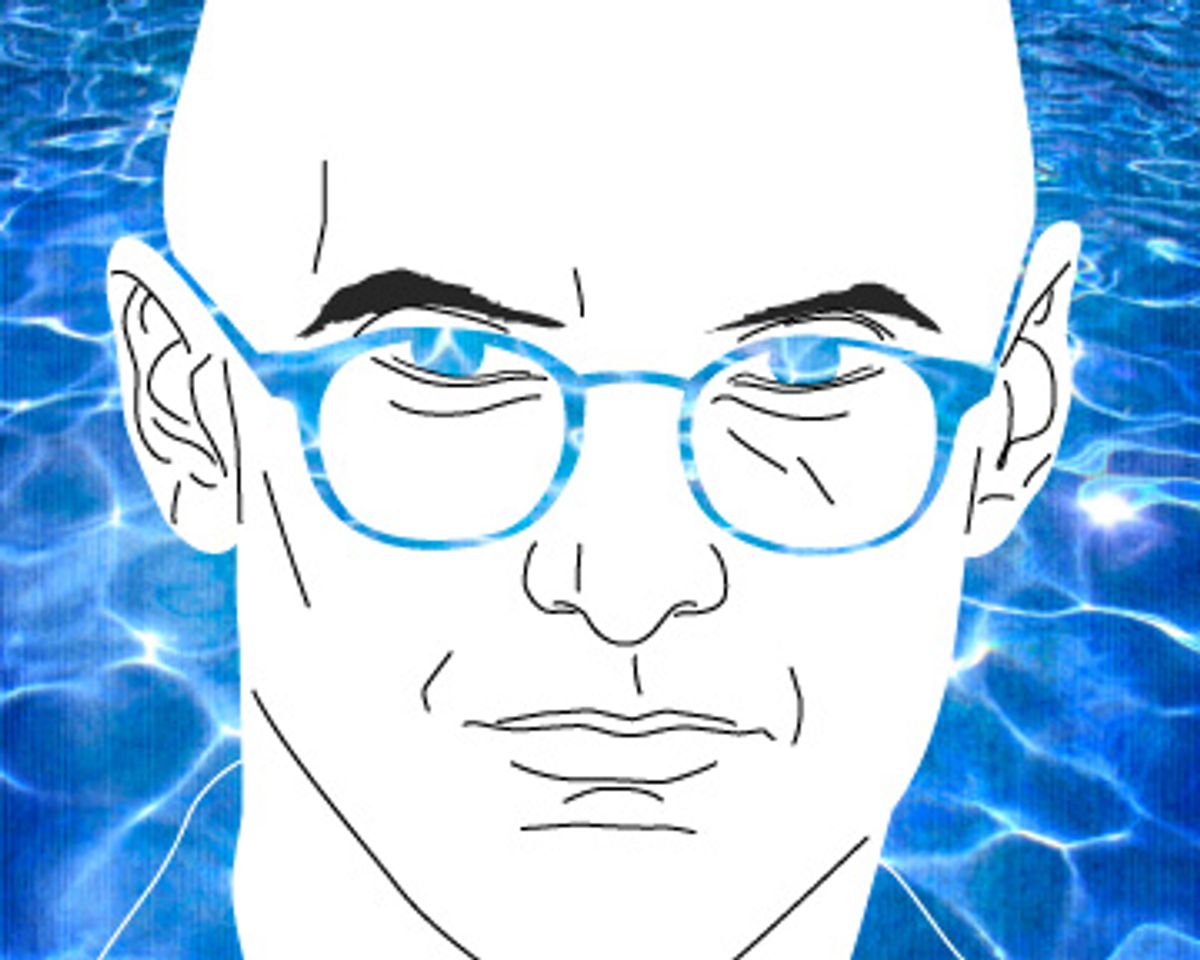
Ken Wilber may be the most important living philosopher you've never heard of. He's written dozens of books but you'd be hard-pressed to find his name in a mainstream magazine. Still, Wilber has a passionate -- almost cultlike -- following in certain circles, as well as some famous fans. Bill Clinton and Al Gore have praised Wilber's books. Deepak Chopra calls him "one of the most important pioneers in the field of consciousness." And the Wachowski brothers asked Wilber, along with Cornel West, to record the commentary for the DVDs of their "Matrix" movies.
A remarkable autodidact, Wilber's books range across entire fields of knowledge, from quantum physics to developmental psychology to the history of religion. He's steeped in the world's esoteric traditions, such as Mahayana Buddhism, Vedantic Hinduism, Sufism and Christian mysticism. Wilber also practices what he preaches, sometimes meditating for hours at a stretch. His "integral philosophy," along with the Integral Institute he's founded, hold out the promise that we can understand mystical experience without lapsing into New Age mush.
Though he's often described as a New Age thinker, Wilber ridicules the notion that our minds can shape physical reality, and he's dismissive of New Age books and films like "The Tao of Physics" and "What the Bleep Do We Know." But he's also out to show that "trans-rational" states of consciousness are real, and he's dubbed the scientific materialists who doubt it "flatlanders."
Wilber's hierarchy of spiritual development -- and the not-so-subtle suggestion that he himself has reached advanced stages of enlightenment -- has also sparked a backlash. Some critics consider him an arrogant know-it-all, too smart for his own good. His dense style of writing, which is often laced with charts and diagrams, can come across as bloodless and hyperrational.
When I reached Wilber by phone at his home in Denver, I found him to be chatty and amiable, even laughing when he described his own recent brush with death. He's a fast talker who leaps from one big idea to the next. And they are big ideas -- God and "Big Self" and why science can only tell us so much about what's real.
You've written that there's a philosophical cold war between science and religion. Do you see them as fundamentally in conflict?
Personally, I don't. But it depends on what you mean by science and what you mean by religion. There are at least two main types of religion. One is dependent upon a belief in a mythic or magic dogma. That is certainly what most people mean by religion. Science has pretty thoroughly dismantled the mythic religions. But virtually all the great religions themselves recognize the difference between "exoteric" or outer religion, and "esoteric" or inner religion. Inner religion tends to be more contemplative and mystical and experiential, and less cognitive and conceptual. Science is actually sympathetic with the contemplative traditions in terms of its methodology.
When you refer to mythic religions, are you talking about the kinds of stories we read in the Bible?
Or any of the world's great religions. Laotzu was 900 years old when he was born. According to the Hindus, the earth is resting on a serpent, which is resting on an elephant, which is resting on a turtle. Those kinds of mythic approaches aren't wrong. They're just a stage of development. Look at [Swiss philosopher] Jean Gebser's structural stages of development. They go from archaic to magic to mythic to rational to pluralistic to integral and higher. Magic and mythic are actual stages. They're not wrong any more than saying "5 years old" is wrong. It's just 5 years old. We expect there to be higher stages. There was a time when the magic and mythic approaches years ago were evolution's leading edge of development. So we can't belittle them.
Where do you think the scientific worldview falls short when dealing with religion?
Conventional science has correctly dismantled the pre-rational myths but it goes too far in dismantling the trans-rational. The mythic and magic approaches tend to be pre-rational and pre-verbal, but the meditative or contemplative practices tend to be trans-rational. They completely accept rationality and science. But they point out that there are deeper modes of awareness, which are scientific in their own way.
What do you mean by trans-rational?
People at these higher stages of spiritual development report a "nondual awareness," a type of awareness that transcends the dichotomy between subject and object. The mystical state is often beyond words. It is trans-rational because you have access to rationality but it's temporarily suspended. A 6-month-old infant, for instance, is in a pre-rational state, whereas the mystic is in a trans-rational state. Unfortunately, "pre" and "trans" get confused. So some theorists say the infant is in a mystical state.
Are you saying people with a rationalist orientation can't make these distinctions?
I'm saying that when people look at mystical states, they often confuse them with pre-rational states. People like Sigmund Freud take trans-rational, oceanic states of oneness and reduce them to infantile states of unity.
Why has the scientific worldview dismissed this trans-personal dimension? For most intellectuals around the world, the secular scientific paradigm has triumphed.
It's understandable. Historically, if you look at these broad stages, the magical era tended to be 50,000 years ago, the mythic era emerged around 5,000 B.C., and the rational era -- secular humanism -- emerged in the Renaissance and Enlightenment. The Enlightenment was an attempt to liberate myth and base truth claims on evidence, not just dogma. But when science threw out the church, they threw out the baby with the bath water.
You can't prove a higher stage to someone who's not at it. If you go to somebody at the mythic stage and try to prove to them something from the rational, scientific stage, it won't work. You go to a fundamentalist who doesn't believe in evolution, who believes the earth was created in six days, and you say, "What about the fossil record"? "Oh yes, the fossil record; God created that on the fifth day." You can't use any of the evidence from a higher stage and prove it to a lower stage. So someone who's at the rational stage has a very hard time seeing these trans-rational, trans-personal stages. The rational scientist looks at all the pre-rational stuff as nonsense -- fairies and ghosts and goblins -- and lumps it together with the trans-rational stuff and says, "That's nonrational. I don't want anything to do with it."
So where does God fit into this picture? Do you believe in God?
God is a perfect example of how these two types of religion treat ultimate reality. You asked, "Do you believe in God?" In exoteric religion, it's a matter of belief. Do you believe in the kind of God who rewards and punishes and will sit with you in some eternal heaven? But in the esoteric form of religion, God is a direct experience. Most contemplatives would call it "godhead." It's so different from the mythic conceptions of God -- the old man in the sky with a gray beard. The word "God" is much more misleading than it is accurate. So there's a whole series of terms that are used instead by the esoteric traditions -- super-consciousness, Big Mind, Big Self. This ultimate reality is a direct union that is felt or recognized in a state of enlightenment or liberation. It's what the Sufis call the "supreme identity," the identity of the interior soul with the ultimate ground of being in a direct experiential state.
It does raise the question of whether God -- or ultimate reality -- has some independent existence, or whether this is just a mental state that our minds can conjure up.
That's right. One way we try to find out is by doing cross-cultural studies of individuals who've had the experience of the supreme identity and see if it shows similar characteristics. The most similar characteristic is it doesn't have characteristics. It's radically undefinable, radically free, radically empty. This formless ground of being is found in virtually all esoteric religions around the world. For the final test, take scientists with a Ph.D. who are studying brain patterns and put them in a contemplative state of the supreme identity and ask them whether they think that state is real or just a brain state. Nine out of 10 will say they think it's real. They think this experience discloses a reality that's independent of the human organism.
Do you see this ultimate reality as some sort of being or intelligence out there?
Well, if you look cross-culturally, what you'll find is that spirit or godhead can be looked at either through first-person, second-person or third-person perspectives. The third-person perspective is to see spirit as a grand "it." In other words, a vast web of life. Gaia in this third person is the sum total of everything that exists. A second-person way of looking sees spirit as a "thou," as an actual intelligence that is present and is something you can, in a sense, have a conversation with, keeping in mind the ultimately unknowable nature of godhead. Many of the contemplative traditions go further and say you can approach spirit as a first person. So that spirit is "I." Or that would be Big Self.
This means "I am God."
That's right. This first-person perspective is an experience of pure "I-am-ness," behind your relative ego. Discovering your Big Self comes directly in the contemplative state of non-dual awareness. This means subject and object are one. It's not that you're looking at the mountain when you're going on a nature walk. You are the mountain. You're not listening to the river anymore. You are the river.
You are a longtime meditator. You've written about having sustained experiences of this nondual awareness. What does it feel like?
[Laughs] It's very simple. It's something that's already present in one's awareness but it's so simple and so obvious that it's not noticed. Zen refers to it as the "such-ness" of reality. [The Christian mystic] Meister Eckhart called it "thus-ness." These states of consciousness are temporary, peak experiences. There's no bliss. Rather, it's an absence of any constriction, including feelings of bliss. The feeling is vast openness and freedom and lightness. You don't have a sense that I'm in here and the world is out there.
You were a budding scientist at one point, a graduate student in biochemistry. Why did you give up the scientific track to study these spiritual matters?
I had a scientific orientation. I think I was a born scientist. In fact, I was one of those kids with the early science labs -- all the frogs you cut up, the explosions in the basement. I went to Duke University in the medical track. And then I decided I wanted to do something more creative, so I switched to biochemistry at Nebraska. But as I moved into young adulthood, mere rationality didn't really seem to be answering the questions that were arising in that stage of my life: Why am I here? What's it all about? What's the nature of reality?
What changed for you?
I realized that exterior science wasn't working. So I turned to Zen Buddhism. To me it was very scientific. It's a practice, an actual experiment. If you do this experiment, you'll have some sort of experience, and you'll get some data. William James defined data as an experience. Then you check your direct experience with other people to make sure you didn't goof up. Some sort of consensual evidence is required. There are several schools of thinking about how to evaluate scientific evidence. One of the most famous is Karl Popper's, where you try to disprove it. So this process is exactly what I was doing in Zen Buddhism. You have to train your mind. And frankly, this mind training was more difficult than anything I did in graduate school.
What about Karl Popper's objection: If you can't disprove something, then it's not science. Can you disprove the effects of meditation? How far can you take this scientific analogy when you're talking about a contemplative practice?
Pretty far, I think. These meditative disciplines have been passed down for hundreds of years, sometimes thousands of years. Much like judo, there are actual techniques that you can learn and pass on. In Zen, you have the practice of zazen. You have to sit and count your breath for up to an hour and concentrate on an object for at least five minutes without losing track. The average American adult can do it for 18 seconds. Then you have the data, what's called satori. Once you train your mind and look into your interior, you investigate the actual nature and structure of your interior consciousness. If you do this intensely enough, you'll get a profound aha experience, a profound awakening. And that satori is then checked with others who've done this practice.
But I doubt many scientists would accept this as proof of science because, ultimately, people are left to describe their own experiences. You can't measure this with any conventional scientific instruments.
You move in the realm of phenomenology. And you either accept phenomenology or you don't. This also applies to psychoanalysis. You get the same complaints that it's not real science, that you can't prove it. Well, fine, but then you can't prove any interior experience you're having. You can't prove you're loving your wife, you can't prove you're happy. Forget all of that, it's not real. If that's the mind-set you have, nobody's going to convince you otherwise. It really comes down to whether there are interior sciences. These interior sciences use the same principles as the exterior sciences. If you define science as based on sensory experience, then these interior endeavors are not science. But if you define science as based on experience, then these interior ones are.
What about brain-imaging studies? Various neuroscientists are hooking up Buddhist monks and Christian nuns to brain-scanning technology, and they see changes in brain activity during meditation or prayer. But can they tell us anything fundamental about the nature of consciousness?
Yes and no. What's starting to show up are significant and unique fingerprints of these meditative states on the brain. That's been demonstrated with people who do a type of meditation that's said to increase compassion -- imagining someone else who's in pain and breathing in their pain, creating a feeling of oneness with that person. These people start showing distinctive gamma wave patterns. These gamma waves show up almost no place else. But let me tell you what it doesn't prove. The claim that it's a higher mental state can only be made if you're looking at it from the inside. We say that waking is more real than dreaming. But brain waves won't tell you that. The brain waves are just different. You can't say one is more real than the other.
This raises a fundamental question about the whole mind-brain problem. Virtually all neuroscientists say the mind is nothing more than a 3-pound mass of firing neurons and electrochemical surges in the brain. Why do you think this view is wrong?
It reduces everything. And you can make no distinctions of value. There's no such thing as love is better than hate, or a moral impulse is better than an immoral impulse. All those value distinctions are erased.
But is that scientific view wrong?
At this point, you enter the philosophy of science, and the argument is endless. Is there nothing but physical stuff in the universe? Or is there some sort of interiority? We're not talking about ghosts and goblins and souls and all that kind of stuff. Just: Is there interiority? Is there an inside to the universe? And if there is interiority, then that is where consciousness resides. You can't see it, but it's real. This is the claim that phenomenology makes.
For example, you and I are attempting to reach mutual understanding right now. And we say, aha, I understand what you're saying. But you can't point to that understanding. Where does it exist? But if you take a phenomenology of our interior states, then you look at them as being real in themselves. And that's where values lie and meaning lies. If you try to reduce those to matter, you not only lose all those distinctions, but you can't even make the claim that some are right and some are wrong.
But somewhere down the road -- 50 years from now, 500 years from now -- once neuroscience becomes much more advanced, will scientists be able to pinpoint where these values and thoughts come from?
I'm saying we'll never understand it. The materialists keep issuing promissory notes. They always promise they're going to do it tomorrow. But interior and exterior arise together. You can't reduce one to the other. They're both real. Deal with it.
You're saying there's no way we can map what's happening in our brains -- the neuronal activity, the synaptic connections -- to explain what's going on in our inner experience.
That's right. All you can do is map certain correlations. You can say that when a person's thinking logically, certain parts of the brain light up. But you can't determine what the person is thinking. More important, you can't reproduce the reality of the person thinking because that's a first-person experience. This first-person reality can't be reduced to third-person material entities. What that means is that consciousness can't be reduced to matter. You can't give a material explanation of how the experience of consciousness arises.
Let's talk about evolution. It seems to me that the great religious traditions don't know what to do with the evolution of the human brain. At some point in our evolutionary history -- maybe 50,000 or 100,000 years ago -- the brain developed a new level of complexity that produced language and conceptual thought, basically, the human beings we are today. Is our consciousness rooted in the material matter in our brains?
An integral approach maintains that an increase in the complexity of matter is accompanied by an increase in the degree of consciousness. The greater the one, the greater the other. So if we look at complexity in evolution, it goes from atoms to molecules to cells to early organisms to organisms with a reptilian brain stem to organisms with a mammalian limbic system to organisms with a triune brain. We find major leaps in consciousness with each of those levels of complexity.
But can you even talk about consciousness before you reach a certain level of evolution? I mean, bacteria don't have consciousness. Plants don't have consciousness.
I don't talk about consciousness. I talk about interiority. What you see is that as soon as you have a cell, it starts to respond to the environment in ways that can't be predicted. If you're just looking at material stuff -- like a planet that doesn't have life on it -- a physicist can tell you where that planet is going to be, barring other forces, 1,000 years from now. But that physicist can't tell you where my dog is going to be two seconds from now. There is a degree of non-determined interiority. It's simply there. You can't dismiss it.
What do you think of the New Age writers who see a link between mysticism and the weirdness of quantum physics? There have been popular books, like "The Tao of Physics" and "The Dancing Wu Li Masters," as well as the hit film "What the Bleep Do We Know." They point out that reality at the quantum level is inherently probabilistic. And they say that the act of observing a quantum phenomenon plays a critical role in actually creating that phenomenon. The lesson they draw is that consciousness itself can shape physical reality.
They are confused. Even people like Deepak Chopra say this. These are good people; I know them. But when they say consciousness can act to create matter, whose consciousness? Yours or mine? They never get to that. It's a very narcissistic view.
But the real problem is what's called "the measurement problem." And 95 percent of scientists do not think the measurement problem involves consciousness. It simply involves the fact that you can't tell where an electron is until you measure it. It's very different from saying it doesn't exist until you measure it. That's entirely different from saying human consciousness causes matter to come into existence. We have abundant evidence that the entire material universe existed before human beings evolved. So the whole notion that human consciousness is required -- it retroactively creates the universe -- is a much harder myth to believe than myths about God being a white-haired gentleman pulling strings up in the sky.
But you seem to have a dualistic view of how to look at reality. There's the material stuff and then there's this interior stuff, and the two have nothing to do with each other.
Well, that's simply a metaphorical way that I talk about it. Spirit is not some other item sitting over here, separate from the material world. It's the actual reality of each and every thing that's arising. The ocean and its waves are typically used as an example to describe this. The ocean is not something different from the waves. It's the wetness of all waves. So it's not a dualistic stance at all.
You've written that many of the great 20th century physicists -- Einstein, Bohr, Planck, Heisenberg -- were actually mystics, even though none of them thought science had any connection to religion.
I wouldn't say it quite that strongly. What happened is they investigated the physical realm so intensely in looking for answers, and when they didn't find these answers, they became metaphysical. I collected the writings of the 13 major founders of quantum mechanics. They were saying physics has been used since time immemorial to both prove and disprove God. Both views are fundamentally misguided. These physicists became deep mystics not because of physics, but because of the limitations of physics.
So understanding that physics can only go so far -- that there are many things it can't explain -- is ultimately a mystical position?
That's correct. These are brilliant writings. They're really quite extraordinary. Not many people realize that Erwin Schrödinger, the founder of quantum mechanics, had a deep satori experience. He found that the position that most matched his own was Vedantic Hinduism -- that pure awareness is aware of all objects but cannot itself become an object. It's the way into the door of realizing ultimate reality. Werner Heisenberg had similar experiences. And Sir Arthur Eddington was probably the most eloquent of the lot. All of them basically said that science neither proves nor disproves emptiness.
You've said Buddhism is probably the esoteric tradition that's influenced you the most. But you also criticize what you call "Boomeritis Buddhism." What's that?
What we found in the '60s was that there was an overinfluence of feelings. Anti-intellectualism was rampant, and it continues to be rampant in a lot of meditative and alternative spiritualities. There's a tendency to explain the trans-rational states in terms that are pre-verbal. So instead of a Big Self, you're just experiencing a big ego. For heaven's sake, this generation was known as the "me generation."
So the irony is that Buddhism is supposed to be a practice where you get rid of your self, but it sometimes becomes all about yourself.
Exactly. If you're caught in Boomeritis, you pay attention only to sensory experience. Mental experience is thrown out the door, and so is spiritual experience. It ends up being, inadvertently, all about yourself and your own feelings.
There's an assumption that master contemplatives, people who can reach exalted states of enlightenment, are wonderful human beings, that goodness radiates from them. Do you think that's true?
Nothing's ever quite that simple. There are different kinds of intelligence, and they develop at different rates. If your moral development reaches up into the trans-personal levels, then you tend to be St. Teresa. But some, like Picasso, have their cognitive development very high but their moral development is in the bloody basement. We think someone is enlightened in every aspect of their lives, but that's rarely the case.
You have many admirers. You also have critics. One objection is that you are too full of yourself. The science writer John Horgan, in his book "Rational Mysticism," said the vibe he got from you was, "I'm enlightened. You're not." How do you respond to this charge of arrogance, the sense that you've unlocked the secrets of the universe and no one else has?
A lot of people see me as much more humble. I continue to change because I'm open to new ideas and I'm very open to criticism. Basically, I've taken the answers that have been given by the great sages, saints and philosophers and have worked them into this integral framework. If that vibe comes across as arrogant, then John would get that feeling. Of course, he was trying to do the same thing, so I would have brushed up against his own egoistic projections. But some people do agree with him and feel that my support for this integral framework comes across as arrogant.
All I've done is provide a map. We're always updating it, always revising it, based on criticism and feedback and new evidence. You see those maps that Columbus and the early explorers drew of North and South America, where Florida is the size of Greenland? That's how our maps are. What's surprising to me is the number of savvy people who've expressed support for my work.
About a year ago, you nearly died from a grand mal seizure, which triggered more seizures. From what I heard, you were on life support systems. You almost bit off your tongue. Weren't you unconscious for several days?
I did have 12 grand mal seizures in one evening. I was rushed to the E.R. comatose. I was in a coma for four days. During that time, I had electric paddles put on my heart three times. I was on dialysis because my kidneys had failed. I developed pneumonia. Ken Wilber was unconscious but Big Mind was conscious. Ken Wilber came to on the fourth day.
Are you saying some part of you was aware of what was going on, even though you were unconscious?
Yes. This is a very common experience of longtime meditators. There is an awareness during waking, dreaming and deep sleep states.
I'm having trouble understanding this. Some part of you was aware of the people moving around you?
There was a dim awareness of the room. It did include people moving in and out of the room and people sitting by the table. It did include certain procedures being done. But there wasn't a Ken Wilber as a subject relating to things that were happening. There was no separate self. Ken Wilber, if he were conscious, presumably would be upset or would be happy when the heart started beating again. But there were none of those reactions because there was just this Big Mind awareness, this nondual awareness.
The way you talk about this, it doesn't sound like such a bad experience! I would've thought this would be horrible.
[Laughs] Exactly. When you listen to more conventional near-death experiences, they don't sound so bad either. In any event, I was told that I would take quite a while to recover. But I walked out of the hospital two days later, with everything normal. So I put that down in part to my own spiritual practice and the rejuvenating capacity that this awareness has.
Does the prospect of dying frighten you?
Not really. What comes up is just thoughts of how much work in the world there is still to do. And with this recent experience -- letting me know that Big Mind is what there is -- that fundamental fear of dying has basically left. Still, when someone asks if I have a fear of dying, I find myself hesitating. What goes through my mind is positive stuff -- friends that I would lose and work that needs to be done.
Shares