When I was in fourth grade, someone you liked was a "good kid." Someone you didn't like was a "retard." (Or, in the colorful patois of my native Boston, a "wicked retahd." That, or this withering shorthand: "a wicked re.") We did not use the term for the special-needs kids. They were "the special-needs kids."
Basically, we used the word to describe any annoying person (or rule or homework assignment). There was also the timeless "loser," of course, and the more ephemeral "dink" -- "douche bag," for its part, came later -- but "retard," and "retarded," with all their variations, packed the most playground punch.
And today, pop culture and the Twitterati, tirelessly mining those formative years for irony pay dirt, have spurred -- for descriptive better or for derogatory worse, depending on whom you ask -- a "retard" renaissance.
You've probably read, heard or even said the word (and/or its "'tard"-based spinoffs) if you watched this year's MTV Video Music Awards; saw "Napoleon Dynamite," "House Bunny" or the trailer for the new Michael Cera movie ("I love you so much it's retarded"); listened to the Black Eyed Peas; heard Howard Stern on Gov. Sarah Palin and work-family balance (according to a listener, he said, "For the sake of that retarded baby, I'm not going to vote for her"); discussed John McCain's plan for health insurance reform; or visited, like, any blog comments section ever.
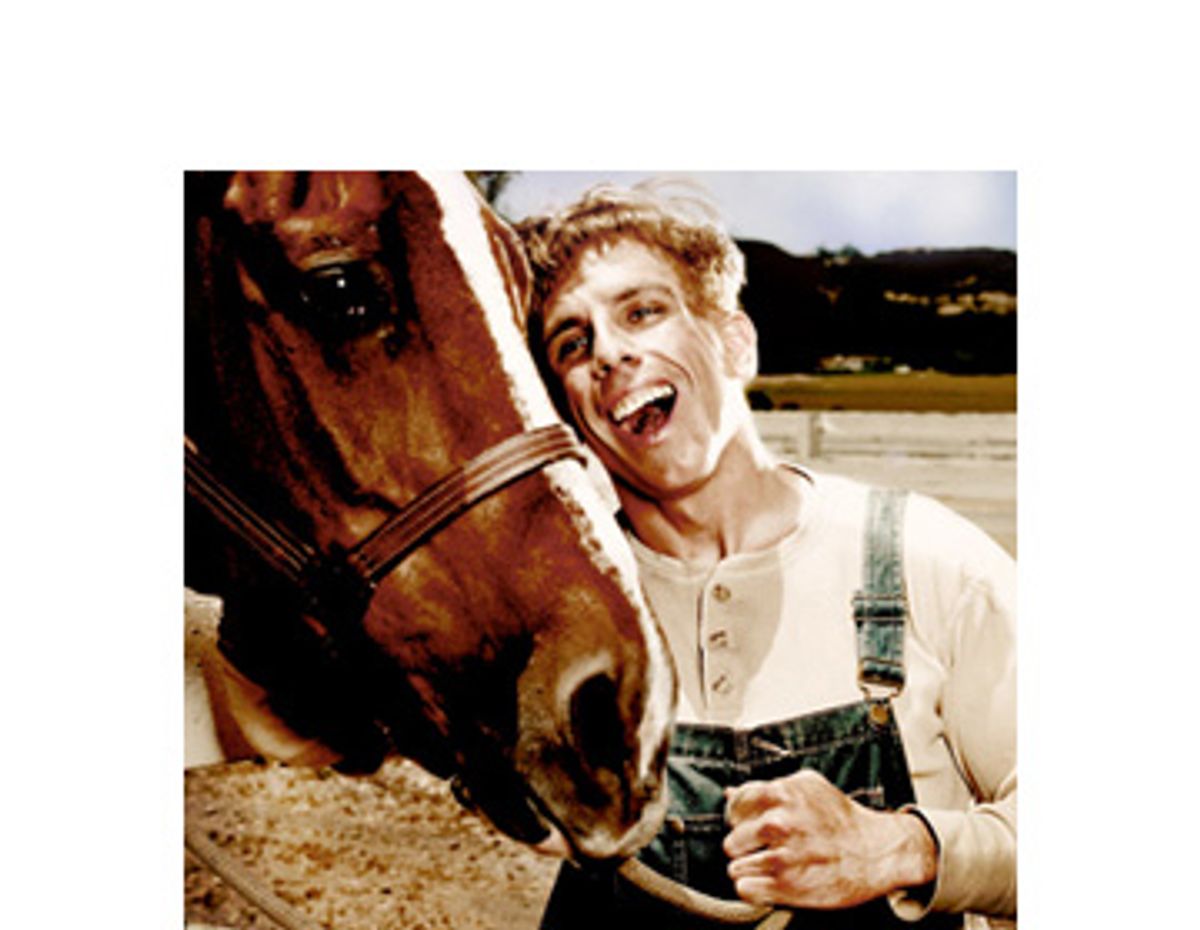
Oh, or if you've read word one about the most recent Stiller-tacular, "Tropic Thunder," whose vast coalition of detractors -- including the Special Olympics, the National Down Syndrome Society and the American Association of People with Disabilities -- are currently leading the "for worse" troops, protesting the use, and use and use of the word "retard" in the movie. The coalition has also objected to the portrayal of the "retard" in question, Simple Jack, played by Stiller's Tugg Speedman in a film-within-a-film, which itself spawned the straight-to-novelty-tee catchphrase of the summer. "You went full retard, man," Robert Downey Jr.'s character -- in blackface -- admonishes a deflated Speedman. "Never go full retard."
The catchphrase factor is part of what has advocates up in arms. Yes, they say, wearily, we know the bit, in context, is satire. (And clearly it is: Not of Simple Jack, but of movies like "I Am Sam" -- that is, of maudlin, "serious," Oscar-bait film portrayals of the intellectually challenged.) But the thing about catchwords, coalition members note, is that they don't stay in context.
"When kids see the movie and then use that word to tease someone -- or call someone 'Simple Jack' -- they're not making fun of Hollywood," says Alex Plank, founder of WrongPlanet.net, a prominent online forum for people with autism and other neurological differences, and a member organization of the "Tropic Thunder" protest coalition. Or, in the words of one blogger whose son has Down syndrome, "When we award tacit acceptance to a term such as 'retard' or 'retarded' in casual conversation -- or worse, when millions of people watch a movie that also awards that tacit acceptance -- it most certainly will gain even more acceptance," she wrote last month. "My son will be going back to school in a couple of weeks. And all around him -- I guarantee it -- kids will be telling other kids not to go 'full retard.' And everyone will think it's OK to say 'retard,' or that this or that is 'retarded.' And my son will walk through the halls, and more people will think of Nick as a 'retard' than did a few months ago. Nick deserves better than that."
But do we need to ban the word entirely? Not necessarily, says Gail Williamson, mother of a working actor with Down syndrome and executive director of the Down Sydrome Association of Los Angeles (which also successfully hounded Fox to pull "Napoleon Dynamite" pens that said, "You guys are retarded"). "But we do have moral and societal guidelines that limit the use of other derogatory words. We're just saying this word needs to be added to that list. It is hate speech."
So it's because of "Tropic Thunder" that the current "hate speech" vs. "irony!" controversy has exploded. But in the broader view of this particular culture war, Stiller & Co. were hardly the first to have dropped the R-bomb. Todd Solondz trivia experts may note that the working title of his 1995 outcast-fest "Welcome to the Dollhouse" reportedly was "Faggots and Retards." And back in 2000, Tina Fey said she had to haggle for permission to use the word on "SNL" -- in a Sully-and-Denise-from-Boston sketch, natch. The final word from NBC's standards and practices division: Yes in late night, no in earlier promos. "The network is very skittish about the word -- and rightfully so," Fey told the New York Observer.
So what's behind the R-word's most recent surge -- in visibility and, depending on where you look, acceptability? And, really, should it go away for good?
As for pinpointing the term's reemergence, there's certain linguistic detective work that just cannot be done. No one can say for sure which cheeky blogger first thought, for instance, "Hmm. 'Idiot'? No. 'Loser'? No, too soft. 'Tool'? Close. But I need something more pungent, more staccato, even more deliberately juvenile. Oh, look, someone from fourth grade just found me on Facebook. Man, I always thought that kid was such a ... [light bulb] RETARD."
But it's not hard to hypothesize about the term's recent proliferation, or its unique descriptive appeal. It is at least a safe bet that -- as feminist blogger Amanda Marcotte suggested to me in a separate analysis of the term "douche bag" -- the full-on deployment of "retard" and (perhaps even more so) "retarded" was at least accelerated in the online snarkosphere, where so many jillions of people complaining about so many jillions of things are, at the end of the day, just going to need some more words. (Cf. "asshat," "douchetard.")
So, then, why "retard"? For one thing, "retard" and "retarded" have that retro, old-skool styling that is not only in vogue but also handy when that puerile, playgroundy connotation is precisely what's needed. Retarded, its fans insist, steps in where, say, "lame" (also an offensive term, if you think about it) leaves off. "I always thought 'retard,' which means slows and pretty in music, was actually a kind of nice way to express the condition. So I'm sorry it got a bad rap," says my friend Dixie, whom I called to find out if the teen TV network where she works would allow the R-word on air. (Answer: No way.) "It got a bad rap precisely because people used the term to mean lame. So now that we don't use it for the developmentally disabled, can we please use it to mean lame, stupid, way stupid? None of these have the punch that retard does. Some things are more than lame. They are retarded. The true essence of a poor, poor decision isn't conveyed well enough with lame. Or with gay, for that matter."
Ah, yes. About "gay." It's also made quite a comeback, from the fourth grade, as an insult -- but not against actual homosexuals. Even if you find that objectionable, there's still a difference. Gays -- unlike "retards" (See? You just can't say that!) -- have been using that term to describe themselves for decades. So the word itself, however you use it, just doesn't have the same thudding impact. And unless I missed them somehow, I haven't heard many murmurs about a radical political strategy to reclaim, à la "queer," the R-word.
In fact, perhaps not surprisingly, things seem to be going in the opposite direction. Just last year, the American Association for Mental Retardation changed its name to the American Association on Intellectual and Developmental Disabilities, on the grounds that, while the term was still useful in certain legal and medical contexts, it had become dated at best, stigmatizing at worst. As one proponent of the name change argued, "It is in the process of dying its own death, of becoming an archaic term as others have before it."
That observation, in a way, bolsters the boosters' central defense: To the degree that "retard" is hate speech, well, we use it to speak of our hate for Paris Hilton. Or people who "go green" ... by private jet. Or certain politicians. Or any display, really, of eye-rolling dumbassery. Not the special-needs kids.
In fact, at least one person very close to the issue says she has no trouble separating the epithet, in this way, from its original meaning. "My sister has Down syndrome and I am most definitely an advocate for her and any developmentally disabled people. That said, I am in no way offended when I hear the word 'retarded,'" says Angelique Uhlmann, 40, a physician in Boston who was not offended by "Tropic Thunder." "In my mind it's just a word. I don't recall people ever calling her that, even, but I do recall people staring at her, mouths agape. That I find much more offensive than a mere word. Looks can kill, as they say."
Ari Ne'eman, an Asperger's autistic who is founding president of the Autistic Self Advocacy Network, isn't buying this argument. "That's like saying, 'I'm not really talking about the Jewish people when I say someone's trying to Jew me out of my money,'" he says. "It's very disingenuous to say this is not about the rights of people with disabilities, because in many ways reality and actions follow terminology. And if we can't reach a point where people with disabilities have the same basic rights to respect in public discourse that any other minority community really demands and is generally afforded, then we're never going to be able to address what is very real and tangible discrimination against people with disabilities." (Discrimination, he says, and even violence, noting that Sen. Joe Biden, Barack Obama's pick for V.P., in 2007 introduced legislation that would, among other things, expand the federal definition of a hate crime to include disability.)
Ne'eman and others maintain that disability is one of the last "acceptable" targets of bigotry. He decries this double standard: "There are people who would never practice bigotry against people of a different skin color or religion but are bigoted in their language or actions against people with disabilities all the time." I'd argue that no one's thrown around "cripple" much since Alexander Haig, but point taken. Plenty of racism has swirled around the Obama campaign, for example, but at least in "distinguished" circles, it has had to come at least a little encoded. We can argue all day about whether a particular, and subtle, turn of phrase, or sleight of Photoshop, or glance was anti-Semitic, or gay-bashing or whatever. But people -- whatever you may make of this -- are going around saying "retard," "retard," "retard," with not a whole lot of frowning in their wake.
Here's how it plays out in my world. The other day an electrician, not a tall guy, arrived at our fourth floor walkup complaining, jokingly, about all the stairs. "It's not easy for me and my midget legs," he said with a grin. Was he actually making fun of my sister-in-law, who is an achondroplastic dwarf? Of course not. Would he have said this to her face? No way. He probably didn't even know that the word "midget" is considered deeply offensive by many people with dwarfism. And yet, I cringed.
Ultimately, anti-"retard" activists are trying to do what I didn't do while that fellow fixed our ceiling fan: Say something. Or at least to get people, perhaps especially people like me -- who found the Simple Jack business hilarious precisely because we're so offended by "respectful" films like "Rain Man," and who are deeply aware of the power of words both to pinpoint and to prick -- to at least think twice about the insult's real-life impact.
"People are comfortable using 'retard' as a dis because in the past no one has stood up and said anything in numbers worth counting. Most marginalized groups come from places of family pride and tradition. They are able to stand strong together out of their heritage and make a statement. But people with intellectual disabilities, scattered through different families, are not part of a celebrated culture," says Williamson, who saw "Tropic Thunder" as equal parts outrage and opportunity. "I think today's high-tech world has finally allowed us to take a stand. Perhaps the word has continued to grow in popularity, since there has been no public pressure against it," she suggests. "Until now."
Shares