

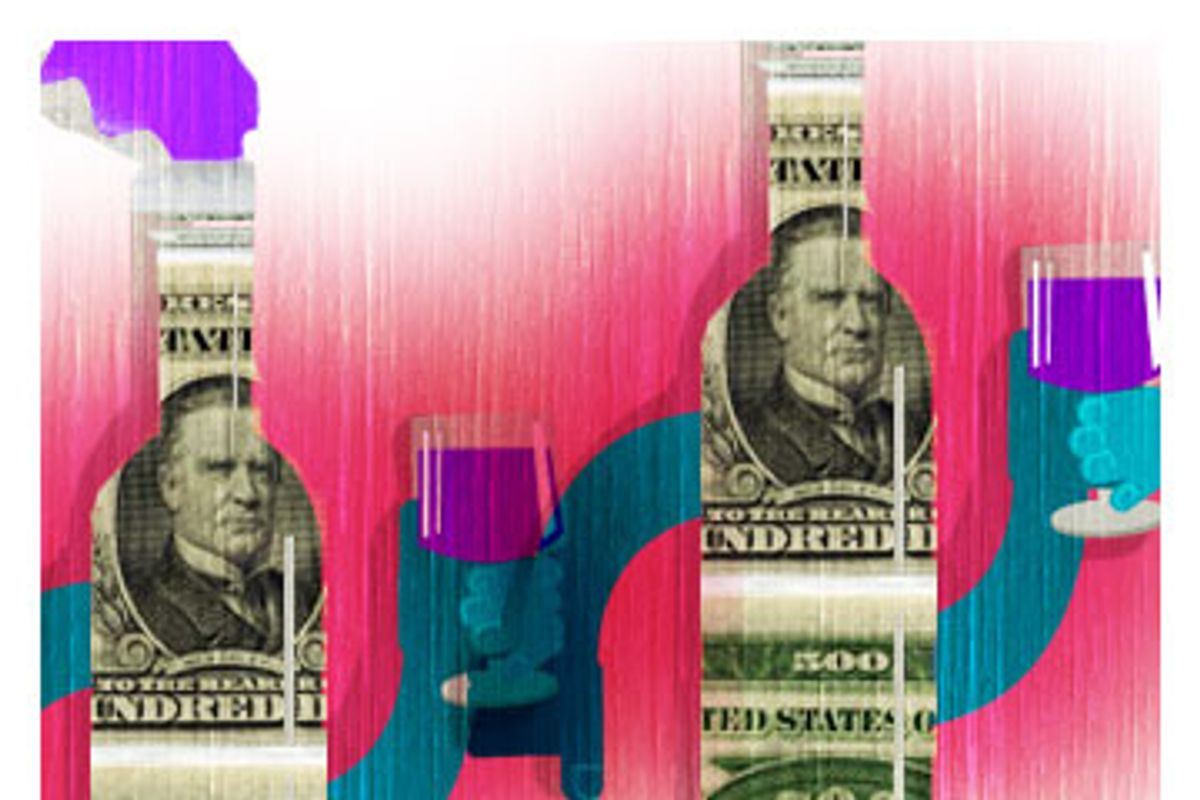
When you find a wine you truly love under 20 bucks you should bow down and give thanks to the gods. Few of us who sip, gurgle and spit for a living -- wine writers, that is -- would disagree with that sage advice from poet-hunter-novelist-wine buff Jim Harrison. Harrison swoons when he finds a saucy inexpensive Bandol rosi that tastes "as soft and pleasant as the back of a girl's knee after a dip in the Mediterranean." If it spawns that kind of moist poetry, I'll take a case. Still, with a few notable exceptions, inexpensive quaffing wines rarely linger in memory. If you're looking for complexity and depth, for the bottomless pleasure offered by a darkly delicious glass of wine, the conventional wisdom goes, you'd better be prepared to lay out some serious green.
In search of unforgettable imbibing experiences, thousands of deep-pocket drinkers are pouring out small and large fortunes to purchase the cult cabernet sauvignons of Napa Valley, Calif., or the reigning French royals of Bordeaux and Burgundy. At $250 to $2,000 a bottle, these wines are made with far more vigilance, in smaller lots, with higher-priced grapes and oak than cheap wines, certainly -- but not necessarily all cheaper wines. There are now many domestic cabernets in the $50-$60 range produced with equal finesse, by winemakers equally fanatical in their approach, from premium hillside fruit that's been coddled, groomed and selected with the same manic zeal, and sorted and barreled with no less love, devotion or expense.
As a result, what these cult-crazed shoppers -- many of them well-heeled collectors -- are buying isn't rarefied wine so much as an object lesson in the fine art of marketing scarcity. It's simple economics: When there's not enough of something to go around, in tandem with a buzz fostered by word-of-mouth and critical acclaim, the intrinsic value of a product becomes less important than its perceived value. That marketing strategy has worked spectacularly well for Harlan Estate, Screaming Eagle and a small handful of other successful producers in Napa who have carefully limited their output in the face of enormous demand. Customers wait months to get onto waiting lists, for a chance to be allocated three or six bottles at most from the few hundred cases of wines each winery produces for their top labels. Acquisition itself becomes the object of desire.
In France, at the very least, money buys a pedigree. A Chateau Lafite Rothschild, Chateau Petrus or a Romanie-Conti enters your cellar trailing several hundred years' worth of dazzling medals, honors and tributes. The rare, coveted Grand Cru or Premier Cru classification, awarded in 1855, is a badge of official recognition that confers nobility as well as celebrity -- and celebrity today translates into mounds of cash. A pre-release 2005 Lafite currently fetches $600 a bottle; an '05 Petrus, $2,000 -- and these wines won't arrive on your doorstep for another two years, or start drinking well for another six or seven years after that. You may not savor their more austere, less fruit-forward style. Still, if you know wines even a little, your senses assure you these are not impostors to the throne. A few sniffs of their French barnyard bouquets tell you they stink in all the right ways.
But what to make of their American counterparts, the parvenus, the upstarts from Napa Valley? With no entrenched classification system to bolster their prestige, and no promise of success based on a lengthy history of high scores for past releases, many wannabe cult cab producers make up the rules as they go along. After actor Martin Sheen suffered a massive heart attack while filming "Apocalypse Now," Francis Ford Coppola screamed at his studio bosses, "Marty's not dead until I say he's dead!" By that same exotic logic, anointing your California wine a Premier Cru, or First Growth, should be enough to confirm its exalted status.
But does it? Consider Harlan Estate on the western border of Oakville in Napa, a celebrated producer of cult cabernet sauvignon, and Chalk Hill Estate, in the northeastern Alexander Valley area of Sonoma. A single bottle of 2001 Harlan Estate currently sells at auction for $400 at Sotheby's in New York, and for $698 at Wine Cask in San Francisco. A bottle of 2003 Chalk Hill cabernet, which won a 94 (out of 100) score from Wine Enthusiast, sells for $59.99.
Not that anyone at Harlan is trying to pull a fast one. Winemaker Bob Levy and general manager Don Weaver send crews out into their hillside vineyards with a single mission: search and destroy. In the trade it's called dropping fruit. To you and me it's pure Darwinism. They cut off any cluster of grapes that might produce inferior wine by virtue of being under-ripe, unevenly ripe, over-ripe, sunburned or somehow anemic. Only the fittest survive, less than half the clusters, and only the fittest of those highly flavored grapes go into the limited bottling of Harlan Estate cabernet. "We separate the sheep from the goats," says Weaver. The goats go into the cheap stuff, Harlan's second label, the Maiden -- which sells at about $100 a bottle.
All that effort, Weaver adds, is in the service of making wine that faithfully expresses the Harlan site as a distinct location producing a distinct flavor profile. When San Francisco real estate developer Bill Harlan purchased 240 acres of forested hillside in western Oakville in 1984 and carved out his vineyards, he had one goal in mind: to make cabernet that would rival Premier Cru Bordeaux. He cleared and planted, and waited 12 years before he was willing to market a wine with the polish and density he sought. Parker gave the first Harlan Estate 1996 release a 92 score, and told his readers to "mortgage the farm" for the 2002, at $300 a bottle. That vintage now retails between $745 and $910.
Weaver and Levy, along with winemakers at most other cult wineries, shower visitors with elaborate tales of their obsessive, meticulous care and handling of the grapes they grow and ferment. Legions of workers line their conveyor belts at harvest time for hours at a stretch, they are quick to report, picking off every speck of stem, leaf or any other debris that could attach itself to the fragile claret orbs.
Pampered, cosseted and groomed, the cabernet berries are hand-pruned and hand-sorted; they rest in micro-lot fermentation tanks -- bridal suites -- inside multimillion-dollar wineries, some with state-of-the-art air circulation systems, until they get ever-so-gently pressed and liquefied. Then they sleep in only the most costly fine-grained white French oak while being analyzed -- and often manipulated -- by teams of chemists, tasters and specialists whose singular mission is to bend nature to their whim to produce lush, ripe-fruit wines with low tannins and no sharp edges.
Chalk Hill, on the other side of the mountain from Harlan, is hardly the Wal-Mart of the wine world, but like hundreds of other Napa and Sonoma wineries, every year it cranks out about 5,000 cases of cabernet sauvignon along with other varieties, fights for shelf space, and isn't in business to service the rich and famous. As such, you might expect its winemaker Steven Leveque to take a slightly more relaxed approach. Not at all. "I have an unrelenting passion for detail," he explains. Patrolling his cabernet vines day and night with vineyard manager Mark Lingenfelder, Leveque cuts off, or drops, more than 60 percent of his fruit to extract as much flavor, tannic balance and ripeness as possible. Clusters fall like soldiers on a battlefield for the greater cause. Leveque doesn't want any two to be close enough to touch, since by rubbing shoulders, he explains, the clusters might block out each other's filtered light and prevent full, even ripeness. Crews pull off leaves by hand.
The work is exhausting, time-consuming, expensive -- and it's only just begun. Once harvested -- with no less rigor than at Harlan Estate -- these selected grapes are hand-sorted with agonizing patience as they slide along the conveyor belt on their way to being gently crushed and de-stemmed. After that, Leveque cold soaks (that is, adds dry ice) to his crushed berries to slow down fermentation and bolster flavor -- an expensive process that is rarely done for this grape variety.
"My goal is simply to nail it every time," Leveque confides. He works closely at Chalk Hill with the world's foremost wine consultant, Michel Rolland, for owners Fred and Peggy Furth. And they proudly put their signatures on the label of every bottle.
- - - - - - - - - - - -
If it's not fanatical diligence and winemaking expertise that distinguishes the most sought-after wines, then what does? Location, you might guess. But while cabernets from the chalky soils of northeastern Sonoma have a substantially different flavor profile from those grown in Oakville, for example, or from the fabled Rutherford Bench, or the eastern slopes of Napa -- when all outlays are accounted for, hand-crafted, premium-quality cabernet sauvignon comes at about the same cost, no matter who makes it, or what it sells for.
Rob Morris, a senior manager for MFK Wine Business Advisors in St. Helena, itemized every expense from grape purchase to barreling and packaging to sales and marketing for a representative hand-crafted premium domestic cabernet in a recent San Francisco Chronicle article by Linda Murphy. The bottom line: $27 a bottle. "Our margins at Chalk Hill," says Leveque, "are grossly low."
But that's often not the case at cult wineries, where critical acclaim from precisely the right sources is essential to developing an elite reputation. Manipulated exclusivity might drive up the price -- but only after demand has been created. And demand takes an investment of time and money.
The woman credited with starting this fine madness, however, did it all with just a little bit of luck, and plenty of native smarts. In 1986, aviator Jeanne Phillips purchased 60 acres on the eastern slopes of Oakville, off the Silverado Trail. She tore out the Riesling vines, planted cabernet, and for her new winery's name, borrowed a pilot's term for open cockpit flying -- Screaming Eagle, so called for the way you look with a 200-mph wind pushing your lips back behind your ears.
"Go with the pitch," was Phillips' motto when piloting her Super Cub. "Go with what you're given." She applied that same flight plan to her grapes. To make sure they went as far as possible in the right direction and landed without incident in her crusher-de-stemmer, she hired a young woman with wine in her blood, Heidi Patterson Barrett, as her winemaker. Heidi's dad had replaced the legendary Andre Tchelistcheff as winemaker at Beaulieu Vineyard, and Barrett had spent much of her youth helping him manage its wine cellar.
Along the way, Barrett developed one of the most respected palates in Napa Valley. "My dad was really intuitive," she says, "and so am I." Barrett's goal was to make a wine that flunked basic math. "I wanted two plus two to equal five. I wanted to make a wine that knocked your socks off, that thrilled you with its delicious qualities when you put the modestly interesting components together. "
To that end, she roamed Phillips' vineyards and became attuned to the subtlest shifts in temperatures and topography. She knew a slight swale or hill rise produced a different weather pattern that produced crucial variations of flavor. In Europe it's said that the finest wine grapes grow in the shadow of the winemaker. Heidi, out among her vines day and night, cast a long shadow.
Screaming Eagle released its first cabernet in 1992, at $75 a bottle, and gave many of its 225 cases away for free to industry friends and local tasting groups in the valley. Praised for its amazing purity and rich style, the wine kept winning blind tastings. Friends told friends, and when Robert Parker Jr. tasted Screaming Eagle, he told his vinophile readers, many of them rich collectors, that he'd discovered perfection. Parker, the most influential wine critic on the planet -- the most influential critic of anything -- awarded Barrett's wine an astronomical 99 points on his 100-point scale. With that, a cult was born.
At the Napa Valley Auction in 2000, a bidder paid $500,000 for six liters of the 1992 vintage.
That's how these things start -- but that's not how they stay. Uniformity matters. A Parker 99 one year, followed by an 89 the next, is an express ticket to TwoBuckChuckville. (Wine Spectator and, to a lesser extent, Wine Enthusiast scores matter, too, for serious collectors.) If you cut your retail price to reflect your lousy new score, you've just announced that you made a lousy new wine. If you don't -- and nobody does -- you risk losing your audience fast.
It's consistency that has kept cult favorites like Screaming Eagle and Harlan Estate at the top of the heap. Over the past 14 years, Barrett has been able to match the public's perception of greatness with uniform vintages that deliver a singular, recognizable style, or cult character. Whether a bottle comes from Harlan or Colgin Cellars or Araujo Estate, a cult wine's character is remarkably similar from one successful producer to another. The style is like being hugged by a friendly bear: You feel the warmth, the weight, and you're not going anywhere for a while -- so you might as well sit back and enjoy the experience.
Stefan Blicker, co-owner of Blicker-Pierce Wine Merchants in St. Helena, specializes in buying and selling rare wines. Blicker has tasted through dozens of cult vintages. "They emphasize fruit, sexy tannin and mouth feel," he says. "They're drinkable at any stage in their life, not like the top Bordeaux. Those wines are completely shut down, they give no pleasure before 10 years. They say, 'Don't bother me, I'll call you when I'm ready!' But the Napa cults are generally fleshier, fatter."
That's where it gets dicey for a winemaker. At present there are three winery superstars: Barrett, Phillip Melka and Bob Levy at Harlan, and one in the vineyards, Davis Abreu. All attempt to make wine that feels massive in the mouth -- worth every nickel -- but not cloying. The wine should announce its elevated status by sending waves of fruit over your palate, ripe dark succulent fruit like cassis with hints of chocolate -- but not appear to emphasize flavor at the expense of complexity.
The term for capturing the essence of place -- the specific soil, microclimate and related conditions of a wine's origins -- is "terroir." No other buzzword gets bandied about in wine country with more intensity, conviction -- or with less precision. At best terroir is adroit alchemy. Yet nothing guarantees that good dirt, perfect drainage, ideal diurnal temperatures, cooling fog, an ex-dot-com millionaire's extravagance or his highly paid winemaker's ingenuity will ensure success, as many failed cult producers have learned in the past decade.
The ones that succeed win consistent Parker scores that create an active secondary market for their select releases, one tailor-made for scalping. You can't get on a direct-sale mailing list at Harlan or Screaming Eagle for years. When you do, your allocation is limited to three to six bottles annually. Money manager Charles Banks bought Screaming Eagle from Phillips last March, promptly fired Barrett after publicly vowing to keep her on based on her extraordinary track record, and raised the going rate to $1,500 for a three-pack of his latest vintage. And so it goes.
If you buy and collect these wines on the secondary market, there's a good chance you'll never drink them. You're probably investing, weighing the odds that your vintage will appreciate so that you can turn the vintage over for a profit -- or at the very least, show it off.
- - - - - - - - - - - -
Me, I collect rubber duckies and pop my corks. Wine is to drink. Pork bellies are to invest in. That Harlan Estate 2000, for instance. I put it into a blind tasting against three other cabs, ranging from $16.99 to $60 a bottle, and invited over two commercial winemaking friends. We tasted and ranked them. Impatient readers can scroll to the end for our scores and notes now. But you'll miss the reason I included the $16.99: I made that choice after chatting up noted wine writer Dan Berger about cult favorites -- and Berger launched into an impassioned, extended monologue on their fundamental deficiencies.
"They represent a parody of fine wine," he told me, just warming up. "They represent somebody's notion of what a wine should taste like if it costs $200 to $400 a bottle. Those wines are overly alcoholic, brazenly flavored. My problem is that I'm old enough to remember the true character of Napa cab, as it once was. That cab had distinctive herbal components that have been manipulated out of these wines. The cult winemakers are terrified of anything that might be considered green. So what you get are heavy fruit wines. They're exhausting; there's not enough acid in them for balance, to accompany food. I defy anyone to find a wine with more true cab character than a Wynn Australian 2002 Coonawarra I had recently. Its price just jumped to $16.99. You show me a cult wine with more true varietal definition, I'll give you $100."
I wouldn't take Dan's money, but I'd take his passion anytime. In his honor, I had two bottles of the Wynn 2002 Coonawarra -- Cab grown north of Melborne -- sent to me for our blind tasting. They got lost en route, and arrived by courier only 10 minutes before the blind tasting began. Wine doesn't like to travel; it often tastes edgy until it settles down for a week, so it was perhaps an unfair test.
Still, I put it up against the Harlan 2000 -- not ranked as one of its superior vintages, but that's the bottle the winery gave me -- a Kuleto Estate 2001 from the Hennessey Basin on the eastern edge of the Napa Valley ($60) and a Stonefly 2001 Napa cab ($30). I chose the Kuleto and Stonefly for their relative anonymity. They're just, well, typical Napa red wines at their retail price levels. All cab, no cult.
The panel I'd assembled made notes on all the usual suspects -- aroma and appearance, flavor, texture, acid balance. None of us have any truck with the traditional solemnity of wine-tasting sessions; we laughed, swapped jibes as we sipped and spit, finally ranking our four wines in preference, then revealing our scores. Peeling off the aluminum foil I'd wrapped around the bottles to preserve their anonymity, we discovered we'd all correctly identified the Harlan Estate. Its rich chocolate, lush cassis flavors and warm plummy aroma marked it as a wine that had been expertly massaged to deliver a formidable sensation of suave depth. What it lacked, to us, was dimension. "It's artificially refined," one of my tasting buddies, winemaker Paul Nichols, remarked. Stefan Blicker, fine wine merchant and passionate cabernet enthusiast, would probably disagree. He thinks that the Harlan Estate cabs are more complex than other cults. "I often get pencil shavings and underbrush," he says. (Who else but us whacked-out wine buffs would consider a Dixon No. 2 Ticonderoga and, for that matter, cat pee and road tar to be desirable traits in a beverage?)
The unanimous favorite turned out to be the Kuleto Estate. Bright fruit, cedar, herbs and a long lingering finish: "Delicious," we said, lifting our glasses in praise.
The Wynn Coonawarra? "Dark cherry, with a hint of celery." We ranked it a close third, just behind the Harlan. The Stonefly, with bitter tannins, came in last.
By common sense, even the highest-scoring Napa cult cabs aren't worth four or five times more than a Kuleto Estate, the 2003 Chalk Hill, or at least a dozen others in the $50-$60 price range. The best cults, in the best years, may be impressive -- opulent, thick and infinitely generous even with the higher alcohol levels that result from extended ripening achieved by longer hang time for the grapes. But still, they're likely to be polished to such a gleam that they fail to reveal those tantalizing, elusive facets that glint beneath the surface, those prismatic recesses of taste and scent that surprise and delight.
That's a lot to ask for, yes, but a cult wine is a lot to pay for, too. What they could all benefit from is a touch of humility. "It's a naive domestic Burgundy without any breeding," the wry James Thurber once observed about a wine he admired, "but I think you'll be amused by its presumption. "
I'm amused by the presumption of cult wines, but then I laugh out loud when George W. tries to sound presidential, too, so trust me at your risk. Instead, trust Alder Yarrow's reviews on his entertaining, shrewd and informative Vinography blog or a wine aficionado friend to steer you to a noble $50-$60 domestic cabernet for a rewarding indulgence, and while you're at the store buy another one and sock it away for a few years.
Once those delicious berry flavors scoot across your tongue and come to a soft landing you'll be perfectly positioned to explore the larger truths revealed by the cult wine phenomenon -- and if the wine's really doing its work, you'll be way too pleasantly distracted to care.
Shares