There are people -- and as much as I'd like to distance myself from them, I once counted myself among them -- who think that just because they have a stove and a good recipe for duck they can open a restaurant. Because it's "only cooking," any hardworking, dedicated person could do it. What seems effortless -- you in the kitchen spooning reduced cider sauce over confited duck leg while your spouse hustles the front, overseeing the dining room with a warm touch and a glass of cabernet, just like the dinner parties you've been throwing in your apartment for ten years -- is not. The difference between being a good cook and being a good chef is as big as the difference between playing online Texas Hold'Em in your pajamas and holding a chair in the World Series of Poker.
When I first opened my restaurant, I improvised everything. Other than having an iron-clad work ethic and a certain compulsion for cleanliness, list making, and straightforward food, I did not know what I was doing. I ran out of items too early, too often. I drank wine during service. I sent incomplete orders out to tables making the last diner sit empty handed. I didn't really have the hang of the language of the line and would expedite tickets without phrasing them: calling out one giant, unpunctuated recitation of orders with no regard for their coursing, timing, or pick up. Worse, I would arrive in the morning and change the entire menu, without warning, for that evening. I did not rehearse, or plot or spend months in the laboratory testing new items until I got them just so. I did not research an ingredient and its best technique so that I fully understood it from all sides. I did not prepare my kitchen staff, and I most certainly failed to warn the floor staff, who had less idea about what they were serving than we had about what we were cooking.
I can assure you, several years later, that not everyone works this way. In fact, no one credible works this way and this is not at all how professional kitchens are run. I can also confirm that this amateurism can really piss some people off. Maybe it especially pisses off landlocked midwesterners who like to see something coming -- like a coastal tornado or the chocolate martini trend -- from a long way off and who like to hunker down and get prepared for it, or possibly it's people born under water signs in particular, I can't say for sure but I am certain that my sous chef, A., was pissed.
She was from Nebraska, at any rate, possibly a Pisces, and she was -- emphatically -- not a spontaneous kind of girl. She preferred a life lived close to the ground, on all fours, ears cocked and cold wet nose quivering to sniff out dangers, predators, and treacheries such as the peril posed by your chef breezing in at ten a.m. with a deli coffee in hand, a bright, fangy smile, and an entire new menu to be ready by six pm.
This concept was received with as much joy and "can-do" excitement as if I had proposed that she and I eat glass.
She, however, had actually run kitchens before and worked in real professional restaurants with pedigrees and French terms and she had been to cooking school. She had not spent the past twenty years, as I had, in shitty tourist restaurants where everyone just added cheese, curly parsley, and an orange half-moon to the plate to make it look better, or working for shitty catering companies where some poor bride's wedding food sat in the back of a cargo van, leaking onto the floor mingling with diesel fumes and the voices of five gay cater waiters sitting on buckets of "demi-glace" singing show tunes, while we drove out to the Hamptons.
No, A. had been diligently building her risumi because she wanted to be in this industry. She was the real deal, and I was lucky to have her. She had method, strategy, precision. My impulse to change the menu on a whim, like a gambler at the blackjack table asking to be hit in spite of eighteen showing, was an assault to her demeanor, training, and professionalism. Walking into a room of chaos and reining it in, my former preferred way of "rocking, dude," to show how competent I was, how durable under whatever circumstance, how willing and able I was to hump it, huff it, tough it out, bang it out (and then retire as soon as possible to the greasy mats outside by the dumpsters to smoke filterless cigarettes with the guys, K-Rock blaring out the screen door), was the equivalent of poking the dog with a stick until, at last, she's baring her incisors. While there are people who thrive on this kind of challenge, A. was not one of them.
She spent the day with the hackles up on the back of her neck, her low shallow breathing like the treble throaty growling of a dog who smells danger out in the black wilderness just beyond the campfire. She was the woman who put all kinds of order into this mayhem I called a restaurant in the first months. She scripted every improvised piece of this show we put on each night. She chased the butcher down when his meat came in too fatty. She put a prep schedule together that made us never run out of any item at any time. She coached us all in the language of the line: Order only! Order and fire! Picking up! All day! She permitted me some wine during service but dragged her finger across her throat as a signal to the bartender when I tried for a lemondrop shot.
- - - - - - - - - - - -
Warm, fried fava beans with a perfectly-cooked artichoke heart, salted. I thought it sounded delicious. But when I arrived with my notes and my prep list for the day and my freshly written menu, eager to try out my new ideas, I was received rather icily by A. It was not the usual convivial day of prep that we had come to enjoy. The amiable chopping and chatting and stirring the broth and having a spoonful of each thing to taste for salt or heat or body or acid had a very cool breeze blowing through it.
We had to be separated, in fact. I prepped in the basement on a stainless-steel table, singing along with the radio set on the golden oldies station, while she grimly prepped upstairs on the line. A. needed silence the way a lost driver needs the radio turned off and everyone in the back seat to halt all chatter until they find their exit.
As the hours passed and the waitstaff started to arrive, an impending sense of disaster began to poison the room. Not only was A. pissed off, but I, ever mature, became pissed back at her. What was her problem? I asked myself. Where was her positive attitude? I wondered. Glibly dismissing my part in bringing her mood down to subzero, failing to understand that if I had suggested a new menu a week in advance, begun to test it on Monday, and maybe run it by the following Friday I would have had a much more pleasant, even cheerful, experience. Instead, I just thought she was being a big downer. Now I know better and I follow the latter scenario; but at the beginning, I just threw all of us onto the fire thinking: I can cook, you can cook, so let's cook.
But I'm also the one who thought soaking the dried fava beans in warm water would soften them enough that when fried, they would still have a starchy satisfying interior with a crispy delicious fried exterior. Of course, I had never tried it out beforehand, but it just sounded logical to me. I remembered eating fried fava beans in Turkey when I was a backpacking teenager, and though I had no idea how to cook them, I relied on my intuition. Since the prep day had gotten away from us, I hadn't had a chance to test all of the dishes before service started, and as the fava beans seemed simple, I'd played triage with them. There had been so much to do all day and such unfamiliarity in doing it that we didn't even manage a family meal that night, which meant that each server had to approach her tables all night not only bluffing her game but doing so on an empty stomach. This fava bean and artichoke item, naturally, came in on the first ticket of the evening, submitted by a leery waitress keeping her distance from the uncharacteristically frosty kitchen where A. and I were silently and bitterly finishing the last set-up of our stations.
My kitchen is the size of your bathroom. It has been described as one of the smallest kitchens in New York City. I am not exaggerating to be funny. It is tiny, and we generate an astonishing quantity of food out of this very small space. A large part of the way it works is that the two people working the line are very tuned into each other at all times and do "the kitchen ballet" in such concert and harmony that Balanchine would be proud. Your knees are always up against your work station, your towel is always in your hand, your cutting board is always wiped clean and free of debris, your tasting spoon is always in your bain of clean water. You never ever stand with one arm akimbo or one leg casually out, you never leave anything extraneous on the counter taking up valuable real estate, and most important, you don't move -- ever -- without announcing it: "I'm behind you. Behind you, hot! Opening oven door! Open oven! Coming around! Coming around, hot!"
To work in this space, you have to talk a lot. You must constantly communicate, so that no one gets hurt. Because it's all fun and games until somebody gets, you know, their eye poked out.
But A. and I were not really talking on this evening. We were quickly in the weeds, reading tickets and cooking food that we had never seen before nor picked up on the line. One great part about learning your station is when you can do it on autopilot: as soon as you hear "lamb" your left hand moves to open the drawer that the lamb is in or pulls down the pan that the lamb is cooked in. You can be doing six other things but when a menu is internalized, your body can execute the food without your mind consciously thinking about it. Your eye registers the plate of mackerel in front of you and your arm automatically reaches over for the smoked almond vinaigrette to finish the plate -- with no conscious thought process.
A new menu fucks everything up. You don't know automatically what goes with what -- you have to read the notes you've taped up on your reach-in door. The pickup is the protocol or flight plan for a finished dish. It tells the cook what steps to follow and in what order. It's the map we follow to get to the plate. Does the duck leg go in a sauti pan on the stove top or on a sizzle plate in the oven? Do I reduce my cider sauce to order or keep a bain of it warm in my station for an easy ladleful at the finish? This can be complicated at the beginning, with ten or fifteen new items, all with their own unique pickup. Especially if you are not the person who conceived the dish or the menu. I, at least, had been mulling this stuff over in my mind for a few weeks and so had a decent mental picture of the pickup as well as the finished look of each item. A. was flying totally by instruments, no sense memory to guide her. It was grueling. And made no less so by having had to prep all day with so much adrenaline and urgency. When you are starting from scratch, there's a lot more to do, and by the beginning of our first seating -- of what would become a long night of service -- we were already exhausted.
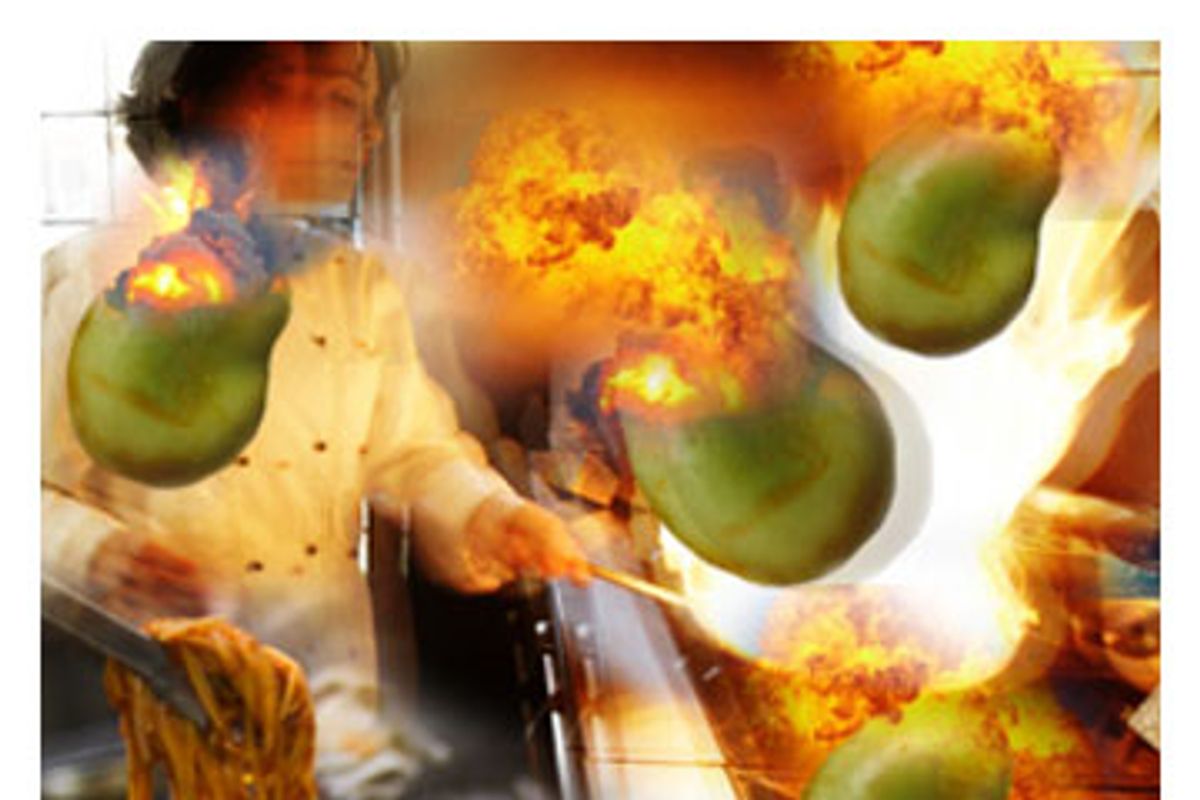
So we weren't talking, and the atmosphere was thick and bitter and I hated A. and she hated me and I started to fry my first batch of fava beans for our first order. Wet beans in deep fat -- wet anything in deep fat -- make a raucous boil. I had, surprisingly, anticipated that; I'd experienced water in hot oil before. But what I didn't realize is that the skins of the beans would burst when submerged in the fat, sending hot globules of fryer fat streaking through the air like sizzling missiles. There were somewhere between fifteen and twenty-five beans per order and 75 percent of them burst in the fat. First came a raucous crackling roiling in the fryer -- exactly the sound of great sudden applause. I took a grandstanding Olympic bow to get A. to laugh but she was having none of it -- and just then whistling, hot fat bombs began flying through the air, stinging us in the neck, the cheeks, the hairline. To call this painful is obviously an understatement. It was stupidly painful and more than dangerous. One of those in the eye and it really would have been an end to the fun and games.
This is when A. started to throw things. A sauti pan flung into the dish station. An empty quart container hurled into the recycling bin. She would come around to plate without warning, and if my arm happened to be in the way of her hot sauti pan, then the resulting corporal's stripe of punishing burn on my forearm was my own concern. A simple "I'm thinking about changing the menu next week and here are my menu items" would have gotten me the customary courtesy of a "Coming around, hot!" but on this night, any bare skin I had -- and any utensil, sizzle plate, pot or pan, whatever the implement of "I'll get you back for this, bitch" -- was fair retributive game.
When you are in the planning stages of your new restaurant, fantasizing about how great it will be to own your own little place and cook delicious food in a warm atmosphere of great congeniality and fraternity, this kind of scene doesn't come up. I kept my head down and my tail between my legs and worked as fast and hard as I could to just keep the food coming and the new menu running. Of course, the artichoke heart with fried fava beans turned out to be the hit of the evening -- one on every ticket! -- giving me ample opportunity to learn my lesson, to really internalize my mistake. I vowed to apologize to A. in the morning, at length, and thank her for teaching me how to not change a menu.
But that, unfortunately, was not to be the simple end of it. Deep in the middle of the eight p.m. rush, while we were ducking fat bullets flying through the already thick air and squinting so as not to get one in the eyeball, A. looked up and out into the dining room and said, "Holy shit, is that Mario Batali at the bar?"
I froze and, with disbelief, followed her gaze. There in fact was Mario Batali eating at Prune for the first time. Suddenly I saw all my new menu items with different and appreciably less confident and permissive eyes, and felt sunken, embarrassed, and ashamed. It's one thing to go along glibly thinking up some food ideas, but is that what you want to present -- untested! -- to a serious eater, a person who is hugely knowledgeable and discerning, someone who will definitely know the difference between good enough and excellent?
I didn't have any idea where Prune was going when we opened. I didn't know that chefs would eat here and cooks and serious food lovers who were savvy and well traveled. In the very beginning, I banked on the adequate palate of the average diner -- and often took advantage of the fact that, for the most part, most people can't tell the difference. My husband, for example, thinks the turkey spinach pesto tortilla "wrap" that he eats for lunch at the hospital where he works is "delicious" but he also thinks the monkfish liver with warm buttered toast at Prune is "delicious" and so he really can't discern between delicious and delishusssss. I think most customers are like this. The problem is that a lot of cooks and chefs and restaurant folks eat at Prune and you don't want to show them your decent pair of eights. You want to kill them with your straight flush.
That night ended, mercifully, and neither of us lost an eye or suffered any other injury. Mario nodded to us encouragingly, paid, and left. We fed the staff a midnight meal. And A., after we had cleaned up, generously joined me in a well-earned lemondrop shot at the bar.
I have seen a lot of chefs refuse to be humbled by their staffs, refuse to learn from their mistakes, refuse even to consider that they are mistaken, but I do not count myself among them. I am grateful to have learned from A. -- albeit the hard way -- how not to introduce a new menu, and how to take good care of my cooks and the people working for me. I also am glad, in the end, that Mario was in the house that night, as it made it crystal clear to me that every night matters, that it's amateur to hope no one will notice.
It's the difference, I discovered, between being a cook and being a real chef. Which I learned by trying to fry wet fava beans.
Shares