

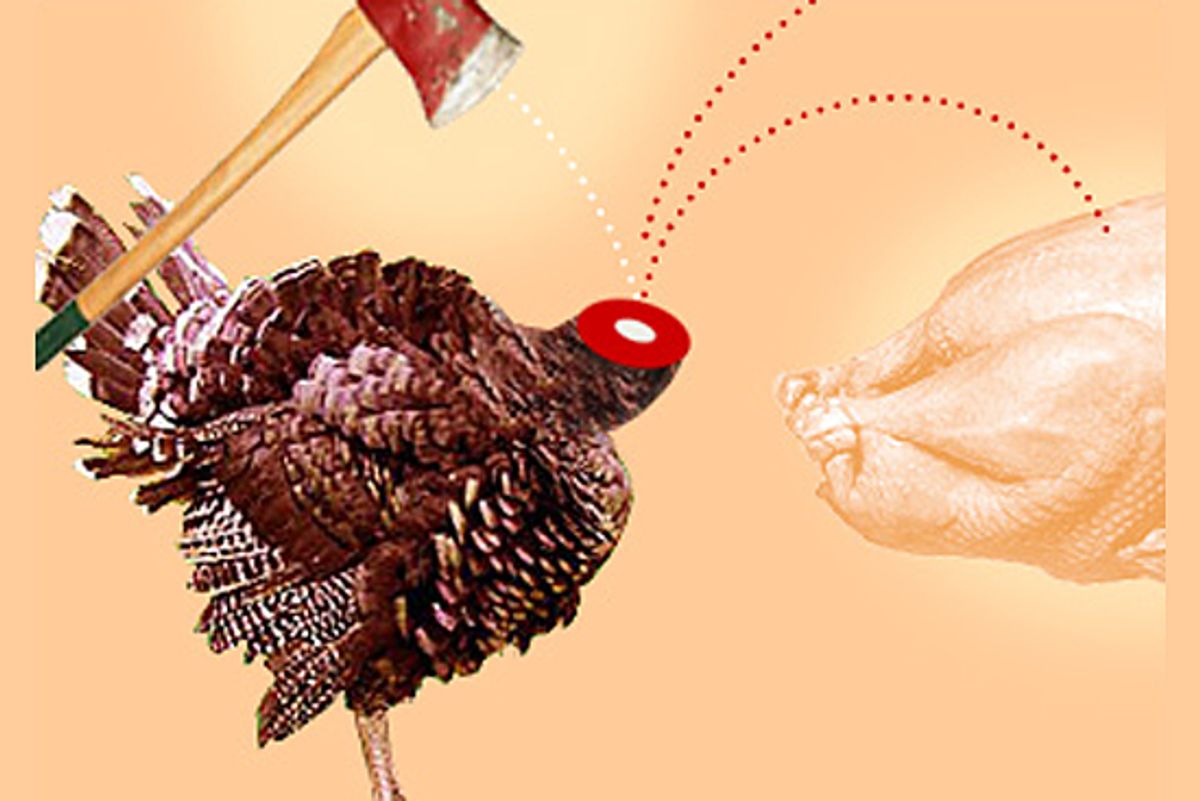
Harold came to me in a box that peeped when I opened it. Just three nights earlier, acting on a tip from a fellow urban farmer, I'd clicked on Murray McMurray, an online specialty hatchery, and well past midnight browsed the feathered fare. Should I order a flock of Toulouse geese? Some Chinese ringneck pheasants? My mouth watered at the thought of home-grown foie gras and as I imagined a medieval-themed dinner party. But in the end, good old-fashioned American pragmatism won out and I sprung for what the catalog called the Homesteaders Delight -- two turkeys, two ducks, two geese and 10 chickens.
When they arrived on my doorstep in Oakland, Calif., after 24 hours en route from Iowa, the chicks were thirsty. The turkeys looked like chickens, only bigger and with a pucker of skin on top of their heads called a pre-wattle. The unpacking over, I dipped each baby bird into a dish of water; they tilted their heads back to swallow, then squirmed for more. It took the turkeys three dunkings before they got the hang of it. Then they waddled over and joined the fluffy pile that had formed under the warming light -- called a brooder -- which I'd prepared for them. Soft and downy, they looked more like sleeping kittens than chickens.
As the weeks went on, I taught the flock to eat, cleaned their crusty butts with Q-tips, fed them greens cut into a chiffonade, carted them out to the garden to get sunshine, caught pill bugs for their afternoon snacks, and moved them into a chicken house we'd prepared from old shipping pallets and chicken wire.
- - - - - - - - - - - -
Like many people who came of age in the 1980s adoring Michael Stipe, Robert Smith and Morrissey, I dabbled in vegetarianism and saw food choice as the ultimate political statement. But lately, with glossy charcuterie cookbooks crowding bookshelves and fashionable restaurant menus chock full of organ meat, I've found some of my old veggie friends embracing sausage and sweetbreads. Now, despite a vocal minority of die-hard vegetarians and vegans, it's carnivores who are chic. Indeed, vegetarianism is still a decidedly fringe food preference: According to a 2006 poll by the Vegetarian Resource Group, only 2.3 percent of the U.S. population are true vegetarians. A similar poll done by VRG in 1999 ferreted out a significant chunk of the population -- almost 9 percent -- who considered themselves "almost vegetarian," meaning that they answer yes when asked if they are vegetarians, but still consume meat, poultry and fish on the sly. People may like to be called vegetarians, but living like one is another matter.
Recently, a number of high-profile foodies -- the most famous being Michael Pollan, author of "The Omnivore's Dilemma" -- have taken a renewed interest in animal husbandry and the art of butchering. My own conversion to carnivorism came with a realization that I could eat grass-fed beef guilt-free. My rationalization went like this: The sun grows the grass, which feeds the cattle, which then feed us. But I hadn't forgotten the PETA videos from my former life. The wheezing pigs; the live chicks piled on top of each other in dumpsters; workers slitting the throats of hanging turkeys, again and again, as casually as turning a page in a book. Part of me still felt that meat, no matter how it was raised, was murder. I thought: If couldn't kill something myself, I shouldn't be eating it. I decided I needed to face my inner killer.
Some things you should know about me: When I vacationed in France, I smuggled home a Corsican sheep's milk cheese that was aged in a goat's stomach and rolled in hand-picked native herbs. I grow heirloom seeds from the Seed Savers catalog -- if my tomato varietals aren't at least 100 years old, I'm not happy. I'm not proud of this persnickety mania, but it may help explain why, for my first kill, I chose to raise rare heritage-breed turkeys.
Heritage breeds include Narragansetts, Royal Palms and Bourbon Reds, all of which can be traced back along a lineage of domesticated turkeys that were crossed with wild American turkeys in the late 1700s. In order to be deemed a heritage breed, the birds must have made the American Poultry Association's "standard of perfection" list in 1874. Today there are only 5,300 heritage turkeys raised commercially, according to the American Livestock Breeds Conservancy.
Harold was a Heritage Bronze -- a mammoth black feathered bird with spots of white on his tail feathers and a blue head that turned red when provoked. His companion, Maude, was petite and lovely, a Royal Palm with alternating white and black feathers like an exquisite, houndstooth jacket.
A heritage turkey is nothing like the bloated, par-frozen beach balls you find at the local mega-mart. Those turkeys, of which there are 270 million, tend to be from one milquetoast variety: the Large White. First introduced in the 1950s, the birds are ideal for industrial production because they grow extremely fast, reaching maturity in less than three months. Sadly, this rapid growth -- and the over-plump breasts and grotesquely large thighs that result from it -- prohibit natural mating. My Harold and Maude, on the other hand, were natural as heck. The fact that they could mate -- and they seemed to genuinely like one another -- came as delightful news.
But it was for taste, not just novelty, that I'd chosen a heritage turkey. I knew the vegetables I grew, heirloom and not, tasted better when I'd cared for them. Once turkeys are taken off the industrial poultry grid, with access to pasture and free to forage, their flavor is enhanced. In my research, I read in the Slow Food handbook that heritage turkeys have firmer and darker meat, with stronger legs, thighs and breasts, due in some part to the fact that they take six months to mature. Ebullient, I wrote up my guest list for Thanksgiving, including foodies I'd never dared invite before. Eating Harold was going to be epic.
- - - - - - - - - - - -
The Large Whites most Americans eat have been bred over the years to be quiet, fearful and unadventurous. Harold and Maude were anything but. These turkeys took the notion of free range and literally ran with it. After three months dabbling in my garden and backyard, they grew ever more curious, and at 20-plus pounds would fly -- fly! -- over the 8-foot fence separating my backyard from my neighbor's, putter in his yard for hours, only to grow hungry and gobble until I came to rescue them. On other days, for kicks, the pair ran down our neighborhood's main drag, nearly causing accidents as drivers rubbernecked.
Tragically, Maude paid the price for her adventurous spirit. Smaller than Harold, she had more lift, and one day flew over a two-story-high chain-link fence and into the backyard of some very unwelcoming pit bulls. Once I reached her she was torn and dead. I flung her limp body over the fence before climbing back over, but by the time I reached the other side, Harold had discovered it. He hit his head on the ground. He puffed up and preened around her fallen body.
As Harold mourned, so did I. Maude was nearly full-grown: Vast quantities of organic meat-bird feed had disappeared down her (now ravaged) gullet and her care had required a considerable output of my time. She deserved better. I dug a grave next to the cat's last resting spot, a shady clearing under a plum tree. As I laid Maude in the ground, I recalled her generous spirit and laughed, remembering the time she pecked Harold's pendulous wattle, mistaking it for a worm and how they'd slept together on the roof of the chicken house every night, cuddled like hobos.
The tears on my cheeks did not bode well for my experiment in killing.
Harold became a lonely turkey. Bored, he scrambled onto our roof to watch television in a nearby apartment. Sometimes he spent the night at the neighbor's. Usually, though, especially as Thanksgiving neared, he simply perched on our back porch, next to the laundry line, emitting enormous turkey poops as he slept. In the morning, when I came outside to feed the animals, he greeted me like a lover, his tail up and feathers puffed.
As the fateful day approached, friends who had grown fond of Harold rallied for a stay of execution. One, a vegan activist, invited Harold to live out his days in his backyard. Another, a vegetarian, pointed me to the Web site of a "turkey refuge" in Orland, Calif., whose ads showed a minor celebrity giving a turkey a smooch.
But this was not the pact that Harold and I had made. I had agreed to shelter and feed him, and he, by virtue of being a domesticated animal, had signed on to eventually give up his life to me. I had been raising him for almost six months. His feed to weight ratio had reached a plateau -- that is, he would no longer gain weight as efficiently as he had in his first six months. It was the ideal moment to butcher. I had a turkey, if only I could figure out how to kill it.
In the end I turned, as my mother had before me, to a book called "The Encyclopedia of Country Living" by Carla Emery. A self-published affair put together in 1969 by Emery and her friends, its stated purpose was to "preserve the precious knowledge of an older generation of homesteaders." Featuring chapters on how to buy cheap land, dig a root cellar, and put up vegetables, along with Scott and Helen Nearing's "The Good Life," Emery's encyclopedia became a bible for the back-to-the-landers like my mother and father.
I flipped eagerly through the book's newsprint pages until I came to the poultry chapter. Emery writes, "I don't think much of people who say they like to eat meat but go 'ick' at the sight of a bleeding animal. Doing our own killing, cleanly and humanely, teaches us humility and reminds us of our interdependence with other species." I nodded my head and quickly turned to the section titled "Killing a Turkey."
Carla's words of wisdom:
1. "First, catch the bird and tie its legs."
2. "The butchering process with a turkey is the same as a chicken except that your bird is approximately 5 times bigger."
3. "The turkey may then be beheaded with an ax (a 2-person job, one to hold the turkey, and one to chop)."
The night before the big day, I was a wreck: worried, and scared that I would botch the execution, that Harold would feel pain, that his feathers wouldn't come off, that I wouldn't be able to clean the meat properly. I visualized, I rehearsed. First, ax to neck, then bleeding, then defeathering, then cleaning, I mumbled like a macabre lullaby before falling asleep.
The next day, at the appointed hour, the afternoon sun streaked the November sky orange -- but Harold was nowhere to be found. I'll admit it: I was relieved. My friend John had come to help and brought his 10-year-old son, TJ. The three of us stood in the garden, a pot of boiling water and a sharpened ax nearby, and wondered what to do.
Harold was smarter than I'd given him credit for, I thought. He knew what was afoot and simply flew away. But then I spotted him, perched on a low fence, watching us. "There he is," I yelled. Harold stood and adjusted his perch. TJ wanted to pet him, so I picked him up. At 35 pounds Harold was quite an armful. But he had always liked being held and didn't struggle.
TJ smoothed Harold's iridescent feathers and looked with wonder at the giant wattle that covered his beak and hung low like an old man's jowls. I told TJ about Harold's life over the past six months, his adventures, his grief about Maude, and his future: on our Thanksgiving table. TJ took it in stride.
"OK, John. Ready?" I asked.
John looked nervous but steadfast; I could depend on him. We burned a little tobacco, a ritual a new-agey friend recommended. She said it was a Native American tradition that showed the animal's spirit which way was up. In Harold's case that seemed particularly appropriate.
It was almost dark when I finally laid Harold's neck across the chopping block. For his part, Harold seemed resigned, bored even, as if this scene had played itself out a thousand times before. I felt a little like an ax murderer as I swung the ax the first time, and more like one as I swung again. Harold had a really big neck.
Muslim tradition says one must look an animal in the eye until its soul departs -- and I was satisfied that Harold and I had a sufficient dialogue. He did gobble once, a warning sound that he and Maude regularly made, which made me a little sad that in the moment of his death he might have been scared. Mostly, though, it was a solemn moment. Head detached from body, I hefted what was once Harold to a bucket to bleed him out. Though headless he thrashed mightily. I felt relieved, giddy and shameful.
Although I usually call myself an atheist, a lonely universe offers little comfort to a person holding the feet of a struggling turkey corpse. My father, who is a voracious hunter and fisherman and never came "back from the land," instilled in me a version of pantheism that usually has few applications for a city dweller. But being a begrudging killer made me recognize the sanctity of life. I took Harold's life and would literally feed myself with it. It was a similar feeling to picking an apple off my own tree -- I was experiencing the transfer directly.
- - - - - - - - - - - -
I took everything off Harold and used it, except for his enormous crop, which was filled with grain and greens. I chopped off his legs -- my punk-rock vegan roommate wanted those even though she said she wouldn't eat a bite of him. Her girlfriend wanted his wings -- which spanned a good 3 feet -- for a costume. The dog got his gizzard, ground up. The cat jumped up on the counter and ate his liver, which sat in a light blue bowl.
After he had "rested" in the refrigerator for a few days per Carla Emery's instructions, I picked off all Harold's little feathers and tweezed his wayward hairs, then slipped garlic cloves, herbs and butter under his skin.
As I prepared him, I thought about how much higher the stakes are when you raise and kill your own animal. Not only had I spent in excess of $100 for Harold, but if he had tasted bad, I would have wasted his life. The burden was on me. But while hard to shoulder, that burden was exactly what I had hoped to cultivate. Meat had became sacrifice, precious, not a casual dalliance.
So it was with more care than usual that I rubbed Harold with olive oil and salt, touched every surface of his body like a mom bathing her baby. It wasn't until I put him into a 450 degree oven that the evening was transformed from a funeral into a dinner party.
That Thanksgiving happened to be the tastiest on record. The meal was simple -- potatoes from the garden, cranberries and Harold. His thigh and leg meat were the color of milk chocolate. Buttery and savory, his flesh was perfectly moist, his skin crackled. Ten guests ate all of Harold, and when it was over, I was left with just a carcass, and all those fond memories.
Shares