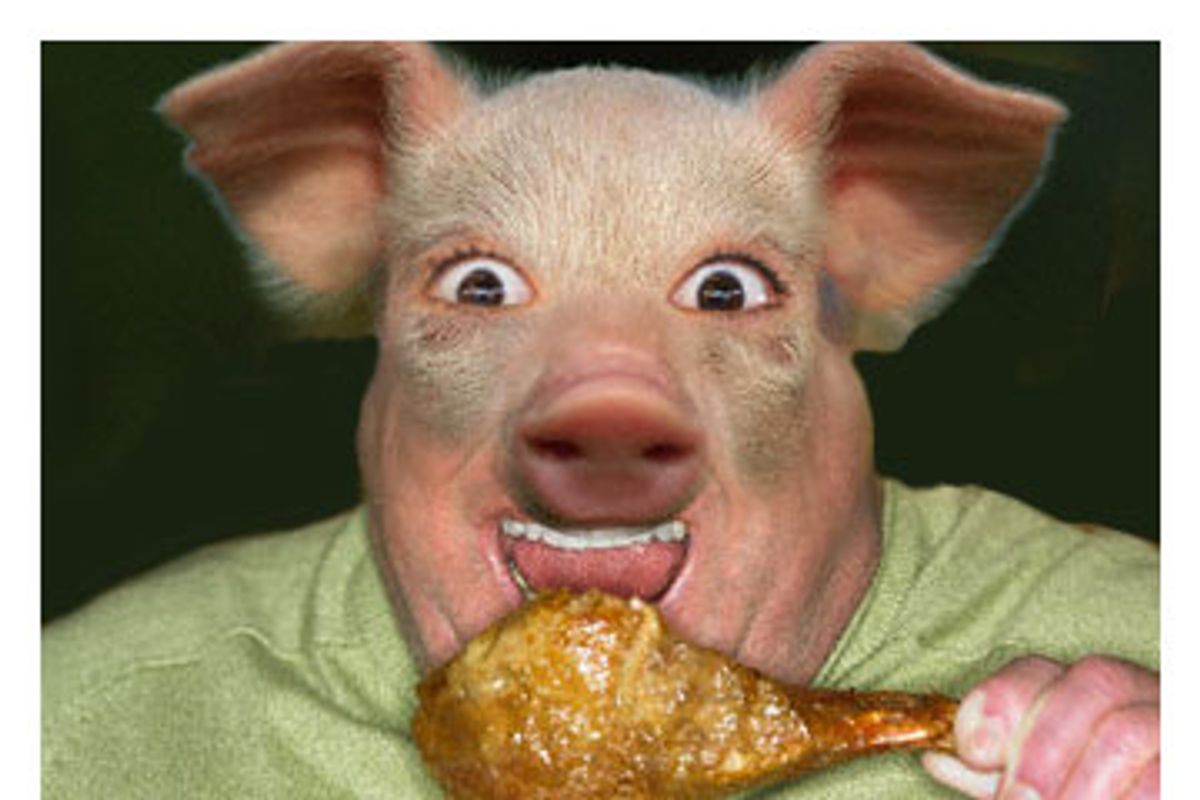
Just call him Dr. Gorge.
Brian Wansink, professor of consumer behavior at Cornell University, is a scholar of the 10-course holiday feast and the office candy bowl. In the Cornell Food and Brand Lab, which he directs, students in psychology, marketing and nutrition conduct experiments to uncover the influences behind our overindulgences. Wansink and his disciples have engineered bottomless soup bowls, which secretly refill, to gauge how much test subjects eat with their eyes vs. their stomachs. They've thrown Super Bowl parties solely for the purpose of measuring how much Chex Mix revelers toss back during the big game. And they've sought answers to such eternal questions as: If 10 different types of Christmas cookies grace the holiday buffet, will people eat more than if there were only five?
In his new book, "Mindless Eating: Why We Eat More Than We Think," Wansink argues that by becoming aware of the myriad cues that instruct us to eat more, we can reverse their influences -- painlessly eating less, without depriving ourselves of the foods we love. He contends that it's not just what we eat that makes many Americans overload on calories, but how we buy and serve food that is to blame for our bulging waistlines. And for everyone hoping to enjoy this year's holiday festivities without piling on pounds they'll regret come Jan. 1, Wansink has this message: Spend less time fretting over the calories in a teaspoon of gravy, and more considering the size of the spoon dishing it out, or the gravy boat it comes to the table in.
Salon called Wansink at his office in Ithaca, N.Y., to discuss yo-yo dieting, the psychology behind "comfort food" and some of the surprising signals that can influence our stomachs.
Whether dining at McDonald's, Subway or the French Laundry, you find that people routinely underestimate how many calories they've eaten. By how much?
In general, the average person of average weight will underestimate their caloric intake by 20 percent. We're wishful thinkers. And we more grossly underestimate when the meals are really, really huge, or when we think that they're really, really healthy.
When we have a low-calorie meal, we typically compensate by eating more of something else. There's a health halo that's associated with foods that we think are good for us, which lends a nice glow to anything at a restaurant that we believe is a healthy, fresh restaurant. For instance, we found that Subway diners believe that they ate healthily, even if they ordered mayonnaise on their sandwich, ordered it with cheese, and got a bag of chips, or some cookies.
What other factors make us eat more irrespective of how food actually tastes?
Most people believe we overeat because we're really hungry or the food tastes really good. But we show in study after study that that is not that case.
If you go to a movie theater, everything says, eat, even if you're not hungry, and even if the food tastes bad. The size of the bucket says "eat more." The noise of the people eating around you says "eat more," the distraction of the movie says "eat more," and the person you're sitting with, if they're still eating, tells you to "eat more."
In one experiment, even when we gave people really stale popcorn, even though they'd just eaten, and even though it was terrible, they still ended up eating it. Our studies found that people given a large bucket ate 51 percent more calories than those who were given a medium bucket.
We eat with our eyes, not with our stomach. One experiment we've done in this realm is with a refillable soup bowl. We found that people eating from the refillable bowl ate 73 percent more soup.
What is a refillable soup bowl?
It's a bowl we devised that would go down about halfway, and then slowly start refilling itself. But it would refill itself so imperceptibly that no one would notice that it was happening.
And you found that people continue to eat based on what's in the bowl?
Exactly; you're using a visual cue. You think: "There's still soup in my bowl, so I still need to keep eating. I haven't eaten half a bowl yet."
Everyone's heard about the concept of "super-sizing" in fast-food restaurants, but where else do you see that phenomenon?
Plates have gotten a lot bigger. Look at the plates in antique stores, from the '40s and '50s. An antique store owner told me customers would really like the pattern on a dinner plate from the '40s, and they'd say: "I like these salad plates. Do you have any dinner plates?" One time, when he told a woman, "No, those are dinner plates," she went back and found a platter, and said, "Do you have any more of these platters that I could use as dinner plates?"
How does serving food on a larger plate encourage someone to eat more?
We find that people eat 92 percent of all the food that they serve themselves. You're likely to eat, if not all of it, most of it. So anything that causes you to take more than you otherwise would is going to cause you to eat more. Six ounces of pasta on an 8-inch plate looks like a pretty good portion. But that same 6 ounces of pasta on a 12-inch plate would look like barely an appetizer.
Does the way food is described influence our impressions of how it tastes?
We are very suggestible when it comes to taste. If someone you're eating with says: "Oh, man! This tastes really great," and then they give you a bite of their food, it's very seldom you don't believe it tastes great, too.
The same thing happens with names. Anytime someone mentions a name that's evocative, it will make you like the food more. If someone tells you you're going to have "double-chocolate Belgian black forest cake," you're going to like that, and think it tastes a whole lot better than if they just said: "Want a piece of chocolate cake?"
Practically everyone thinks that they're too smart to fall for these sorts of things, yet you argue that we all do anyway.
That's why these [influences] have such power. Almost all of us think we know what we like. We believe we're too smart to be tricked by something so silly, and that's where we really, really, really get tripped up. Because we say: "Hey, come on. Look. I'm a smart guy and no little trick is going to throw me off balance." That's the real power of these habits, and that's what makes them so ubiquitous. We deny that they ever happened to us.
But what's the evidence that it does affect everyone, and not just suckers?
I've heard people say: "Well, come on. Something like this can affect the uninformed, but it's not going to influence someone who is intelligent and well-informed." And that's seems like a good point.
So, as an experiment, we took a bunch of really intelligent people -- MBA graduate students at the University of Illinois at Urbana-Champaign -- competitive students who had gotten into graduate school. I spent 90 minutes informing them that if they serve from a big bowl, they're going to take more than if they serve from a medium bowl. I demonstrated it. I lectured about it. I showed them a video about it. I even broke them into discussion groups so that they could discuss ways they could prevent it from happening to them. I did everything short of an interpretive dance.
Then, they went away for a holiday break. When they came back I invited them to a Super Bowl party at the end of January, six weeks later. As they came to the party they went to one of two rooms. In one room, they were given a bowl, but sitting in front of them was two large, gallon bowls of Chex Mix. Then, they served themselves, and we weighed how much they'd taken.
We did this in a very sneaky way. We handed them something that they had to fill out, so they had to put their plate down, and there was a scale, concealed by a tablecloth, underneath where they put their plate. At the same time, 20 of their colleagues were going through a different room that had four medium half-gallon bowls of Chex Mix. So, instead of large bowls they served from medium-size bowls, but it's the same total volume of Chex Mix.
When people served themselves from the huge bowls, they served themselves 53 percent more Chex Mix. Now, these were smart people and they were very well informed. In fact, six weeks earlier we'd spent 90 minutes drilling them over and over and over again about how big bowls cause you to pour more. So, after the Super Bowl was over we weighed how much they'd actually eaten, and the people who served from the huge bowls ate 57 percent more.
When we said, "Hey, here's what's happened. We told you guys about this six weeks ago, why did you get fooled?" people were still unwilling to say that the size of the bowl fooled them. They'll deny it until they're blue in the face. They say: "Oh, well, yeah, I was really hungry today," or "I skipped lunch," or "It smelled really good." They'll say anything but that bowl could have possibly influenced them.
You're saying that because people don't believe that they can be fooled by these cues, you can't even educate them out of it?
That's absolutely correct. Instead of letting cues lead you to eat more, you need to reverse these cues so that they work for you rather than against.
How can you reverse them?
You can use smaller serving bowls. You can use smaller plates. You can move the candy dish just 6 feet away from you, rather than 3 feet. You can use tall, skinny glasses, instead of short wide glasses. You can put the serving bowl in the kitchen, rather than leaving it on the table family-style, which is what most people do.
You can also eat out of a dish, and not out of a package, because we eat with our eyes; if we eat out of a huge package we don't really know when we're done. But if we pre-plate or pre-pour things we have a better idea as to what we really have eaten.
We're now in the middle of a season of overeating, which is typically followed by an orgy of diet vows right after New Year's. What are some ways people can get through this season without gaining a ton of weight, but also without missing out on the fun of the holidays?
One strategy is to use the rule of two. We know that variety causes you to eat too much food. So, anytime you're at a holiday buffet, go to the buffet as many times as you want -- but on any given trip never put more than two types of foods on your plate.
If you say: "Hey, look they have cantaloupe, and they have brownies." You can put as much cantaloupe on your plate and as many brownies on your plate as you want to that first time, but you can't put anything else. And then, if you want to go back a second time, you can do the exact same thing, but you might want to pick two different foods, like the water chestnuts wrapped in bacon and the peppermint ice cream. But you can't put anything else on your plate. You can have as much of those two items as you want to, but you can't put anything else.
What we find is that putting two items on your plate is kind of boring. People will do it, but because it's much more boring than piling your plate with 20 items, people end up eating a lot less. Our studies show they end up eating 27 to 28 percent less food.
What about managing big family holiday meals?
If the way you show love to grandmother or your mother or aunt is to make sure you eat their special family recipe, one key is to take small amounts, but do it frequently. Rather than put a big 1,000-calorie pile of dressing on your plate, put a little bit on at a time, and eat that -- that way you can always have something on your plate, and you can always say: "Hey, I think I'm going to have some more dressing. That is really great." What your host is going to remember isn't the fact that you only put a teaspoon on the first time. They're going to remember that you went back for seconds and thirds.
Do you have advice for people who are trapped in a cycle of yo-yo dieting?
Nobody gains 50 pounds overnight, but everybody hopes to lose 50 pounds overnight. Realize that the easiest way to lose weight, if you do not want to have it be your major objective in life, the easiest way to do so is to do so gradually. Do it in the same way you gained the weight, by slowly carving out 200 or 300 calories a day. In a year's time you're going to be 30 pounds lighter, without having felt like you're sacrificed.
Why do you think it's a bad idea for people to ban their personal vice foods -- whether French fries or ice cream -- in order to lose weight?
Any method that is based on deprivation is bound to backfire. It doesn't matter whether you're being deprived of your favorite foods, television or affection. Any deprivation is going to find a way to get back at you. Smaller amounts of these foods can still end up satisfying people, still give them some degree of satisfaction, without leading them to binge. If you get a good taste of something, sometimes that's all it takes.
What are the biggest myths about why Americans overeat?
Because the food tastes really good or because we're really, really hungry. The reality is that we overeat because of the cues we set up for ourselves -- like the way we arrange our tables, the way we plate our food, where we put serving dishes, who we eat with, what we watch or what we do while we eat, where we store our food, how we eat at work, and the size of the packages we buy.
What foods do you find people most frequently gravitate to for comfort?
We did a survey of over 1,000 people, and 40 percent of their favorite comfort foods ended up being things that are reasonably healthy for you -- meal-related foods, like soup, pasta, steak, casseroles -- as opposed to candy, cakes, chips and ice cream. But one thing is that men tend to prefer those meal foods -- the pasta, beef, soup, casseroles -- while women tend to eat more of the other things.
Why is that?
When we asked men, they said: "When I eat meal-related foods, I really feel cared for, I feel like I'm important, I feel like I'm the center of attention." And when we asked women about those same foods, women said: "Yeah, we like them, they just don't really give us that much comfort, because when we think of these foods we think of the fact that we're probably going to have to make them, we're probably going to have to clean up after them." For women, they didn't have associations of comfort. They had associations of work. That's why women tended to gravitate more toward some of these foods that are less effort -- ice cream, cake, cookies, candy, chips -- all of which are pretty much pre-made foods. They don't take much effort to dish up, or to clean up.
New York City has considered requiring some chains, like McDonald's and Starbucks, to add calorie labeling to restaurant menus and menu boards. But you're skeptical that this will help people make better food choices. Why?
We've found over and over that labeling is good for the people who care, and a lot of people just don't care. A lot of people are in an indulgent mood when they eat out. In some cases, it ruins the whole experience. When I go to a French restaurant, I don't really want to know how many calories are in something, because I'm there to have fun, not to kind of feel guilty the whole meal.
Why have so many fast food restaurants failed at promoting their new "healthy" offerings, like the McDonald's McLean burger?
There are two big reasons. First of all, most of those items have been set up for failure. Anytime you tell someone a food is healthy, the connotation is that it's going to taste bad -- even if the food is good. And if you're expecting it's going to taste bad, you'll have convinced yourself it tastes bad before you even bite into it. Labeling something "healthy" is the kiss of death.
The second reason is that the return on investment that companies look for in these foods might be too high. They may expect it to sell much better than is realistic, and as a result they might pull the plug prematurely. They may not let the market fully develop.
What we need to realize is that the typical person who is walking into a fast food restaurant doesn't have a BMW or a Jaguar. They're walking in with a few bucks in their pocket, and they want to have something good to eat, and feel full.
Shares