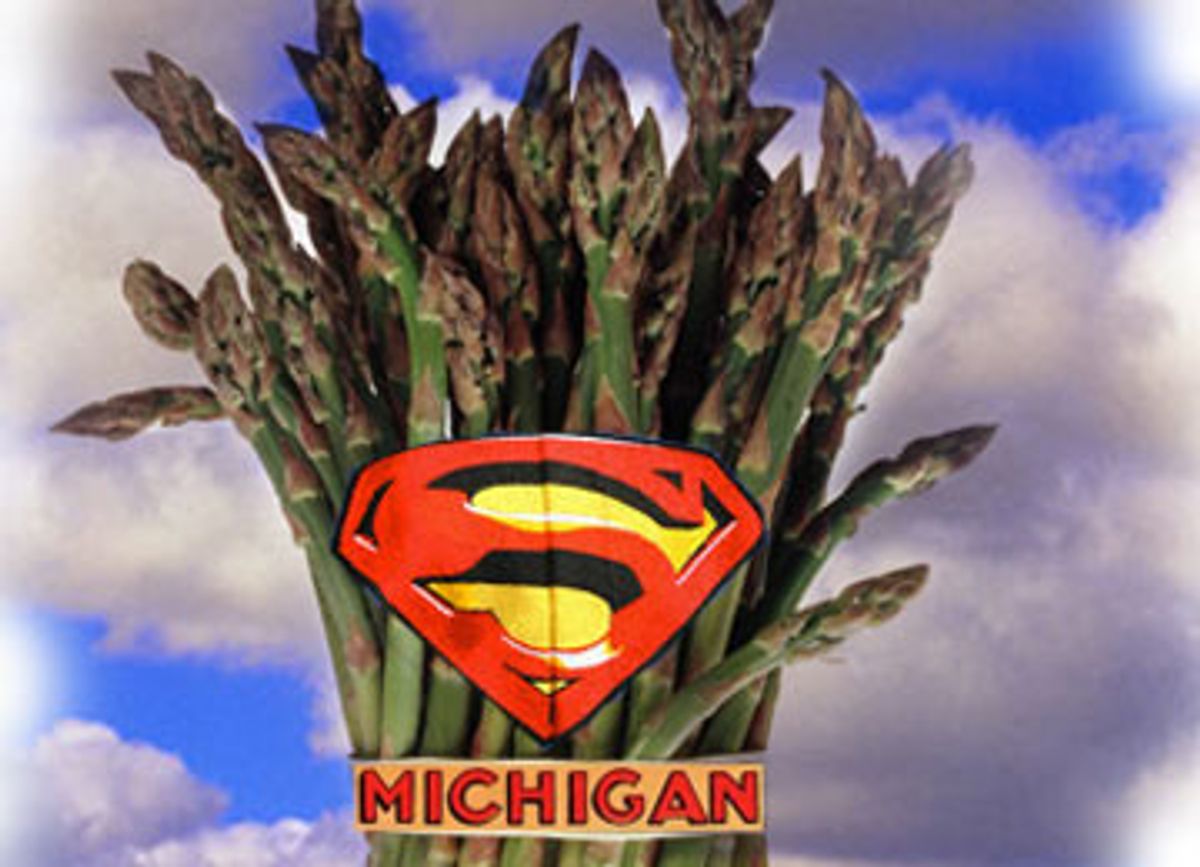
Last spring, I ate asparagus every day for two months. I turned into a superhero of asparagus.
In my secret life, I was the Spargelfrau. Perhaps it wasn't the right name for a superhero. I got it from a magazine article a friend sent me about asparagus season in Germany, which happens there at roughly the same time it happens in Michigan -- May through June. The article said some German villagers get so excited about their asparagus, they eat it every day while the season lasts.
The Spargelfrau, I think, is actually supposed to be the woman who sells asparagus, not the one who buys it all up and eats it. (It strikes me now that Spargelfrau could mean wife of asparagus. I don't know if domestic union with a vegetable merits a pair of Underroos.)
In some famous little asparagus town in Germany, there is a statue of the uber-Spargelfrau, fat cheeked and grinning, a sort of wholesome vixen. She has a cart on wheels. She is holding armfuls of bronze asparagus.
Surrounded by bushels of real greens in an open market, the Spargelfrau makes a charming newspaper photograph. But I picture her there, in the town square in winter, covered in snow, holding that dead, cold asparagus out to nobody. Poor Spargelfrau. In real life, asparagus heroism is temporary. It is intense. There is a great deal of asparagus all at once. The hero must ingest this -- raw! steamed! roasted! grilled! -- and then, abruptly, stop. There are no memorials. By July the heroism must be forgotten in an orgy of peppers, summer squashes, pole beans. Nowhere in the world should there be asparagus in winter.
- - - - - - - - - - - -
The winter in Michigan is long, dark, and damp. There are three things you can get fresh here year round: beef, bread, and beer. Everything else comes from far away. Everything else, in winter, comes from a Sysco truck, along with millions of Styrofoam coffee cups. If we lived close to the land, Neander-Michiganders, we would hoard potatoes. As it is, we import vegetables, pulpy and withered.
But who needs them? The weather, perhaps like winter somewhere in Germany, makes you want nothing but beef and beer. If you know what you are doing in a Michigan winter, you will greet depression with depressants. Pad your dying soul with flesh. Give up and get fat. Hibernate. In the impossible spring your cheeks will be round enough for the right spargel grin. A grin worthy of the triumph of cathedral tips breaking through the ground: the asparagus is here!
The asparagus is all that's here, in the farmer's market in May, aside from a few stalks of rhubarb. We are still wobbly on our indoor legs. Under our eyes are deep circles of leftover winter despair. We have been waiting so long for a vegetable or fruit. The spring equinox back in March was irrelevant, cruelly crafted for a lower latitude. We started thinking of strawberries when we saw the first crocuses killed by frost, but that was a pipe dream. The strawberries still aren't quite ripe -- but when they are, they will be dark and concentrated, almost as though they've had to furrow their brows.
Michigan is a place, for me, of two firsts: living alone, and depending heavily on the seasons. Before I moved here, I couldn't avoid the fact that I lived in an international pleasure dome: New York City.
I shopped at the Greenmarkets as much as I could. I kept up with the slight seasonal differences between Jersey tomatoes and upstaters, and distrusted calendar-defying hydroponics. Often, especially at Union Square, there was overwhelming bounty. I always liked a tiny Greenmarket for providing a challenge or imperative: oh, it's only the tomatillo people today. I would have to make salsa. On assignment.
The dawning and dwindling ends of the growing season are also good for imposing menus. There might be only radishes and arugula in the early spring. In fall there are nothing but oven fillers: long-cooking squashes and apples that eventually give way to warty gourds and Christmas wreaths.
But even though there are real farms and farmers in the regions around the city, New York defies reliance on the season. When pickings were slim in the winters I lived there, I just bought pineapples and papayas at the Korean bodega. I could get these at midnight if I wanted to. The growing seasons of the rest of the world were ours. Eating local in New York City can mean eating mung bean-sprouts that have arrived from somewhere far away via Chinatown, or fishing a cake of tofu out of your local deli's counter.
Of course there are supermarkets where I live now. I buy bananas. I buy lemongrass and cilantro. I don't stop myself from trying (usually failing) to get a good fig, even if you can't grow one anywhere near here.
But partly because I don't have a car, the easiest and most satisfying place for me to shop is the farmers market. I can walk there. And in summer, the Michigan crops -- cherries, corn, eggplants, leafy greens, tomatoes, blueberries, apricots, squashes -- are miraculous. In late fall, though, I fail to make the shift to the supermarket, with its Chilean grapes, its Texan greens. I keep going to the farmers market even when there is almost no food. From November through April, I wander under the corrugated shed roof, along the walkways where farmers huddle by portable heaters on Saturday mornings to sell apple fritters and cider. We greet each other with mutual suspicion -- what are you doing out here? In our eyes is a lean and hungry vegetable craving. In our cheeks is an apple doughnut, our serving of fruit and fiber and happiness for the day.
- - - - - - - - - - - -
So, even if you don't like asparagus, you can understand the thrill of seeing those bundles of slim stalks standing upright on the tables one early Saturday morning. It's still chilly out. Maybe you haven't had your first cup of coffee. But the asparagus tips sparkle, in your green-starved eyes, like jewels. Their live green is more alluring than money. (For the purposes of this essay, all asparagus will be green. What is white asparagus? It is grown in secret caves, as mushrooms are. It is a long, spooky fungus. It is naked and phallic. White vegetables do not make me want to live.)
The only reason you don't like asparagus is that you have eaten it in winter. You have eaten it cooked to olive green. The stalks were fat and woody. In your mouth, an inner slime spurted out of an unchewable skin. Some of this skin you removed from between your teeth like dental floss.
The real spring asparagus is picked at dawn, if you are very lucky, and driven here in just thirty minutes in crates. Take the most slender stalk from the rubber band. You can bend it into a full arc, but still snap it crisply just above the base. The tip is like a baby's ear, sheathed in the slightest fuzz. The stem is luminous with moisture, as if it might ooze a drop from its center. Eat it raw, right away, first thing in the morning. There is only a hint of astringency left on your teeth.
The asparagus superhero feels, at this moment, that she could eat all her asparagus raw for the rest of spring. But there is going to be a lot to eat. Eventually, so as not to go crazy (though she wears an aura of craziness already; though the craziness is part of the wonder of spring), she will have to diversify. She will have to find recipes.
Shopping for one at the farmers' market, especially as the season goes on and the vegetable multiplies, can be a challenge. Farmers want to get rid of a lot in a little time. They'll be packing up by two o'clock. They'll give you a bargain if you take two, or three for eight. They'll sell a peck. They grew this for you. How can you insult them by trying to buy single servings? The bounty of the land does not come in single servings.
The Spargelfrau comes home with enough asparagus to feed a sumo wrestler. She wraps the bottoms of the stalks in a wet paper towel to keep them springy in the refrigerator. On no day of the week will she be so ungrateful as to leave it off the menu.
The spring of superheroism took off when I went with Rodger, the chef at a local restaurant -- where I also worked -- to pick asparagus. He was trying to establish relationships with farmers so that he could gradually shift the restaurant to local, and when possible, organic produce. One of his main sources for asparagus was the field of a dirt farmer who let the community come and harvest his asparagus crop -- it was an old field that wasn't worth his efforts, in comparison to selling dirt. Rodger took crews of his friends and restaurant staff to pick. Rodger counted the number of boxes we had filled with asparagus and left some money in a coffee can behind the barn.
Asparagus grows on a complex root system. It is difficult to plant, easy to harvest. The stalks stick up from the ground, and snap off in your fingers right where they should, at the end of tenderness. We should have been there in the morning, when dew clings to the plants, but we didn't make it there until the far side of noon. The day had turned sunny and parched. The sun, somehow, made the stalks hard to see, playing tricks like it does on a highway mirage. The field appeared to be almost empty. Others had been there to pick only a couple days before, but there was still a deceptive amount of asparagus in the field, standing upright, unprotected. We worked along the rows stooping, snapping, making piles. After a while, the process turned hallucinatory in the bright sun -- one moment I couldn't see any asparagus; then, suddenly, I could see nothing but asparagus.
"Have you eaten any yet?" Rodger called from his row. I had been too reverential, attempting some kind of professionalism. I bit into a stalk. It was sweet and delicate and clear.
My one day of contact with the vegetable at its source drew me deeper into its thrall. What is the opposite of kryptonite? I was fueled to almost dangerous levels by the green stuff. Or -- is Popeye a superhero? -- maybe this vegetable was my special spinach, without the can. My next few meals were made of asparagus I had picked myself. But it was clear that as long as anyone was still out there picking, I'd go on eating asparagus.
The single person, if he is concerned as I am about plowing through his leftovers to avoid confrontations with rotten produce, must create multiple variations on the single ingredient, or repeat themes. A head of lettuce or a bell pepper stretches beyond one meal. A loaf of bread lasts from sandwich to toast to French toast to croutons.
Steaming is next up from raw on the ladder of asparagus evolution. Tender, local spring asparagus cooks in a couple of minutes. The danger of steaming asparagus is letting it get too watery to hold onto its sauce -- sometimes the butter slides off, the lemon dilutes. Steamed asparagus can sink into a puddle on the plate.
After steaming comes roasting. Roasted asparagus is a triumph. The tips turn brown and sweet like chicken wings. You cut the slipperiness. The skin crinkles a little, like a grilled rather than a boiled hot dog -- without all the liquid, the flavor is intense.
But by June, it starts to get too hot for even the superhero to turn the oven up to 450 degrees. I move the asparagus to the grill. This involves threading stalks of asparagus onto three skewers until I have built a kind of raft that rests on the grill without falling through. Some of the asparagus stalks are too thin to be pierced this way. Inevitably, something about the precarious arrangement fails. Stalks fall onto the coals and shrink into sparklers. Some stay on top but blacken. The few that survive make it worth the effort.
I steam, I roast, I grill. I don't know what nutrients are in asparagus, but I am infused with them. To be this happy in Michigan borders on insanity. Yes! The old winter depression bordered on insanity too. Living in a place of lesser contrasts, how would you know what it feels like to come back from the dead?
- - - - - - - - - - - -
There was no particular reason, after a while, for my determination to eat asparagus every single day it was on the market, except that I had been doing so since the beginning and was assuming the pride of a challenge. By June, there were other vegetables in the market. I could have quit. But I wanted to be Spargelfrau. Sometimes, eating alone is humble. Sometimes, though, the reason to go through with cooking for yourself is the chance to brag about it afterwards. When I talked to my ex-boyfriend on the phone, we would recount meals we had made for ourselves -- see, I live pretty nice on my own. The asparagus thing was more of a party trick.
Perhaps I should have admitted from the beginning that there is something I love about asparagus aside from the miracle of spring, and even aside from its deliciousness. I love the pee. Nothing seems to redeem the workings of the digestive system like asparagus. It's another verification, after a long winter, that I am alive. Natural processes are working! In fact, what the human digestive system and asparagus do to each other, each proclaiming itself, seems downright heroic.
I have heard the pee is genetic: some people get it, some people don't. The first bite of that first stalk of raw asparagus was all it took for me. The pee smells like absolutely no other pee. It almost smells good. And it always makes me feel redeemed. This is the pee from a healthy vegetable! Beet pee, on the other hand, is always alarming -- I never remember that I have eaten the beets, and I think I am dying -- and coffee pee makes me suspicious, as if the coffee has stripped all the minerals from my insides and dumped them, like a whole bottle of vitamins, out at once.
Despite my airing of it here, digestive processing of asparagus is an intense personal experience. You should enjoy it alone. Some things you should make sure to eat together with people -- garlic, sardines. Your breath will smell, your hands will smell, you will exude a special kind of sweat, and it will all be wonderful if your friends are doing it too. But you can eat asparagus all alone and then socialize without fear. Kiss whom you like. The pee (I hope) is yours alone, unlike your breath or your sweat, which you can't help but share.
- - - - - - - - - - - -
Asparagus season is as long as Lent. I have to fool myself by not making asparagus the main, plain ingredient. After all, I remember, it's supposed to be a side dish. Those evil supermarket asparagi sit around all winter waiting for someone to overcook them and leave them in a puddle next to a pork chop.
I can disguise the asparagus by cutting it up in bits and tucking it into things. Leftover cooked asparagus goes into omelettes and frittatas. I hide asparagus underneath gruyere on toast. I sneak it into risotto with lemon and Parmesan. I make soup with cream and tarragon. I put it in pasta with garlic and anchovies. I eat it in bites that alternate with bites of hardboiled egg.
Now there is solid good weather and a variety of produce. I have come back to life, and I am forgetting my gratitude for that vegetable that summoned me from the dead. Will I ever be able to pee again without forcing a reprise of my meal into my head? Is there anything new I can do with this stuff? In late June, I start to hate asparagus. My body is desperate for non-asparagic nutrients. The superhero skips a day. Two days. The superhero crumbles, forsaking her old fuel.
But then, on the tables of the real Spargelfrau in the farmers market, the bunches start to fatten and then to dwindle. I am penitent. It is going to disappear, and I am going to miss it for another ten months. I buy from this last burst of asparagus, pay homage, cooking it so that it shines alone, roasted in olive oil and salt and pepper, with just a little lemon over it.
And thankfully, it is gone. Mirage or no, there is not a stalk left in the field. There is so much in the market -- eggplants, carrots, beets, bell peppers, red and blue and brown potatoes, fade-to-white leeks -- that I don't have to champion any one thing at all -- until the fall, when I will be the Empress of Pears.
- - - - - - - - - - - -
(c) 2007 by Jenni Ferrari-Adler.
Shares