

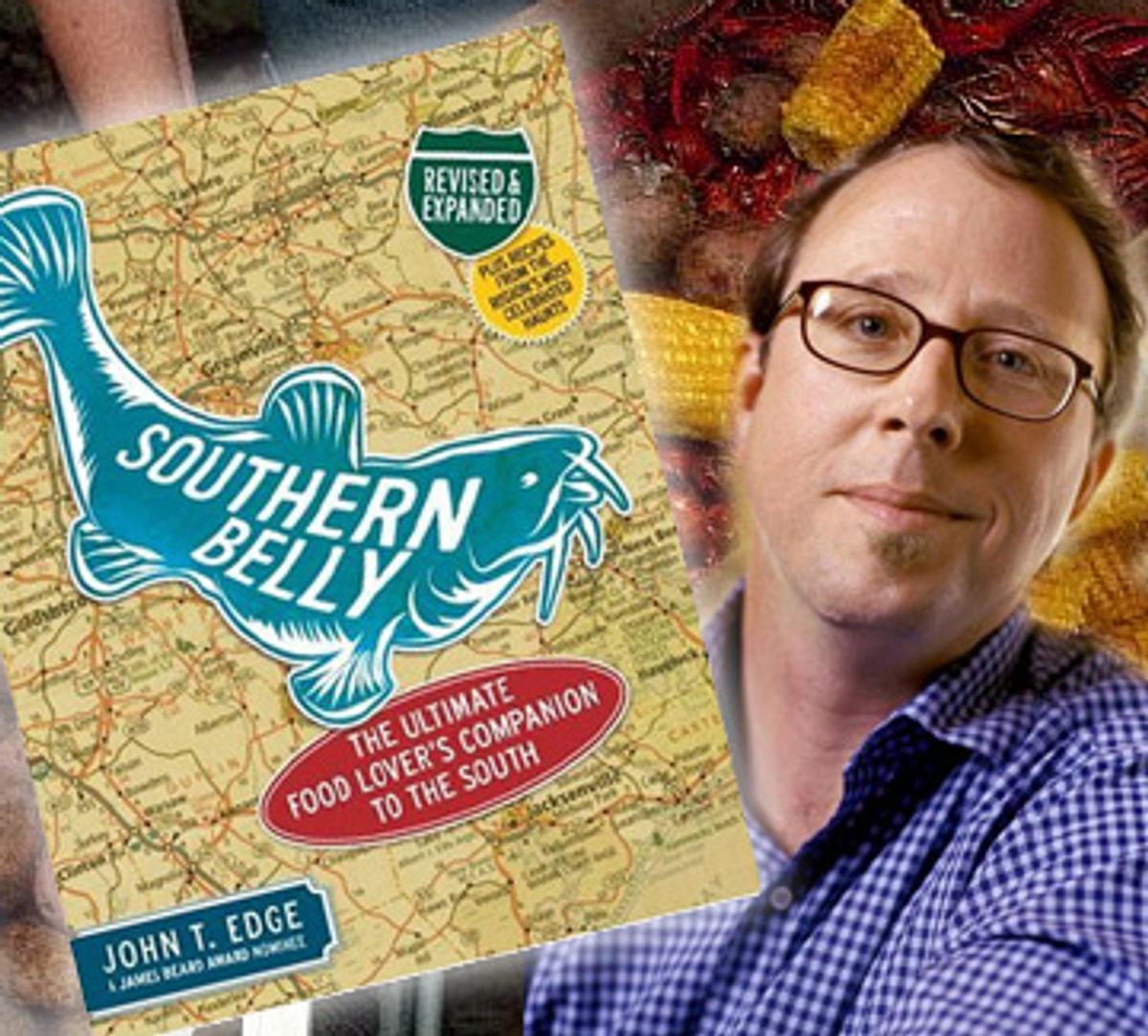
With one hand on the wheel and one on his cellphone, John T. Edge is driving from Atlanta -- where 300 people turned out to hear him read the night before -- to an event in Columbia, S.C., where, he jokes, he expects an audience of eight. "But seriously," he says enthusiastically, "I think people really are waking up."
Edge is a man on a mission, a mission to preserve and celebrate two of America's greatest cultural gems: the food and the food lore of the South. "When I sit down at a table, I want to commune with cooks past and present," he writes in the introduction to his newly revised version of "Southern Belly: The Ultimate Food Lover's Companion to the South." "I want to know their life stories. I want to understand their struggles."
For his efforts, Edge has been called "the Faulkner of Southern food," nominated for four James Beard awards and named a finalist for the M.F.K. Fisher Distinguished Writing Award. In addition to his writing, Edge also directs the Southern Foodways Alliance, a society dedicated to preserving traditional Southern culinary culture. The Web site declares, "We set a common table where black and white, rich and poor -- all who gather -- may consider our history and our future in a spirit of reconciliation."
"Southern Belly" is the apotheosis of Edge's great passions for Southern food and Southern people. The book is filled with pictures, drawings, maps, stories, recipes and -- most important -- a carefully culled selection of Southern restaurants that serve what Edge calls "honest food." He is a spirited guide -- so spirited, in fact, that during the course of our phone conversation, he became so enraptured that he missed his exit.
But Edge will recover his route, surely, and perhaps along the way he'll do what he does best: uncover another unsung gastronomical treasure with a surprising, uniquely Southern story.
You write a lot about "honest food." How do you define it?
It's food that has a back story, that has a reason to be. It's food that doesn't come from a focus group. People who never used the word "concept" when opening the doors of their restaurant. It's food that is, for me, of a place, that means something to the people in the community, who patronize a restaurant or buy their ham from an artisan.
Do you feel like most people in the South are still eating honest food?
(Laughs) Well, look, a lot of fast food has come out of the South. Whether it's Burger King or Hardee's, for the past two generations -- or one generation, really -- Southerners have fallen hard for fast food. In the same way, a generation before, Southerners threw out their corn bread and reached for a loaf of Wonder Bread, because the store-bought food and the tissue-wrapped fast-food burger was exotic. Your ma didn't make it; somebody made it in a gleaming food factory, whether that factory was a bakery or a McDonald's. But the good news is that all across the country -- certainly not just the South -- people are reacquainting themselves with the importance of vernacular food.
But do you worry that the roots of Southern food have been lost in translation as corporations try to package it?
Absolutely. There's been a prostitution of Southern food by the likes of Cracker Barrel, and before them Po' Folks. They've commodified and prostituted it in a way that's salable in a very simplistic way to a mass audience, so that Southern food is all grease and grits. And it's not. I mean I love grease and grits, but it's not my daily diet. I truly believe that the culprit of much of the dietary problems of the South is not the traditional diet, but the siren song of KFC and McDonald's.
Many of the figures you write about are cultured and sophisticated or go against the popular stereotype of what it is to be Southern. How do you define a Southerner?
First, thank you for recognizing that in the book. I believe that the South has been a benighted and tortured place for a long time -- it still is benighted and tortured, but I love it -- and one of the few things that blacks, whites, Jews, Christians, whomever can hold high and say we created this together is our music and food. It's not stratified by way of class and not divided by way of race or religion: It's something in which Southerners can take pride. I want to write about a South that's evolving. Because I recognize that South myself; I recognize a multifaceted, multihued South that isn't stuck in 1865, codified when the Civil War ended. The evolution of the South didn't cease in 1965 during the Civil Rights movement: The culture evolved.
The South I see is a place on a map but it's also a system of beliefs, and when it comes to cooking it's a place that respects and honors simple cooking that's not simplistic. There's an honesty and a forthrightness to Southern food in this day of molecular cuisine, a lot of which I like, by the way. I had bacon cotton candy in South Carolina a few weeks ago.
Where did you have that?
It's a place called McCrady's. The chef is named Sean Brock. He's 28 and he's of the Ferran Adrià school, but he's a kid from the South. He's toying around with Southern food, but he respects what he's toying around with; he understands it at its core before he starts playing with it. He's great.
In "Southern Belly" you mention Kool-Aid pickles. I think you'd have to convince me that those taste good.
Here's the thing: I don't want to convince you that Kool-Aid pickles taste good. That's not the point. I wrote a piece for the [New York] Times maybe six weeks ago about Kool-Aid pickles and I tried to write in such a way that said, "Here I am, a 43-year-old white boy, looking at these kids in the Mississippi Delta who invented a new folk dish. They have invented a new folk food. And these kids love the taste of dill pickles doused in Kool-Aid. If I don't like it, what do they care?" I use my powers as a guide in this book, but I also throw in things that are curious and so far beyond my own experience that I don't want to pass judgment, I just want to put it out there.
What's your process? How do you find the places that you put in your book?
Some of it is the informal information network of Southern food obsessives. I keep tabs with folks in different places around the South and around the country. I also read other people's work. I have a good friend named Fred Sauceman who has written two books over the past two years on the foods of Appalachia, and his corner of Appalachia up in Tennessee. His books are far richer than my survey of 200-some odd places -- he can give you 200-some odd places in his neck of the woods.
It must be hard to whittle it down. How do you decide what to keep in?
In most places I try to find a story that is a larger Southern story, whether it's about race or gender or whatever the case may be. I added an entry in this edition about the Mayflower, a cafe in Jackson, Miss., that does a beautiful job with trout and red fish -- and I could write about that only, but it's also about the Greek experience in America, and especially in Jackson, Miss. I try to find a story that captures something I want to say about the South.
How do you elicit stories? Do you identify yourself and what you're doing?
I do at the end of the meal. I don't before. Because sometimes you're in a place and the food is dreadful and you know at that first bite and it's the kind of food where you're hiding the creamed corn that came from a can underneath your napkin when it's time to pay your bill. I also don't want people to pay for me. I really believe that it's deeply important for people who work in this field that they don't accept free food. Southerners are incredibly hospitable people: You tell them you're working on something and then you walk to the cash register and they want to be a host to you and they say, "You're not paying." I want to avoid that because I want people to respect what I do and I deeply disrespect people who say, "I work for so and so," and want their food for free.
Did a lot of places you'd written about close down in the years between the first edition of "Southern Belly" and this new release?
There are quite a few places in the last book that aren't there anymore, and there are quite a few that have changed management. But I've also found new places. And even in the new edition of the book, I bet you money that of 200 places, five of them have probably closed by now. These things happen. There are families running these and sometimes somebody gets sick, something happens.
What about the effects of Hurricane Katrina?
Amazingly, almost all of the restaurants that I wrote about in or around New Orleans have recovered and reopened. Even some that were hit hard by Katrina, including Willie Mae's Scotch House, which I wrote about getting hit in the book, have reopened.
You're especially interested in the history of integration and how it ties up with food. Why do you think food and food establishments were so central to the Civil Rights movement?
Except for sex, eating is the most intimate activity we regularly engage in with others. The fight of the citizens of the South to exclude blacks from churches and schools -- well, the subtext of that was: "If we let you sit down next to us at the restaurant, the next thing we know you'll be diddling our wives." But there were multiple contradictions there too, not the least of which was that the food was oftentimes prepared by African-Americans. The tradition of Southern cooking, the greatness of Southern cookery, leverages for a large part the expertise and the knowledge of African-American cooks. We were very comfortable with blacks cooking our food, but if blacks went from the kitchen to the dining room that's where the problems began.
Given what you just said about Southern food coming out of the black experience, do you think there's a correlation between the grueling lives of people in America under slavery and the development of rich, fatty Southern food traditions?
I think you're right. One generation or two generations ago they needed hardy food. That was true for African-Americans and it was also true for working-class Southerners. Food was fuel. And your palate in successive generations is hard-wired for that taste, that pork fat bobbing in that pot of greens.
But now it seems unsustainable. I turned on Paula Deen yesterday and she was deep-frying a cheesecake.
I think there's a difference between television stunt food and a yearning for a taste of collard greens that were cooked with a pig trotter in the pot. Those foods at their core are not that unhealthy. One of the important things about the South is that it was rural and agricultural more than other regions. We were eating local before other regions. Poverty does that. African-Americans who were working in a cotton field all day and had a kitchen garden near their shack were eating supremely local food. They were flavoring their greens with a little bit of meat. Fried chicken was an indulgence, it wasn't an everyday food.
When you've gone back to places that were notorious in the past for segregation, have you found they have changed much?
In some cases [the tension] is still pretty palpable. I'm driving to Columbia right now and my hope is that I can get to Maurice's Piggie Park to see what it feels like in there; it's been a couple of years since I've been there. I want to check the temperature. Much has changed in the South and yet race relations are still a vexing problem. At Maurice's, last time I was there he was flying the Confederate flag high and saying that it wasn't about race. And that's just not possible. No matter how he might feel about that flag, it's a symbol of divisiveness and oppressiveness for many. I'm a white child of privilege, and it's a symbol of oppression for me.
When you talk to somebody with racist attitudes -- for example, Ollie McClung, who says in "Southern Belly" that he wasn't conscience-stricken by segregation -- do you find it hard to reserve judgment?
I wrote a piece about that struggle for the Oxford American about a restaurant that I used to go to in college that was a Klan hangout. It's a location where a murder during the Civil Rights movement was planned and celebrated. I went back to write about it and figure it out, and the coda to it was I was going back to confront these people. And I basically chickened out. Completely. So that little piece reads like a confession of sorts. I try to be fair to people I write about and yet a book like this is a book of opinions.
I really believe that if you're going to write about the food in the South and you don't write about race, you're leaving out a good part of the story. Even if you're at the opposite end of the political spectrum, you need to find a way to get at that because it's central to the question of food in South.
Have you ever been in the opposite situation -- in a place with mostly African-American clientele where you were the only white person?
Yes, I have. I went to Puff Daddy's restaurant on Peachtree in Atlanta. I wasn't treated badly, but I was the white freak in a room full of well-heeled African-Americans. It was interesting to have the tables turned.
There's a restaurant now in Atlanta that I love going to that's called Rare and advertises their food as "soul tapas." It's a very welcoming restaurant for black, white, whomever -- with Amos and Andy cartoons playing in the back. They have such a great vibe: They are doing collard green pot stickers and all this fun stuff. It is a very upwardly mobile, black Atlanta restaurant. At first I felt like an interloper walking through the door, but five minutes into it, I felt completely at home because when we share food we share much of the same experience of the South. A lot divides us, but one of the reasons I'm so interested in food is that a shared love of okra can unite us too.
Shares