

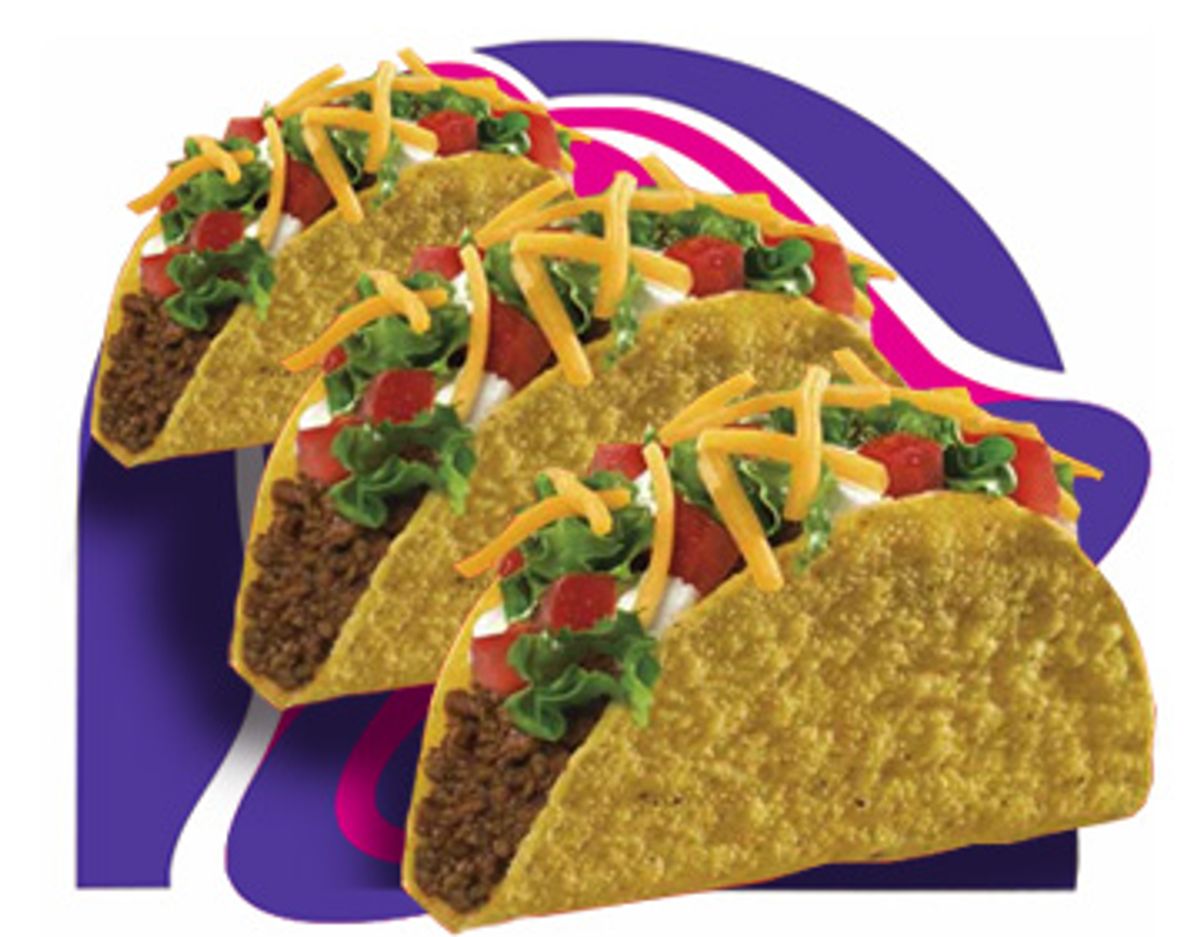
I'm having a señor moment. Dinner tonight is the unthinkable: a Taco Bell Original Taco and Burrito Supreme, abominations that haven't profaned this chowhound's palate since I was a kid in Southern California, birthplace of fast food. I'm committing this foodie felony partly because I'm à la recherche du whatever: the goldenrod-and-avocado-colored memories of my '60s-'70s youth, when dinner out, more often than not, meant Taco Bell.
Growing up white and middle-class in San Diego in those days meant that "cultural hybridity," as the postmodernists like to call it, was my birthright: Mexicans might have been "wetbacks" and "beaners," but our shared historical (sometimes literal) genes, reaffirmed on school trips to the region's Spanish missions, meant that Mexican food was "our" food.
Somehow, Taco Bell outlets felt like home, in an Alta California, Helen Hunt Jackson, wrought-iron-lantern kind of way. Their cute little mission-style facades, scaled down to Disneyland proportions and topped by a hole-in-the-wall-style belfry, complete with fiberglass bell, felt cozily familiar to Southern Californians like me. The Old California vibe was enhanced by trash cans shaped like saguaro cactuses and gas-jet fire pits (an inexhaustible source of entertainment for junior pyromaniacs, in that dark age before iPod and Gameboy). Sure, the theme-parked architecture put a friendly face on the mission system, built on the backs of enslaved Indians. And the original Taco Bell sign -- the proverbial lazy Mexican dozing against a cactus -- was to Mexicans what the golliwog was to American blacks. But we were clueless Anglos, and who knew?
The food, if not truly Mexican, was at least Mexican-ish. Not that my family scrupled at the difference: recently transplanted from Connecticut and resigned, in a Stockholm syndrome sort of way, to my mom's unhappy-homemaker cooking -- the vaguely resentful, let-them-eat-Hamburger Helper cuisine of '70s mothers politicized by Ms. and Maude -- we either didn't know what distinguished a real taco from a Taco Bell taco, or just didn't care.
But that was then. This is now. Which is the other reason I'm eating Taco Bell tonight: I want to sink my teeth into the culture clash between past and present -- the whiter, more monocultural society we were, versus the hyphenated nation we've become. Taco Bell harks back to the Wonder Bread America of 1962, when the chain was founded on the assumption that real Mexican food was too slow, too spicy, too unpronounceably foreign, even in the Los Angeles suburb of Downey, where Glen Bell launched his chain. "Buh-ree-toh," I ordered, prompted by the painfully phonetic rendering on the early Taco Bell menu boards. "Toast-ah-duh." Ordering in Español when you can't even habla! How bitchin' is that?
Paradoxically, even as its architecture and barefoot, serape-clad mascot, the "Taco Bell Boy," insisted on the Mexican-ness of the brand, Taco Bell was taking the "Mexican" out of Mexican food -- destigmatizing it by deracinating it. Since the 19th century, the racial unconscious of white Southern California had projected its fear and loathing of brown-skinned people onto the food they ate. The racist commonplace that Mexican food is dirty -- a coded way of saying that our brown-skinned neighbors to the south are third-world cucarachas, peeing in the Great Race's gene pool -- is a durable myth. In 1895, the chronicler of frontier life John G. Bourke noted that the "abominations of Mexican cookery have been for years a favorite theme with travelers," then joined in the fun, deploring Mexicans' "indifference to the existence of dirt and grease" (not to mention their "appalling liberality in the matter of garlic" and their "recklessness in the use of chili colorado or chili verde").
Taco Bell made Mexican food safe for postwar white America by turning down the tongue-searing heat, translating alien ingredients into the gabacho idiom, and automating food prep: The queso fresco sprinkled onto Mexican tostadas became cheddar cheese; the fragrant, meltingly delicious tortillas made by hand in Tijuana taco stands became prefab taco shells, uniform as widgets.
Most important, Glen Bell recontextualized the experience of eating Mexican food. In the gothic fantasies of white America, taquerias indifferent to the existence of dirt and grease served meat of uncertain origin and colon-scarring spiciness, calculated to exact Montezuma's revenge from whimpering, backfiring whites. Bell moved Mexican food to the right side of the tracks: Brightly lit and spotless as operating rooms, early Taco Bells were staffed and patronized exclusively by Anglos, at least in my experience. (Times have changed, apparently: SoCal-based Mexican-Americans interviewed for this story claimed that the sight of Latinos working and eating at Taco Bell is not at all uncommon.)
"At the time, Mexican restaurants were considered dirty," said the culinary historian Andrew F. Smith, in an e-mail interview. Raised in L.A. in the '60s, he recalled that "in racist Southern California, Mexicans and Mexican-Americans, then popularly known as greasers, were also considered dirty. Few suburban Anglo kids ate Mexican food until Taco Bell arrived. It sanitized 'Mexican' food (and in many ways, it also cleaned up the image of Mexican-Americans)."
But what's Taco Bell's reason for living in an America where public schools are adding mariachi to the music curriculum and huitlacoche is the new porcini? In the United States of 2007, Hispanics are now the nation's largest minority -- at 44.3 million, they make up 15 percent of the population -- and 64 percent of them are of Mexican origin. Who needs partial-birth cuisine like the Meximelt or the Crunchwrap Supreme when the real thing, in more and more American cities, is just a barrio away? Yet, defying all cultural logic, the chain "serves more than 2 billion [American] consumers each year in more than 5,800 restaurants," according to its Web site; in 2005, company-owned Taco Bells rang up $1.8 billion in sales, while franchisees tallied $4.4 billion. However, as the chain's corporate parent, Yum Brands Inc., concedes in its first quarterly statement of 2007, U.S. operating profits are down by 11 percent, thanks to "negative and unforeseen incidents at Taco Bell" (translation: Andromeda strain of E. coli! Rodent infestation from hell!). Taco Bell had been Yum's most profitable brand. To compound its woes, the chain is getting squeezed, on one hand, by local restaurants selling home-style Mexican cuisine, and on the other by "fast casual" competitors such as Chipotle Mexican Grill, Qdoba and El Pollo Loco (all of whose offerings are, in this writer's opinion, higher-quality and more authentic than Taco Bell's).
But opinions differed regarding the cultural politics of eating at Taco Bell. "This fake Mexican food on steroids can never come close to the dishes my mother, tías [aunts], and welita [grandmother] used to cook for me and our family," writes Luis Valderas, 40, a San Antonio Chicano artist.
Francisco Bustos, a "border-crossing writer" who lives in San Diego, remembers a cousin who worked at Taco Bell saying the beans "weren't real." Bustos writes, "What did he mean by the beans not being real? I guess I simply thought, right, claro que si. If they're not cooked the way our parents and grandparents cook them ... it changes everything in a plate. No real beans means no real plate."
Daniel Olivas, on the other hand, seems to savor the cognitive dissonance of Taco Bell's "wonderfully wrong" gloss of Mexican cookery. "I admit to being awestruck by the warped brilliance it took to invent something like the Mexican Pizza," writes Olivas, a lawyer and fiction writer living in California's San Fernando Valley. Obviously, he concedes, "It's nothing like the food my mom makes, but I'm not expecting that ... I'm not one of those Chicanos who believes that Mexican food is sacred. I'll leave such snootiness to the French."
But it is Perry Vasquez's wry, ambivalent take on Taco Bell that best encapsulates the brand's polyvalent slipperiness, as well as the deeply personal, sometimes paradoxical ways in which we negotiate consumer culture. To Vasquez, a San Diego artist whose work explores border culture, Taco Bell's "corporate caretakers swallow up every exploitable image of the Spanish history and Mexicanismo and turn it into something like Hello Kitty."
Ironically, Vasquez "had very good feelings" associated with the brand when he was growing up in conservative, fundamentalist High Point, N.C. He and his mother and brother had moved there from Escondido, Calif., after his parents divorced, and when a Taco Bell opened "in the late '60s or early '70s, I actually took some pride in it," writes Vasquez. "For me, it was like having a small part of California in North Carolina. Much of my identity was built around being from California. It was fun for me to go there with friends and say, 'Yes, this is what a taco is like. We eat them all the time in California. Aren't they good?'"
They were good. Or, at least, I remember them that way, in defiance of my gastronomic superego's insistence that Taco Bell food is a dismal simulacrum of the real thing. That's the perversity of memory: No matter how sophisticated my palette has grown, nor how politicized it has become, I still feel a nostalgic fondness for Taco Bell tacos, triggered by sense memories of that first bite, when the shell would disintegrate into a heap of tortilla shards and meat on the orange wrapping paper that doubled as a tray. The sublimity of that crunch, the sensuous contrast between brittle, ultra-thin shell (worlds away from the chewy, chamois softness of the griddle-warmed tortillas served by Tijuana taquerias) and moist, spicy-sweet meat: Taco Bell tacos combined the delights of Pringles chips and sloppy Joes. For a kid in the late '60s and '70s, what could be better?
But why am I, a gabacho who barely speaks Jell-O-shooter Spanish, so devoted to the pursuit of the One True Taco? Is my ironic dream of making a "run for the border," as the Taco Bell tag line has it, leaving behind the Wonder Bread soullessness of white, middle-class culture for the mythic richness of Mexicanismo? Isn't that just the old Orientalist fantasy of going native, equal parts Malcom Lowry and Cabo Wabo?
Then again, maybe my hopelessly overdetermined reading of Mexican food is simply the product of a Proustian preoccupation with lost time, an attempt to beam back to the endless summers of my San Diego youth.
Before I bite into my Original Taco, I perform a "CSI"-like necropsy of it, anxiously examining what the Taco Bell menu insists is "crisp, shredded lettuce" and what I insist is limp, dispirited lettuce. Dissecting it with my fork, I probe the "real cheddar cheese" (accept no substitutes!) and tiny mound -- a tablespoonful or two, at most -- of what is purportedly "seasoned ground beef."
I think of the Carolina highway patrolman who found a freshly hawked lunger, courtesy of one disgruntled employee, dangling from one of his Taco Bell nachos. I think of the scores of people poisoned, in 2006, by the E. coli outbreak in Taco Bells throughout the nation. I think of the plague of rats gamboling contentedly around a Greenwich Village Taco Bell; NBC reporter Adam Shapiro described one showboating rodent climbing onto an upside-down stool, then dangling from it "like a gymnast." Cute, in a Willard meets "Ratatouille" sort of way.
With these thoughts as an amuse-bouche, I take my first bite. I chomp through the millimeter-thin shell, flavorful as corn-fed cardboard and eerily crunchless in the soggy-armpit humidity of a New York summer. Chewing, I ruminate on the L.A. Weekly food writer Jonathan Gold's comment to me, "I don't think there's any such thing as authentic Mexican food" -- this from a Pulitzer Prize-winning critic who also told me, with palpable excitement, about his lard connection, a guy who sells "manteca de carnitas ... the liquid lard rendered in the process of making carnitas [fried pork], liquid gold. I fried a few batches of chicken in it last night, accompanied by fiery red salsa and homemade tortillas, and I'm pretty sure I saw god herself."
So what is Gold, a guy who admits he "did plow through most of the Semiotext(e), Frankfurt school, poststructural stuff" in his 20s, saying? That Jacques Derrida had it right when he dropped the chalupa on Western philosophy? Derrida argued that meaning can never be pinned down, since we define every concept in a system of knowledge using terms from within that system. In other words, there is no cosmic meaning that stands outside a self-referential system -- no "transcendental signified," to use Derrida's term. Or, in this case, no authentic Mexicanismo. No transcendental taco to which all tacos refer.
So maybe I need to lose my illusions of an authentic Mexican-ness, somewhere over the border. But not before I've mainlined some of Gold's liquid gold. I reflect on all the psychobiographical and cross-cultural meanings I've tried to stuff into a folded, fried tortilla, symbolically speaking. Then I recall Perry Vasquez's mini-dissertation on the matter: "What is a taco? It's a fast food entrepreneur's task to ask that question, much the same way a modernist painter might ask: What is a painting? A 'taco' is an empty form, a genre, a shell that can be stretched, expanded, recombined, redefined, and recontextualized ... up to a point maybe, until it is no longer a taco and then apparently it becomes a wrap. And that's the ingenuity of it. But is it worth eating? In my opinion, no ... Unless you're faced with starvation ... and even then maybe not ... Orale!"
As I munch, one thing, at least, is instantly clear: You can't go home again.
Shares