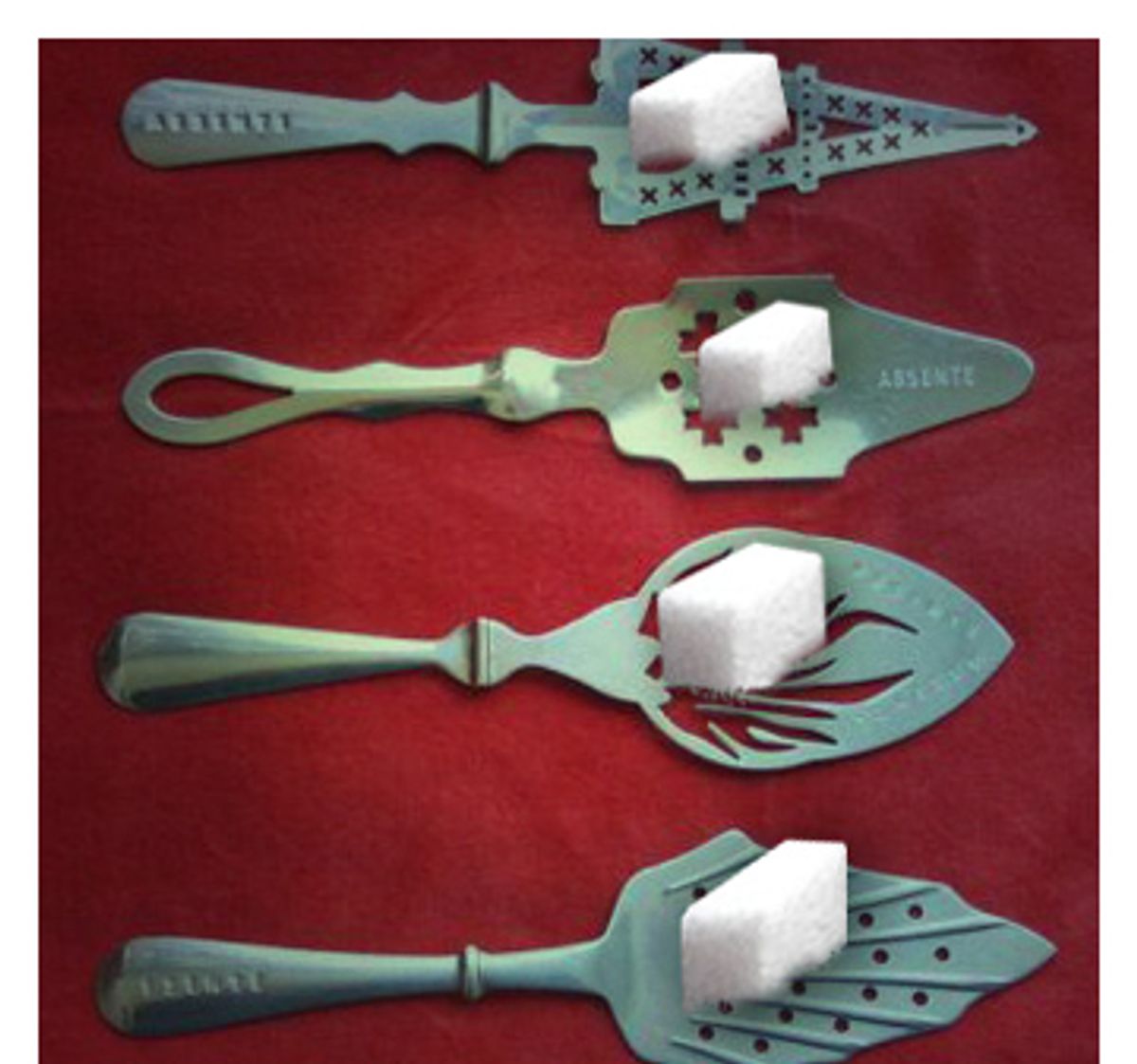
Perhaps you already have your own absinthe story. You drank it in New Orleans one foggy night, too full of fumes to remember much aside from the cloudy green swirl of the drink as water drip-dropped into the glass. You smuggled a cheap bottle back from Spain and brought it out at cocktail parties like a magic trick. You tried it at a party where someone mixed a batch in the back room, and it was caustic stuff, as mean as moonshine. You sipped it in a gloomy underground Czech bar, where everyone looked like spies, and the bartender lit the sugar cube aflame. Or perhaps you've never even touched absinthe, maybe you just read about it, and became interested in the lore of the Green Fairy -- how it was a muse to the artists of the belle epoque, how it made people mad, made them hallucinate, made them slaves to the drink, how it drove Van Gogh to cut off his ear. Perhaps you don't have a story about absinthe at all.
Well, now would be a good time to get one.
Absinthe is legal in the United States for the first time since 1912, the year it was banned in America. Eight years later, Prohibition levied the same fate on all spirits, but while beer, wine, and liquor made a triumphant comeback -- expanding into an industry that can cozily encompass both a Courvoisier XO and a can of Pabst Blue Ribbon -- absinthe languished in exile for nearly a century, a casualty of bad publicity, special-interest lobbies and mythology. That allowed absinthe to become something of an urban legend, something to talk about in whispers, with wide eyes. Much is said about absinthe; very little of that is true.
So let's clear up a few misconceptions. Absinthe does not make you hallucinate. It is not wildly addictive. It will not cause you to lop off your ear, unless (possibly, on the off-chance) you are a deeply disturbed painter racked by poverty, heartbreak and mental illness. Rather, absinthe is a good drink. It is most reminiscent of Pernod, a kick of licorice with a lingering menthol taste. (The similarity is not coincidental; Henri-Louis Pernod first commercialized absinthe in France in 1805.) Absinthe's flavor comes from its muscular key components -- anise, wormwood and fennel -- and though it's certainly an acquired taste, there's also something appealing about the ritual and presentation of it. Absinthe has its own special glasses, slotted spoons and drips. Absinthe even has its own verb, "louche," to describe the milky cloud kicking up when water hits the drink. Watching this -- on the right night, in the right light--you start to understand why artists like Toulouse-Lautrec and Rimbaud and Verlaine found inspiration in the stuff. And you start to understand why people might think it contained a little bit of black magic, too.
Absinthe was the drink of 19th-century Paris. At the time, the French wine industry had been decimated, and absinthe, with its otherworldly color and reputation for spurring creativity, matched the decadence and glamour and artistry of the era. Absinthe may not cause hallucinations, but its buzz has been likened to a kind of "waking drunk," in which inhibitions are lowered but synapses fire faster, the perfect companion for a lively barside debate. But things went sour for absinthe as the end of the century approached. Degas' famous 1876 painting, L'Absinthe, is a portrait of overindulgence and isolation: a woman slumped over her cafe table in front of an absinthe glass, face gone slack. In 1890, the book "Wormwood: A Drama of Paris" vilified absinthe, portraying the downward spiral that inevitably follows a drink. (Think "Reefer Madness" for fin-de-siècle Paris.) In 1905, a disturbed Swiss man, drunk on absinthe, murdered his entire family. Absinthe didn't make him do it -- any more than a bipolar who hacks up his neighbor after drinking Jamesons has been deranged by Irish whiskey. But the tide of public opinion had shifted, spurred on by negative digs from prohibitionists and the wine industry, not interested in the competition. European countries began banning absinthe in 1906. Six years later, America followed suit.
Environmental chemist T.A. Breaux, who has studied absinthe for 14 years, explains what led to the drink's decline. "As absinthe became immensely popular, there was a drive to make it cheaper," he says. "In urban areas, where they didn't have a lot of space for distillation equipment, people made absinthes from cheap industrial alcohol, using chemicals that would induce the green color. There were people who had an interest in capitalizing on this, and they failed to make a distinction between these cheaper drinks and real absinthe. It's a little bit like using Mad Dog as a reason to ban Bordeaux."
Absinthe remained legal in Spain and Czechoslovakia and the U.K. -- places where it had never been popular in the first place -- but as the drink's mythology grew, those spots became magnets for tourists, who sought out the stuff for its forbidden-fruit allure. The absinthes were often served with a sugar cube -- as with your iced tea, it's a matter of personal preference -- but in Czechoslovakia, bars began dribbling alcohol over the sugar cube and setting it on fire, one of those barside ta-das that became associated with the experience. "That was actually created by a distributor in England, realizing that Czech absinthes would not louche," says Breaux. "You add ice water and nothing happens, and since that would be an extreme disappointment to the public, they had to come up with some distraction." Breaux, like most absinthe experts, is adamantly against the practice. It caramelizes the sugar, changing the taste of the drink. It burns off the alcohol. It's dangerous. But come on, let's face it: It's also cool.
By the time Breaux started his research in the early 1990s, "the international market was littered with product that had attempted to cash in on the mystique without offering anything substantive. These unscrupulous mixers would throw in some green dye and sell it to tourists, because no one knew what it was or what it was supposed to taste like."
Absinthe became legalized in Europe in 1988, when the European Union established food and wine standards, though years passed before anyone did anything about it. Even in France, people still feared the sinister forces of the Green Fairy. Absinthe's story proves how powerful a story can be even if it isn't true. There are razor blades in the Halloween apples! Someone could steal your kidneys and leave you in a bathtub of ice! And you could start out the evening with a nice cocktail and end it in a mental institution, stark raving maaaaad.
Video: Tasting the devilish drink
For the past decade and a half, Breaux has been actively tearing down these myths. He has become a rock star in the absinthe community for his own high-quality artisanal line of absinthe, Jade Liqueurs (produced in France), and his obsessive analysis of pre-ban absinthe samples, which led to the crucial discovery that the most controversial element in absinthe -- thujone, a component of the bitter medicinal herb wormwood -- was there only in trace amounts, well under the legal limit for thujone in this country.
Earlier this year, the American government lifted its ban on absinthe. The first entrant into the market is Lucid, distributed by New York-based Viridian Spirits and currently enjoying the highest profile. Part of that is due to the man hired to collaborate on the product -- none other than Breaux, who developed Lucid at a distillery in Saumur, France. I've heard snide comments about the bottle design -- a pair of cat's eyes meant to evoke Théophile-Alexandre Steinlen's Le Chat Noir poster art, an homage to a Montmartre cabaret, though it mostly reminds me of Andrew Lloyd Webber's "Cats" -- but I haven't heard gripes about the drink. Lucid is a solid absinthe. And so far, a popular one.
"We've sold thousands more cases than expected," says Jared Gurfein, president of Viridian Spirits. "There is a huge interest in absinthe. Unbelievable."
And, Breaux adds, "there is nothing neutered or modified about it. This is the same absinthe they drank 100 years ago."
(Actually, a few bloggers might argue this point. Not surprisingly, absinthe has an intense online community, where discussions of, say, thujone content spiral off into gigantic threads.)
Lance Winters became interested in absinthe after working five years as a moonshiner. Recently, his St. George Absinthe Vert was cleared for sale. "Absinthe is the pinnacle of the distiller's art form," he says. "It exemplifies all the things that are difficult to do but beautiful when achieved. The anise, the wormwood, the fennel-- these are three very powerful ingredients, aromatically and flavor-wise. It's like getting a whole bunch of strong voices in one room and getting them to harmonize." At times, it can go terribly wrong. There has certainly been no shortage of nasty absinthe over the years. But, as Winters says, "when it works, it can give you goosebumps."
St. George has a more robust flavor than Lucid, which is admittedly toned down for an American market. It has an herbal, earthy bouquet, and packs such a wallop that it almost makes my tongue feel numb, like a potent bleu cheese. Another absinthe cleared for distribution is Kübler, a Swiss absinthe. (Kübler lobbied extensively to get the U.S. absinthe ban repealed.) As an Absinthe Blanc, or clear absinthe, Kübler may lack the flair of the green-yellow louche, but perhaps audiences will eventually forgo the drama and settle for flavor.
"There's an expansion in people's minds about what spirits are all about," says Winters. "We saw this take place with wine, where people went from just ordering any chablis or burgundy to actually knowing the differences between grapes. We saw this in the craft brewing revolution, which took us from these horrible, bland, mass-produced beers to people making beers with these insane peaks and flavors."
But what happens to an illicit drink when it is robbed of its illicitness? Part of what gave absinthe so much power -- in the mind, if not the marketplace -- was its lore and illegality. Like opium, absinthe conjures exotic images of romantic destruction; unlike opium, absinthe isn't actually dangerous. A great many people have learned about absinthe through films, where it is a stand-in for lawlnessness and vice. "Moulin Rouge," "From Hell," "Murder by Numbers," and the frat-boy midnight movie "Eurotrip" all featured absinthe as a trippy narrative device--at the very least, an opulent set piece. But the drink's place in pop culture is perhaps best encapsulated by "Bram Stoker's Dracula," directed by Francis Ford Coppola (who also happens to be a vintner), where history's bloodthirsty count sips from a green bottle marked "SIN." So dangerous. So lavish. So goth.
In fact, goth high priest Marilyn Manson is marketing his own red absinthe -- Mansinthe (!) -- currently available online. This could hardly be considered a good sign, especially for those who don't want the drink's rich historical and literary history to be lost in the hype of another bourgie trend.
Michelle Nolan is a bartender at Pravda, a bar in New Orleans' French Quarter that sells absinthe. "There are three types of customers who come in here looking for it," she says. "The first is the frat guy, who maybe saw Johnny Depp drink it in a movie. They ask for shots of absinthe, and nine out of 10 times we don't serve them, because you really don't want to shoot a drink that costs $20. It's like taking a shot of Remy Martin. The second type is literary -- their favorite author wrote about it; they want to know if there really is a muse. And the third is connoisseurs, for whom cost is no object. But they like sitting at the bar and talking about this drink they know everything about." A recent fourth addition might be people who read about it in a magazine. Because there has been no shortage of those stories recently.
Evidence of its current chic can be found at Employees Only -- a charming roaring '20s-style bar in New York's West Village -- where a handsome Serbian bartender named Dushan Zaric (who also co-owns the bar) makes a variety of absinthe cocktails for me. And, much as I do like straight absinthe, I find these mixed drinks easier to sip socially; they demand a little less of my attention. There is my favorite, the Billionaire Cocktail -- 107-proof bourbon, homemade absinthe bitters, lemon juice and homemade grenadine. There is absinthe and champagne, crisp and effervescent, a drink reputed to be a favorite of Ernest Hemingway's. It's hard to imagine absinthe could ever be the next vodka and Red Bull, but if people caught on to how good these drinks taste, it might be more than a mere trend.
Nobody's predicting a drink once fabled for inducing madness will take over the glitzy table-service clubs of L.A. anytime soon. But you know what? If that happened, I would totally start watching "The Hills" again.
Shares