Ahmed Wali Karzai, the brother of the president of Afghanistan, gets regular payments from the CIA and has for much of the past eight years, The New York Times reported Tuesday.
The newspaper said that according to current and former American officials, the CIA pays Karzai for a variety of services, including helping to recruit an Afghan paramilitary force that operates at the CIA's direction in and around Kandahar.
The CIA's ties to Karzai, who is a suspected player in the country's illegal opium trade, have created deep divisions within the Obama administration, the Times said.
Allegations that Karzai is involved in the drug trade have circulated in Kabul for months. He denies them.
Critics say the ties with Karzai complicate the United States' increasingly tense relationship with his older brother, President Hamid Karzai. The CIA's practices also suggest that the United States is not doing everything in its power to stamp out the lucrative Afghan drug trade, a major source of revenue for the Taliban.
Some American officials argue that the reliance on Ahmed Wali Karzai, a central figure in the south of the country where the Taliban is dominant, undermines the U.S. push to develop an effective central government that can maintain law and order and eventually allow the United States to withdraw.
"If we are going to conduct a population-centric strategy in Afghanistan, and we are perceived as backing thugs, then we are just undermining ourselves," Maj. Gen. Michael T. Flynn, the senior American military intelligence official in Afghanistan, was quoted by the Times in an article published on its Web site.
Ahmed Wali Karzai told the Times that he cooperates with American civilian and military officials but does not engage in the drug trade and does not receive payments from the CIA.
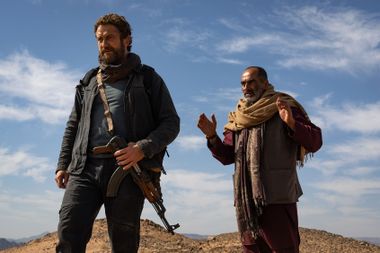
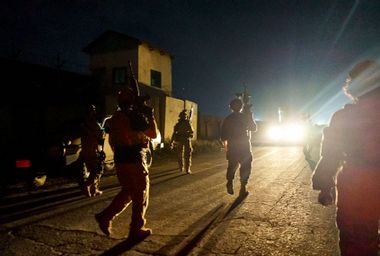
Karzai helps the CIA operate a paramilitary group, the Kandahar Strike Force, that is used for raids against suspected insurgents and terrorists, according to several American officials. Karzai also is paid for allowing the CIA and American Special Operations troops to rent a large compound outside the city, which also is the base of the Kandahar Strike Force, the Times said.
Karzai also helps the CIA communicate with and sometimes meet with Afghans loyal to the Taliban, the newspaper reported.
CIA spokesman George Little declined to comment on the report.
$57,077.60. That’s what we’re paying per minute. Keep that in mind -- just for a minute or so.
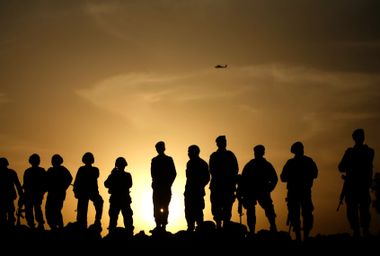
After all, the surge is already on. By the end of December, the first 1,500 U.S. troops will have landed in Afghanistan, a nation roughly the size of Texas, ranked by the United Nations as second worst in the world in terms of human development.
Women and men from Camp Lejeune, North Carolina, will be among the first to head out. It takes an estimated $1 million to send each of them surging into Afghanistan for one year. So a 30,000-person surge will be at least $30 billion, which brings us to that $57,077.60. That’s how much it will cost you, the taxpayer, for one minute of that surge.
By the way, add up the yearly salary of a Marine from Camp Lejeune with four years of service, throw in his or her housing allowance, additional pay for dependents, and bonus pay for hazardous duty, imminent danger, and family separation, and you’ll still be many thousands of dollars short of that single minute’s sum.
But perhaps this isn’t a time to quibble. After all, a job is a job, especially in the United States, which has lost seven million jobs since December 2007, while reporting record-high numbers of people seeking assistance to feed themselves and/or their families. According to the U.S. Department of Agriculture, 36 million Americans, including one out of every four children, are currently on food stamps.
On the other hand, given the woeful inadequacy of that “safety net,” we might have chosen to direct the $30 billion in surge expenditures toward raising the average individual monthly Food Stamp allotment by $70 for the next year; that's roughly an additional trip to the grocery store, every month, for 36 million people. Alternatively, we could have dedicated that $30 billion to job creation. According to a recent report issued by the Political Economy Research Institute, that sum could generate a whopping 537,810 construction jobs, 541,080 positions in healthcare, fund 742,740 teachers or employ 831,390 mass transit workers.
For purposes of comparison, $30 billion -- remember, just the Pentagon-estimated cost of a 30,000-person troop surge -- is equal to 80 percent of the total U.S. 2010 budget for international affairs, which includes monies for development and humanitarian assistance. On the domestic front, $30 billion could double the funding (at 2010 levels) for the Children's Health Insurance Program and the Low Income Home Energy Assistance Program.
Or think of the surge this way: if the United States decided to send just 29,900 extra soldiers to Afghanistan, 100 short of the present official total, it could double the amount of money -- $100 million -- it has allocated to assist refugees and returnees from Afghanistan through the State Department's Bureau of Population, Refugees and Migration.
Leaving aside the fact that the United States already accounts for 45 percent of total global military spending, the $30 billion surge cost alone would place us in the top-ten for global military spending, sandwiched between Italy and Saudi Arabia. Spent instead on “soft security” measures within Afghanistan, $30 billion could easily build, furnish and equip enough schools for the entire nation.
Continuing this nod to the absurd for just one more moment, if you received a silver dollar every second, it would take you 960 years to haul in that $30 billion. Not that anyone could hold so much money. Together, the coins would weigh nearly 120,000 tons, or more than the poundage of 21,000 Asian elephants, an aircraft carrier, or the Washington Monument. Converted to dollar bills and laid end-to-end, $30 billion would reach 2.9 million miles or 120 times around the Earth.
One more thing, that $30 billion isn’t even the real cost of Obama’s surge. It’s just a minimum, through-the-basement estimate. If you were to throw in all the bases being built, private contractors hired, extra civilians sent in, and the staggering costs of training a larger Afghan army and police force (a key goal of the surge), the figure would surely be startlingly higher. In fact, total Afghanistan War spending for 2010 is now expected to exceed $102.9 billion, doubling last year's Afghan spending. Thought of another way, it breaks down to $12 million per hour in taxpayer dollars for one year. That’s equal to total annual U.S. spending on all veteran's benefits, from hospital stays to education.
In Afghan terms, our upcoming single year of war costs represents nearly five times that country’s gross domestic product or $3,623.70 for every Afghan woman, man, and child. Given that the average annual salary for an Afghan soldier is $2,880 and many Afghans seek employment in the military purely out of economic desperation, this might be a wise investment -- especially since the Taliban is able to pay considerably more for its new recruits. In fact, recent increases in much-needed Afghan recruits appear to correlate with the promise of a pay raise.
All of this is, of course, so much fantasy, since we know just where that $30-plus billion will be going. In 2010, total Afghanistan War spending since November 2001 will exceed $325 billion, which equals the combined annual military spending of Great Britain, China, France, Japan, Germany, Russia, and Saudi Arabia. If we had never launched an invasion of Afghanistan or stayed on fighting all these years, those war costs, evenly distributed in this country, would have meant a $2,298.80 dividend per U.S. taxpayer.
Even as we calculate the annual cost of war, the tens of thousands of Asian elephants in the room are all pointing to $1 trillion in total war costs for Iraq and Afghanistan. The current escalation in Afghanistan coincides with that rapidly-approaching milestone. In fact, thanks to Peter Baker’s recent New York Times report on the presidential deliberations that led to the surge announcement, we know that the trillion-dollar number for both wars may be a gross underestimate. The Office of Management and Budget sent President Obama a memo, Baker tells us, suggesting that adding General McChrystal’s surge to ongoing war costs, over the next 10 years, could mean -- forget Iraq -- a trillion dollar Afghan War.
At just under one-third of the 2010 U.S. federal budget, $1 trillion essentially defies per-hour-per-soldier calculations. It dwarfs all other nations' military spending, let alone their spending on war. It makes a mockery of food stamps and schools. To make sense of this cost, we need to leave civilian life behind entirely and turn to another war. We have to reach back to the Vietnam War, which in today's dollars cost $709.9 billion -- or $300 billion less than the total cost of the two wars we're still fighting, with no end in sight, or even $300 billion less than the long war we may yet fight in Afghanistan.
This might be one of the most self-contradictory episodes in the annals of American punditry:
Tom Friedman, The New York Times, yesterday:
A corrosive mind-set has taken hold since 9/11. It says that Arabs and Muslims are only objects, never responsible for anything in their world, and we are the only subjects, responsible for everything that happens in their world. We infantilize them.
Tom Friedman, over and over and over, for the last two weeks, on Afghanistan:
I feel like we're like an unemployed couple who just went out and decided to adopt a special needs baby.
The person who has spent weeks depicting Afghanistan as a "special needs baby" is now lecturing us about the "corrosive mind-set" of "infantilizing" Muslims. And the person who is now inveighing against seeing ourselves as "subjects" and Muslims as "objects" was one of the most vocal cheerleaders for the attack on Iraq on the ground that our invasion would "put Iraq on a more progressive path and stimulate some real change in an Arab world."
The "point" of Friedman's column yesterday is to call for a "civil war" in the Muslim world. Calling for wars is what Tom Friedman does most frequently. Today's not one of those days when I'm willing to wallow in the muck of his "argument," but Daniel Larison's superb response makes that unnecessary. Suffice to say: if I had to identify one fact that would illustrate for historians the rot and destructiveness of American political and media culture in this era, I would point to the fact that the trite, sociopathic, and grotesquely muddled mind of Tom Friedman is widely considered by political and media elites to be deeply Serious, profound and oozing great wisdom.
UPDATE: In addition to everything else, Friedman's views of the Muslim world are as stagnant as they are patronizing. In yesterday's column, he wrote: "How many fatwas — religious edicts — have been issued by the leading bodies of Islam against Osama bin Laden and Al Qaeda? Very few." That is virtually identical to this false claim from a column he wrote more than four years ago -- on July 8, 2005: "To this day - to this day - no major Muslim cleric or religious body has ever issued a fatwa condemning Osama bin Laden." As Juan Cole documented the last time Friedman made that claim, there have been numerous such fatwas from some of the most influential Muslim leaders of various stripes and sects.
Friedman thinks it's wrong to "infantalize" Muslims. That's why he spends so much of his time lecturing them on what they should do and/or urging that new wars be waged on and among them.
A common explanation for the U.S. presence in Afghanistan is Washington's interest in Central Asian fuel sources -- natural gas in Turkmenistan and Uzbekistan and petroleum in Kazakhstan. The idea of Zalmay Khalilzad and others was to bring a gas pipeline down through Afghanistan and Pakistan to energy-hungry India. Turkmenistan became independent of Moscow in 1991, making the project plausible. For this reason some on the political right in the U.S. actually supported the Taliban as a force for law and order.
If that was the plan, it has failed. Instead, China has landed the big bid to develop a major gas field in Turkmenistan, along with a pipeline to Beijing. Turkmenistan had strongly considered piping the gas to Moscow instead, but developed conflicts with Gazprom.
So the U.S. is bogged down in an Afghanistan quagmire, and China is running off with the big regional prize.
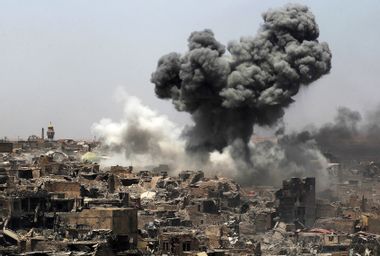
On Tuesday, radical guerrillas deployed a bomb to kill eight persons and wound 40 in an upscale area of Kabul where foreigners, including Indian aid workers, live -- in another sign of the deterioration of security in Afghanistan's capital. It is obvious how long a gas pipeline would last under these circumstances.
I'm not sure very many politicians in Washington were ever really so interested in the gas pipeline. For someone like then Secretary of Defense Donald Rumsfeld, making Afghanistan a U.S. base may have aimed at surrounding and weakening Russia and keeping it from reemerging as a peer (a la the attempted push of NATO into places like Georgia).
Some U.S. leaders, however, were pushing for it. In recent years a Turkmenistan pipeline was seen as a way of forestalling India from breaking the embargo on Iran. And I remember that in fall 2001, when congressmen asked Colin Powell how the Afghanistan war would be paid for, he replied that the region is rich in resources. Since Afghanistan is not, he must have been speaking of places like Turkmenistan.
In any case, the Chinese just demonstrated that you don't need war to get resources. Avoid costly adventurism and grow your economy like hell, and it all falls into your lap.
In May, 2008, Dick Cheney caused an uproar when he told ABC News' Martha Raddatz that public opposition to the war in Iraq was, in essence, irrelevant:
RADDATZ: Two-third of Americans say it’s not worth fighting.
CHENEY: So?
RADDATZ: So? You don’t care what the American people think?
CHENEY: No. I think you cannot be blown off course by the fluctuations in the public opinion polls.
Today, New York Times Editorial Page -- which has become one of the most vehement supporters of the war in Afghanistan (and Pakistan) -- echoed Cheney's sentiment when demanding that European leaders escalate their commitments to the war despite overwhelming and growing opposition among their citizenry:
Germany’s chancellor, Angela Merkel, and France’s president, Nicolas Sarkozy, have repeatedly stated that their countries have a stake in the future of Afghanistan and the future of NATO. But both are wary of pushing their voters too far, too fast. (Both have essentially postponed their decisions on further troop contributions until late next month.) Democratically elected leaders cannot ignore public skepticism, but they should not surrender to it when they know better.
Although Cheney's decree was a bit more blunt and not as concerned with meaningless self-justifying caveats ("Democratically elected leaders cannot ignore public skepticism, but . . . "), those statements seem quite similar.
In the U.S., public opinion toward Afghanistan is now decidedly more pro-war than it is in Europe. Whereas polls earlier this year found majorities of Americans against the war, polls now show that -- after Obama's decision to escalate again -- a majority supports his "surge." That's not surprising: when you combine (a) GOP support for any American war (especially one begun by George Bush) with (b) the support of many Democrats for anything and everything Barack Obama endorses, you get a majority. And indeed, this recent change in public opinion towards the war in Afghanistan is due to "a notable jump in support from the president’s Democratic base" once Obama announced his "surge." Obama speaks and many Democrats follow, even into more war (see this weekend's explanation of "Obamania" from Matt Taibbi about how and why that works).
But even with all of the "debate" over the war in Afghanistan, there are still significant anti-democratic features to it. Over the weekend, Time's Joe Klein, undoubtedly reciting what his hawkish government sources told him, trotted out a brand new "justification" for the war in Afghanistan: we have to stay in order to prevent India and Pakistan from going to war with each other. The U.S. government excels at finding brand new Urgent National Security Reasons to continue fighting wars once the original justifications fail or otherwise become inoperative: no more Al Qaeda in Afghanistan? Still have to stay, otherwise India and Pakistan will fight. As part of his stenography services, Klein explained:
[S]ome of the best arguments about why this war is necessary must go unspoken by the President.
So there are deeply compelling reasons to escalate in Afghanistan. But they're secret. They "must go unspoken by the President." The American people have no right to know what the alleged purposes and objectives are of this war. They're supposed to fight in it (a tiny percentage, anyway) and pay for it with massive debt but they can't be told why it's really being fought. And, of course, one of the most significant prongs of this war -- the one fought with Predators and drones in Pakistan -- is something no American government official will even mention, let alone explain and defend. Recent escalations of that part of the war -- as well as ones being actively considered still, such as targeting a large Pakistani city where high civilian causalties are likely -- will remain strictly secret. That, too, "must go unspoken by the President."
It's true that as a Constitutional Republic, the U.S. is not governed by direct democracy. Political leaders are at times expected to exercise judgment independent of public opinion. And once wars are underway, things like troop movements and battle plans are legitimately classified. But whether to fight wars -- and the reasons they're being fought -- are probably the least appropriate decisions to immunize from public opinion.
The Constitution ties the ongoing use of military force to the approval of the American citizenry in multiple ways, not only by prohibiting wars in the absence of a Congressional declaration (though it does impose that much-ignored requirement), but also by requiring Congressional approval every two years merely to have an army. In Federalist 26, Hamilton explained that this Constitutional requirement is vital for ensuring constant public involvement in debates over war and peace. In Federalist 24, he described the need for public involvement in such matters as "a great and real security against military establishments without evident necessity." That's because the Founders were all too aware, as John Jay put it in Federalist 4, of the "variety of other motives, which affect only the mind of the sovereign, [that] often lead him to engage in wars not sanctified by justice or the voice and interests of his people."
Urging leaders to continue to wage wars in the face of great public opposition, as the NYT Editorial Page does today, is deeply misguided and undemocratic. But fighting wars for secret, undisclosed reasons -- as Klein suggests and defends is being done by the Obama administration -- is even worse. But -- as former Navy Commander Jeff Huber and former Marine Scott Ritter, among others, have both recently pointed out -- Dwight Eisenhower's warning has come true: the military has become its own branch of government, uncontrolled by anyone and almost entirely unaccountable. It virtually always gets what it wants. The stated reasons for fighting in Afghanistan make so little sense that Klein is almost certainly right that the real causes are undisclosed. It's extremely difficult to imagine a circumstance that could justify that.
The world has noted the irony that President Barack Obama is delivering his acceptance speech for the Nobel Peace Prize after launching an escalation of the Afghanistan war. Of course, the critique is a little misplaced, since the prize is for a specific policy success, not for being a pacifist.
Still, Obama was clearly given the prize to encourage him in the direction of peace. It is the tragedy of the sole superpower that it is unconstrained by peers and so can launch wars of choice and shatter international law at will. It can be counseled but not blocked. He was awarded this honor as a counsel.
So here are the things Obama can do to redeem his prize.
1. Get out of Iraq on schedule. We can't stop their low-intensity conflicts, and they are more likely to compromise with each other if we are not there.
2. Resist calls for Iran to be bombed. Such a raid would guarantee that Iran would start a crash program to develop a nuclear weapon, and there would be no way to stop it short of full-scale war.
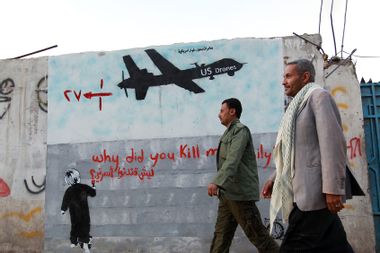
3. Stop allowing the CIA to operate drones with which to assassinate people. It is illegal and shameful. The U.S. military must be in charge of defending the country by force or we are a police state.
4. Get the Palestinians a state by the end of 2011, even if by unilateral recognition. Palestinian statelessness is the biggest human rights scandal in the world, since citizenship is the right to have rights. This step alone would solve the bulk of U.S. problems in the Arab world and would deal a deadlier blow to al-Qaida than capturing Osama bin Laden.
5. Stick to the plan of beginning a U.S. troop withdrawal from Afghanistan in summer 2011. Karzai and the generals will attempt to embroil us in a decades-long quagmire. No one will remember his Nobel Peace Prize if President Obama lets that happen.
So our cerebral president has decided that the way out of Afghanistan is to plunge in further: 30,000 more U.S. soldiers, maybe 7,000 NATO troops, more bombs, more Predator missile strikes in the border regions of Pakistan and an 18-month timetable for commencing withdrawal. Or something.
Administration spokespeople were all over Washington making it perfectly clear that Obama's July 2011 target date couldn't be hazier. "I do not believe we have locked ourselves into leaving," Secretary of State Hillary Clinton told a congressional committee. She said the idea was to notify everybody on all sides that the United States has no long-term intention of occupying Afghanistan.
Meanwhile, Defense Secretary Robert Gates indicated that, depending on events, the target date could change. "We must not repeat the mistake of 1989 and turn our backs on these folks," he said, referring to U.S. neglect after the Russian retreat from Afghanistan that many believe led to the Taliban takeover.
According to CBS News, however, White House press spokesman Robert Gibbs said the president insisted the plan was "etched in stone. Gibbs said he even had the chisel." But of course that's a joke, so it's anybody's guess what it means. Calculated ambiguity, then, appears to be the point.
There was more of the same in lengthy, well-sourced, same-day articles in the New York Times and Washington Post describing President Obama's decision-making process. "Intense, methodical, rigorous, earnest and at times deeply frustrating for nearly all involved" was how the Times described it. "Mr. Obama," Peter Baker's account said, "peppered advisers with questions and showed an insatiable demand for information."
So the president's in charge. That's the first thing the White House wanted understood. Second, he inherited a terrible mess from his predecessor. "All of those in the room," the Post's version stressed, "were familiar with [Gen. Stanley] McChrystal's classified 66-page assessment of 'serious and deteriorating' conditions in Afghanistan, which made clear that 'we were starting from zero after eight years of war,' a civilian adviser said."
Third, Dick Cheney can just sit down and shut up. Campaign rhetoric aside, Obama pressed the generals for speeded-up deployments. Presented with a Pentagon plan that envisioned a gradual 18-month troop buildup, he reportedly emphasized to Gen. David Petraeus that "What I'm looking for is a surge. This has to be a surge."
Petraeus, of course, conceived and executed the vaunted 2007 "surge" in Iraq that's touted as the Bush administration's greatest (perhaps only) success in that misbegotten war. While the strategy's ultimate success won't be known until U.S. combat forces actually leave Iraq, it's seemingly made an orderly withdrawal possible, which appears to be all Obama hopes for in Afghanistan -- an interval of relative stability enabling the Karzai government to get its act together.
Or not, which is where things could get tricky. Reportedly, Gen. Petraeus cautioned Obama to think of the current Afghan government as essentially "a crime syndicate." That is, a hierarchical, semi-conspiratorial organization based on tribal and familial loyalties rather than abstract ideals of patriotism or public service -- basically the only way Afghan society has ever run, and realistically the only way it's going to function after Americans leave.
Something else Obama's team confronted was the impossibility of military victory. "Mr. Gates and others," the Times reported, "talked about the limits of the American ability to actually defeat the Taliban; they were an indigenous force in Afghan society, part of the political fabric." One may as well talk of driving Baptists out of Texas.
That said, anybody who imagined that this president -- any American president -- was going to abruptly pull out of a NATO action in Afghanistan, or to negotiate from a position of weakness, potentially leading to the spectacle of ragtag Taliban militiamen overrunning Kabul in beat-up Japanese pickup trucks and threatening a consequent reestablishment of al-Qaida bases there, simply isn't dealing with political reality, Afghan or American.
The success of Obama's plan further hinges on Pakistan's ability to confront jihadist elements on its side of the border. Essentially, the president is like a poker player trying to draw to an inside straight, gambling that his troop buildup can buy enough time to bribe Taliban fighters motivated by dislike of foreign invaders more than jihad into changing sides, another Afghan tradition.
It's definitely a long shot. The hopeful part of Obama's policy, however, resides precisely in the calculated ambiguity of the July 2011 date.
"Our troop commitment in Afghanistan cannot be open-ended," the president said in his televised speech, "because the nation that I am most interested in building is our own."
So when was the last time a president spoke in the language of realism, acknowledging limits to American power in remote parts of the world, and to America's ability to pay for endless wars of marginal strategic importance?
It's an important first step. Will there be another?
© 2009, Gene Lyons. Distributed by Newspaper Enterprise Association