Updated: Today
Topic:

Bank Reform

Wall Street owners angry with their purchase

Elizabeth Warren bails out of Harvard

The law professor cancels a class. Does she need free time for a bruising confirmation fight?

Elizabeth Warren bails out of Harvard
Reuters/Mike Theiler
Elizabeth Warren

Don't expect anything to happen before the Labor Day weekend, but the latest iota of information on Elizabeth Warren could, just maybe, or quite possibly, be construed as encouraging. A tweet from the Columbia Journalism Review's Ryan Chittum points us to a Washington Post item by Brady Dennis reporting that the law professor suddenly dropped out of her fall contracts class at Harvard.

"I'm writing to let you know that Professor Jerry Frug will be teaching your Contracts class this term instead of Professor Elizabeth Warren," law school dean Martha Minow wrote to students on Tuesday, according to an e-mail obtained by The Washington Post. "Professor Warren regrets that she will not be able to teach you this fall and we regret the last minute change."

Classes are scheduled to begin next Wednesday.

How does this tidbit rank against the news that Warren was spotted having lunch with Obama advisor Valerie Jarrett or that she was seen leaving the White House on a Thursday afternoon a couple of weeks ago? The Post observes that she managed to teach her class during the last two years, even while overseeing the congressional panel investigating TARP. So something is up.

I choose to be heartened. A class full of Harvard law students may be disappointed, but where they lose out, the nation gains.

Monday link dump: The sandwich party patriots

  • Alex Pareene writes about politics for Salon. Email him at apareene@salon.com and follow him on Twitter @pareene More Alex Pareene

Bush appointee invents America where everyone agrees with him

Former Bush administration recess appointee Peter Kirsanow has written what he thinks is a clever post indeed at The Corner, in which he wonders how liberals can possibly claim to love America when vast, huge, massive majorities of Americans hate liberals and everything they stand for.

Emphasis mine:

Consider some of the statements from prominent politicians and their acolytes in the elite media regarding recent controversies -- the Ground Zero mosque, the Arizona illegal-immigration law, the financial-reform bill, the California marriage referendum, Obamacare, Afghanistan, and the administration's Gulf drilling moratorium. Their commentary suggests (if the polling on these issues is reasonably accurate) that approximately 70 percent of Americans are racist, xenophobic, greedy, homophobic, uncaring, and stupid religious bigots, and bloodthirsty, polluting imperialists to boot.

Well.

Sixty-eight percent of Americans oppose the so-called "ground zero mosque," according to one CNN poll. According to an Economist poll, a majority of Americans acknowledge that Muslims have the constitutional right to build houses of worship.

Fifty-five percent of people support the immigration bill. A majority of respondents -- 54 percent! -- also believe that the bill will lead to anti-Hispanic discrimination.

Then his list of things 70 percent of Americans support gets odd. A vast majority of Americans supported stricter financial reform, in April. In July, pollsters found that most Americans had no opinion of the financial reform bill, and many had never heard of it. Other polls found that people didn't think it would work. Responses seem to depend entirely on how the question is worded.

California's Proposition 8 passed with 52.24 percent of the votes. One recent CNN poll found a majority of Americans favoring gay marriage, and support for gay marriage is on the rise in every state in the nation.

Opposition to healthcare reform remains, with fluctuations, around 50 percent. Many Americans don't know much about it.

Americans no longer particularly support the war in Afghanistan, but being antiwar doesn't track with the "liberals think 70 percent of Americans are imperialists and bigots" argument, at all. (When the question is about Obama's handling of the way, the results are usually close to tied between approval and disapproval, in the mid-40s.)

According to Gallup, 47 percent of Americans support lifting the drilling moratorium and 46 percent oppose.

So! "If the polling on these issues is reasonably accurate," Peter Kirsanow basically just imagines, in his head, that 70 percent of Americans agree with him about everything.

It takes a strange sort of psychology to imagine that slim majorities of Americans, as measured by sometimes wildly divergent opinion polls, are infallible, as long as they agree with you. Though I guess the task is made easier if you are simply convinced, without evidence, that vast majorities are on your side.

But, based on that logic, how can Kirsanow possibly claim to love this nation, when majorities still hate his former boss, and so many millions voted to elect Barack Obama and this entire Democratic Congress?

The best part of Kirsanow's post is actually the second line, on Democrats' complaining about having their patriotism called into question during the Bush years: "Of course, no one had questioned their patriotism...." Someone tell that to the entire 2004 Republican convention!

  • Alex Pareene writes about politics for Salon. Email him at apareene@salon.com and follow him on Twitter @pareene More Alex Pareene

Dodd vs. Warren shows that government is broken

The senator says the professor can't be confirmed, so Obama, with two majorities, should compromise

The true meaning of Dodd vs. Warren
Reuters/AP
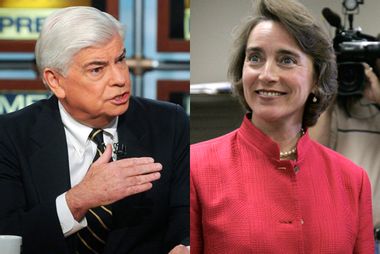
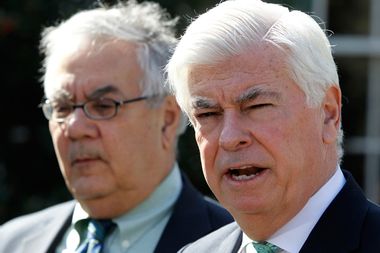
Elizabeth Warren, chair of the Congressional Oversight Panel investigating TARP, and Sen. Christopher Dodd, D-Conn.

Alert the Elizabeth Warren media! We've known for at least a month that Sen. Chris Dodd, D-Conn., the lame-duck chairman of the Senate Banking and Finance Committee, isn't the biggest fan of the Harvard Law School bankruptcy expert whom progressives are championing for the job of director of the newly created Bureau for Consumer Financial Protection. Here's the latest news, from a lengthy American Banker interview with Dodd recapitulating the arduous legislative struggle for bank reform: He's still opposed.

Dodd acknowledged he wanted FDIC Chairman Sheila Bair to consider heading the consumer bureau, but he confirmed that she is not interested.

He also recognized that consumer groups were lobbying to have Harvard professor Elizabeth Warren head the agency, but he said she would have difficulty being confirmed.

"If the administration goes through an eight-month debate over who is going to run this, you are going to do damage before you start," Dodd said. "You need to have a good-quality individual, and if [Warren] can be confirmed, then step up and do it. I just think it's a problem, but I could be wrong."

Dodd may indeed not be wrong. Appointing Warren could spark a long political fight that does some damage to the potential effectiveness of the consumer protection agency by delaying its implementation. On the other hand, not appointing Warren could also do some damage -- to progressive enthusiasm for Democrats in the midterm elections.

But there's a deeper problem at play here than just tactics. A president whose party controls both houses of Congress with significant majorities, and who took office following one of the greatest financial crises in the nation's history, should have no problem appointing whomever he wants to an important new post created by bank reform legislation that, rightly or wrongly, will be seen as one of the Obama administration's signal achievements. The notion that getting a consumer advocate into a position involving consumer advocacy might take eight months and not even succeed is ridiculous. That's not how government should work.

We can't dismiss the possibility that Dodd's concern over whether Warren can be confirmed is merely a smoke screen disguising some long-held antipathy toward her, instead of an honest appraisal of her chances. But there's another possible explanation, too: The insane, absurd rigmarole involved in getting anything accomplished in the U.S. Senate has drained all the life out of Dodd. Throughout the American Banker interview, Dodd repeatedly talks about the challenge of doing the best you can do under the circumstances you are in -- a process that requires constant compromise and accommodation and sacrifice.

"You want to write a good bill. You can get votes, but in order to get the votes your bill becomes a shadow of itself or you try and write a stronger bill but you don't get the votes. So what's the point, you don't have a bill," he said. "You try to write the bill in a way that would be a strong bill -- that those who are watching this would say this is a remarkable bill in terms of what it does and you've got the 60 votes to pass it."

Dodd said he was pulled and pushed from both sides.

"You are working against, what was it, a thousand lobbyists that got hired to work against this bill?" he said. "I don't have a Republican partner, I have a one-vote margin in conference. It's a complicated subject matter. I've got a left that doesn't think you're being strong enough and a right that thinks you've gone too far."

Further exacerbating the situation: The other side stands to gain politically by preventing you from succeeding at all, and is willing to pretend to negotiate as a pure stalling tactic. You might think that, now that he is no longer running for election, Dodd would feel free to lambaste this mockery as the sham that it truly is. But the opposite has happened. Dodd seems to be suffering from a form of Stockholm syndrome. He's been part of a broken system for so long that he's completely internalized its rules. If GOP willingness to abuse the process of how legislation gets made becomes standard operating procedure to the point where even non-Cabinet appointments become all-out political wars, then so be it. Better to accommodate, than fight.

In this sense, the fight over Elizabeth Warren is a proxy fight over the currently inoperative system of government we are suffering under, because there's little question that in many ways the Obama administration has mirrored Dodd's capitulation. As a result, it is true, legislation has been passed. We have healthcare reform and bank reform. But we also have a right-wing outraged at even the pale "shadow" of reform and a left wing apoplectic at how little has been achieved.

That leaves precious little room for cheerleaders. No wonder Obama's approval levels keep sinking. The set of people willing to make the argument that "something is better than nothing, even if that something is achieved by sacrificing your true goals in the face of intransigence from your enemies and spineless accommodation from your allies" was never big to begin with, and gets smaller every day.

The credit card pound of flesh gets pricier

As expected, banks respond to a crackdown on their abusive behavior by raising rates. But we're still better off

The credit card pound of flesh gets pricier
iStockphoto/Salon

It is no coincidence that the Wall Street Journal chose to mark the moment new rules kicked in that clamp down on abusive credit card practices by running a front page story declaring that credit card interest rates are on the rise.

On Aug. 22, the final phase of the Credit Card Accountability, Responsibility and Disclosure Act of 2009 came into effect, instituting new limits on penalty fees and other requirements. (US News & World Report has a good breakdown on the changes here.)

On Aug. 23, the Wall Street Journal reports, citing data covering the second quarter of 2010,  "issuers responded by pushing card rates to their highest level in nine years."

The juxtaposition jibes all too nicely with the warning frequently voiced on the Journal's opinion pages that any attempt to reduce credit card company profits by clamping down on exorbitant fees or arbitrary, outrageous interest rate hikes would be answered by higher across-the-board interest rates and scarcer cheap credit.

To her credit, Journal reporter Ruth Simon gives some room to people pushing back on this thesis. First, there's New York Democratic Rep. Carolyn Maloney, the sponsor of the CARD Act:

Rep. Carolyn Maloney (D-NY), said that despite the rising rates, the law benefits consumers because it eliminates unwelcome surprises and provides them with a clear picture of the costs they will face. "Better that consumers should know up-front what the interest rate is, even if it's higher, than to be soaked on the back-end by tricks and hidden fees."

Then there's the kicker, in which a banking lobbyist notes that, once the economy improves, competition will inevitably offer borrowers lower rates.

"This is a very competitive industry," says Kenneth Clayton, senior vice president at the American Bankers Association, a trade group. "Somebody will take advantage of lower defaults to drive prices down."

In fact, it will be easier for banks to compete, and for borrowers to choose. A lower interest rate, in theory, will mean exactly that: a lower interest rate, instead of an interest rate that is only lower because the bank intends to make up for lost profits with an avalanche of fees.

The Journal doesn't give us too much detail on the new rules. Let's pick out just two: Late fees can no longer be larger than your minimum payment, and you can't be charged multiple fees for a single transgression.

For example, under the old rules, you could miss a $10 minimum payment, and get slapped with a $30 fine. And if the $30 fine happened to knock you above your credit limit, you could get hit with another fee for breaking that rule, too.

Maloney is right: Getting upfront information about how much your credit will really cost is a feature, not a bug, of the new rules. And if that means less accessibility to cheap credit, is that entirely a bad thing? The illusion that money was cheap fostered bad behavior at every level of the U.S. economy prior to the great credit crunch. Now, as documented by the Federal Reserve Bank of New York's quarterly report on household debt and credit, Americans have been closing their credit card accounts and paying off their outstanding debt. Perhaps if credit had been more expensive to begin with, we wouldn't have gotten in so far over our heads. And perhaps the real reason that the credit card companies are raising their rates has more to do with the fact that prudent consumer behavior is cutting into their bottom lines, than to the new rules.

And yes, of course the banks will find ways to game the new rules. But that's why we now have a Bureau of Consumer Financial Protection to guard our backs. So let's get Elizabeth Warren on the job, pronto!

Elizabeth Warren gets her own rap video

Can Obama resist the combined power of Auto-Tune and a Sergio Leone homage? Video

Elizabeth Warren gets her own rap video
YouTube screen shot

Given this blog's commitment to following every twist and turn of Elizabeth Warren's epic quest to become the first director of the Bureau for Consumer Financial Protection and thenceforth raze Wall Street to the ground, I am compelled to present you with the Sheriff Warren Rap, courtesy of the Main Street Brigade.

I think Felix Salmon is correct to observe that it is hard to "imagine anybody doing this for" any of the other candidates for the position. We could leave it at that, but I'm hoping readers will take a stab at three additional essay questions.

1) What does the Sheriff Warren rap tell us about the evolution of American politics as it pertains to the appointment of Senate-confirmable government officials?

2) Can you think of any other rap video that namechecks Oklahoma (excluding references to college football)? If not, what does this tell us about the relevance of coastal cultural enclave decadence to flyover country?

3) Explain how the cooptation of Ennio Morricone and the use of Auto-Tune increase our understanding of predatory lending.

Page 1 of 36 in Bank Reform Earliest ⇒

About Bank Reform

After thirty years in which the principle that markets know best ruled economic policy-making in the United States, the great financial crisis of 2007-2008 brought the deregulatory era to a shrieking halt. The challenge now facing lawmakers and the Obama administration is whether they can craft a new set of rules that will prevent an out-of-control Wall Street from dragging the entire global economy into the gutter once again.

But expectations for bank reform are low. The proposals being debated in Congress don't do enough to solve the problem of too-big-to-fail financial institutions, or to protect consumers. Even worse, to gain enough Republican votes to guarantee passage, Democrats will likely make compromises that further weaken the bill. Despite the greatest financial crisis in more than 70 years, the U.S. government still doesn't have much appetite for meaningful reform.

See also: Bank Bailouts, Ben Bernanke, Goldman Sachs, Mortgage Crisis, Timothy Geithner, U.S. Economy, Wall Street
Bank Reform in the news

Loading...

Currently in Salon

Other News

www.salon.com - sacdcweb02.salon.com