

Silicon Valley is home to some 65,000 millionaires, plus a bumper crop of billionaires. It's one of the richest regions in the country, and a driving force behind the nation's record economic boom. But it's also the setting for a vexing national conundrum: The gap between rich and poor is growing, and nowhere faster than in California, birthplace of the new economy.
Even if families work hard at multiple jobs, they often have a hard time making ends meet -- especially after paying for high-cost housing. Technology drives the area's economy, but the industry leaves many people behind.
Concepcion Garay, 49, lives in Silicon Valley. After 21 years of working in the factories of companies like Control Data, Sperry Univac, Amdahl and Fuji Optical -- most of which moved to Asia or Mexico -- she's now working for $8.40 an hour as a home healthcare aide. It's less than she was making years ago in the factory -- despite the big boost in pay and benefits that came after she and fellow aides organized into a union.
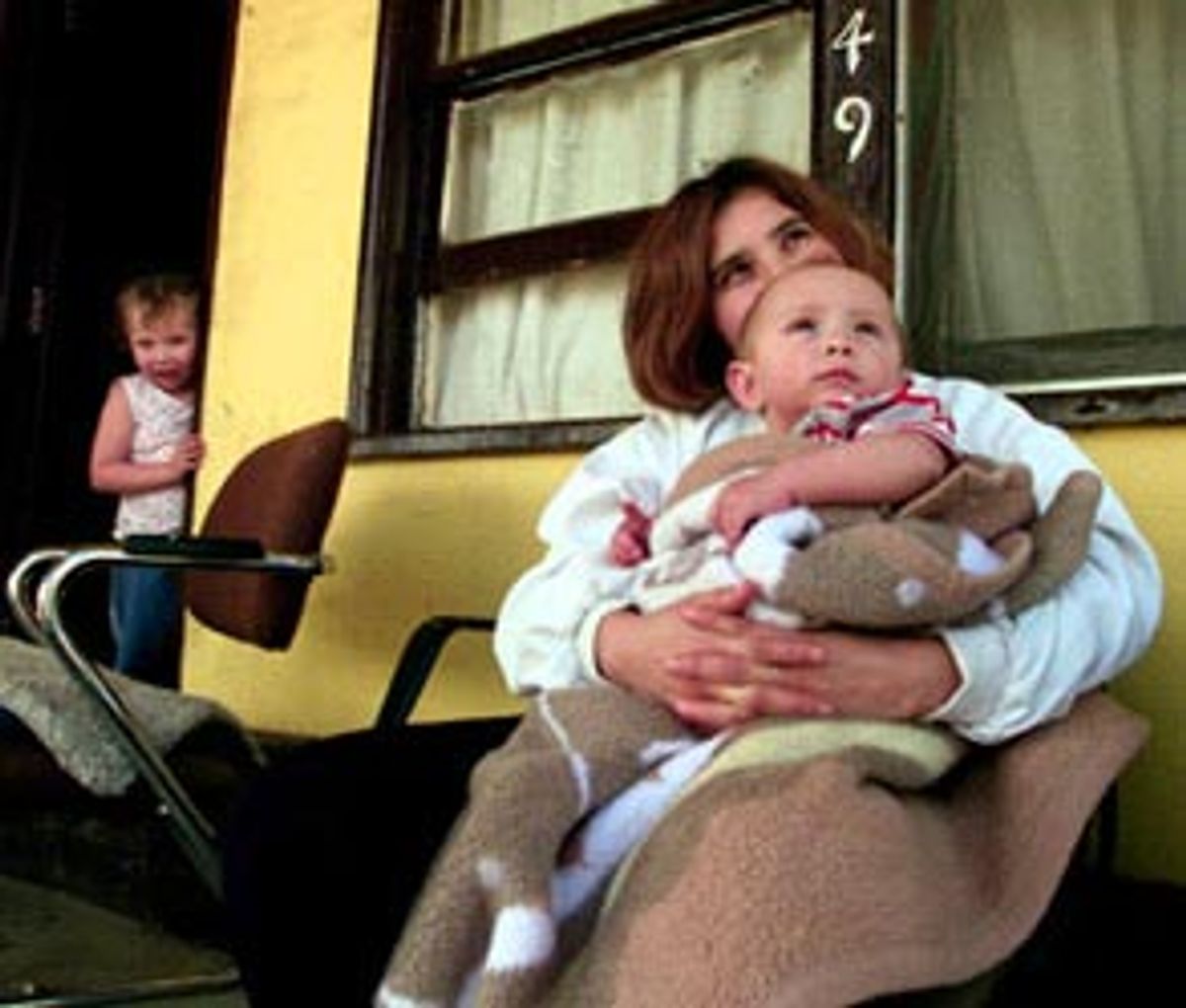
Marcella Juarez, 29, recently emigrated from Mexico. She makes $488 a month at a Taco Bell; her husband makes around $1,000 a month as a day laborer. The rent on their rundown two-bedroom apartment in a crime-burdened neighborhood of East San Jose is $1,225 a month. They manage to survive on an income that officially puts them well above poverty level by living with their two children in one bedroom, then renting out the other bedroom to four other hardworking immigrant men.
James McCuiston, 28, found a home in San Jose when he moved from Texas as a teenager. He graduated from high school, then worked in a variety of jobs, including several computer-chip manufacturing companies, but he was laid off in one of the frequent and sudden twists of corporate fortunes characteristic of the Silicon Valley economy. Now through a temporary employment agency he found a job running the stockroom of a small company, earning $10 an hour -- full-time employees who used to do his job earned $16.25 an hour. In the evening he waits tables. He figures that with the two jobs he might make enough to rent a room in an apartment with someone else. For now he's crashing for free with a friend and sharing his car.
"Some things are unfair," he reflected as he took a lunch break in the glaring San Jose sun. "You see people younger than me driving around in a BMW or Mercedes who don't have a care in the world. It's real difficult for those of us who don't have Mom and Dad looking out for them and can back them up if something goes wrong ... I'd like to think of myself as middle class, but now I definitely fall into the poverty level. I see myself as working class, and I don't see myself getting out of it for a while."
Despite the long run of economic growth in the 1990s, the economic chasm between the rich and the rest of the nation that first opened up more than 25 years ago has continued to grow. In some respects, that growth has slowed somewhat in recent years. The wages of the poorest Americans have risen significantly, and the median family income has crept upward, thanks to minimum wage increases and a tight labor market.
On Monday, California decided to raise its minimum wage by $1, to $6.75, over the next two years. Congress is expected to back a similar raise in the national minimum wage, which is $5.15.
But the gap has continued to spread between the average worker and the richest 5 percent of Americans, an elite that has been the principal beneficiary of both soaring executive salaries -- up 63 percent from 1989 to 1999 -- and the booming stock market (despite the hype about the growing proportion of Americans invested in the stock market, the nation's richest 5 percent own four-fifths of all common stock).
California's economy is still booming, outperforming the rest of the country by many measures since 1995. But at the same time, income inequality in California is greater and growing faster than in the rest of the country taken as a whole, and compared to almost every other state.
In late August a San Francisco Federal Reserve Bank study reported that median family income dropped by 4 percent from 1989 to 1999, even though it rose 8 percent for the rest of the nation. "In 1998," the bank reported, "a greater number of Californians lived in poverty, a smaller number were in the middle class and a majority had family incomes below those of comparable families living outside of California." Only the top 30 percent of families outperformed the rest of the country. (This in a state where incomes had been well above average at all levels for most of the decades after World War II.)
In addition, the cost of living in California is much higher than in most of the United States, making California workers even worse off. Taking into account the cost of living, the Los Angeles Alliance for a new economy recently calculated that 40 percent of Angelenos live in poverty.
The biggest factor in high living costs is housing -- especially in the Bay Area. In San Jose, for example, the median house costs more than $400,000. Because of those prices, fewer Californians own homes than other Americans. Renters suffer the greatest hardship: Forty percent of San Jose renters spend more than 30 percent of their income on housing.
Why is California, once the land of opportunity, now the leader in inequality? The experts disagree, but it seems likely that many of the same forces affecting the rest of the economy are hitting California more forcefully. Also, a few special factors -- including an influx of immigrants, aerospace cutbacks and a movement toward cutting taxes -- have amplified those tendencies. Once again, economists say, California may be a national trendsetter.
The big picture for the whole country since the mid-1970s is clear: Inequality has been growing, most strikingly when looking at men's wages, a bit less dramatically when measuring family incomes (since more women and other family members have joined the workforce). There have been some small but important changes to that picture, especially in the past five years.
Despite advances by African-Americans and other minorities, the gap between rich and poor has widened, and the middle has shrunk, as documented by two studies released on Labor Day, the State of Working America, the authoritative biennial report from the Economic Policy Institute (EPI) in Washington, and Economic Apartheid in America from United for a Fair Economy in Boston.
According to EPI economists Lawrence Mishel, Jared Bernstein and John Schmitt, wages -- especially at the bottom -- have been growing, thanks both to low unemployment and a higher minimum wage. But middle-income workers have not fared quite as well. During the past decade, Mishel and his colleagues write, "wages at the bottom and the middle grew closer, while the top pulled further away from the rest." Wages are also up partly because productivity is up. But shareholders, executives, banks and bondholders are getting a growing share of the pie compared to labor. The shape of inequality has changed, but the overall trend has not reversed.
Economists are still in raging arguments about how much Silicon Valley's computer and information technology has contributed to the increase in productivity. The EPI crew argues that the high-tech impact is high. In fact, its report attacks one of the most common notions about why inequality is growing.
Many people assume that rapid technology growth is creating a great demand for skilled workers -- and also making uneducated workers less relevant, effectively bidding up wages for the skilled and depressing pay for the unskilled. "The answer why [more rapid growth of inequality] is happening in California is fairly clear," says San Francisco Chamber of Commerce vice president Carol Piasente. "The growing economy in San Francisco is a highly knowledge-based, highly skilled economy -- where the good wages are. Those jobs in knowledge-based industries paying high wages are growing fast here." Economist Deborah Reed of the Public Policy Institute of California argues that higher wages for highly educated workers and the influx of immigrants explain half of California's higher rate of inequality last year.
But the EPI economists say the surge in technological change and demand for skilled workers have been going on for many decades. The overall educational level of the workforce has also risen. Although there may be spot shortages of certain kinds of expertise now at the peak of a long boom, none of these factors explains the continuous rise in inequality since the early 1970s.
There's been a huge growth in jobs in Silicon Valley, but high-paid, high-tech jobs are only a small part of the picture. Nationally, EPI reports, the information technology industry contributes only about 7.5 percent of all new jobs. Even in California computer-related service jobs make up only 2 percent of all jobs (and 6.4 percent of service jobs), according to a Labor Day report from the nonprofit California Budget Project.
More surprising, despite the high wages that systems analysts and computer engineers command in Silicon Valley, the EPI economists report that the wages of information-technology workers over the past decade simply kept pace with wages of similarly skilled workers -- for women in the technology business, wages even slipped behind. The average computer-industry worker is not getting fabulously richer than other workers with comparable training.
The California economy is mainly generating crummy jobs that offer little opportunity to use brainpower. The California Budget Project study by economists Mary C. Daley and Heather N. Royer reported that, despite the image of California as the vanguard of a new information economy reliant on brainpower, only three of the 15 job categories with the largest number of job openings in recent years required a four-year degree, and 10 out of the 15 paid less than $10 an hour.
Many of the new jobs in California in both services and light manufacturing have developed precisely because wages are so low, argued Jean Ross, executive director of the California Budget Project. And the high-tech industry -- which has shipped much of its manufacturing overseas -- generates both bad and good jobs. "For every systems analyst and programmer, you're having more child-care workers, retail workers, stockroom attendants and delivery truck drivers for goods sold through e-commerce," she said.
But the gap isn't just between high school graduates and engineers with a Ph.D. Employers do pay more for better educated workers, but the EPI team found that 80 percent of the "education premium" went to managers and sales workers -- leaving crumbs behind for all the computer engineers and programmers. This doesn't support the notion of technology driven inequality, but rather buttresses the popular notion that corporate executives are simply making out like bandits at everyone else's expense.
What does California's economy mean for the rest of the nation? In their recent Federal Reserve study, economists Daley and Royer argue that if California had the same population as the rest of the country, and if the recession had not lasted longer in the state than in the rest of the country, inequality in California would not be so much higher than in the rest of the country.
But the recession lasted longer in part because California lost so many good-paying, mainly unionized aerospace jobs. Over the past decade more than 200,000 manufacturing jobs in typically well-paid durable goods industries disappeared. And that's not just a cyclical change; those jobs aren't likely to be coming back, partly because many have gone overseas.
Is immigration, one of the biggest recent demographic changes in California, the culprit? Sweatshop industries have emerged to take advantage of immigrant labor, and contractors have used immigrant labor to push back on unions and drastically cut wages in several skilled trades, especially in residential housing construction. There's intense competition at the bottom, from farm labor to janitorial work, hotel cleaning to personal service, and that drives down wages.
But immigration by itself isn't the explanation. As Peter Dreier, professor of politics at Occidental College, noted, "A janitor or hotel worker in San Francisco makes several dollars an hour more than a typical janitor or hotel worker in Los Angeles because more of them have been unionized for a longer time ... If immigrant workers are undocumented, they're intimidated from forming unions, and employers effectively discriminate in their decisions to pay immigrants less than native workers."
But as unions adapt their strategies, "These same immigrants are in the forefront of the struggle to unionize the workforce," Dreier says, as indicated by the janitor strikes earlier this year and hotel organizing drives throughout California.
So what does explain the rising inequality? The rising influence of corporations in politics and the labor market, according to the Economic Apartheid in America study. Chuck Collins and Felice Yeskel of United for a Fair Economy argue that corporations have shaped the economy, from Federal Reserve anti-inflation policies to global economic agreements.
The analysis in the State of Working America lays much of the blame for growing inequality on a weakened labor movement, Federal Reserve policies focused only on fighting inflation and changed corporate strategies: an emphasis on increasing shareholder value, wildly escalating executive compensation, a relentless drive to cut costs through downsizing, subcontracting and simply driving employees harder.
Globalization has also hit California particularly hard, because of its proximity to Mexico and East Asia. The freer flow of capital, goods and, to a lesser extent, labor has been a leading force behind the changes for jobs and workers.
Whatever the reasons, in a winner-take-all marketplace, social expectations about how employers should behave have changed. Management strategies that emerged during earlier recessions, which cut commitments to workers and treat them more as contingent costs than business assets, have remained popular in the globalized economy.
"Memories of the early '90s are still fresh in business minds in California," Ross said. This has led many companies to hold down pay, despite difficulties finding workers, and to rely on temps and other contingent workers rather than build up a permanent staff.
Many years of crimped public spending have also directly and indirectly lowered living standards in the state. California's education system has dropped far behind in the nation, thanks in part to Proposition 13, passed in 1978, which limits property taxes. And less public spending means fewer good state and local jobs are being created.
What would the picture look like in California if things had gone differently? United for a Fair Economy estimates that, if average pay for production workers had grown as fast as pay for chief executives, factory workers would be making an average of $114,035 a year (instead of $23,753) and the minimum wage would be $24.13 (not $5.15).
Temp workers like McCuiston, fast-food employees like Juarez and newly unionized hourly wage workers like Garay are hoping to see California's opportunities increase. Their frustrations are one reason the state is now so strongly Democratic -- as well as a hotbed of support for Ralph Nader. In fact, support for Nader has surged in this state, from 4 percent in September to 6 percent according to a poll taken last week by the Public Policy Institute of California.
The state is also the center of some of the most aggressive union organizing in the country. Whatever the causes of California's trend-setting inequality, and whatever their proposed solutions, a growing number of Californians seem determined to turn it around.
Shares