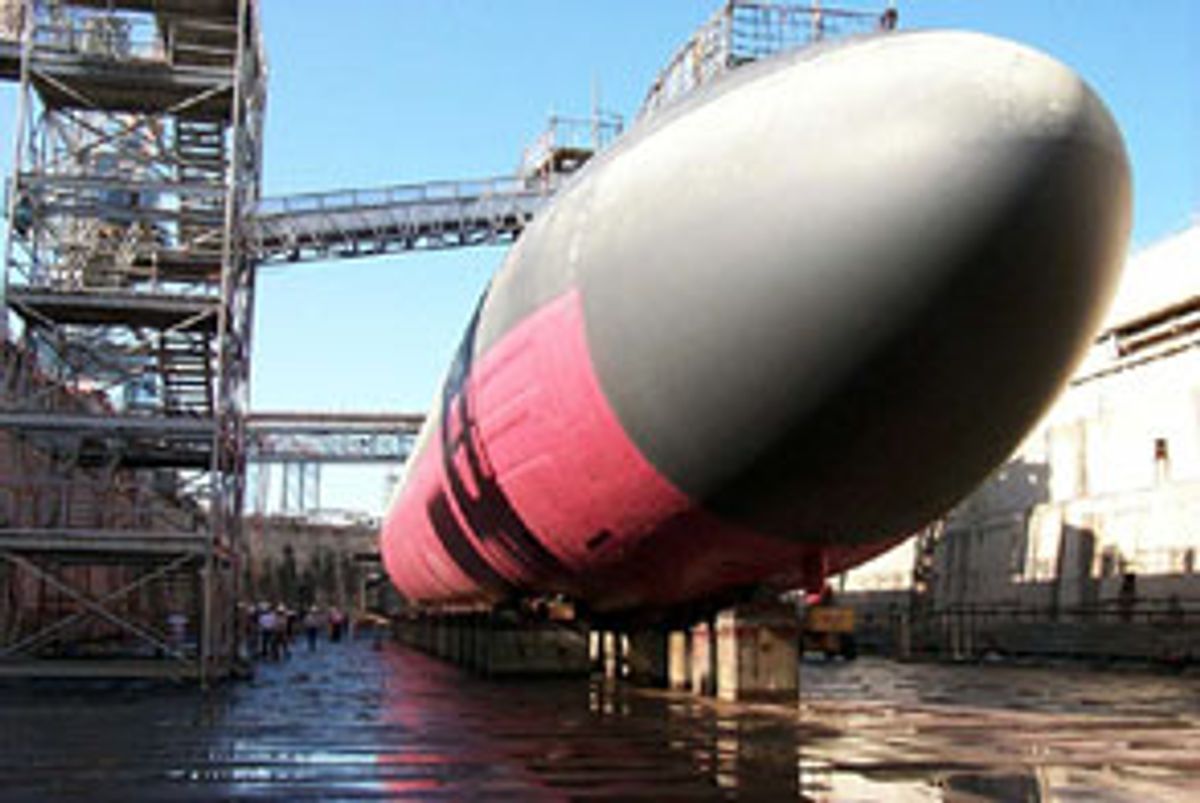
With each new revelation about civilian involvement in the USS Greeneville incident, the situation is growing murkier and more embarrassing for the U.S. Navy.
On Friday, the results of the Navy's preliminary investigation of the accident, in which a Navy submarine collided with the Japanese fishing vessel Ehime Maru, were leaked to the conservative Washington Times newspaper. The paper published excerpts that had been read over the phone to a reporter. The report's conclusions paint an unsettling picture of the involvement of civilians in the accident. The Navy reportedly acknowledges in the document that civilians may have been a contributing factor in the crash, jeopardizing not only the lives of those onboard the Ehime Maru, nine of whom are now missing and presumed dead, but also the crew and passengers of the Greeneville. Though the Navy and a number of former officers and Naval experts have defended the safety of what the Navy refers to as "civilian embarks," the latest allegations raise stark questions about the soundness of that policy.
The report offered the first concrete evidence that the Navy's longtime practice of bringing civilians aboard for joy rides on submarines may pose a threat to public safety. "The location and number of civilian visitors did interfere with the ability of the OOD (officer of the deck) and commanding officer to use the fire-control system and converse with the (technician) in ascertaining the contact picture from the time the ship was preparing for periscope depth until the (rapid ascent) was conducted," the Navy report states, according to the Times.
The role of civilians in the accident will be a major focus of a rare public court of inquiry proceeding that will begin in March in Hawaii. Another subject of the review will be why the Navy conducted the emergency-surfacing operation that led to the crash. Did they do it to make the undersea voyage more thrilling to the civilians aboard the Greeneville? That's another sensational allegation that has fueled criticism since the Feb. 9 incident.
The report specifically criticized the crew of the Greeneville for allowing too many civilians to gather around the ship's periscope. And though it does not blame civilians as the sole cause of the accident, the leaked document makes clear that their presence distracted the crew, and could have been a serious contributing factor. And it flies in the face of what the Navy has told the press so far about the accident.
When asked by PBS "Newshour" host Jim Lehrer on Feb. 15 whether there was any indication so far in the Navy's investigation that civilians played a role in the collision, Secretary of Defense Donald Rumsfeld stated, "None whatsoever." He was backed up by other defense spokespersons who parroted his line.
"First of all, on the civilians, as Secretary Rumsfeld said, there is no indication at this point in the investigation that the civilians had any impact on the outcome. We'll continue to look at that," one stated last week.
It was the fourth major blow to the Navy P.R. machine since the deadly collision. First, the Navy took a full week to release a list of civilian passengers on the ship -- several days after two passengers went on NBC's "Today" show to reveal that they had been at the controls of the submarine as it rocketed to the surface. Reporters had been asking the Navy for the list ever since it revealed -- the day after the accident -- that civilians had been aboard the Greeneville. But the Navy remained intransigent, citing the privacy rights of the passengers -- even as some of them came forward to make network television appearances. That prompted an apology from Rear Adm. Stephen Pietropaoli, who told reporters on Feb. 15, "Clearly, in hindsight, we could have done a much better job of making that information known not only to you all, but to the NTSB." Pietropaoli offered a more insightful explanation in a Washington Post interview, admitting that the "institutional reflex for military officers is to continue to gather information and say nothing."
The National Transportation Safety Board, which is now leading the investigation, also revealed Wednesday that the Navy told its investigators that the submarine's fire control technician says he was unable to do his job because the tight quarters of the Greenville's control room had become packed with civilians. That technician's job is to plot sonar data on a large paper chart, which is then used by the captain and crew members in navigation.
Even more damaging was a Washington Post report Friday that the doomed Ehime Maru had been tracked by the Greeneville's sonar at least one hour before the collision -- and that Cmdr. Scott Waddle had been fully aware of the trawler's presence in the vicinity. According to the report, Waddle also told investigators that he was not warned about the boat's proximity to the submarine by his fire control technician. That sailor told investigators that his work was halted because he was distracted by civilians in the overcrowded control room.
Citing unnamed sources at the Pentagon, CNN and the Washington Times both reported that the Navy has found the Greeneville crew had conducted a periscope search that was "too low and too deep to detect the nearby ship." This was all bad news, of course, for suspended Cmdr. Waddle, who on March 5 will face the court of inquiry and possible criminal charges.
The recent developments will no doubt prompt a full review of the Navy's civilian embarkation programs -- a demand that Rumsfeld soundly made on Thursday, as he banned the placement of civilians in controlling positions on military vehicles and called for a review of safety procedures for civilian ride-alongs in general.
The Navy has long permitted select civilians to participate in its embark programs. It's a public relations strategy aimed at developing public support through backstage tours, as it were. And the United States is not alone in conducting such programs. It's also done in the United Kingdom and Russia, two countries with large and respected militaries. A notable exception, however, is Japan, which does not permit civilians to ride on military vessels. And that's one factor that has made it difficult for the Japanese to understand how this accident happened.
In a recent editorial, the Japanese-language Yomiuri Shimbun opined:
Investigations have revealed a series of careless and inappropriate actions on the part of the submarine. We cannot bear to hear such revelations, and, at the same time, we feel strong anger. Especially, the fact that civilians were allowed to be at the controls of the submarine caused us to doubt the U.S. Navy's stance on safety. Facts about having civilians on board and allowing some of them to operate controls have become known one after another, after the media's pursuit of the truth and the investigation of the accident by the U.S. National Transportation Safety Board (NTSB), leading the families of the missing Japanese to distrust the U.S. side.
But in the U.S. Navy civilian embarks are routine -- so much so that officials can't even recall when the programs were initiated.
Generally, requests are made directly to the Navy, and embarks are approved by a number of criteria, mainly having to do with public relations. This places an emphasis on journalists, business owners, politicians and other community leaders. Rumsfeld has acknowledged that these programs are "a reward for work people have done to help the Navy or the Navy League -- things like that."
Those rewards can also lead to criticism, as when journalists revealed that among the passengers aboard the Greeneville were contributors to the USS Missouri Memorial Association, whose trip had been arranged by former Adm. Richard Macke, who volunteers for the organization. Macke's reputation had been indelibly stained after he joked to reporters in 1995 about the rape of a 12-year-old Japanese girl by three U.S. servicemen. "I've said several times, for the price they paid to rent the car, they could have had a girl," he said, implying that soliciting a prostitute would have prevented the rape. The unfortunate quip ultimately cost him his job.
Two men affiliated with the Missouri Memorial Association were allowed by the submarine's captain to sit at the controls as it made its emergency ascent.
The Navy denies that organizations like the Missouri Memorial Association increase the pressure for civilian embarks. Pacific Fleet spokesman Lt. Cmdr. Flex Plexico says, "It just happened that these civilians were contributors to the Missouri, but I don't think that had any bearing on whether or not they were brought aboard the submarine. They were seen as business and community leaders, and that's one of our target audiences to bring out to sea, so they can share that experience with their businesses and communities."
However, between 1999 and 2000, civilian embarks in the Pacific Fleet increased from 11,644 passengers to 14,273. Plexico attributes the increase to better efficiency in running the programs, an increase in requests and the recent Department of Defense program "Reconnecting with America," a public relations program designed to build popular support for military operations.
"We've been doing this for years -- trying to give the American people a better idea of what their sailors do, where their money goes. Our belief is that ships, submarines and airplanes belong to the taxpayers. If they pay for it, then we ought to do our best to show them what they paid for," Pimlico says. He also says that anyone can request to sail on a submarine like the Greeneville by calling a Navy public affair's office or the area command.
"But nobody embarks people aboard Navy ships, submarines or aircraft besides the Navy. We take referrals from people -- if somebody says, 'Hey, there's a group of people that I think would benefit from going out on a submarine,' then we take that referral and contact the group. But a Navy command makes the final decision as to who will embark," he states.
The presence of high-powered citizens, however, could make it more difficult for crewmembers to do their jobs. In an interview Thursday, Ned Beach, a former Navy captain and author of the bestselling book "Run Silent, Run Deep," offered the following poignant example that goes to the heart of the question: "Chances are that this sonar man is a young guy, probably in his very early 20s," he says, applying a hypothetical situation to the fire control technician who admitted this week that he wasn't able to do his job because civilians had crowded the control room. "He hasn't got the horsepower to say to some 50-year-old bank manager, 'Please sir, get out of my way.'" Nonetheless, Beach still believes the Navy should continue to carry civilians on its vessels. "The Navy's been doing this for many years -- as many as 50 or 60. It's all been well received and everyone has been pleased. Of course, if a disaster happens, then you have to cope with it."
The Navy maintains that it has strict criteria for determining who is permitted to ride along. Applicants must meet a variety of criteria before they are permitted on an embark. First and foremost, says Plexico, is the physical condition of the passenger -- because they must climb ladders and fit through tight spaces. It also depends on the ship or submarine's schedule. "We can't embark everyone, so if we can get a group of people that is known to have influence or the ability to communicate that message a larger group of people, it's a better return on our investment. That's why we embark media -- we know that individually we can't bring everyone on board -- there aren't enough underway or enough ships or submarines. If we bring on a journalist, they can talk to tens or hundreds of thousands of people." The Navy does not keep statistics for the number of journalists it takes on its vessels each year.
Prior to the Greeneville accident, there has been no major public debate over whether or not civilians should be allowed to actively participate in naval operations. One of the criticisms in the Navy's preliminary report was that too many civilians were crowded into the control room of the Greeneville during a critical time prior to the accident. However, Navy policies do not specify a limit on the number of civilian passengers aboard a ship at any given time.
"There is no specific maximum, but safety considerations, such as access to emergency breathing apparatus, and logistics concerns, such as length of underway period, composition of group and plans for getting the guests on and off the submarine are all factors taken into account," says Jensin Sommer, a spokeswoman for Navy headquarters in Washington. "Sixteen is not an unusually high number of civilian guests for an orientation embarkation, but more of an average."
Others are more critical about placing civilians in control positions than they are about the number of passengers aboard. Jane's Defense magazine spokesman Paul Beaver criticized the proximity of civilians to the controls of the Greeneville last week. "By all means take them to see a nuclear-powered submarine, but don't allow them to be in the control room." But the Navy denies that the men were actually in control of the emergency operation.
In a press conference, Navy spokesman Pietropaoli told reporters that crewmen never relinquished control. "In a technical sense, they [the civilians] had their hands on control surfaces at the control station," he said. "In a real sense, they were 100 percent the entire time, as always -- many of you have done this procedure yourself, although perhaps not an emergency surfacing, in driving the submarines when you've been brought to a submarine -- in a real sense, they have a fully qualified, very interested watch-stander standing directly behind them over their shoulder, with their hands on your hands, ensuring that you don't have a sudden spasm and do something you should not do."
Regardless of the ultimate outcome of the investigation, it seems clear from preliminary reports that the Navy has procedures that are too loose in regard to civilian passengers. Nuclear submarines are compact vessels with controls and perils spread throughout. If the Navy is unable to control the movement of its passengers or the commanders of any vessel permit civilians to be in positions or areas that compromise the safe navigation of a ship or submarine, then it may have to reconsider permitting them aboard.
As Ned Beach said, "I would be unhappy to see the Navy greatly reduce the opportunity to take civilians out on cruises like this because of this one incident. But nine people lost their lives, and how do you take that into account? The monument to these nine lives may be to restrict the Navy's operational capability to do these things. That's what the Navy may have to do to pay for the accident."
Shares