

The only thing most intellectuals care about more than politics is office politics. It's an axiom that the low stakes of the intellectual world are inversely related to the ferocity over which they are fought; as much as they crave it, few genuine intellectuals wield power with much skill. Those who do try to exercise political influence usually end up as courtiers and "policy intellectuals" churning out position papers from the bowels of think tanks and foundations.
The relationship between intellect and power is an inherently neurotic one, and seldom has this neurosis been more successfully exploited than during the Cold War, when the CIA enlisted left-leaning intellectuals in the fight against the Soviet threat. As difficult as it may be to imagine, the organization believed, in the words of Arthur Schlesinger Jr., "that democratic socialism was the most effective bulwark against totalitarianism." And who better to fight the communists than those who had been betrayed by that "god that failed"?
With access to power, these intellectuals developed an intoxicating sense of relevance. Suddenly ideas were no longer simply ideas: They were a stockpile of powerful cultural weapons with which to wage the life-or-death battle for men's minds. "It's worth considering what these people had in common. They were all Christians, in a non-sectarian, T.S. Eliot kind of way," Frances Stonor Saunders quotes novelist Richard Elman in her fascinating new history, "The Cultural Cold War." "They believed in a higher authority, a higher truth which sanctioned their anti-Communist, anti-atheist crusade."
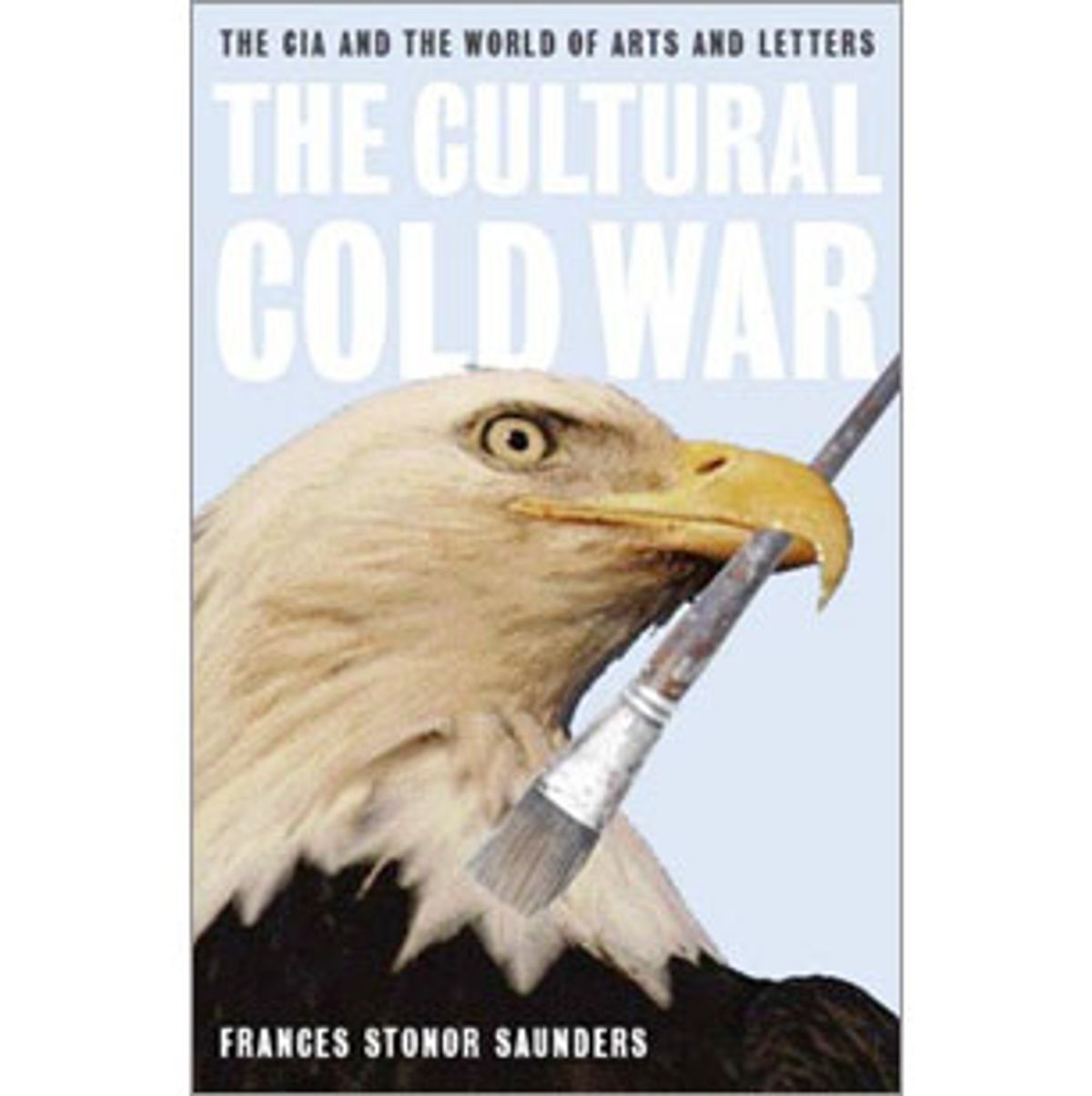
It is Saunders' perhaps unwitting achievement to have portrayed the CIA in a better light than that of most of the intellectual elite the agency funded -- who were, in one way or another, compromised by covert government money. While news that the CIA waged a cultural war in Europe by infiltrating the leading magazines, foundations and organizations of the postwar era has lost its shock value since first revealed by the Nation and Ramparts in the mid-'60s, the story of the intellectuals who were on the CIA payroll has remained largely untold. And a tawdry tale it is, chock-full of hubris, back-stabbing and ineffectual bumbling. Were it made into a movie, "The Cultural Cold War" would more closely resemble the dark antics of "Dr. Strangelove" (with a few David Lodge characters thrown in) than the moral seriousness of "The Spy Who Came in From the Cold."
So who exactly knew about the CIA's role and when did they know it? While this question might seem a trivial one to be resolving in the year 2000, it lies at the heart of Saunders' book. As with the Alger Hiss case or the assassination of President Kennedy, what you thought about the part that CIA funding played said a lot about what kind of person you were. An unwitting dupe? A knowledgeable cynic? A true-believing CIA intellectual? Some combination of the three?
The most startling aspect of "The Cultural Cold War" is the comprehensive list Saunders has compiled of those who took CIA funds: Isaiah Berlin, Sidney Hook, Lionel and Diana Trilling, Robert Lowell, Daniel Bell, Mary McCarthy, Mark Rothko, Bertrand Russell, Arthur Schlesinger, Edward Shils. At times it seems as if few critics, composers or artists of any talent resisted. With the CIA's operations in Iran (1953), Guatemala (1954), Cuba (1961) and Vietnam, the question of how much one knew became as much a moral as an epistemological one.
Saunders' story begins in the winter of 1947, when the short-lived U.S.-Soviet alliance degenerated into a wary standoff. The warm and cuddly image of "Uncle Joe" Stalin that the West's wartime propaganda machine encouraged turned out to be masking a reality that was anything but. With the Nazis defeated, Stalin began a campaign to win over Eastern Europe's labor unions, youth groups, cultural institutions and publishers. Although dwarfed by the United States' economic and military might, the Soviet Union did much in the early years of the Cold War to establish its central paradigm as a cultural one. "America," Saunders writes, "despite a massive marshaling of the arts in the New Deal period, was a virgin in the practice of international Kulturkampf."
Under the auspices of the Truman Doctrine and the Marshall Plan, the CIA waged a campaign to establish the Pax Americana. The Office of Policy Coordination, a CIA division, immediately launched what amounted to a covert psychological program to "nudge the intelligentsia of western Europe away from its lingering fascination with Marxism and Communism towards a view more accommodating of 'the American way.'" The essential strategy was conceived by diplomat George Kennan: "They have fought us with unreality, with irrationalism. Can we combat this unreality successfully with rationalism, with true, with honest, well-meant economic assistance?" he asked. Of course not. "A central feature of this program," writes Saunders, "was to advance the claim that it did not exist." And so the CIA launched a top-secret European campaign designed to showcase the principles of freedom and democracy.
To press its cause, the CIA founded the Congress for Cultural Freedom, an institution that brings to mind Dwight Macdonald's description of the Ford Foundation: "a large body of money completely surrounded by people who want some." A sprawling organization with dozens of offices in 35 countries, it funded 20 magazines and sponsored hundreds of conferences, art exhibits and performances across the globe. The congress was the brainchild of Michael Josselson, "the Diaghilev of America's counter-Soviet cultural propaganda campaign," who had been a buyer at Saks before joining the CIA. The congress was the CIA's de facto Ministry of Culture, funding the magazines, exhibitions and concerts at a furious pace. The Crusade for Freedom, the Truth Campaign, the Militant Liberty Campaign -- many of the congress' programs sounded positively Orwellian, a synthesis of the saccharine and the sinister, with a dash of noir thrown in for good measure.
The CIA's funds were laundered through both legitimate foundations (Ford and Rockefeller) and agency fronts (the Fairfield Foundation) and directed toward projects that advanced the anti-communist cause. While many were absurd -- Russian translations of Eliot's "Four Quartets" airdropped into the Soviet Union, a tour of the USSR by the Yale Glee Club -- others, such as the Museum of Modern Art's first show of abstract expressionist paintings, articulated a sophisticated CIA aesthetic. In the eyes of America's cultural mandarins, abstract expressionism "spoke to a specifically anti-Communist ideology, the ideology of freedom, of free enterprise. Non-figurative and politically silent, it was the very antithesis to socialist realism," Saunders writes. Some other CIA escapades seemed designed to benefit the organization's in-house intellectuals, such as printing 50,000 copies of Arthur Koestler's anti-communist "Darkness at Noon" -- all of which were immediately snapped up by the French Communist Party in what may have been the first (unintended) East-West business alliance.
Encounter magazine was the jewel in the CIA's crown, "our greatest asset," according to Josselson. Based in London and edited by Irving Kristol and Stephen Spender (and, later, Melvin Lasky and Frank Kermode), it was a cultural journal on a par with the Partisan Review, which Saunders says also received CIA money. Although toeing a predictably pro-American line, it could often be entertaining and learned -- "as lively and bitchy as a literary cocktail party," Saunders writes. Encounter's office politics were at least as interesting as its Cold War politics: Kristol sparring with Spender, Josselson feuding with Kristol, Lasky angling for a job, a disastrous period when the famously unreliable Macdonald became an editor. One wonders how the CIA expected to undermine the Kremlin when it had so much trouble keeping tabs on a bunch of City College kids.
But the longstanding controversy surrounding Encounter had less to do with its contents than with its CIA patrons. A crucial feature of the agency's program was the ruse that it did not exist; an intellectual's pro-American views couldn't advance the cause unless they were perceived as independent. The problem was, with the European cultural scene devastated by the war, the Congress for Cultural Freedom's largess in funding European journals, concerts and intellectual gatherings raised eyebrows from the start. Many suspected CIA meddling all along. The Sunday Times labeled Encounter's first issue "the police-review of American-occupied countries," and Kenneth Tynan likened the congress' collection of magazines to a "cultural NATO." Although the CIA's role now looks like the worst-kept secret of the Cold War, most of those who were involved with Encounter claim they knew absolutely nothing about it.
But knowledge is a slippery thing, and like ex-communists who make a point of the precise date they broke with Moscow (1939 being a better vintage than 1956, and certainly better than 1968), the Cold War intellectuals developed a calculus of moral purity according to which the prize went to those who remained willfully ignorant the longest. "Mike did try to tell some people, but they said they didn't want to know," claimed one of Josselson's henchmen. "They knew as much as they wanted to know, and if they knew any more, they knew they would have to get out, so they refused to know."
In private, Isaiah Berlin assured Lasky that "men of sense and goodwill will understand" that Encounter received money that had originated with the CIA; but when the magazine's CIA connection became public knowledge, Berlin attacked Lasky for "having compromised decent people." William Phillips, whose Partisan Review was published by the CIA-funded American Committee for Cultural Freedom from 1957 to 1967, still claims he never suspected anything untoward. And perhaps he never did. "The most effective kind of propaganda," explains a National Security Council directive from 1950, is the kind where "the subject moves in the direction you desire for reasons he believes to be his own."
Saunders underscores the hypocrisy of these editors' willingness to "suck the teats" of the congress long after they suspected it was a government operation. But I wonder whether her moral zeal obscures the very paradox that held the whole thing together. Perhaps this gray zone -- the state of "not knowing" something that you surely do know -- was the key to the program's success, the magical elixir one must swallow in exchange for a chance to determine the course of history. Was learning about the CIA's role a demoralizing piece of information for these intellectuals or a naughty secret that only confirmed their importance? "These stylish and expensive excursions must have been a great pleasure for the people who took them at government expense," Random House editor Jason Epstein observes. "But it was more than pleasure, because they were tasting power. Who wouldn't like to be in a situation where you're politically correct and at the same time well compensated for the position you've taken?"
What a time to be an intellectual -- free to express what you believed, as long as you claimed to be ignorant about what you suspected, and all of it paid for by the U.S. government. I miss the Cold War.
Shares