

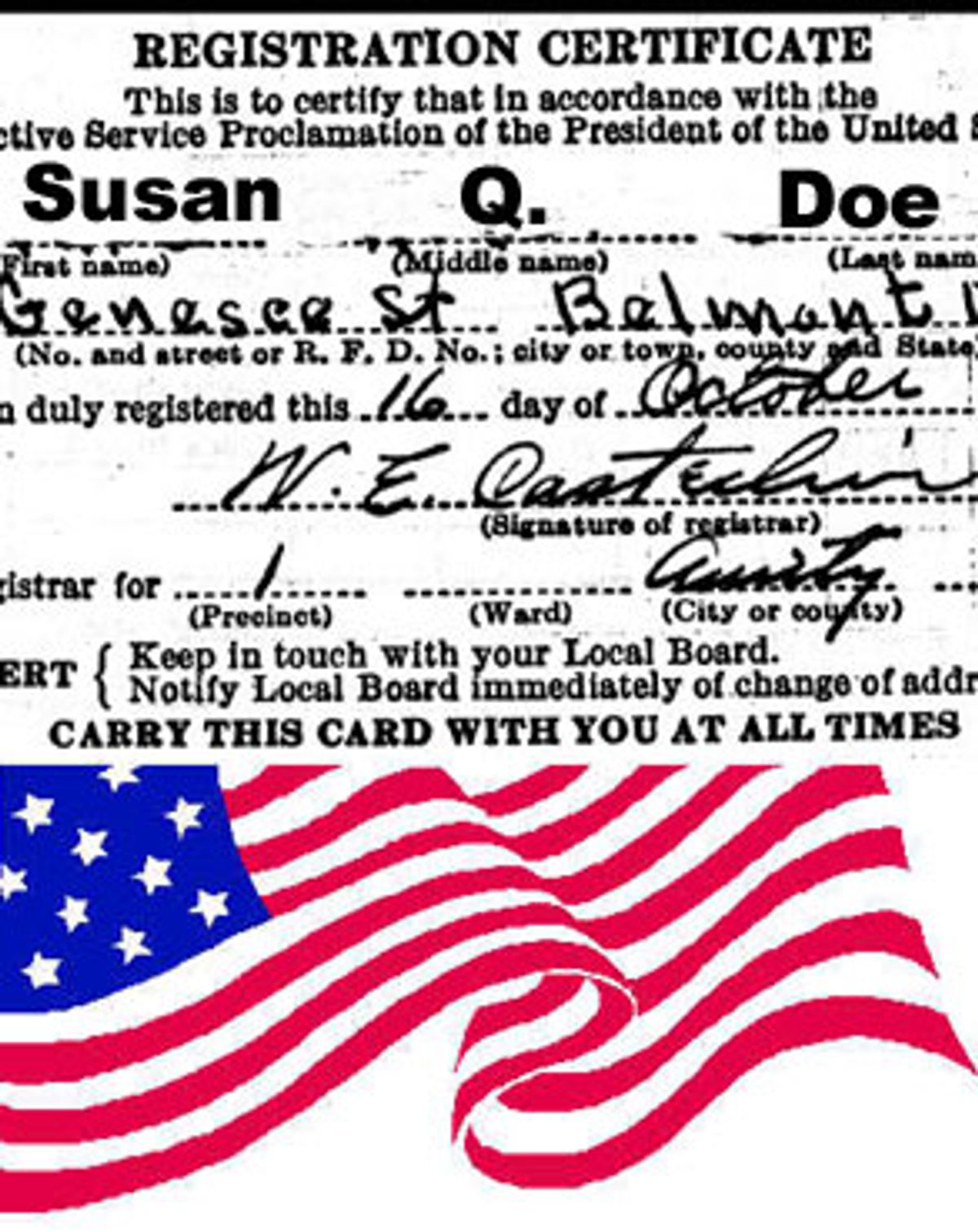
The hundreds of thousands of Americans who registered with the Selective Service last year have exactly one thing in common: They're all men.
Actually, that's not quite true. They were all born men. Federal law requires that all "male persons" register with the Selective Service within 30 days of their 18th birthday. And as far as the Selective Service is concerned, you're a "male person" if you were born male. Change your gender before your 18th birthday and you've still got to register, even if there's not a snowball's chance in Hilla that you'll make it through the Army physical. The same rule applies if you're blind or deaf or without the use of your arms or legs; so long as you were born with a manly member, you've got to sign on the government's dotted line.
But if you're a woman -- a big woman, a strong woman, an iron-pumping brute of a woman dying to go mano a mano with Saddam's Republican Guard -- Uncle Sam might want you in his Army, but he doesn't want you to register for his draft. When President Carter reinstated registration in 1980 following the Soviet invasion of Afghanistan, he suggested that women be included in the process. Congress said no.
And so when Sam Schwartz turned 18 last year, he filled out that Selective Service postcard and put it in the mail. But when Sam's stepsister turns 18 this year, she won't.
One night at dinner, Sam's stepsister started teasing him about having to register. It might have ended there, but sibling spats can take on a different dimension when your father is a civil-rights lawyer. Sam's father, Boston attorney Harvey A. Schwartz, suggested that Sam research the legal implications of male-only registration. Sam did the research, and last week his father filed a lawsuit on behalf of Sam, his stepsister and three other Massachusetts youths. The suit, which was filed in the U.S. District Court in Boston, argues that the male-only registration requirement violates the Constitution's guarantees of due process and equal protection of the law.
The Supreme Court rejected a virtually identical challenge in 1981. Writing for the 7-3 majority in Rostker vs. Goldberg, Chief Justice Rehnquist explained that the purpose of a draft would be to enlist "combat replacements." Because men -- and not women -- could serve in combat, the court concluded that it was appropriate for Congress to include men and not women in the registration process.
Sam says times have changed. Women now serve in many combat positions, and Sam and his co-plaintiffs believe that it is time for women to be subject to registration -- that is, if anyone is subject to registration at all. Just as Iraq war opponent Rep. Charles Rangel, D-N.Y., has done in introducing legislation to bring back the draft, Sam and his co-plaintiffs hope their lawsuit will cause Americans -- and especially young Americans -- to think twice about registration, about a draft and about the coming war with Iraq.
Earlier this week, Salon spoke with Sam and his stepsister, Nicole Foley, by phone from their home in Ipswich, Mass. Sam was on a break from Colby-Sawyer College in New London, N.H. Nicole, a senior at Ipswich High School, was getting ready for swim practice.
So whose idea was it to sue the government?
Sam: It all started out over dinner one night. I had just recently gotten my draft card, and I was complaining that I had to go register for the draft and about all the penalties that went along with it. And Nicole started jabbing at me about how she didn't have to register.
Nicole: At first I was just kind of jabbing him about it, but then the discussion grew into why I didn't have to register and why he did. And we came up with the conclusion that that might not be the fairest thing. So it kind of started as a joke and then grew into something serious.
When did it become "something serious"?
Nicole: About a half an hour later. Actually, there was a lot of time in between the two, time to think about it, time to mull things over.
Sam: Well, the idea sprang from that dinner, but it took another four months or so for us to sit down and decide to go ahead with the lawsuit. Because there are the moral issues that go along with it. Like, do you want women in the draft and to send them to war. I mean, no one wants anyone in the draft, and no one wants anyone going to war. But finally we thought, You know, it really is unfair that this is the only gender-based law on the books.
The Supreme Court considered exactly that question in 1981, and the majority of the justices concluded that Congress could require the registration of men but not women without violating the due process clause of the Constitution. In the face of that ruling, how does your lawsuit have a chance of succeeding?
Sam: I think we have a pretty good chance of winning this lawsuit. The law is obviously unconstitutional. In 1981, 30 percent of the jobs in the military were open to women. And now it's close to 80 percent of the jobs, including being a fighter pilot and, I believe, secondary diversion artillery. Women have more opportunities now in every military field. In the Coast Guard, women can do 100 percent of the jobs. In the Air Force, women can do about 95. The lowest number is in the Marines, which is primarily infantry, and that's about 62 percent.
So, Sam, does the lawsuit mean that you think Nicole ought to be drafted?
Sam: No. I don't want anyone to be drafted. And that's sort of a roundabout way of describing my goal here. I want people to be aware that registration is still around. Another plaintiff in the case, Evan Simmons -- when he registered for the draft, he and his friends didn't even realize what they were doing. It was just like, "Oh, we had to sign this thing and mail it back in." And there are a lot of implications that can happen just by signing that little postcard and mailing it back in. But to them, it wasn't anything. And that's how the majority of today's youth feel. I've talked to a whole bunch of guys who have just registered, and they have no idea what they're signing or anything. I just want to make people aware that this is still around, that this is still a possibility. The possibility of us going to war is very real, especially in the next month, and there is a huge possibility that men -- and women -- could possibly be going to Iraq to die.
It sounds like you're both opposed to a war with Iraq.
Sam: Yes.
Nicole: Well ... yes, right now I am.
OK, one at a time.
Sam: I'm opposed to the war because it's pretty much unjustified. We haven't found any weapons of mass destruction in Iraq yet. We're just going in there because we have an oil crisis, because President Bush cannot find Osama bin Laden, so he's trying to divert attention from that. And it's a political action. The Persian Gulf War raised the first President Bush's popularity, and now [his son] is trying to raise it again.
Nicole: I agree with Sam that right now we don't have enough information to justify a war. But I think that at some point it might be the case that we do have to go in, but with more justified reasons. I just feel like right now our reasons aren't very coherent.
If the president presented a set of reasons that you found coherent, would you volunteer for the Army then?
Nicole: I don't know. Right now, I want to go to college. So I'd take things one step at a time. But you know, even if I could, I'm not sure I would be one who wanted to be on the front lines. I'd definitely consider joining in a different way. For instance, we were talking at dinner last night that, if there were a draft, the first they might draft might be doctors. And I want to be a doctor. So that might be a way I would consider going.
Sam, would you ever considering volunteering for the Armed Forces?
Sam: I would consider volunteering if it was a just cause, if it was fighting a true evil. If we were back in 1945, I would definitely volunteer for the Army. But if it's an unjustified reason, if it's just a political reason, I don't think it would be worth going in and dying for. There are other means to solve problems.
How have your friends responded to the lawsuit?
Sam: Among my friends, there has been some mixed reaction, like, "Well, women give birth, so why don't men go fight the wars?"
Nicole: I've had, well, not a rough time, but I've had to hold my ground quite a bit. It's been interesting. The girls, for the most part, have been more on my side than the boys. Isn't that funny? It's not what I would have expected. I had one math class where we got into this discussion at the beginning of math. I had talked to all of my girlfriends before that. My math class, it's primarily guys, and they were really laying it on me pretty thick, just saying that they didn't think that women could hold their weight as much as men did. It really just struck me. In a society where we try to be very p.c., their comments seemed to be very out of date, and their reasoning to be from a couple of decades ago.
But the girls you know have been supportive?
Nicole: Yeah, it's funny. I talked to the girls, and then in this math class, I was basically talking to their boyfriends. The girls are like, "Yeah! We can do everything the guys can do." They were really supportive and thought it was a great idea.
Do either of you think that women should be in frontline combat positions?
Sam: During my research, I've found that in England they did a study and found that women are just as capable as men in combat. And in Israel, women are forced to serve in as many jobs as men are. But it's a real tossup of a question because of the moral question. Because of the male instinct, you don't want women going up to the front lines and dying. But then, you also don't want men going up to the front lines and dying. But I've seen research that has proven that women can do just as much as men.
Nicole: But at the same time, I'd be very afraid to be on the front lines. I would have to think really hard about that. I don't know. I think it might also depend on physical qualifications. But that could be for everyone, too, both men and women.
Imagine, Sam, that you're in the Army in a foxhole somewhere with the enemy firing upon you, and you turn to your side and see that a new soldier has come to help you out -- and it's Nicole. How would you feel about that?
Sam: It's a hard question. First of all, she's my family, and you want to protect your family. It would be the same way if my brother was in the foxhole with me.
But would you rather have your brother in the foxhole?
Sam: Well, comparing their sizes, I'd rather have my brother.
Nicole: He's a good foot taller than me.
Sam: My brother is 6-foot-4, 200 pounds. [Nicole is 5-foot-4 and about 100 pounds.] But it really depends on the person, the individual, man or woman. I've seen women who can outrun me, outlift me, do just about everything better than me. And then I've seen men who couldn't beat up my sister.
Shares