

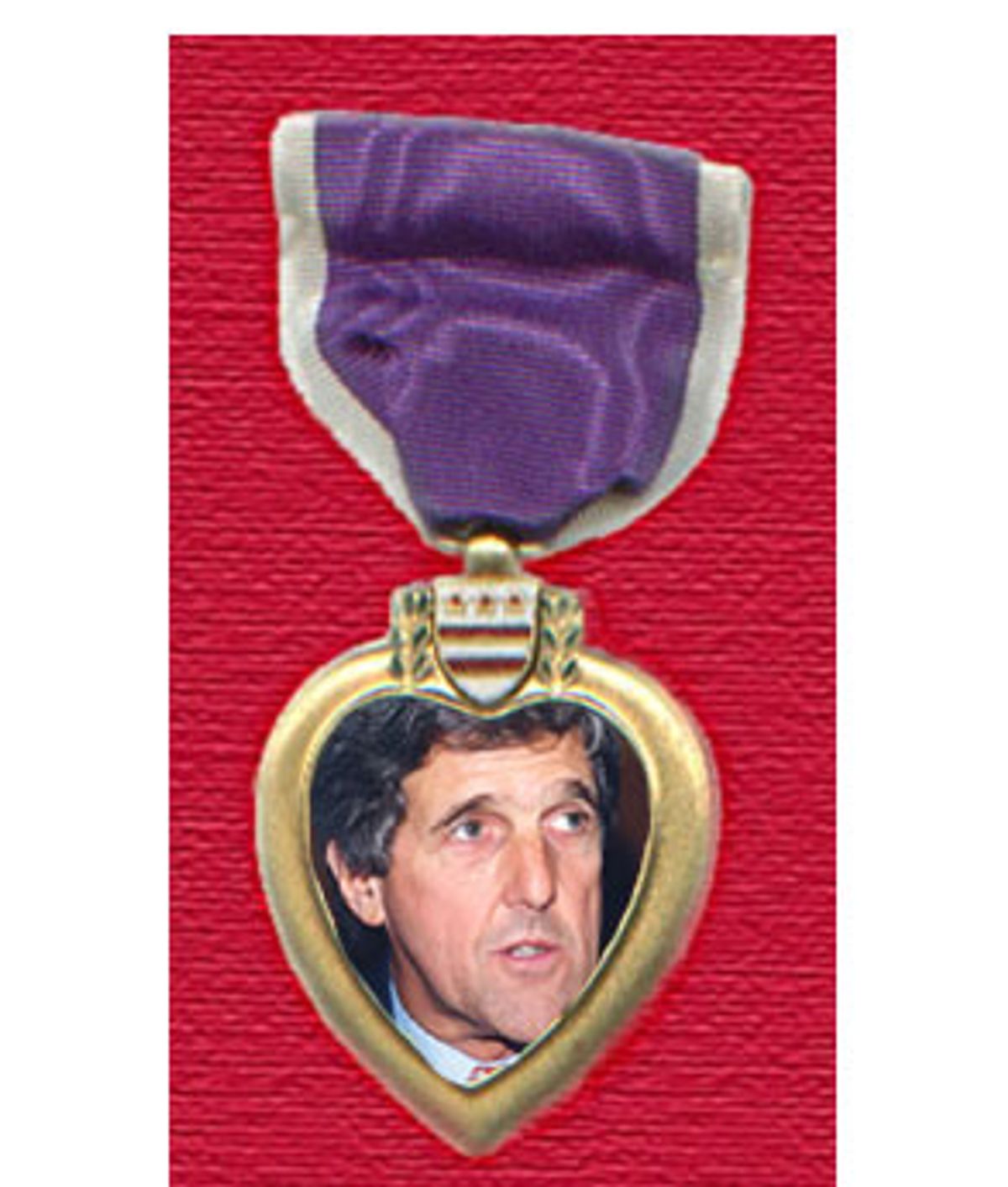
It was Dec. 2, 1968, and Lt. j.g. John Kerry was on a special nighttime covert mission in Vietnam. He had been ordered into a Viet Cong-infested peninsula north of Cam Ranh Bay to disrupt a smuggling operation. His vessel was a Boston Whaler, a boat that could float after taking 1,000 rounds of automatic weapons fire. Much of the evening was spent apprehending fishermen in a curfew zone. At approximately 2 a.m., however, they proceeded up an inlet with wild jungle on both sides of the boat. As they approached a bay, Kerry's whaler fired flares into the air. To their horror, not far from them, were a startled group of Viet Cong smugglers trafficking in contraband.
"We opened fire," Kerry told me in a Jan. 30, 2003, interview. "The light from the flares started to fade, the air was full of explosions. My M-16 jammed, and as I bent down to grab another gun, a stinging piece of heat socked into my arm and just seemed to burn like hell. By this time one of the sailors had started the engine and we ran by the beach strafing it. Then it was quiet."
Kerry and crewmates blew up the smugglers' beached sampans and then headed back to Cam Ranh Bay. "I never saw where the piece of shrapnel had come from, and the vision of the men running like gazelles haunted me," Kerry continued. "It seemed stupid. My gunner didn't know where the people were when he first started firing. The M-16 bullets had kicked up the sand way to the right of them as he sprayed the beach, slowly walking the line of fire over to where the men had been leaping for cover. I had been shouting directions and trying to un-jam my gun. The third crewman was locked in a personal struggle with the engine, trying to start it. I just shook my head and said, 'Jesus Christ.' It made me wonder if a year of training was worth anything." Kerry, never trying to inflate the incident, called it a "half-ass action." Nevertheless, the escapade introduced Kerry to the V.C. and earned him his first Purple Heart.
As generally understood, the Purple Heart is given to any U.S. citizen wounded in wartime service to the nation. Giving out Purple Hearts increased in 1968 as the United States Navy started sending swift boats up rivers in the Mekong Delta. Sailors -- no longer safe on aircraft carriers or battleships in the Gulf of Tonkin -- were starting to bleed, a lot. Vice Adm. Elmo Zumwalt himself would pin the medal on John Kerry at An Thoi about six weeks after the doctor at the Cam Ranh base took the shrapnel out of the young officer's right arm. "He called me in New York to tell me he had been wounded," his then girlfriend and later wife, Julia Thorne, remembered. "I was worried sick, scared to death that John or one of my brothers was going to die. He reassured me that he was OK."
Now it is 2004, John Kerry is the presumptive Democratic nominee for president, and a couple of reporters are bringing into question whether he deserved a Purple Heart for that daring action. The Boston Globe and the New York Post have run hurtful stories quoting Kerry's commanding officer that evening, Lt. Cmdr. Grant Hibbard, now a retiree in Gulf Breeze, Fla., grouching that Kerry's wound wasn't large enough. Hibbard was not even on the Boston Whaler when the firefight erupted. Nevertheless, the New York Post quotes Hibbard -- a proudly registered Republican -- as griping Kerry's injury "didn't look like much of a wound to me."
In the wake of the controversial Bush National Guard story, reporters today, anxious to break a headline, are combing through Kerry's Vietnam past. The name of the game is to find a conservative ex-Vietnam hand to say something negative about Kerry. It's an automatic newsmaker, guaranteed to get picked up by Newsmax.com, the Weekly Standard, Rush Limbaugh, the New York Post and other conservative outlets. At issue is an attempt to downgrade Kerry's Vietnam War heroism. The major anti-Kerry Vietnam War Internet complaint, it seems, echoes Hibbard: that his minor wounds weren't big enough to warrant Purple Hearts. Unfortunately neither the Boston Globe nor New York Post takes the time to explain to readers that Purple Hearts are not given out to soldiers/sailors for the size of the wound. Only by the grace of God did the hot shrapnel that pierced Kerry's arm not enter his heart or brain or eye.
For the record, Purple Hearts are given for the following enemy-related injuries:
a) Injury caused by enemy bullet, shrapnel or other projectile created by enemy action.
b) Injury caused by enemy-placed mine or trap.
c) Injury caused by enemy-released chemical, biological or nuclear agent.
d) Injury caused by vehicle or aircraft accident resulting from enemy fire.
e) Concussion injuries caused as a result of enemy-generated explosions.
Examples of injuries or wounds which clearly do not qualify for award of the Purple Heart are as follows:
a) Frostbite or trench foot injuries.
b) Heat stroke.
c) Food poisoning not caused by enemy agents.
d) Chemical, biological, or nuclear agents not released by the enemy.
e) Battle fatigue.
f) Disease not directly caused by enemy agents.
g) Accidents, to include explosive, aircraft, vehicular and other accidental wounding not related to or caused by enemy action.
Given the hurly-burly circumstance of Dec. 2, 1968, Kerry -- and the other men on the mission -- are not sure whether they were hit by enemy fire or if shrapnel from one of the other men on the Boston Whaler injured Kerry. It could have even been Kerry's own M-16 backfiring that caused the shrapnel wound. It doesn't really matter. The requirement makes it clear that you are awarded a Purple Heart for "Injury caused by enemy bullet, shrapnel or other projectile created by enemy action." Does anybody dispute that Kerry's wound was created by enemy action? As the stipulation also makes clear, Kerry would have been awarded a Purple Heart even if he never bled, if, for example, he had suffered a concussion from a grenade. So to set the record straight: Kerry deserved his first Purple Heart -- period. To say otherwise is to distort the reality of the medal.
Unfortunately, the Boston Globe and New York Post stories omit fully reporting the bylaws. They present Hibbard at face value, downplaying the fact that he is a Republican criticizing a fellow veteran hoping to cause him public embarrassment. According to the Globe, Hibbard -- in classic blowhard fashion -- said Kerry "had a little scratch on his forearm, and he was holding a piece of shrapnel." Adding further verbal insult, Hibbard apparently claimed: "I've had thorns from a rose that were worse." The straight-faced Globe reporter, in fact, claims that Hibbard told him that Kerry's wound resembled a "scrape from a fingernail." Not included in either newspaper account, however, is Kerry's medical report from the incident. He shared it with me last year when I was writing "Tour of Duty." It reads: "3 DEC 1968 U.S. NAVAL SUPPORT FACILITY CAM RANH BAY RVN FPO Shrapnel in left arm above elbow. Shrapnel removed and appl. Bacitracin. Ret. to duty." Is shrapnel removed from an arm really like a "scrape from a fingernail"? Or a thorn prick? The answer, of course, as any sensible person can surmise, is no.
Which raises the question: Why the medical record omission? Why the cruel attempt publicly to mock Kerry for his wound? Why the media need to play "gotcha" with something as sensitive as a war injury? This Dec. 3 medical report is proof that Kerry had shrapnel taken from his arm. According to Kerry, who should know, the doctor wrapped a clean white bandage around his arm. After the procedure he rightfully put in for a Purple Heart. Kerry clearly met the requirements -- as listed above -- for deserving one. From the hospital room Kerry returned to duty. That's apparently when he held the shrapnel out in his palm for Hibbard to see.
The Globe, however, let Hibbard off the hook, no serious questions asked. On the one hand he claimed Kerry was holding his shrapnel and then he also claims it was a scratch. Are we to believe that following his surgical procedure Kerry went to Hibbard and ripped off his battle dressing to show him the wound that looked like a "scrape from a fingernail"? Or is Hibbard simply surmising it was a thorn prick? Worse still, Hibbard now claims that he was opposed to Kerry being awarded the Purple Heart. Really? Then why didn't he fight against it harder? His superficial answer can be found in the Globe: "I do remember some questions, some correspondence about it. I finally said, 'Ok, if that's what happened ... do whatever you want.' After that I don't know what happened. Obviously, he got it. I don't know how." Does this sound like a reliable source? Is that fuzzy-mindedness worth reporting as serious news? Why wasn't Hibbard asked why he stayed quiet for 35 years?
Let me offer Hibbard an answer to his question. The U.S. Navy chose to award Kerry a Purple Heart because he qualified for it. Only a fool -- or an exceedingly modest man -- wouldn't apply for a Purple Heart that was due him. Kerry was neither. But Kerry did not receive it because, as the Post claims, he had "strong ties to the Kennedy machine in Massachusetts (Bobby Kennedy speechwriter Adam Walinsky wrote Kerry's famous 1971 antiwar Washington speech)." Kerry's only tie to the "Kennedy machine" was that as a college student he slapped a "Ted Kennedy for U.S. Senate" bumper sticker on his VW and campaigned for a summer around Cape Cod. As for Walinsky writing Kerry's famous April 22, 1971, speech/testimony -- it's utter nonsense. Walinsky has consistently denied the rumor. At his Boston home Kerry has a file brimming with his various drafts of the speech/testimony. He, in fact, had delivered parts of the speech months beforehand. Why is it so hard to accept the fact that Kerry -- like thousands of other Vietnam Vets -- was awarded a Purple Heart as a small token of appreciation for risking his life for his country?
Back in 1964 Bob Dylan wrote a lyric for the song "It's Alright Ma (I'm Only Bleeding)." At one point in it he asks whether nothing in American life is "really sacred." When retired U.S. naval officers, 35 years after the fact, start whining to the press that a war wound wasn't big enough to warrant a Purple Heart -- and the Boston Globe goes along for the ride -- you realize Dylan's prophecy. Today the tabloids truly are king. Call me naive, or too pro-veteran, but it seems to me we should be thanking every Purple Heart recipient for their duty to country, not demanding of them explanations for why their wounds weren't bigger or fatal. Ridicule Kerry on his liberal Senate record, or so-called aloofism, or even his outspoken Vietnam Veterans Against the War protests, but leave his old battle scars alone.
This story has been corrected since it was originally published.
Shares