

Asta Levene, an artist and interior decorator from New Orleans' French Quarter, has high cheekbones, black hair with funky blond streaks and a Lithuanian accent. She also has a 10-year-old son who hasn't been in school for months. "Every day he's saying, 'I want my life back, I want my school back,'" she says. But his school, like many in this tattered city, remains closed, and every other school she's tried to enroll him in says there's no room. When she calls city government officials, they give her a list of schools to try. "Then you go there and you hear the same answer," she says. She has a former science teacher come over several times a week to tutor her son, and she's trying to teach him herself, but she worries he's falling behind. "He's in fourth grade and he's going to have to be tested," Levene says.
There are other children in similar situations in New Orleans, though how many is unclear. Members of the local teachers union, civil rights lawyers and neighborhood activists speak of neighborhoods overrun with involuntarily truant students. "At the very least, 200 to 250 parents of school-age kids have been denied access to schools here in New Orleans for no other reason than that the schools are saying there's no room," says Tracie Washington, one of New Orleans' leading civil rights lawyers. As reports of children being turned away from schools pile up, anger is building in the community. Two lawsuits have been filed to force New Orleans to reopen its public schools.
Before the storm, New Orleans operated 117 public schools for 65,000 kids -- over 90 percent of them African-American. Today, only 20 schools are open. School officials say that by August, as families, now scattered across the country, begin to return to New Orleans, the district will open more schools and be able to handle a total of 25,000 kids. But the current lack of available schools is about more than the physical destruction wrought by Katrina. To many activists, it points to serious inequities in the massive transformation of the New Orleans public school system. Long one of the nation's worst, the school system is being re-created as a laboratory for charter schools, a type of reform often favored by conservatives and opposed by teachers unions and others who see it as a gateway to privatization. Nearly 90 percent, or 102 schools, could ultimately be run as charters. Nothing on this scale has ever been tried before.
Brenda Mitchell, president of United Teachers of New Orleans, says she is not a conspiracy theorist, but when she considers the new charter system, she is not sure how else to think. "It's all part of the privatization and social engineering of the city, limiting the return of poor people and African-Americans," she says. "If you're not providing housing for them, if you don't want to provide schools to educate them, how are they going to come back to rebuild the city?"
Yet this isn't simply a battle between callous privatizers and righteous locals. Plenty of residents are desperate for a school system that works, and they're eager for a restructuring. New Orleans public schools were a disaster well before Katrina hit, and some of the city's education experts see a once-in-a-lifetime chance to rebuild them free of the stifling, often corrupt bureaucracy that's impeded progress in the past. "For a long time before the storm, the Louisiana public schools have been in the bottom 10 percent of national performance scores, and New Orleans has been at the bottom of that," says Michael Cowan, executive director of the Lindy Boggs Literacy Center at Loyola University, and an advisor to the education committee of Mayor Ray Nagin's Bring New Orleans Back Commission.
"Public education in New Orleans for a long time has been about everything but the well-being of children," he says. "It's about who controls contracts. It's about the union agreement. It's been tremendously racially polarized. By and large, our public school system has been one of the big limitations on quality of life in the city for a long time."
Cowan describes himself as a political liberal, but he's behind the city's current school reforms. "Forty percent of adults in the city of New Orleans read below the sixth-grade level," he says. "Another 30 percent read below the eighth-grade level. The public schools have been a gross failure for a long time. There has been a strong movement to try and do something about that for quite a while, and when the storm hit, it did present the city with an extraordinary opportunity to do something about our schools within a period of time that would have been utterly impossible if we had continued to try and chip away at it."
By decimating the school system and scattering the student body, Katrina gave New Orleans an educational clean slate. With Louisiana strapped for funds, and congressional Republicans looking to hand out money for privatized schools, Gov. Kathleen Blanco and the Legislature hatched the new charter plan. The legislation gives the state jurisdiction over school districts with poor performance records. (The state took over 102 of New Orleans' 117 public schools.) In turn, the state can farm them out to charters operated by nonprofit groups, foundations or universities. Indeed, the feds have come through in the wake of Katrina, awarding $21 million to Louisiana for charter schools. Today, all but three of the 20 open schools in New Orleans are charters.
In general, charter schools are semiautonomous public schools run by private groups that contract with the city. They have the authority to hire and fire their own faculty -- who needn't meet state certification standards -- and design their own rules and curriculum, reducing the power of teachers unions and school boards.
Charter schools have been around in many cities since the early 1990s, but they've never dominated an entire public school system. Before Katrina, Washington, D.C., led the nation in charter schools, with about a quarter of its public schools run as charters.
All things being equal, there is no evidence that charter schools work better than traditional public education. Just last month, the National Center for the Study of Privatization in Education at Columbia University's Teachers College, released a study showing that, when adjusted to take account of the differences in income and geography among various groups of students, kids in charter schools perform worse than those in public schools. Yet advocates still champion them as a way to slice through the educational bureaucracy.
Even Cowan -- who didn't know about the kids who can't get into school -- is worried about the massive transformation in New Orleans. "There has never been an experiment on this scale with charter schools in an urban school district," he says. "We have to do everything we can to support and resource these schools and get this right. It's a big challenge."
Under the new regime, all of the city's public school teachers -- more than 5,000 -- have been let go, and those who want to continue teaching in the city have to reapply for their jobs, often for less money. Rather than be assigned a neighborhood school, the charter system gives parents the power to choose where their children will be educated. The problem is that, without a guaranteed neighborhood school, some parents can't find any schools at all. Compounding the difficulty, New Orleans isn't yet offering school bus service, so parents without cars have a hard time if they can't get their kids into classrooms nearby.
"This just shouldn't be," says Washington, the civil rights lawyer. "If you ask people to return, there need to be schools."
In late January, Washington filed a class action suit against the Orleans Parish School Board, the state of Louisiana and all of New Orleans' charter schools. "Even more frightening," she says, than the 200 parents who have been denied access to New Orleans schools, "is that kids with special needs are being told that there is absolutely no space for them. They're being wait-listed and told they may not get into school until next year."
Washington is a pretty, broad-shouldered black woman who wears a tangle of pearls around her neck and has the "Sex and the City" theme song as her cellphone ring tone. Since Katrina, she's worked almost entirely pro bono, representing evacuees facing eviction from their hotel rooms and advising migrant workers being housed in filthy conditions by contractors. Her father is living in her office for the moment, so she works out of donated space at Hope House, the ramshackle headquarters for several progressive organizations, located on a rundown block of St. Andrews Street.
To Washington, the current problems in school enrollment are inherent to charters, which foster competition for places in preferred schools. She also fears the remaining public schools in the Orleans Parish School System will fall into further neglect in the new hierarchy of charter schools. "You cannot have a city where you decide you're going to have a caste system and allow the schools run by the Orleans Parish School System to be the dumping grounds for students that nobody else will take," she says.
The week before she filed her lawsuit, she says, she was standing across the street from Hope House, being interviewed by an out-of-town reporter, when four kids rode by on their bicycles. It was 1:30 in the afternoon. She says she stopped the interview to grab one of the kids, a little boy, and ask him why he wasn't in school.
"I don't go to school," he told her.
"What do you mean, you don't go to school?"
"I don't go to school," he repeated. "My mama tried to put us in school and nobody would take us, so we don't go to school. We might go back to Dallas. They like us in Dallas."
After that, Washington started asking around to find out whether local activists knew kids were being turned away from schools. She called New Orleans school superintendent Ora Watson and learned that there was a waiting list of people who'd called the Orleans Parish School Board office looking for a place for their kids. Washington got a copy of the list, which was over 200 names long, and started calling the people on it. One family had eight kids, only one of whom was in school. Another, Nicole Manning, was supposed to restart her old job as a cashier at Harrah's casino, but she was worried that she wouldn't be able to because no schools would take her learning-disabled 9-year-old son, Nicholas. Washington sued on behalf of the parents.
Meg Casper, director of communications for the Louisiana Department of Education, refuses to discuss the lawsuit directly. However, she insists that her office spent the weekend calling the names on the waiting list and that only 14 of them had been unable to find school placement. Since then, she said, "We've placed those 14 students."
Yet at the time Casper spoke, Manning, who was on the list, still hadn't found a school for her son. Someone from the Department of Education had called her, but only to say that they were working on her case. "I'm supposed to be getting a call again, so it's just a waiting process," she said. This week she finally heard back from officials. They'd found a place for her son to start school on Feb. 20.
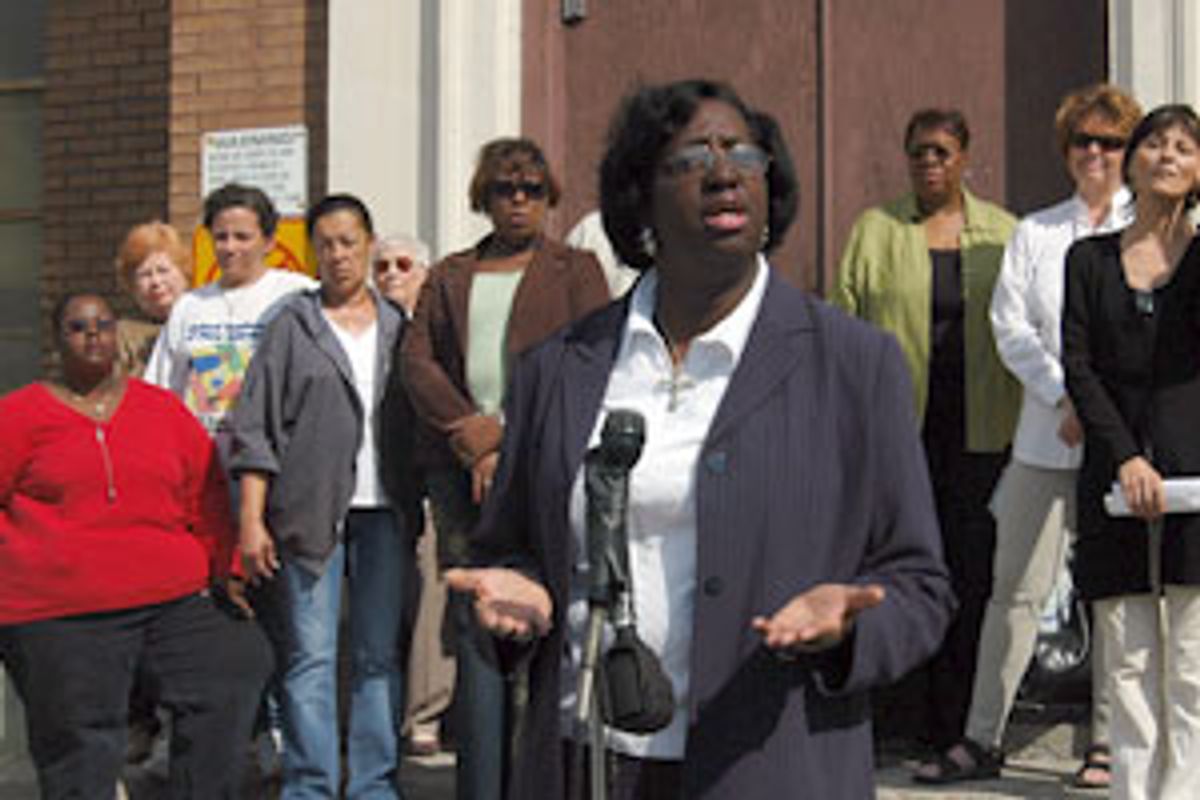
Meanwhile, other parents are still waiting. A week after Washington filed her suit, United Teachers of New Orleans, the city's teachers union, filed a similar one, asking for a court order to reopen schools and provide free transportation for students. At a press conference in front of Joseph Craig Elementary, a shuttered school in the city's Treme neighborhood, Levene joined union officials and unemployed teachers. As they spoke, a woman driving a red truck noticed the TV cameras and pulled up.
"Please open some more Orleans Parish schools!" she shouted. Her name was Angela Ratliff, and when she pulled over, she explained that her two daughters, Raven and Letika -- both in the truck -- had been in middle school at the well-regarded Capdau, which was a charter school even before Katrina. She returned to New Orleans on Dec. 29, but when she tried to re-enroll her daughters, the school was full and they were turned away.
Ratliff said she was on her way to put her daughters on a waiting list for two public schools that were supposed to be opening later in the month. Until she enrolls them, she said, "I can't work. It's not like my family's here to help me baby-sit. Now I'm riding around with two girls because they have nowhere to go to school."
Shares