

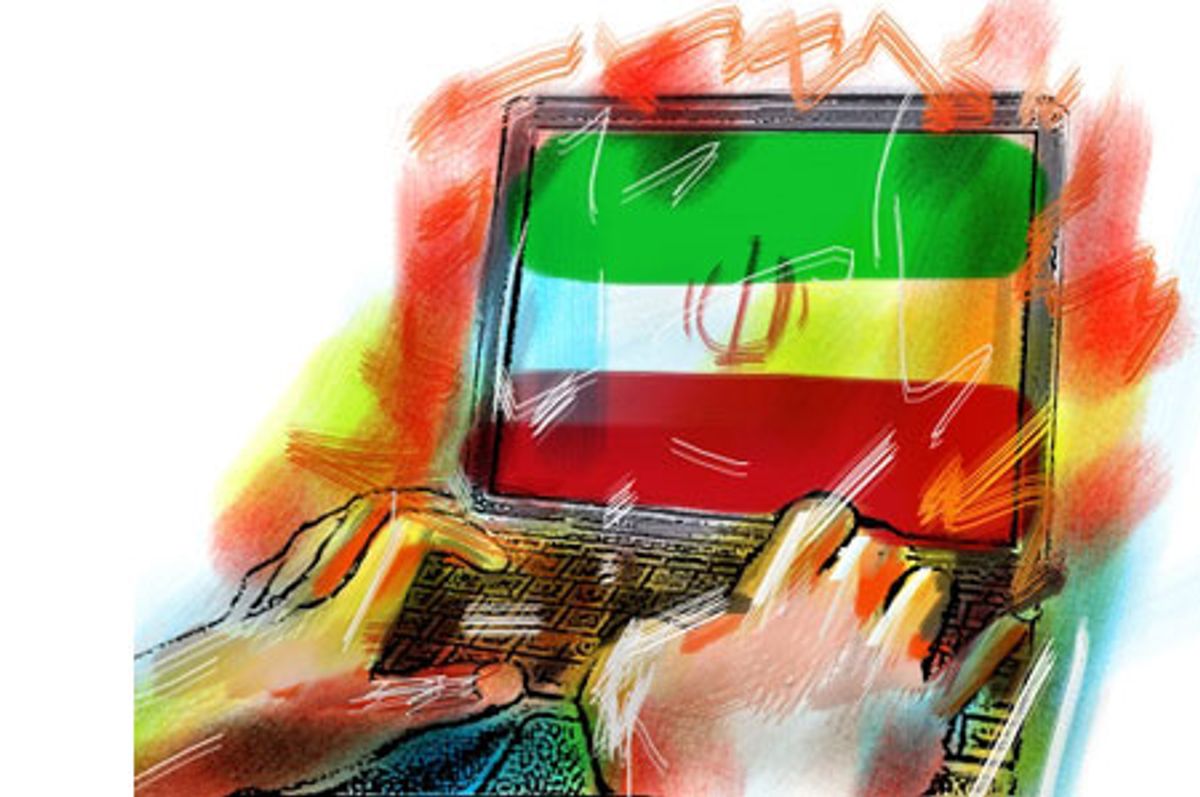
In February, Iranian student Mojtaba Saminejad, celebrated a bitter anniversary -- one year in prison for authoring a blog that enraged the country's ruling mullahs. He's not the only blogger languishing in an Iranian jail: In 2003, Iran's was the first regime known to imprison a blogger, Sina Motallebi, author of the popular site RoozNegar.com. And in January, journalist Arash Sigarchi was found guilty and given a three-year sentence for "insulting the Supreme Guide" online.
Those were trumped-up charges, according to writer and advocacy worker Nasrin Alavi, the author of "We Are Iran," a recent anthology of Iranian blogs. "When Arash was first arrested, I went through his archives and couldn't initially find the inflammatory statements," she said. In these cases, "they were just unlucky in that someone decided to make an example of them. Especially with Arash, who was being tried by a small-town judge who wanted to really make a name for himself as revolutionary. A lot of that goes on Iran. To work your way up the system there's rivalry to show off your revolutionary credentials."
Alavi, now based in London, wrote the book about bloggers to show the world an Iran beyond the familiar radical images created by the current regime and echoed by the Western media. "I wanted to show the changing consciousness of Iran and the conversations people were having behind closed doors," she said.
The attack on bloggers is the Iranian regime's latest crackdown on freedom of speech. In the last six years, more than 100 magazines and newspapers (including 41 dailies) have been shut down, and many journalists imprisoned. Those reformist papers had flourished after the 1997 election win of the relatively liberal president Muhammad Khatami. But as Khatami's powers were curtailed by the hard-liner establishment, so were the newspapers that had prospered under his government.
Young Iranians, well educated and net savvy, have turned to the Internet to get news and information -- and to discuss their society. A recent Harvard summit cited more than 700,000 Farsi blogs, mostly based in Iran, making Farsi the second-most-popular language in the entire blogosphere.
The government has now moved against Internet media. The BBC's Farsi service, which provides national and international news, has been blocked, and according to Reporters Without Borders, the filtering of Web sites considered "non-Islamic" is on the increase.
But given the technology of blogging, the government can't realistically silence every blogger in Iran -- so it's also logging on and trying to get in on the act. In February, Iran's culture ministry held the "Revolutionary Bloggers Conference" to promote pro-regime blogs, such as that run by Saleh Meftah, a member of the Basij militia. In a recent post, Meftah boasted of the excitement he felt at attacking the Danish embassy in Tehran during the worldwide controversy over caricatures of the prophet Mohammed published in a Danish newspaper.
Yet, the posted replies show how the government's plans for pro-regime blogs could backfire. "I cannot hide my hatred of you and your actions," wrote one respondent. "It's your bestial breed that give Westerners cause to insult our dear prophet and faith."
Most blogs don't just show how Iranians feel about critical issues like the cartoon controversy, nuclear weapons and the inflammatory Islamist rhetoric of hard-line President Mahmoud Amadinejad. They also give insight into the tension bubbling up in the ordinary hearts of Iran's predominantly young population. (Seventy percent of Iranians are under the age of 30.)
Spooky, 22, at My Lucid Dreams, agonized recently over an on-off relationship: "Maybe he knows that I am a swinger type gal." Rodman, a 24-year-old who authors Planet Rodmania, enjoyed the Hollywood film "Eternal Sunshine of the Spotless Mind" and wonders whether Tehran will ever have a proper vehicle-pollution study.
Blogging in Iran took off in September 2001, when journalist Hossein Derakhshan posted a "how to blog" article in Farsi, which coincided with the regime's newspaper crackdown. "It was unbelievable," said Alavi, who was living in Iran at the time. "Journalists were being put behind bars and suddenly you could read things that you couldn't get anywhere else."
Alavi says the majority of young Iranian bloggers represent a new, nonviolent breed of activist. She believes that, having lived under theocracy, they are desperate for a genuinely accountable government. "Radical Islamic government has run its course. The revolution wasn't to become Muslims -- it was for economic growth and equality. That still hasn't happened yet."
Amadinejad was voted in as president last summer with just such an agenda but instead has fallen back onto anti-Western, Islamist rhetoric. He has called the Holocaust a "myth," declared that Israel should be "wiped off the map," and jump-started nuclear research in defiance of international regulations. On his watch, the Danish embassy was attacked by a mob, and a week later an Iranian paper launched a competition for cartoons ridiculing the Holocaust.
Even though Ahmadinejad promised to champion the little guy against Iran's corrupt elite, in Tehran, state-backed thugs have been beating up bus drivers striking for better pay. "I detest him, his party and his ideas," Tehran blogger "Mr. Behi" told Salon recently. "He is a mob kind of president and came to power with impractical slogans for the economy and radical ideas about politics."
The 28-year-old tech worker was one of several bloggers Salon contacted by e-mail. Mr. Behi describes himself as secular in his thinking, but says he also adores the prophet Mohammed. "Democracy, as I believe in it, is freedom but also respect for others," he said. "I detest the fact that some others burn the flag of countries because of their opposition to a group of citizens from those countries."
He also put forward the argument that the anti-cartoon protests at the embassy were orchestrated by the government. "I can assure you that those who did this in Tehran were not regular people," he said. Alavi agrees, saying, "There is no freedom of assembly in Iran. An attack like that is not a spontaneous process -- it's a foreign policy directive."
The protests may have been staged, but there was still genuine anger over the cartoons. "Nina," a 24-year-old university student and computer programmer in Tehran, was very unhappy at seeing the cartoons. "They were a lie," she said. Reza, 31, said he found two of the cartoons "soaked in hatred. They put Muslim violence and terrorism squarely at the door of the Prophet Muhammad. A big historical lie. The publication of these cartoons was thus irresponsible and contemptible. So were the violent attacks on the missions."
Tehran-based writer and blogger H. Utanazad told Salon: "Making fun of the deities and their assorted satraps is one of our favourite pastimes in Iran. Some of the best jokes are to be found in some of the more devout households. But in times of war people tend to lose their sense of humour -- everywhere, all the time."
Iran's hard-liners have a legacy of shackling politics to religion, a legacy from which it's tough to break free. "These slogans against Israel and U.S. started when the revolution happened 27 years ago," said Mr. Behi. "Ahmadinejad is so stupid not learning the politics of today. I believe in the miseries Jews had in World War II, and I feel sorry for them. The bad thing is that the event has never been brought to the full attention of Iranian people. They are as biased about the world as the Western people are about the Middle East."
"Denial of the killing of Jews is like denial of killing of hundreds of thousands of Iranians by chemical weapons during the Iran-Iraq war," Mr. Behi said. "These days no one in the trial of Saddam talks about those victims. We have the same feelings towards that and we are also ignored."
But young Iranians also appear to have absorbed the hard-line views of the president, even among the educated and tech-savvy Internet users. E. Haddadian Moghaddam, 32, an Iranian translator and journalist currently pursuing post-grad work in Sweden, sees merit in Ahmadinejad's suggestion that the Jewish homeland be moved to Europe, America or elsewhere. "I see his view of moving the land of Israel somewhere outside the present land as a possible solution," Moghaddam said. "As for his opinion [denying] the Holocaust, I would prefer to see it just as a personal opinion that is open to criticism."
Nina also thinks the idea to move Israel is worth considering, adding, "In my opinion, President Ahmadinejad is right."
Yasget, a 23-year-old student, argues that Iranian politics is less one-dimensional than many outsiders realize. He claims Ahmadinejad only spoke once about wiping Israel off the map. "Then he never spoke about it because someone told him: 'Are you crazy? Do you want them to attack us?'"
If America or Israel were to attack Iran, the nuclear program would, of course, likely be both the pretext and the target. Many of the bloggers agree that Iran has the right to develop nuclear technology, believing the regime's assertion that its primary use would be for generating energy. "Many young, aspiring scientists and researchers like to test the new horizons of sciences, namely atomic energy," Moghaddam said. "Also, Israel enjoys atomic power and bombs without any international control." Others point to a nuclear-armed India and Pakistan.
Iran may have massive reserves of oil and natural gas, but, Nina said, "Iran needs nuclear researches to provide a huge resource of energy to help reduce consuming oil."
Mr. Behi calls the issue "scary" on his blog and disagrees with any nation having nuclear weapons. "Pakistan is a much more volatile country, where people themselves are much more conservative and Islamic radical than Iran," he said, pointing out that although there were sanctions against Pakistan's military nuclear program, these were relaxed when the United States needed Pakistan's help in the Afghan war. That gives a clear message, he said, that "the no-nuke Middle East idea is negotiable" even if the Iranian government tries to build a nuclear weapon.
Utanazad said he believed that the ruling clergy were trying to do exactly that. "I'd like to see a concerted effort to reduce the already existing stockpiles and ultimately have them eliminated even in countries that already have them," he said. "One more country with those weapons doesn't make me feel any safer. And especially controlled by such brutally authoritarian regime as the Islamic Republic."
The bloggers' views of rising confrontation with the West cut in different and sometimes conflicting directions.
"Twenty seven years ago, we set up a revolution to end an American government in Iran," said Nina, the student. "I do not really think Iranian people want to see them back with their new collection of weapons, marching on the streets. If a U.S. attack is coming to us, I will do everything to defend my homeland."
Utanazad offered this view of America's role in the world today: "Long term, this callous, thoughtless militarism in America is going to have to be looked square in the face and dealt with. This romanticism about violence is dangerous, both for the planet and for the health of the American Republic as well."
"War kills and Iranian people are not America's enemies," said Mr. Behi, whose childhood memories of the Iran-Iraq war cause him to worry about an attack on his country today. "The opposition always get [blamed] that they are paving the way for foreign attack. Many of those who are opposing the current government will need to shut up as soon as the country comes under attack. That will be the biggest gift to Ahmadinejad -- to prove that U.S. is the true enemy of Iranian people."
The government is now trying to create an all-Iran intranet, to give it greater control over what Iranians do online and stamp out the kind of dissident opinions you've just been reading. With the crackdown intensifying, Alavi finds that bloggers have become more guarded. "I'm trying to write an afterward to the book and I'm having difficulty getting bloggers to allow me to quote them," she said. "Even bloggers who gave permission for the inclusion of their blogs on the condition of total anonymity are now hesitant." But the Iranian regime could be fighting a demographic tide that may one day overwhelm them. "Iran's youthful majority will ultimately determine the future of their country," Alavi said.
The irony is that being pro-American in Iran is rebellious, and the young now frame their dissent not with talk of jihad, but in terms that Americans would understand. Young Iranians love Hollywood, even if Western movies are officially banned. Yasget, who recently watched "Sin City," "Crash" and "The 40-Year-Old Virgin," said, "I believe in a global culture, but I don't want all the content of that culture to be from the West."
"My feeling is more nuclear weapons bring more madness to the world," Yasget added. "One of my favourite movies is 'Dr Strangelove.'"
Shares